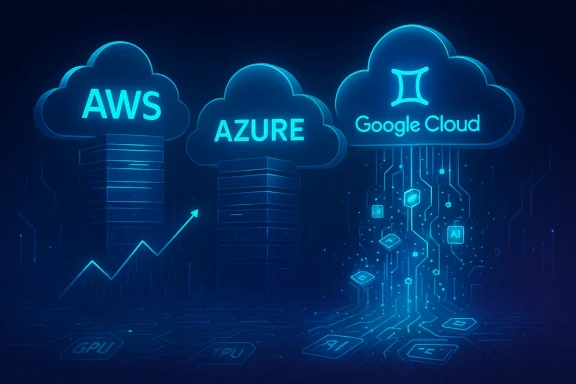
The cloud market has flipped from steady expansion to a sprint: Q4 results from Amazon, Microsoft, and Alphabet show cloud revenue reaccelerating sharply on the back of AI demand, but while all three posted impressive growth, Google Cloud emerged as the short‑term growth leader — and the earnings season laid bare both the enormous opportunity and the mounting risks tied to massive capex and supply constraints.
The fourth quarter of 2025 felt like a milestone more than a routine reporting period. Industry tracking firms estimated global cloud infrastructure services at roughly $119 billion for the quarter, up about 30% year‑over‑year, a marked reacceleration attributed primarily to generative AI workloads and the surge in enterprise AI projects.
That market dynamic turned corporate earnings into a proxy fight for the economic value of AI: cloud vendors that can host massive model training and inference while controlling serving costs stand to win not only market share but also outsized operating leverage. The Big Three — Amazon Web Services (AWS), Microsoft Azure, and Google Cloud — are now the epicenter of that contest, and Q4 results exposed how different strategies (scale, partnerships, full‑stack models, custom silicon) are playing out in revenue growth, margins, and capital commitments.
But the story that dominated headlines was Amazon's jaw‑dropping capex plan: management announced an intention to invest roughly $200 billion in capital expenditures for 2026, saying the spend would be concentrated “predominantly in AWS” to meet what it called exceptionally high demand. Management framed the commitment as necessary to monetize AI capacity as it is installed. The market reaction was swift and negative in the immediate term, reflecting investor worry about execution risk and the timing of returns on such an outsized deployment.
Key points:
Key points:
Key points:
That said, the marketplace is entering a capital‑intensive phase. The next year will be defined by how effectively each vendor converts astronomical capex into usable, competitively priced capacity; how they manage supply constraints; and whether claimed model cost improvements translate into lower, sustainable prices for enterprise inference. For buyers and investors alike, the prudent posture is skeptical optimism: AI is real and lucrative, but durable leadership requires disciplined execution across infrastructure, software, and economics — not just headline growth percentages.
Source: AOL.com Amazon, Microsoft, and Alphabet All Reported Robust Cloud Growth. 1 Was a Clear Winner
 Background: why Q4 2025 matters for the cloud era
The fourth quarter of 2025 felt like a milestone more than a routine reporting period. Industry tracking firms estimated global cloud infrastructure services at roughly $119 billion for the quarter, up about 30% year‑over‑year, a marked reacceleration attributed primarily to generative AI workloads and the surge in enterprise AI projects.That market dynamic turned corporate earnings into a proxy fight for the economic value of AI: cloud vendors that can host massive model training and inference while controlling serving costs stand to win not only market share but also outsized operating leverage. The Big Three — Amazon Web Services (AWS), Microsoft Azure, and Google Cloud — are now the epicenter of that contest, and Q4 results exposed how different strategies (scale, partnerships, full‑stack models, custom silicon) are playing out in revenue growth, margins, and capital commitments.
Overview of the results: three distinct narratives from the Big Three
Amazon Web Services: scale, monetization, and a headline capex number
Amazon reported AWS revenue of about $35.6 billion in Q4, up 24% year‑over‑year, with management calling it the fastest AWS growth rate in 13 quarters. That acceleration, the company says, was driven by AI workload adoption plus continued growth in core infrastructure.But the story that dominated headlines was Amazon's jaw‑dropping capex plan: management announced an intention to invest roughly $200 billion in capital expenditures for 2026, saying the spend would be concentrated “predominantly in AWS” to meet what it called exceptionally high demand. Management framed the commitment as necessary to monetize AI capacity as it is installed. The market reaction was swift and negative in the immediate term, reflecting investor worry about execution risk and the timing of returns on such an outsized deployment.
Key points:
- AWS remains the largest cloud by revenue and capacity, leveraging decades of incumbency to monetize enterprise migrations and AI workloads.
- Amazon’s $200B capex plan dwarfs peer guidance and signals a bet on rapid scale as the core defense/attack mechanism in AI infrastructure.
Microsoft Azure: partnership leverage, strong bookings, and supply balancing
Microsoft’s fiscal Q2 2026 results showed Azure and other cloud services growing about 39% year‑over‑year (38% in constant currency), a very robust figure that reflects the company’s early and deep commercial integration with large AI customers, including its strategic relationship with OpenAI. Microsoft highlighted a massive remaining performance obligation (RPO) and huge commercial bookings, and management repeatedly said that customer demand continues to exceed supply, particularly for GPU capacity and other short‑lived AI assets. Capital spending in the quarter was sizable (reported capex of $37.5 billion for the period) with a plan to increase capex growth to satisfy demand.Key points:
- Microsoft is translating strategic partnerships and a broad enterprise stack into high‑value, long‑duration commitments, boosting RPO and revenue visibility.
- The tradeoff is supply management: Microsoft must decide how to allocate constrained GPU capacity across customers and products, and it’s willing to expand capex to reduce that bottleneck.
Google Cloud: the acceleration winner, powered by Gemini and falling serving costs
Alphabet reported Google Cloud revenue of $17.7 billion in Q4 — up 48% year‑over‑year — the fastest growth rate among the Big Three for the quarter. Management attributed the surge to enterprise AI demand and the commercial adoption of its Gemini family of models. Alphabet disclosed several headline metrics: more than 8 million paid seats of Gemini Enterprise sold since its launch, the Gemini app surpassing 750 million monthly active users, and a claimed 78% reduction in Gemini serving unit costs over 2025 due to model and infrastructure optimizations. Alphabet guided to a very large 2026 capex range of $175–$185 billion, aimed at servers, data centers, and AI infrastructure.Key points:
- Google Cloud’s growth outpaced peers in Q4 and the segment reported meaningful margin improvement year‑over‑year.
- Alphabet’s combination of in‑house models (Gemini), custom chips/TPUs, and a vertically integrated stack appears to be delivering both demand and cost efficiency — at least according to company disclosures.
Why Google looks like the “winner” (for now)
There’s a specific set of empirical facts that underlie the claim that Google was the clear winner in Q4:- Fastest cloud growth rate: Google Cloud’s 48% year‑over‑year revenue growth overtook AWS and Azure on a percentage basis for the quarter. That acceleration matters because it signals not just near‑term demand but the potential for market share movement if the trend persists.
- Commercial traction for first‑party AI: Alphabet reported strong uptake for Gemini across consumer and enterprise surfaces — large paid seat counts and explosive user growth in the Gemini app. That suggests both top‑line monetization vectors (subscription/seats) and large ad/product engagement benefits.
- Serving cost improvements: Alphabet’s claim of a 78% reduction in serving unit cost for Gemini over 2025 is a game changer if sustained: lower inference costs improve unit economics and make broader deployment of large models viable across lower‑margin enterprise use cases. That is a direct lever on margin expansion for cloud AI services.
- Backlog and committed revenue: Google reported a sizable cloud backlog (reported at $240 billion), and Alphabet’s commentary around more large, multi‑year enterprise commitments underscores durable demand. When customers sign large‑scale commitments that include model hosting and enterprise agents, it raises the ceiling for future revenue recognition.
But the picture is more nuanced: strengths, caveats, and risks
Strengths across the three vendors
- Scale and reliability (AWS): Amazon’s decades of cloud operation deliver unmatched scale, a broad product catalog, and a deep partner ecosystem. AWS’s revenue base still dwarfs the others, and growing at 24% on a $142B annualized run rate is materially different than higher percentages on smaller bases.
- Commercial commitments and platform breadth (Microsoft): Microsoft’s book of business (huge RPO, large enterprise customers, and tight partnerships) gives it revenue visibility and high‑value recurring streams. Its ability to reallocate fungible fleet capacity and monetize enterprise workflows is a durable advantage.
- First‑party model momentum and cost optimization (Google): Google’s integrated model‑to‑inference stack (Gemini + data centers + TPUs + software optimizations) can simultaneously offer product differentiation and margin improvement if the company continues to lower serving costs and prove its model economics.
Material caveats and execution risks
- Capex chases supply and ROI timing: All three companies signaled that demand exceeds supply for AI compute, and each is increasing capex substantially. Amazon’s $200B plan and Alphabet’s $175–$185B range for 2026 are on a scale previously unseen in corporate capex programs. Those commitments carry execution risk: supply chain constraints, component price volatility, permitting and energy costs for data centers, and the multi‑year timeline for realizing returns create the potential for temporary margin pressure and investor scrutiny.
- Concentration and counterparty risk: Microsoft’s sizable exposure to a few mega‑customers (OpenAI is cited as a large single commitment) raises questions about concentration and negotiating leverage. If a large customer changes priorities or in‑sources, the effects on bookings and utilization could be material.
- Model economics and cost claims need independent scrutiny: Alphabet’s 78% cost reduction claim is dramatic and, if true, transformative. But the company’s statement is internal and not third‑party audited. Independent verification over subsequent quarters will be critical; investors should watch inferred metrics such as cloud gross margins, operating income, and unit economics disclosed in future quarters to corroborate the claim. Until then, treat the number as a management disclosure that requires corroboration. Caution: this is currently a company claim awaiting independent confirmation.
- Competitive intensity and pricing dynamics: The massive capex commitments increase the risk of a race to the bottom in pricing for commodity GPU inference if vendors prioritize utilization over margin. That dynamic could benefit hyperscale customers and erode near‑term margins if not balanced by higher value services and large enterprise contracts.
- Regulatory and geopolitical headwinds: As these platforms become infrastructure for national‑scale AI, regulatory scrutiny will intensify — from data localization to export controls on advanced chips. That can raise compliance costs and constrain international deployment. These are policy risks outside company control but with direct business impact. (This is a forward‑looking, high‑uncertainty area.)
What the numbers imply for enterprise adopters and buyers
If you are an IT leader choosing where to run your AI workloads, here is a practical take:- For maximum raw scale and the broadest service catalog, AWS remains the predictable choice; however, expect Amazon to expectably prioritize customers that commit to long‑term consumption as it monetizes new capacity.
- For integrated enterprise product scenarios (M365, Dynamics, GitHub) and large commitment programs that may include custom SLAs, Azure offers strong traction and deep enterprise relationships — but supply allocation (GPU availability) may be a gating factor in the short run. Plan for capacity negotiation and consider booking commitments if latency and availability are crucial.
- If you need tight integration with first‑party LLMs and a model‑centric stack that may deliver better inference economics, Google Cloud is increasingly compelling — especially if Alphabet’s cost improvements translate into lower prices for enterprise inference. But buyers should demand clear SLAs, transparent pricing on inference, and pilot validation against workloads before scaling.
- Map expected token volumes and peak concurrency to vendor pricing and anticipated unit serving costs.
- Ask vendors for trial credits on both training and inference to benchmark real costs on your workloads.
- Negotiate multi‑year commitments only after validating supply allocation guarantees for GPU/TPU access.
- Factor in data gravity: running inference close to where the data lives can reduce latency and cost.
- Insist on transparent cost reporting for model serving (cost per 1k tokens or cost per inference).
Financial and market implications: winners, losers, and the path forward
From a market perspective, the Q4 results should be read as both opportunity and a leveling field:- Market share movement is possible but slow. Amazon still controls the largest share of cloud infrastructure, Microsoft holds a powerful enterprise position, and Google is accelerating from a smaller base. If Google keeps growing at high double digits while maintaining cost reductions, it can narrow the gap over years, but scale effects favor incumbents. Synergy estimates placed the Big Three’s combined share north of two‑thirds of the public cloud market in Q4, underscoring the high barrier for new entrants.
- Capital intensity is the new competitive moat. The winner is likely the vendor that can optimize capex deployment to deliver both the lowest inference cost and the best differentiated AI services. That requires not just money but supply chain agility, software efficiency (model serving optimizations), and energy access. Alphabet’s claim of 78% serving cost decline — if sustained and verifiable — would be a strategic advantage; but delivering it at scale across geographies is a separate challenge.
- Margins will be lumpy. Heavy up‑front capex will depress near‑term free cash flow and could compress margins until utilization ramps. Investors should expect quarterly variability as vendors balance capacity additions, depreciation, and demand realization. Microsoft’s large RPO and Amazon’s AWS backlog provide visibility, but that doesn’t eliminate near‑term margin risk.
How to read the “winner” narrative without falling into hype
The press cycle loves a single winner narrative, but a disciplined read requires separating (a) one‑quarter growth rates on smaller bases from (b) durable competitive advantage that sustains share gains over time.- Relative growth percentages are scale‑sensitive. A smaller base can grow faster in percentage terms; this is true for Google Cloud versus AWS. Amazon’s CEO explicitly noted that higher percentage growth on a smaller base is not the same as high‑percentage growth on a much larger base — a mathematically correct point that should temper simplistic winner declarations.
- Confirm management claims with operational metrics. For any sweeping claim (e.g., “78% reduction in serving cost”), investors and customers should look for corroborating proof in subsequent quarterly margins, unit economics disclosures, and third‑party performance benchmarks. Treat headline efficiency numbers as directional until validated.
- Watch bookings and committed revenue, not just current quarter revenue. Large multi‑year commitments (RPO/backlog) are more indicative of durable demand than one quarter’s spike in API calls. Microsoft’s and Alphabet’s reported backlogs and RPO growth are meaningful signals; AWS’s backlog and monetization pace are comparable indicators to watch.
Strategic takeaways for investors, IT buyers, and competitors
- Investors: expect a multi‑quarter period of heavy capex, uneven margins, and headline volatility. Favor vendors that combine strong demand, measurable unit cost improvements, and execution discipline on data center builds and supply chains.
- IT buyers: prioritize contractual clarity around capacity access and cost transparency for inference; pilot before committing millions to a single provider; use multi‑cloud strategies where viable to hedge supply and bargaining power risk.
- Competitors and partners: niche or vertical cloud providers that specialize in GPU/GPU‑adjacent workloads (and those with flexible pricing models) can exploit short‑term supply tightness by offering differentiated service levels — a viable route to relevance despite the Big Three’s dominance. Synergy’s data show a rise of specialized providers in the top ten cloud rankings, reflecting this dynamic.
Looking ahead: three metrics to track next quarter
- Cloud gross margins and operating margin progression — will cost reductions claimed by Google show up as improved margins, and can AWS and Azure match on unit economics?
- Committed bookings / RPO trajectory — growth in multi‑year commitments is the clearest signal of sticky enterprise demand.
- Capex deployment and utilization — how quickly capex translates into usable GPU/TPU capacity and how utilization ramps on that capacity will determine the timing of returns. Keep an eye on supplier constraints (chip supply), data center build timelines, and depreciation trends.
Conclusion
Q4 2025 was a definitive proof point that AI is not a sideline; it's the primary accelerator for cloud growth. The Big Three delivered strong results, but for different reasons: AWS with scale and monetization, Microsoft with enterprise commitment and platform breadth, and Google with model‑driven momentum and claimed cost breakthroughs. Alphabet’s Google Cloud posted the fastest growth rate and presented striking efficiency claims that, if validated over time, will shift the economics of AI hosting.That said, the marketplace is entering a capital‑intensive phase. The next year will be defined by how effectively each vendor converts astronomical capex into usable, competitively priced capacity; how they manage supply constraints; and whether claimed model cost improvements translate into lower, sustainable prices for enterprise inference. For buyers and investors alike, the prudent posture is skeptical optimism: AI is real and lucrative, but durable leadership requires disciplined execution across infrastructure, software, and economics — not just headline growth percentages.
Source: AOL.com Amazon, Microsoft, and Alphabet All Reported Robust Cloud Growth. 1 Was a Clear Winner