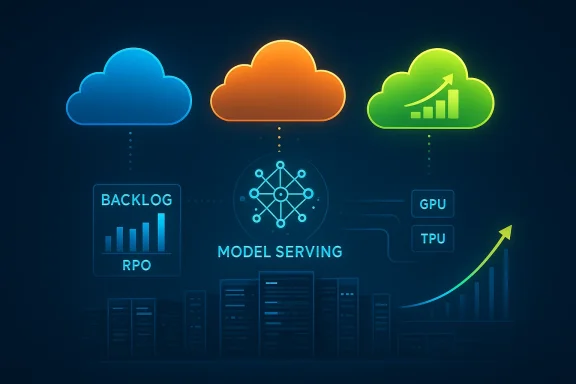
Cloud revenue surged across the board in Q4 2025, but the big news wasn’t just higher numbers — it was the way AI demand reshaped market dynamics, pushed hyperscalers into aggressive capital spending, and produced a surprising narrative winner: Google Cloud. The latest earnings season confirmed that Amazon Web Services (AWS), Microsoft Azure, and Google Cloud are no longer just infrastructure providers — they’re the engines powering a new wave of enterprise AI. Each reported strong results, but differences in growth rates, efficiency gains, and capital plans point to a shifting competitive landscape that will matter for customers, partners, and investors alike. ps://www.techtarget.com/searchcloudcomputing/news/366638805/GenAI-drives-119B-cloud-revenue-in-Q4)
AI workloads demand vast amounts of compute, specialized accelerators (GPUs/TPUs), and high-throughput networking. Over the past year this translated into a tectonic shift in cloud consumption patterns: enterprise cloud infrastructure spending leapt as customers bought capacity not just for storage and web services, but for training and serving generative AI models. Independent market trackers put Q4 2025 cloud infrastructure revenue at roughly $119.1 billion, about 30% year‑over‑year growth, with the Big Three — AWS, Microsoft, and Google — taking the lion’s share of the market. That surge is the clearest quantitative sign that AI is the proximate cause of the acceleration.
Market dynamics to understand:
Why the numbers matter:
Why the numbers matter:
Why the numbers matter:
Balanced interpretation:
For customers and IT leaders, the quarter’s results mean thinking beyond simple price lists. Plan for capacity constraints, demand contractual certainty, and design architectures that allow you to follow the economics as they evolve. For investors and observers, the quarter is an opening salvo in what will be a multi‑year contest — one measured by growth rates, cost efficiencies, execution of capex plans, and ultimately the ability to deliver reliable, scalable, and cost‑effective AI services.
The Motley Fool and many outlets declared Google Cloud the quarter’s winner based on growth and cost efficiency, and that view is supported by the numbers and company disclosures — but the strategic race is far from decided. Keep watching capex execution, serving economics, and how each provider turns AI demand into recurring commercial traction: those are the variables that will determine who ultimately leads the AI cloud era.
Source: The Motley Fool Amazon, Microsoft, and Alphabet All Reported Robust Cloud Growth. 1 Was a Clear Winner | The Motley Fool
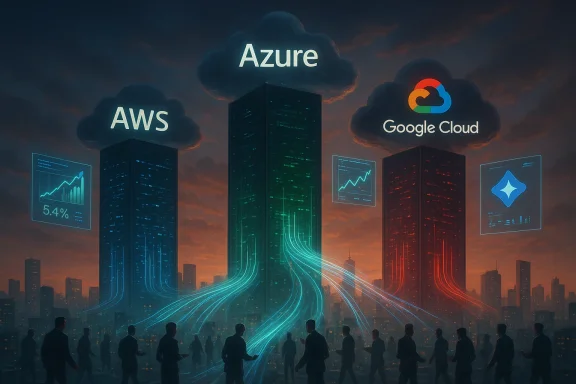 Background: How AI Became the Cloud Market’s Growth Fuel
AI workloads demand vast amounts of compute, specialized accelerators (GPUs/TPUs), and high-throughput networking. Over the past year this translated into a tectonic shift in cloud consumption patterns: enterprise cloud infrastructure spending leapt as customers bought capacity not just for storage and web services, but for training and serving generative AI models. Independent market trackers put Q4 2025 cloud infrastructure revenue at roughly $119.1 billion, about 30% year‑over‑year growth, with the Big Three — AWS, Microsoft, and Google — taking the lion’s share of the market. That surge is the clearest quantitative sign that AI is the proximate cause of the acceleration. Market dynamics to understand:
- AI workloads drove both higher revenue and a sharp increase in short‑lived capex (GPUs, custom silicon).
- Providers are simultaneously chasing growth and managing supply constraints (GPUs, data center sites, power).
- Growth percentages are meaningful, but base sizes matter: a high growth rate on a smaller base is different from moderate growth on a very large run‑rate.
The Quarter in Numbers: What Each Titan Reported
Amazon Web Services — scale with accelerating growth
AWS reported $35.6 billion in Q4 2025 revenue, a 24% year‑over‑year increase, which the company described as its fastest growth in 13 quarters. Amazon stressed that this expansion is AI‑driven and that demand currently outstrips available capacity. To meet that demand the company announced an ambitious $200 billion capex plan for 2026, stating most of the spending will be directed at AWS and AI infrastructure. Investors reacted strongly to the spending plan even as AWS’s operating income remained robust.Why the numbers matter:
- AWS remains the largest player by run rate and revenue, so 24% growth on a $142B annualized run rate represents enormous absolute dollars and continued dominance.
- Amazon’s capex signal is a declaration of intent: doubling down on AI compute, chips, robotics, and logistics to secure long‑term leadership.
Microsoft Azure — breadth, enterprise traction, and supply constraints
Microsoft reported its fiscal 2026 second quarter (ended Dec. 31, 2025) results showing Azure and other cloud services up 39% year‑over‑year (38% in constant currency), with Intelligent Cloud revenue at $32.9 billion. Microsoft emphasized enterprise demand across workloads and a growing remaining performance obligation (RPO), and executives warned that customer demand continues to exceed supply, prompting higher capex expectations for fiscal 2026. This quarter also reflected Microsoft’s multi‑product approach: AI features across Microsoft 365, Azure, and developer tooling are pulling customers into its ecosystem.Why the numbers matter:
- Microsoft’s cloud growth benefits from product breadth (SaaS productivity, server products, Azure), making its AI traction more sticky for enterprise customers.
- The supply bottleneck is real — Microsoft is buying short‑lived accelerators in large quantities, which raises near‑term capex and operational complexity.
Google Cloud — the fastest grower and the efficiency story
Alphabet reported Google Cloud revenue of $17.7 billion, a 48% year‑over‑year increase, and highlighted that growth was driven by demand for its Gemini family of AI models and AI‑native solutions. Alphabet disclosed two striking operational data points: more than 8 million paid seats of Gemini Enterprise sold in a short window, and the Gemini app surpassing 750 million monthly active users. Even more notable, Alphabet claimed it reduced Gemini serving unit costs by 78% over 2025, a major efficiency improvement that boosts margins over time. Alphabet guided $175–$185 billion in capex for 2026, mainly to expand servers and data centers for AI.Why the numbers matter:
- Google Cloud’s 48% growth is the fastest among the Big Three and suggests it is capturing disproportionate AI spend relative to its current base.
- The 78% reduction in serving unit costs is a potential game‑changer: lower cost‑to‑serve increases gross margin leverage and makes aggressive price/performance positioning possible.
Why Motley Fool (and Others) Call Google the Winner — and What That Really Means
The investment write‑ups that crowned Google Cloud the quarter’s "winner" emphasize three points: fastest gion of Gemini, and significant cost reductions in model serving. Those observations are valid and supported by Alphabet’s disclosures, but "winner" depends on the lens you use. The Motley Fool piece the user supplied argues that Google’s combination of revenue acceleration and improved economics makes it the quarter’s standout. That is a defensible editorial stance given the reported figures and is echoed by other outlets.Balanced interpretation:
- From a growth rate perspective, Google Cloud clearly won the quarter: a 48% uplift outpaces peers.
- From an absolute dollars and profitability perspective, AWS remains the dominant cash engine and retains scale advantages that small competitors can’t easily replicate.
- From an efficiency and momentum perspective, Google’s 78% lowering of serving unit costs is a structural advantage if sustained.
Deeper Analysis: Strengths, Risks, and Strategic Implications
1) Scale vs. speed: the tradeoff
- AWS strength: unparalleled scale, broad service catalog, and enterprise adoption across industries. Scale brings stickiness, global footprint, and diversified revenue sources. Its 24% growth atop a massive base still represents huge incremental cloud dollars.
- Google strength: speed of AI product commercialization and the ability to turn generative AI consumer traction into enterprise revenue. Rapid model cost improvements make it feasible to serve more workloads profitably.
- Microsoft strength: platform integration and enterprise relationships. Azure + Microsoft 365 + GitHub + OpenAI makes a compelling end‑to‑end offering for corporations adopting AI at scale.
- High growth on a small base (Google) may not translate into leadership in absolute dollars without sustained multi‑year acceleration.
- High capex bets (Amazon’s $200B; Alphabet’s $175–$185B) increase scale but raise near‑term free cash flow pressure and execution risk.
- Supply constraints (GPU shortages, datacenter build timelines) create quarterly variability and revenue recognition timing issues across all three providers.
2) Economics: cost per token, serving efficiency, and margin leverage
Google’s claim of a 78% reduction in serving unit costs for Gemini over 2025 is important because AI economics are highly sensitive to per‑token and per‑query costs. Lowering cost by this magnitude:- Improves gross margins for model serving.
- Enables competitive pricing or margin expansion.
- Makes it easier to deploy models at higher scale without hitting prohibitive operating costs.
3) Capex arms race: the supply side of AI demand
All three hyperscalers are accelerating capital spending to close the gap between demand and available AI compute. Two points to parse:- Short‑lived vs. long‑lived assets: Microsoft noted a large share of its capex was for short‑lived assets (GPUs/CPUs) — purchases that need rapid replenishment and create cash flow pressure. Amazon and Alphabet also emphasized servers and AI infrastructure in their capex guidances.
- Investor response: markets often react negatively to unexpectedly large capex guidance, as seen in the after‑hours moves when Amazon and Alphabet announced outsized 2026 plans. That reaction partly reflects concerns about near‑term cash flow and the uncertain timing of returns from AI investments.
4) Channel and product strategies: how each provider monetizes AI
- AWS: focuses on flexible model hosting (Bedrock), managed services (SageMaker), and partnerships (Anthropic, etc.). It sells infrastructure and developer tools to a broad set of customers.
- Microsoft: bundles AI into enterprise workflows (Copilot in Microsoft 365, Azure OpenAI Service) and relies on deep corporate relationships and licensing to lock in long‑term contracts.
- Google: uses its model family (Gemini), GCP stack, and enterprise partnering to capture both consumer and enterprise AI use cases — often turning consumer engagement into enterprise demand.
What This Means for IT Decision‑Makers and Windows Users
- Short term (0–12 months): expect supply‑constrained procurement cycles for AI capacity. Lead times for GPUs and large Azure/AWS/GCP commitments will be longer, and enterprises should plan procurement and project timelines accordingly. Microsoft explicitly warned that demand exceeds supply — a condition likely to persist into 2026.
- Vendor selection strategy: prioritize total cost of ownership (TCO) for AI workloads — not just headline price. Google’s serving cost reductions and Microsoft’s integrated productivity stack change the calculus for many enterprise scenarios.
- Hybrid and edge: organizations that can design hybrid AI deployments (on‑prem inference for latency‑sensitive tasks, cloud for training and scale) will have more leverage over cost and resiliency.
- Windows ecosystem impact: Microsoft’s cloud expansion (and its integration of Copilot into Windows and Office) means Windows‑centric enterprises will increasingly consume AI via Azure-linked services — making Microsoft an attractive managed path for many customers.
Risks and Red Flags
- Capex execution risk: spending commitments in the hundreds of billions bring project execution risk (site permits, power availability, hardware supply). Delays could amplify short‑term supply constraints and push back expected revenue capture.
- Margin pressure vs. price competition: hyperscalers may choose to compete on price to win large AI customers, compressing margins even as revenues grow.
- Regulatory and geopolitical exposure: large data center expansions and increased enterprise handling of sensitive data expose providers to data sovereignty, export control, and antitrust scrutiny.
- Model risks: widespread reliance on large models introduces third‑party dependency and systemic risk if model suppliers or key partners face outages, licensing disputes, or reputational harms.
A Reality Check on "Winner" Narratives
Headlines declaring a single quarter "proof" of future dominance are tempting but often premature. The quarter’s results are a clear sign that Google Cloud has momentum: high growth, strong Gemini adoption, and notable cost reductions. However:- AWS’s sheer scale and profitability continue to provide a competitive moat that a faster‑growing smaller player must overcome to take leadership in absolute market share.
- Microsoft’s integrated enterprise reach and OpenAI partnership give it unique advantages in stickiness and large enterprise deals.
- Sustained leadership requires multi‑quarter consistency across revenue growth, margin expansion, capex efficiency, and customer wins — not just a single outstanding quarter.
Practical Takeaways for CIOs, Dev Leads, and IT Architects
- Reassess vendor TCO assumptions: include model serving cost, token pricing, and storage/egress math — not just compute list prices.
- Prioritize contractual commitments: multi‑year or committed spend agreements can provide supply certainty in a constrained market.
- Design for portability: to avoid vendor lock‑in, build systems that can redeploy models across clouds or to on‑prem hardware when economics demand it.
- Negotiate for performance: as hyperscalers expand capacity, there will be windows where price/performance improves — good contracts can capture those benefits.
- Monitor regional capacity and power constraints: AI data centers are energy‑intensive; regional availability may shape where workloads should run.
Looking Ahead: What to Watch in 2026
- Quarterly capex execution and the pace at which new GPU/TPU capacity comes online. Will capex translate into usable capacity fast enough to satisfy demand?
- Sustained unit‑cost improvements for model serving beyond 2025 — if Google keeps reducing serving costs while maintaining model quality, competitive dynamics will shift materially.
- Pricing and packaging innovations: expect new model‑subscription, committed‑use, and verticalized AI offerings targeted at enterprises.
- Competitive moves: partnerships (e.g., Microsoft + OpenAI), acquisitions of AI tooling vendors, aicon rollouts will influence market positions.
- Regulatory developments: data processing rules, export controls, and antitrust actions could curtail or reshape go‑to‑market strategies across geographies.
Conclusion
Q4 2025 was a landmark period for cloud computing: revenue surged, AI adoption accelerated cloud demand, and big‑ticket capex plans signaled a long grind to build the compute backbone of the AI era. Google Cloud’s 48% growth and claimed 78% reduction in serving unit costs give it a strong claim to the quarter’s top performance, while AWS’s scale and Microsoft’s enterprise integration keep both firmly in the running for leadership over the next several years. The real takeaway is systemic: AI has become the primary growth engine for cloud infrastructure, and hyperscalers — through enormous capex and rapid product innovation — are racing not only for market share but to define how enterprises run AI at scale.For customers and IT leaders, the quarter’s results mean thinking beyond simple price lists. Plan for capacity constraints, demand contractual certainty, and design architectures that allow you to follow the economics as they evolve. For investors and observers, the quarter is an opening salvo in what will be a multi‑year contest — one measured by growth rates, cost efficiencies, execution of capex plans, and ultimately the ability to deliver reliable, scalable, and cost‑effective AI services.
The Motley Fool and many outlets declared Google Cloud the quarter’s winner based on growth and cost efficiency, and that view is supported by the numbers and company disclosures — but the strategic race is far from decided. Keep watching capex execution, serving economics, and how each provider turns AI demand into recurring commercial traction: those are the variables that will determine who ultimately leads the AI cloud era.
Source: The Motley Fool Amazon, Microsoft, and Alphabet All Reported Robust Cloud Growth. 1 Was a Clear Winner | The Motley Fool