

Holstin’s shadowed, ooze‑ridden town arrives at the crossroads of classic survival horror and modern indie ambition — a striking Polish‑set psychological horror that swaps rigid camera rules for a fluid, multi‑perspective system and is now poised to reach a far wider audience after Team17 stepped in to publish the title.
Holstin began life as Sonka’s labor of love: a small‑team project with an unmistakable aesthetic and a clear pedigree of influences. The game was first shown in concept and demo form across 2023–2025 showcases, building attention through repeated public demos that proved the project’s central mechanical promise — a hand‑drawn, pixel‑infused world rendered in 3D and presented through a dynamic camera system that shifts between isometric exploration and closer, over‑the‑shoulder combat. In December 2025, Sonka announced a publishing partnership with Team17, a move that shifts Holstin from an indie curiosity toward a more prominent release strategy. Team17’s involvement brings not just distribution muscle but — as Sonka has said publicly — funding and support intended to expand the project’s scope, improve voice acting and polish, and allow the team to realize additional creative goals for its 1990s Poland setting.
Sonka’s cultural specificity also matters. Placing the game unmistakably in 1990s Poland — with Polish voice acting and local color — elevates it from being a mere stylistic recreation to something with context. That lived‑in specificity can anchor the surreal elements and make the grotesque feel more tangible.
The final judgment will depend on follow‑through. If Team17’s involvement yields measurable improvements — better audio direction, tightened combat, optimized multi‑platform performance — Holstin could become a breakout cult hit among horror fans. If scope increases without commensurate polish, the game risks joining the long tail of promising demos that never deliver on the full promise.
Holstin’s blend of hand‑crafted pixel work, regional identity, and camera innovation is a rare and welcome vector for survival horror — a title that doesn’t simply rehash old formulas but attempts to twist them. If Sonka and Team17 deliver on the promise, Jeziorne‑Kolonia may become one of the most memorable indie horror towns in recent memory.
Source: Windows Central https://www.windowscentral.com/gaming/holstin-should-be-on-your-radar-xbox-pc/
 Background
Holstin began life as Sonka’s labor of love: a small‑team project with an unmistakable aesthetic and a clear pedigree of influences. The game was first shown in concept and demo form across 2023–2025 showcases, building attention through repeated public demos that proved the project’s central mechanical promise — a hand‑drawn, pixel‑infused world rendered in 3D and presented through a dynamic camera system that shifts between isometric exploration and closer, over‑the‑shoulder combat. In December 2025, Sonka announced a publishing partnership with Team17, a move that shifts Holstin from an indie curiosity toward a more prominent release strategy. Team17’s involvement brings not just distribution muscle but — as Sonka has said publicly — funding and support intended to expand the project’s scope, improve voice acting and polish, and allow the team to realize additional creative goals for its 1990s Poland setting. What Holstin Is — The Essentials
Holstin is best summarized by its three core pillars:- A 90s‑set, Eastern European setting. The game takes place in Jeziorne‑Kolonia, a small lake town in Poland whose people, wildlife, and buildings are being consumed by a grisly, slime‑like infection. The atmosphere leans heavily into decay, quiet dread, and an off‑kilter local flavor that the developers use to create a distinct identity.
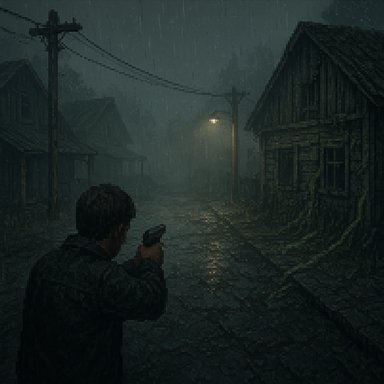
- Dynamic camera and perspective shifting. Exploration is primarily isometric, but when combat begins the camera smoothly transitions to a tighter, third‑person, over‑the‑shoulder view for aiming and firefights; certain sequences — notably driving — can change the perspective again, sometimes into first‑person. This is not only a presentational trick but a design choice that alters how players plan, panic, and survive.
- Survival mechanics married to narrative tension. Players scavenge scarce supplies, craft ammunition, manage stamina and inventory, and interrogate locals — many of whom are losing touch with reality. Holstin draws inspiration from series like Resident Evil and Silent Hill while aiming for a moodier, Twin Peaks‑adjacent storytelling approach.
Visual Identity and Audio
Hand‑drawn pixels, 3D lighting
Sonka describes the game’s tech as a “2XD Rendering” approach: hand‑drawn pixel art layered into fully three‑dimensional environments with dynamic lighting and camera rotation. The result is a pixel aesthetic that reads as tactile and cinematic rather than merely retro. The team touts eight camera angles for exploration, and the demo shows highly effective use of lighting to hide — or reveal — threats depending on your vantage.Language and voice
A notable production choice is full voice acting in both Polish and English. Sonka has emphasized Polish audio as an authenticity move — the voices underpin the game’s cultural texture and help sell the unsettling performance of townsfolk caught between sanity and something else. Team17’s publishing support has been explicitly tied to upgrading performance quality where needed.Gameplay Deep Dive
Exploration: isometric as strategy
In the isometric mode, Holstin encourages careful observation and methodical exploration. Environmental puzzles, locked routes, and verticality (for example, climbing radio towers or finding shortcuts) reward curiosity. The angle also reinforces the feeling of being watched by the town itself: distant silhouettes, shifted perspectives, and the weird geometry of collapsed structures instill dread long before combat begins. Demo play reports consistently praise how environmental design converts a pixel world into an ominous playground.Combat: aim, switch, survive
Combat is where Holstin’s stunt really matters. Instead of forcing players to fight from the isometric view, the game lets you “aim” and the camera will slide into an over‑the‑shoulder third‑person framing. This makes ranged encounters much more immediate — headshots matter, spatial awareness changes, and there’s a stamina mechanic that penalizes you for excessive aiming time. Melee, stealth, and makeshift weapons round out the combat loop, and scarce resources keep every confrontation tense. Early demos show the mechanic working well to heighten stakes, though some players noted tuning issues in older builds that Sonka has been iterating on.Driving and perspective variety
At times, Holstin switches once more into a first‑person perspective while driving a battered van through mud and ooze. These sequences are explicitly designed to change pacing: they are kinetic, claustrophobic, and often act as bridges between slow exploration segments. The use of perspective as a gameplay device — not just as a camera novelty — is a crucial part of Sonka’s design thesis.Platforms, Demo, and Release Status
- Demo availability: Sonka has released multiple public demos over time; the most substantial “Jeziorne‑Kolonia” demo is currently playable on PC via Steam and offers roughly two hours of hands‑on experience with the opening segments and core mechanics. Demo pages and community reviews show overwhelmingly positive feedback for the demo builds.
- Platforms planned: The full game is slated for PC (Steam), PlayStation 4/5, Xbox One/Series X|S, and Nintendo Switch (with coverage mentioning a future Switch 2 as platforms evolve). Team17 lists the title across major platforms in its publishing announcement. No concrete launch date has been announced; Sonka and Team17 describe the project as coming when it’s ready and are using the demo and a planned crowdfunding window to refine scope.
- Publishing shift: The partnership with Team17 was announced in December 2025 and is explicitly tied to expanding the game’s reach, funding production upgrades, and supporting higher production values such as voice work and polish. This is the most significant business development in Holstin’s lifecycle to date.
Why Holstin Matters to Horror Fans (And to Xbox/PC Audiences)
- A fresh take on a familiar formula. Holstin’s mixture of isometric exploration and over‑the‑shoulder combat revitalizes a classic survival structure. The camera transitions are designed to change the player’s mindset: wide planning versus up‑close vulnerability. That blending could position Holstin as one of the more inventive indie takes on the Resident Evil / Silent Hill lineage.
- Cultural specificity as atmosphere. Few modern horror games lean so explicitly into a specific regional identity. Jeziorne‑Kolonia’s Polish milieu — from architecture to voice acting choices — gives Holstin an instantly recognizable texture that separates it from anonymous “post‑apocalyptic” towns. Authenticity here becomes a design asset.
- Indie production with AA ambitions. The Team17 partnership signals that Holstin is not simply an experimental demo; the project is being shepherded toward a proper, multi‑platform launch with resources behind it. For Xbox and PC players, that increases the chance the final product will feel complete and well supported.
Strengths — What Holstin Already Does Well
- Distinct visual identity. The hand‑drawn pixel + 3D lighting approach is more than retro glamour; it’s evocative and supports gameplay by using shadows and parallax to hide and reveal threats. Reviewers and demo players repeatedly highlight the art direction for delivering “real” horror in a pixel package.
- Camera system as design. Making camera perspective integral to gameplay is bold. When it works, it creates tactical and emotional variety: the same corridor feels different in overhead planning mode than it does when you’re pressed for a headshot in third‑person. Multiple outlets have called this the game’s standout technical and design achievement.
- Polishable foundation. The Team17 partnership suggests Sonka will have the runway to expand content, rework player feedback from demos, and improve performance and audio — concrete upgrades that can turn a promising demo into a robust release.
Risks and Open Questions
- Control and tuning complexity. Any project that switches camera and control paradigms mid‑play risks player confusion. Early demo feedback included notes about aiming feel and melee clarity; while Sonka has iterated, the final game needs tight, consistent controls to make shifts feel intentional rather than jarring. This is a common pitfall when blending isometric navigation with shoulder‑aim combat.
- Scope creep under new funding. Publisher support is double‑edged: it provides resources but also raises expectations. Sonka has signaled intentions to expand content and polish, which could extend timelines and increase complexity. For backers and players watching the Kickstarter or demo progress, there’s a risk that ambitions outstrip the team’s practical capacity unless scope is tightly managed. Team17’s track record with indie titles is strong, but execution risk remains.
- Crowdfunding pressure. Sonka has discussed a Kickstarter campaign as part of the funding plan. Crowdfunding can offer creative freedom and community engagement, but it also adds public deadlines and obligations that must be balanced against the publisher’s schedule. Any mismatch in expectations could create friction. Reported Kickstarter plans should be considered tentative until the campaign launches and backing goals and stretch targets are published.
- Platform parity and optimization. Delivering a 3D pixel aesthetic with dynamic lighting across PC, Xbox, PlayStation, and Switch (and potential handheld hardware) is nontrivial. The Switch, in particular, may demand significant optimization or graphical scaling. Ensuring consistent performance and visual fidelity across platforms will be a technical challenge for Sonka and Team17 to manage.
Practical Advice for Players Interested Now
- Try the PC demo on Steam to judge the camera and combat transitions first‑hand; early demo builds present the clearest picture of how the core loop feels in practice.
- If you prefer authenticity, enable Polish voice acting (the demo and Sonka’s materials make clear this track exists) to experience the setting as the developers intended.
- Watch for the Team17 updates and any Kickstarter details; the publisher will likely use those channels to communicate roadmaps, release windows, and platform specifics.
Editorial Analysis — Can Holstin Escape “Retro Clone” Fatigue?
The indie scene is saturated with games that borrow from the survival horror classics. Holstin distinguishes itself not by nostalgia alone, but by trying to rethink a central tension: the role of viewpoint in building dread. Where many “retro” titles simply reproduce a fixed camera or a pixel skin, Holstin treats camera perspective as a gameplay lever. That is an important distinction.Sonka’s cultural specificity also matters. Placing the game unmistakably in 1990s Poland — with Polish voice acting and local color — elevates it from being a mere stylistic recreation to something with context. That lived‑in specificity can anchor the surreal elements and make the grotesque feel more tangible.
The final judgment will depend on follow‑through. If Team17’s involvement yields measurable improvements — better audio direction, tightened combat, optimized multi‑platform performance — Holstin could become a breakout cult hit among horror fans. If scope increases without commensurate polish, the game risks joining the long tail of promising demos that never deliver on the full promise.
The Bottom Line
Holstin is a compelling bid to evolve classic survival horror for modern indie audiences. Its art style, multi‑modal camera system, and Polish setting are distinctive strengths, and Team17’s publishing deal materially improves its odds of reaching a wide audience with a more finished product. For PC and Xbox players who appreciate atmospheric tension, careful resource management, and inventive design, Holstin is worth watching — and the Steam demo already offers a solid taste of what Sonka aims to deliver. Caveat: the full game’s release date remains unannounced and a Kickstarter campaign is referenced in developer communications; both milestones are subject to change and should be treated as tentative until Sonka or Team17 publish firm dates or campaign details.Holstin’s blend of hand‑crafted pixel work, regional identity, and camera innovation is a rare and welcome vector for survival horror — a title that doesn’t simply rehash old formulas but attempts to twist them. If Sonka and Team17 deliver on the promise, Jeziorne‑Kolonia may become one of the most memorable indie horror towns in recent memory.
Source: Windows Central https://www.windowscentral.com/gaming/holstin-should-be-on-your-radar-xbox-pc/
