
Microsoft’s 2026 Work Trend Index finds that Hong Kong employees are adopting AI faster than their organizations are redesigning work, with 18 percent of local AI users classified as Frontier Professionals and 75 percent reporting pressure to adapt, according to findings released on June 22, 2026. The headline is not that Hong Kong has an AI skills problem. It is that Hong Kong may have the opposite problem: workers are ready enough to move, while management systems remain built for the pre-agentic office. That mismatch is becoming the real productivity bottleneck.
For years, the default enterprise story around artificial intelligence has been adoption anxiety. Workers were expected to resist it, managers were expected to cajole them, and vendors were expected to sell reassurance along with software licenses. Microsoft’s Hong Kong findings complicate that tidy narrative.
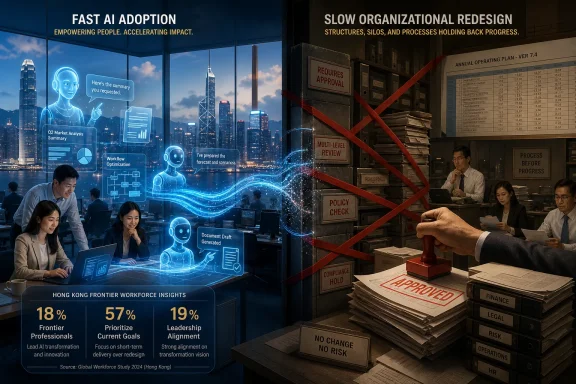
The data suggests that a meaningful share of Hong Kong workers are already well into the practical phase of AI use. Eighteen percent of local AI users fall into Microsoft’s “Frontier Professional” category, above the 16 percent global benchmark. These are not merely employees who occasionally ask a chatbot to rewrite an email; Microsoft uses the term for workers who are more deeply integrating AI into how they think, produce, check, and redesign work.
But the more revealing number is not the 18 percent. It is the 57 percent of Hong Kong AI users who say they prioritize current goals over redesigning work with AI, compared with 45 percent globally. That is the paradox in miniature: more pressure, more capability, more visible upside — and yet a stronger pull back toward existing workflows.
This is what happens when AI adoption outruns organizational change. People learn the tools, discover the shortcuts, see glimpses of new operating models, and then return to a calendar full of approvals, reporting cycles, compliance gates, and manager expectations that were never rebuilt around those tools. AI becomes a private productivity layer sitting awkwardly on top of public bureaucracy.
Still, dismissing the language would be a mistake. The underlying problem it points to is familiar to anyone who has watched enterprise technology land inside a real organization. Tools arrive faster than incentives change. Training arrives faster than governance. Pilot programs arrive faster than job descriptions. Employees are told to innovate, but evaluated against last quarter’s targets.
Hong Kong’s results are striking because they show this gap in a market that is not obviously lagging in AI awareness. Three-quarters of Hong Kong AI users report pressure to adapt to AI, above the 65 percent global figure. Yet that pressure does not automatically translate into redesign. In fact, the local workforce appears more likely than the global average to stay focused on current goals.
That is not irrational conservatism. It is rational behavior inside organizations that have not changed the terms of success. If the reward system still favors immediate delivery, low visible risk, and adherence to known processes, then employees will use AI where it helps them survive the day — not where it forces them to renegotiate how work is done.
That matters because AI at work is not just a personal productivity app. Once it touches documents, decisions, customer communications, software development, finance workflows, or HR processes, it becomes an organizational system. Someone has to decide what quality looks like, what risks are acceptable, what data can be used, when human review is mandatory, and how experimentation should be measured.
In the absence of that direction, employees improvise. Some become ambitious and careful. Some become reckless. Many become quiet. They use AI in ways that help them, but avoid advertising how much the process has changed, because disclosure can invite scrutiny without offering protection.
This is a governance failure disguised as a culture problem. If leaders say “use AI” but do not agree on standards, employees hear a slogan rather than a strategy. If leaders say “transform work” but still punish missed short-term targets, employees learn that transformation is optional theater and delivery is the real law.
That is not how serious transformation works. Process redesign carries switching costs. Teams have to document new practices, test outputs, revise handoffs, and sometimes accept a temporary drop in speed while they rebuild the workflow. If the only recognized wins are near-term deliverables, then AI will be used mainly to accelerate the old process rather than replace it.
The result is a familiar enterprise anti-pattern: productivity theater. Employees produce more drafts, more summaries, more meeting notes, more slide outlines, and more status updates. The work feels faster, but the organization has not necessarily become more effective. In some cases, it simply creates more machine-assisted activity for other humans to review.
That is the uncomfortable edge of the Work Trend Index findings. AI can make individuals feel more capable while leaving the organization structurally unchanged. Without redesign, the technology risks becoming a pressure amplifier — helping workers keep up with growing demands rather than helping the company ask whether those demands still make sense.
Workers do not just need permission to use AI. They need a definition of good AI-assisted work. They need to know when an AI-generated answer is good enough to move forward, when it needs verification, and when it should never be used without expert review. They need examples, escalation paths, and shared norms.
The quality question is especially important in knowledge work because AI failure is often plausible rather than obvious. A bad spreadsheet formula, a subtly wrong legal summary, a hallucinated citation, or a misleading customer analysis can look polished enough to travel far before anyone catches it. The more fluent the tool, the more important the review culture becomes.
Managers therefore sit in a newly important middle layer. They translate broad AI ambition into local operating discipline. A company can publish principles and buy licenses, but the manager decides whether a team treats AI output as a draft, a decision, a hypothesis, or a liability.
Experimentation takes time, and time is the resource most organizations pretend not to control. A team cannot seriously redesign a reporting workflow, automate a research process, or build a reliable agent-assisted handoff if every hour is already consumed by business-as-usual commitments. The organization must make room for learning, failure, and iteration.
That does not mean giving employees vague permission to “play with AI.” It means deciding which workflows are worth rethinking, which metrics can temporarily bend, and which risks require supervision. Experimentation without boundaries becomes chaos; experimentation without time becomes hypocrisy.
Hong Kong’s 57 percent figure — the share prioritizing current goals over redesign — should be read through this lens. Workers are not necessarily choosing the old way because they lack imagination. They may be choosing it because no one has reduced the cost of choosing anything else.
Ambitious redesign is different from using AI to polish existing outputs. It asks whether a report should exist at all, whether a meeting can become an agent-mediated workflow, whether a customer-support process can move from reactive triage to predictive intervention, or whether a software team can reallocate human attention from boilerplate implementation to architecture and review.
Those changes threaten established routines. They can blur accountability. They can unsettle people whose authority is tied to existing processes. That is why ambition has to be sponsored, not merely tolerated.
The manager’s role is no longer just to allocate tasks and check progress. In an AI-saturated workplace, the manager increasingly defines the safe frontier: the edge at which a team can change how work happens without losing control of quality, compliance, and trust.
That tension shows up plainly in the data. Hong Kong workers feel more pressure than the global average to adapt, yet are also more likely to prioritize current goals. In other words, pressure is not producing transformation. It may be crowding it out.
This should worry executives. If capable employees learn that AI is useful but organizationally unsupported, they may route around official systems. Some will use sanctioned tools in unsanctioned ways. Others will bring personal workflows into corporate contexts. The risk is not just shadow IT in the old sense; it is shadow process design, where the real work increasingly happens through undocumented AI-mediated shortcuts.
For regulated industries, finance, legal services, public-sector contractors, and cross-border businesses, that is not a minor concern. AI governance cannot be reduced to blocking risky tools or approving safe ones. The harder problem is understanding how work itself is changing after the tool is introduced.
That shift has consequences for IT departments. Supporting AI at work is not just a licensing question. It touches identity, data classification, endpoint management, browser policy, retention, eDiscovery, audit logs, app governance, and user training. The AI assistant is only as safe as the permissions, data boundaries, and workflow assumptions around it.
Administrators will also have to contend with uneven maturity inside the same organization. Some teams will be ready for advanced AI workflows. Others will barely have reliable document hygiene. Some managers will set quality standards. Others will treat AI as magic or menace. A single enterprise-wide deployment can therefore produce radically different outcomes depending on local culture.
This is where Microsoft’s management-heavy framing is useful, even if one treats the branding with caution. The constraint is not simply whether the tenant has Copilot enabled. It is whether the organization has a working model for how AI-assisted work is proposed, reviewed, secured, measured, and improved.
The first wave of AI productivity metrics has often leaned on user sentiment, time saved, and anecdotal output gains. Those are useful early signals, but they can flatter the tool. A worker who produces more material is not necessarily producing better business outcomes. A team that answers faster is not necessarily reducing risk. A department that automates drafts may simply shift burden downstream to reviewers.
The more useful question is whether AI changes the unit economics of a workflow. Does it reduce cycle time without increasing rework? Does it improve decision quality? Does it cut error rates? Does it let senior staff spend more time on judgment and less time on assembly? Does it reduce burnout, or merely raise expectations?
Hong Kong’s findings hint that advanced users see genuine capability gains. But they also show why those gains can stall. If the organization cannot measure redesigned work differently from conventional work, then the safest metric remains the old metric. And the old metric will keep pulling employees back into the old process.
But human agency can also become a comforting phrase that masks work intensification. If AI lets one person do the work of three, the organization may not respond by making the job more strategic. It may simply expect one person to carry more output. Without redesign, agency can become accountability without authority.
That is why leadership alignment and incentives matter so much. If employees are expected to supervise AI systems, they need time and authority to do that supervision properly. Reviewing AI output is work. Designing prompts, checking sources, validating assumptions, and monitoring downstream effects are not free activities.
The danger is that organizations treat AI output as a labor-saving input while treating human review as an invisible residual duty. That produces a brittle system: faster on the surface, riskier underneath, and dependent on workers silently absorbing the extra cognitive load.
That makes Hong Kong a useful early warning case. If a workforce with above-average Frontier Professional representation still defaults to current goals because leadership and incentives lag, then slower-moving markets should not assume adoption alone will save them. The bottleneck will arrive everywhere, just at different speeds.
The lesson for executives is uncomfortable because it moves responsibility upward. It is easier to buy tools than to change management practice. It is easier to announce an AI strategy than to reconcile conflicting executive priorities. It is easier to praise experimentation than to protect the teams whose experiments fail.
For IT leaders, the lesson is equally blunt. AI governance cannot live only in the security office, and AI enablement cannot live only in training portals. The two have to meet in operating design: the concrete rules, workflows, metrics, and managerial practices that determine how AI is used when real deadlines arrive.
But employees cannot redesign the organization by themselves. They usually cannot change incentives, reporting structures, compliance interpretations, procurement rules, or performance evaluation criteria. They cannot unilaterally decide that a slower experimental month is acceptable in exchange for a better workflow next quarter.
That is why the low reward figure matters. When only 10 percent of Hong Kong AI users say they are rewarded for reinventing work with AI even without immediate results, the organization is effectively asking for transformation on volunteer terms. Some unusually motivated employees will do it anyway. Most will not, and they should not be blamed for that.
AI transformation is not a grassroots productivity hack. It is a management project that requires grassroots intelligence. The distinction matters.
 Hong Kong’s AI Problem Is Not Hesitation, but Containment
For years, the default enterprise story around artificial intelligence has been adoption anxiety. Workers were expected to resist it, managers were expected to cajole them, and vendors were expected to sell reassurance along with software licenses. Microsoft’s Hong Kong findings complicate that tidy narrative.The data suggests that a meaningful share of Hong Kong workers are already well into the practical phase of AI use. Eighteen percent of local AI users fall into Microsoft’s “Frontier Professional” category, above the 16 percent global benchmark. These are not merely employees who occasionally ask a chatbot to rewrite an email; Microsoft uses the term for workers who are more deeply integrating AI into how they think, produce, check, and redesign work.
But the more revealing number is not the 18 percent. It is the 57 percent of Hong Kong AI users who say they prioritize current goals over redesigning work with AI, compared with 45 percent globally. That is the paradox in miniature: more pressure, more capability, more visible upside — and yet a stronger pull back toward existing workflows.
This is what happens when AI adoption outruns organizational change. People learn the tools, discover the shortcuts, see glimpses of new operating models, and then return to a calendar full of approvals, reporting cycles, compliance gates, and manager expectations that were never rebuilt around those tools. AI becomes a private productivity layer sitting awkwardly on top of public bureaucracy.
Microsoft’s “Frontier” Language Is Salesy, but the Management Gap Is Real
Microsoft’s terminology deserves some skepticism. “Frontier Professionals” and “Frontier Firms” sound engineered for slide decks, customer events, and Copilot campaigns. The company has every incentive to frame AI not as a feature inside Microsoft 365, but as an operating-model revolution that conveniently requires more Microsoft software, more Microsoft cloud infrastructure, and more Microsoft consulting gravity.Still, dismissing the language would be a mistake. The underlying problem it points to is familiar to anyone who has watched enterprise technology land inside a real organization. Tools arrive faster than incentives change. Training arrives faster than governance. Pilot programs arrive faster than job descriptions. Employees are told to innovate, but evaluated against last quarter’s targets.
Hong Kong’s results are striking because they show this gap in a market that is not obviously lagging in AI awareness. Three-quarters of Hong Kong AI users report pressure to adapt to AI, above the 65 percent global figure. Yet that pressure does not automatically translate into redesign. In fact, the local workforce appears more likely than the global average to stay focused on current goals.
That is not irrational conservatism. It is rational behavior inside organizations that have not changed the terms of success. If the reward system still favors immediate delivery, low visible risk, and adherence to known processes, then employees will use AI where it helps them survive the day — not where it forces them to renegotiate how work is done.
Leadership Alignment Is the Missing Control Plane
The most damning figure in Microsoft’s Hong Kong release is not about workers. It is about leadership. Only 19 percent of Hong Kong AI users say their leadership is clearly and consistently aligned on AI, below the 26 percent global figure. That means more than four in five local AI users do not see a coherent executive posture on one of the biggest workplace technology shifts in a generation.That matters because AI at work is not just a personal productivity app. Once it touches documents, decisions, customer communications, software development, finance workflows, or HR processes, it becomes an organizational system. Someone has to decide what quality looks like, what risks are acceptable, what data can be used, when human review is mandatory, and how experimentation should be measured.
In the absence of that direction, employees improvise. Some become ambitious and careful. Some become reckless. Many become quiet. They use AI in ways that help them, but avoid advertising how much the process has changed, because disclosure can invite scrutiny without offering protection.
This is a governance failure disguised as a culture problem. If leaders say “use AI” but do not agree on standards, employees hear a slogan rather than a strategy. If leaders say “transform work” but still punish missed short-term targets, employees learn that transformation is optional theater and delivery is the real law.
The Safest Path Is Still the Old Path
The release says only 10 percent of Hong Kong AI users report being rewarded for reinventing work with AI even without immediate results, compared with 13 percent globally. That is a small difference numerically, but culturally it is enormous. It means the organization is asking employees to experiment with uncertain methods while offering them very little cover when the experiment does not immediately pay off.That is not how serious transformation works. Process redesign carries switching costs. Teams have to document new practices, test outputs, revise handoffs, and sometimes accept a temporary drop in speed while they rebuild the workflow. If the only recognized wins are near-term deliverables, then AI will be used mainly to accelerate the old process rather than replace it.
The result is a familiar enterprise anti-pattern: productivity theater. Employees produce more drafts, more summaries, more meeting notes, more slide outlines, and more status updates. The work feels faster, but the organization has not necessarily become more effective. In some cases, it simply creates more machine-assisted activity for other humans to review.
That is the uncomfortable edge of the Work Trend Index findings. AI can make individuals feel more capable while leaving the organization structurally unchanged. Without redesign, the technology risks becoming a pressure amplifier — helping workers keep up with growing demands rather than helping the company ask whether those demands still make sense.
Managers Are Becoming the Gatekeepers of AI Quality
The clearest dividing line between Frontier Professionals and everyone else is managerial behavior. Microsoft’s Hong Kong findings show that 79 percent of Frontier Professionals say their manager sets quality standards for AI work, compared with 59 percent of Non-Frontier Professionals. That is a large gap, and it points to a practical truth that often gets lost in executive AI speeches.Workers do not just need permission to use AI. They need a definition of good AI-assisted work. They need to know when an AI-generated answer is good enough to move forward, when it needs verification, and when it should never be used without expert review. They need examples, escalation paths, and shared norms.
The quality question is especially important in knowledge work because AI failure is often plausible rather than obvious. A bad spreadsheet formula, a subtly wrong legal summary, a hallucinated citation, or a misleading customer analysis can look polished enough to travel far before anyone catches it. The more fluent the tool, the more important the review culture becomes.
Managers therefore sit in a newly important middle layer. They translate broad AI ambition into local operating discipline. A company can publish principles and buy licenses, but the manager decides whether a team treats AI output as a draft, a decision, a hypothesis, or a liability.
Experimentation Needs Space, Not Slogans
The same managerial pattern appears in experimentation. Microsoft says 80 percent of Frontier Professionals in Hong Kong report that their manager creates space for experimentation, compared with 61 percent of Non-Frontier Professionals. That gap captures the difference between AI as an instruction and AI as a practice.Experimentation takes time, and time is the resource most organizations pretend not to control. A team cannot seriously redesign a reporting workflow, automate a research process, or build a reliable agent-assisted handoff if every hour is already consumed by business-as-usual commitments. The organization must make room for learning, failure, and iteration.
That does not mean giving employees vague permission to “play with AI.” It means deciding which workflows are worth rethinking, which metrics can temporarily bend, and which risks require supervision. Experimentation without boundaries becomes chaos; experimentation without time becomes hypocrisy.
Hong Kong’s 57 percent figure — the share prioritizing current goals over redesign — should be read through this lens. Workers are not necessarily choosing the old way because they lack imagination. They may be choosing it because no one has reduced the cost of choosing anything else.
Ambition Is Also Managed
Microsoft’s third managerial comparison is perhaps the most revealing: 81 percent of Hong Kong Frontier Professionals say their manager encourages more ambitious work redesign, compared with 63 percent of Non-Frontier Professionals. That suggests the frontier is not simply a personality type. It is a managed condition.Ambitious redesign is different from using AI to polish existing outputs. It asks whether a report should exist at all, whether a meeting can become an agent-mediated workflow, whether a customer-support process can move from reactive triage to predictive intervention, or whether a software team can reallocate human attention from boilerplate implementation to architecture and review.
Those changes threaten established routines. They can blur accountability. They can unsettle people whose authority is tied to existing processes. That is why ambition has to be sponsored, not merely tolerated.
The manager’s role is no longer just to allocate tasks and check progress. In an AI-saturated workplace, the manager increasingly defines the safe frontier: the edge at which a team can change how work happens without losing control of quality, compliance, and trust.
Hong Kong’s Operating Model Is Being Tested by Its Own Talent
Hong Kong’s position in the findings is interesting because the city’s business culture often prizes speed, responsiveness, and execution under pressure. Those traits can accelerate AI adoption at the individual level. They can also make structural redesign harder, because the immediate demand always feels more urgent than the systemic fix.That tension shows up plainly in the data. Hong Kong workers feel more pressure than the global average to adapt, yet are also more likely to prioritize current goals. In other words, pressure is not producing transformation. It may be crowding it out.
This should worry executives. If capable employees learn that AI is useful but organizationally unsupported, they may route around official systems. Some will use sanctioned tools in unsanctioned ways. Others will bring personal workflows into corporate contexts. The risk is not just shadow IT in the old sense; it is shadow process design, where the real work increasingly happens through undocumented AI-mediated shortcuts.
For regulated industries, finance, legal services, public-sector contractors, and cross-border businesses, that is not a minor concern. AI governance cannot be reduced to blocking risky tools or approving safe ones. The harder problem is understanding how work itself is changing after the tool is introduced.
The Windows and Microsoft 365 Angle Is Bigger Than Copilot
For WindowsForum readers, the obvious product connection is Microsoft 365 Copilot. But the Work Trend Index should not be read only as a Copilot marketing document. It is also a preview of how Microsoft wants the Windows and Microsoft 365 estate to evolve: from a suite of applications into an environment where humans, copilots, and agents coordinate work across documents, chats, meetings, workflows, and business systems.That shift has consequences for IT departments. Supporting AI at work is not just a licensing question. It touches identity, data classification, endpoint management, browser policy, retention, eDiscovery, audit logs, app governance, and user training. The AI assistant is only as safe as the permissions, data boundaries, and workflow assumptions around it.
Administrators will also have to contend with uneven maturity inside the same organization. Some teams will be ready for advanced AI workflows. Others will barely have reliable document hygiene. Some managers will set quality standards. Others will treat AI as magic or menace. A single enterprise-wide deployment can therefore produce radically different outcomes depending on local culture.
This is where Microsoft’s management-heavy framing is useful, even if one treats the branding with caution. The constraint is not simply whether the tenant has Copilot enabled. It is whether the organization has a working model for how AI-assisted work is proposed, reviewed, secured, measured, and improved.
The Productivity Claim Needs a Harder Audit
Microsoft’s global Work Trend Index says many AI users report producing work they could not have produced a year earlier, and the Hong Kong release says 57 percent of local AI users make that claim, rising to 73 percent among Frontier Professionals. That is meaningful, but it is also self-reported. The next phase of enterprise AI maturity will require harder measurement.The first wave of AI productivity metrics has often leaned on user sentiment, time saved, and anecdotal output gains. Those are useful early signals, but they can flatter the tool. A worker who produces more material is not necessarily producing better business outcomes. A team that answers faster is not necessarily reducing risk. A department that automates drafts may simply shift burden downstream to reviewers.
The more useful question is whether AI changes the unit economics of a workflow. Does it reduce cycle time without increasing rework? Does it improve decision quality? Does it cut error rates? Does it let senior staff spend more time on judgment and less time on assembly? Does it reduce burnout, or merely raise expectations?
Hong Kong’s findings hint that advanced users see genuine capability gains. But they also show why those gains can stall. If the organization cannot measure redesigned work differently from conventional work, then the safest metric remains the old metric. And the old metric will keep pulling employees back into the old process.
The Human Agency Story Cuts Both Ways
Microsoft’s 2026 Work Trend Index leans heavily into human agency: the idea that as AI systems take on more execution, people move toward direction-setting, judgment, oversight, and quality control. That is a compelling frame, and in its best version it is true. The value of a human worker shifts from producing every artifact manually to deciding what should be produced, why it matters, and whether it is correct.But human agency can also become a comforting phrase that masks work intensification. If AI lets one person do the work of three, the organization may not respond by making the job more strategic. It may simply expect one person to carry more output. Without redesign, agency can become accountability without authority.
That is why leadership alignment and incentives matter so much. If employees are expected to supervise AI systems, they need time and authority to do that supervision properly. Reviewing AI output is work. Designing prompts, checking sources, validating assumptions, and monitoring downstream effects are not free activities.
The danger is that organizations treat AI output as a labor-saving input while treating human review as an invisible residual duty. That produces a brittle system: faster on the surface, riskier underneath, and dependent on workers silently absorbing the extra cognitive load.
The Local Lesson Is Global
Although Microsoft’s June 22 release focuses on Hong Kong, the pattern is not unique to the city. The global Work Trend Index also points to a broad gap between individual AI use and organizational readiness. Hong Kong’s numbers simply sharpen the contrast by showing a market where talent readiness is comparatively strong and structural support appears comparatively weak.That makes Hong Kong a useful early warning case. If a workforce with above-average Frontier Professional representation still defaults to current goals because leadership and incentives lag, then slower-moving markets should not assume adoption alone will save them. The bottleneck will arrive everywhere, just at different speeds.
The lesson for executives is uncomfortable because it moves responsibility upward. It is easier to buy tools than to change management practice. It is easier to announce an AI strategy than to reconcile conflicting executive priorities. It is easier to praise experimentation than to protect the teams whose experiments fail.
For IT leaders, the lesson is equally blunt. AI governance cannot live only in the security office, and AI enablement cannot live only in training portals. The two have to meet in operating design: the concrete rules, workflows, metrics, and managerial practices that determine how AI is used when real deadlines arrive.
The Redesign Burden Cannot Be Pushed to Employees
There is a tempting managerial dodge in all of this: if employees are the ones closest to the work, perhaps they should be the ones to reinvent it. That is partly true. The people doing the work often know where the waste lives. They can identify repetitive handoffs, unnecessary meetings, fragile spreadsheets, and approval loops that exist mainly because nobody has challenged them.But employees cannot redesign the organization by themselves. They usually cannot change incentives, reporting structures, compliance interpretations, procurement rules, or performance evaluation criteria. They cannot unilaterally decide that a slower experimental month is acceptable in exchange for a better workflow next quarter.
That is why the low reward figure matters. When only 10 percent of Hong Kong AI users say they are rewarded for reinventing work with AI even without immediate results, the organization is effectively asking for transformation on volunteer terms. Some unusually motivated employees will do it anyway. Most will not, and they should not be blamed for that.
AI transformation is not a grassroots productivity hack. It is a management project that requires grassroots intelligence. The distinction matters.
The Numbers Point to a Management Rewrite, Not Another AI Pep Talk
The practical reading of Microsoft’s Hong Kong findings is narrower and more urgent than the usual AI keynote language. The issue is not whether employees have heard of AI, tried AI, or felt pressure to use AI. Many have. The issue is whether their organizations have made the old way less rational than the new one.- Hong Kong has a slightly larger share of advanced AI users than the global benchmark, which suggests the market’s talent base is not the primary obstacle.
- Hong Kong AI users report more pressure to adapt than the global average, but they are also more likely to prioritize current goals over redesigning work.
- Leadership alignment is weaker in Hong Kong than in the global sample, leaving employees without a consistent executive signal on how AI should change work.
- Rewards for AI-driven reinvention remain rare, which makes short-term delivery the safer career choice.
- Managers appear to be the decisive layer because Frontier Professionals are much more likely to report clear AI quality standards, protected experimentation time, and encouragement to redesign work ambitiously.
- IT teams should treat AI deployment as an operating-model change that touches governance, identity, data, compliance, endpoint policy, and management practice, not simply as another software rollout.
References
- Primary source: Media OutReach Newswire
Published: 2026-06-22T02:12:07.639607
Loading…
www.media-outreach.com - Official source: news.microsoft.com
- Official source: microsoft.com
2026 Work Trend Index report: Agents, human agency, and opportunity
As AI and agents take on execution, our own agency expands. The question is whether organizations are built to capture it.www.microsoft.com - Related coverage: forbes.com
Microsoft Work Trend Index 2026 Shows AI Productivity Is Not Enough
The 2026 Work Trend Index shows that marginal AI productivity gains are outpacing organizational redesign that might harness AI for durable strategic advantage.www.forbes.com - Official source: blogs.microsoft.com
How Frontier Firms are rebuilding the operating model for the age of AI - The Official Microsoft Blog
Updated May 11, 2026: The post was updated to reflect that third-party plugins will be available starting May 12, 2026. Spend time with any software engineering team right now and you’ll see something worth paying attention to. Over the last few years, the way software gets built has moved...blogs.microsoft.com - Related coverage: smart-team.io
Loading…
smart-team.io

- Related coverage: mer.vin
Microsoft 2026 Work Trend Index: How Frontier Firms Orchestrate Human-Agent Teams - Mervin Praison
Microsoft's 2026 Work Trend Index gives engineering leaders a vocabulary for human–agent collaboration and ships Copilot Cowork mobile, plugins, and Agent...mer.vin - Related coverage: techradar.com
'Every business leader knows the world is changing, but far fewer have a clear picture of what to do about it': Microsoft flags the changing world of AI at work, and why "Frontier Firms" are leading the way | TechRadar
Microsoft digs deep into how businesses are using AIwww.techradar.com - Related coverage: pcgamer.com
Using 'trillions of anonymised productivity signals', Microsoft thinks nearly half of people like AI in their work | PC Gamer
There's dozens of us who don't!www.pcgamer.com - Related coverage: assets-c4akfrf5b4d3f4b7.z01.azurefd.net
Microsoft 2026 Work Trend Index Annual Report
Agents, human agency, and the opportunity for every organizationassets-c4akfrf5b4d3f4b7.z01.azurefd.net
- Official source: cdn-dynmedia-1.microsoft.com