

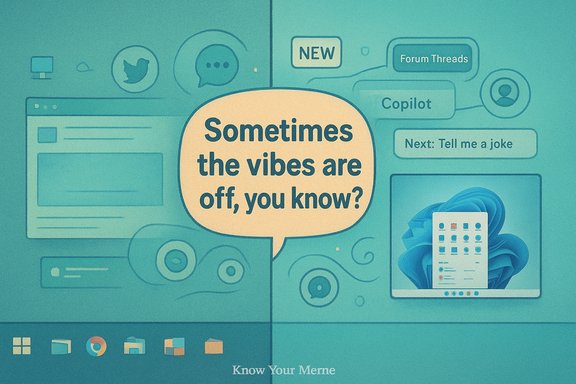
Sometimes a single caption can do more reputational damage than a thousand product briefings, and the recent Know Your Meme image quip—“Sometimes the vibes are off, you know? Still I’d trust them more than Windows 11”—is a compact case study in how meme culture amplifies anxieties about modern operating systems.
Know Your Meme began life as a web series and wiki project that chronicled the life cycle of internet jokes and trends, and has since evolved into a central archive for meme researchers, journalists, and community submissions. The site is operated by Literally Media Ltd., and the brand and site operate under the Know Your Meme trademark and policies that identify the company as the rights holder. Windows 11, Microsoft’s post‑Windows 10 evolution, shipped as a staged upgrade beginning October 5, 2021; its launch promised a modernized design, improved security posture, and deeper integration with Microsoft services. In parallel, Microsoft set October 14, 2025 as the official end‑of‑support date for Windows 10, accelerating both user migration pressure and the cultural conversation about whether Windows 11 is worth the move. This article examines why a throwaway meme about “vibes” resonates so loudly with Windows users, how internet culture influences product reputations, what the data and community discussion actually show about Windows 11, and where the real risks — and opportunities — lie for both users and Microsoft.
Windows 11 contains a mix of legitimate improvements and contentious trade‑offs. The meme’s potency arises because Microsoft’s design and product choices intersect everyday workflows, privacy perceptions, upgrade economics, and the human need for control. Fix the technical friction, offer clear choices around AI and telemetry, and the memes will change tone — from sardonic complaints to affectionate nostalgia for what the platform gets right.
For now, a photo caption that says you’d “trust them more than Windows 11” functions as a cultural accelerant: it focuses attention, compresses complex grievances into a single shareable vector, and forces companies to reckon with the emotional side of product stewardship. That’s uncomfortable, but it can also be useful — when organizations listen.
Source: Know Your Meme Sometimes the vibes are off, you know? Still I’d trust them more than Windows 11...
 Background / Overview
Know Your Meme began life as a web series and wiki project that chronicled the life cycle of internet jokes and trends, and has since evolved into a central archive for meme researchers, journalists, and community submissions. The site is operated by Literally Media Ltd., and the brand and site operate under the Know Your Meme trademark and policies that identify the company as the rights holder. Windows 11, Microsoft’s post‑Windows 10 evolution, shipped as a staged upgrade beginning October 5, 2021; its launch promised a modernized design, improved security posture, and deeper integration with Microsoft services. In parallel, Microsoft set October 14, 2025 as the official end‑of‑support date for Windows 10, accelerating both user migration pressure and the cultural conversation about whether Windows 11 is worth the move. This article examines why a throwaway meme about “vibes” resonates so loudly with Windows users, how internet culture influences product reputations, what the data and community discussion actually show about Windows 11, and where the real risks — and opportunities — lie for both users and Microsoft.Why a meme about “vibes” matters for a desktop OS
Memes compress complex social and technical complaints into instantly shareable units. The joke about trusting “them” more than Windows 11 telegraphs three stacked messages in one short line:- A perception problem: users feel uneasy about Windows 11’s behavior or direction.
- A trust deficit: the comparison implies Microsoft’s product is less trusted than questionable alternatives.
- Humor as signal: the laughter is itself data — it reveals collective irritation or skepticism.
The concrete complaints behind the punchline
To understand why memes target Windows 11, we need to unpack the substantive criticism that feeds the jokes. Across enthusiast forums and mainstream reporting, recurring themes emerge.1. UI and workflow regressions
Many long‑time Windows users say Windows 11 removed or restricted long‑standing UI affordances — smaller but meaningful controls that powered muscle‑memory workflows. Common complaints include the constrained taskbar (less flexible placement and sizing), a Start menu that foregrounds recommendations and pins in ways that disrupt discoverability, and a pared‑down right‑click context menu that hides frequently used actions. These are not just nitpicks; they affect daily efficiency for power users and IT teams.2. Copilot and the “AI everywhere” feeling
Microsoft’s push to embed generative AI — branded as Copilot across productivity apps and the OS — has been a strategic priority. For many users, however, the result feels like persistent nudging rather than helpful assistance: preinstalled Copilot elements, search bar prompts, and the presence of agentic features can be perceived as intrusive or an inescapable monetization vector. Recent AI updates deepen integration (for better or worse), including hands‑free activation and agentic “Copilot Actions.” The move intensifies both excitement among early adopters and skepticism among privacy or control‑focused users.3. Hardware, compatibility and migration friction
Windows 11’s stricter hardware requirements (TPM 2.0, Secure Boot and newer generation CPU checks) combined with Microsoft’s phased rollout created a two‑tier ecosystem: devices that “just work” and older but serviceable machines that are excluded. That friction has real consequences now that Windows 10 support has ended; organizations and consumers face decisions about replacement, extended security updates, or remaining on unsupported systems. The pressure to migrate has intensified, and it’s a frequent source of social resentment and meme fodder.4. Telemetry, in‑OS promotions and perceived commercialization
Across the OS are points where Microsoft suggests or promotes cloud features, Microsoft 365 upsells, OneDrive backup prompts, and recommended apps. For users who paid for Windows or an OEM device, these nudges can feel monetized and unwelcome — another legitimate vein of criticism that gets distilled into jokes about “vibes.” Forum discussions repeatedly identify the pushy marketing tone as a top annoyance.5. Quality control issues and update regressions
Patch Tuesday and cumulative updates have sometimes introduced regressions that created tangible disruption: File Explorer behaviors broken after updates, Copilot or other features misbehaving, or UI inconsistencies across staged rollouts. These incidents amplify distrust because they hit everyday tasks and are easily screenshot or meme‑ified for public consumption.What Windows 11 does well — and why that complicates the narrative
The meme‑driven negativity overlooks important technical and security gains. A fair analysis must balance the joke with the facts.- Security improvements: Windows 11 emphasizes hardware‑backed security constructs (TPM 2.0, virtualization‑based security) that materially raise the bar against certain classes of attacks when enabled and properly configured. This is not marketing spin — Microsoft’s documentation and platform guidance reflect that architecture.
- Modern UX refinements: features like Snap layouts, integrated virtual desktops, File Explorer tabs, and overall visual consistency are genuine productivity upgrades for many users. For folks who appreciate cleaner aesthetics and built‑in modern window management, Windows 11 can be a step forward.
- Defender and platform hardening: in independent lab cycles and vendor analysis over 2023–2025, Microsoft Defender continued to mature, reducing the reflexive need for third‑party AV for many consumer scenarios when combined with safe browsing hygiene. This reduces some risk for average users.
How meme culture magnifies small failures into strategic headaches
Memes are not merely humor; they are rapid‑deployment public feedback. Their effects are tangible in four ways:- Reputation velocity: a single viral image or quip can reach millions faster than a company can issue an FAQ. The emotional punch of a joke often outpaces measured technical rebuttals.
- Aggregated user signal: when thousands of memes echo the same point, engineers and product teams can treat the humor as a proxy for systemic UX problems.
- Recruitment and hiring effects: repeated public mockery of product stewardship can make it harder to recruit top creative talent in marketing or product design.
- Enterprise risk: organizations that see end‑user frustration expressed en masse may delay adoption or demand more rigorous migration testing — slowing commercial adoption.
Case study: The “trust” joke’s lifecycle
- A user crafts a one‑line caption comparing Windows 11 unfavorably to an ambiguous “them.”
- The caption is posted to a meme gallery and picked up by Know Your Meme, where it’s archived and potentially annotated.
- Forum conversations amplify the caption with technical examples: “This is why my Start menu is broken” or “KB update killed Explorer,” converting humor into troubleshooting threads.
- Press outlets and social feeds highlight the meme as a cultural data point; Microsoft’s product and marketing teams now see the joke reflected in sentiment analytics.
What Microsoft could do (and what users can do) — pragmatic steps
The meme isn’t merely comic relief; it’s a prompt for remedial action. Here are actionable steps that could blunt the meme machine and rebuild trust.For Microsoft (product and comms)
- Treat friction points as triageable defects. Prioritize restoring or making optional small UX choices that disproportionately affect power users (taskbar flexibility, context menu options).
- Offer clearer, granular controls for AI integration. Let users opt into Copilot features with transparent privacy packaging and local control toggles.
- Improve update QA and communication. Where staged rollouts are necessary, deliver clear changelogs, rapid rollback options, and test channels that mirror enterprise diversity.
- Recalibrate marketing nudges in the OS. Transparency about what’s promotional versus functional reduces the feeling of an always‑on monetization engine.
For users and IT admins
- Assess needs: power users should test new features in an Insider or lab ring before wide deployment.
- Use supported workarounds or community tools cautiously. Third‑party mods can restore functionality but may increase attack surface. Back up and test in isolated environments.
- Prepare migration paths: with Windows 10 support ended, evaluate hardware eligibility, ESU options, or alternative OS paths for unsupported machines. Microsoft’s lifecycle guidance and third‑party explainers help form migration timelines.
Risks from letting memes dictate policy
While memes are useful early‑warning signals, using them as a policy compass has pitfalls.- Overreaction: chasing social media may lead to reversals that sacrifice long‑term architectural goals (e.g., security trade‑offs made to please nostalgic users).
- Signal noise: memes emphasize affective reaction over measurable harm; distinguishing performative outrage from systemic problems is essential.
- Security exposure: widespread use of third‑party “fixes” to silence OS nudges can create exploitable vectors — a perverse outcome of attempting to be “funny but functional.”
The larger takeaway: cultural context shapes product trust
The Know Your Meme entry for a caption like this does more than archive a joke; it signals to product teams, journalists, and eventual historians that an OS elicited a particular emotional response at a given moment. That’s meaningful data. But it’s not destiny.Windows 11 contains a mix of legitimate improvements and contentious trade‑offs. The meme’s potency arises because Microsoft’s design and product choices intersect everyday workflows, privacy perceptions, upgrade economics, and the human need for control. Fix the technical friction, offer clear choices around AI and telemetry, and the memes will change tone — from sardonic complaints to affectionate nostalgia for what the platform gets right.
For now, a photo caption that says you’d “trust them more than Windows 11” functions as a cultural accelerant: it focuses attention, compresses complex grievances into a single shareable vector, and forces companies to reckon with the emotional side of product stewardship. That’s uncomfortable, but it can also be useful — when organizations listen.
Conclusion
Memes are shorthand for public sentiment, and the Know Your Meme entry that jokes about trusting a nebulous “them” over Windows 11 is a vivid example of cultural feedback turned viral. The joke itself is lightweight, but the concerns beneath it — UI regressions, AI integration friction, update regressions, and migration pressure — are heavy and consequential. Balanced reporting and product response require triangulating meme signals with hard telemetry and independent reporting: Microsoft’s documentation and company blog on Windows 11’s rollout and architecture, the lifecycle guidance on Windows 10 end‑of‑support, and the mass of community discussion captured on specialist forums all point to a platform at an inflection point. Ultimately, humor is a powerful form of feedback. The complaint hidden inside the meme — “something feels off” — is fixable. Whether Microsoft chooses to treat that feeling as a surface irritant or as a signal of deeper product misalignment will determine whether future captions still mock Windows 11 or instead celebrate the next, genuinely user‑centered iteration.Source: Know Your Meme Sometimes the vibes are off, you know? Still I’d trust them more than Windows 11...
