

Microsoft’s internal shorthand for disasters — phrases like “on fire,” “even the fires are on fire,” and formalized “What’s on Fire” meetings — isn’t a cute corporate meme. It’s an operational survival strategy baked into the company’s daily workflow and visible in both archival recollections and contemporary reporting. A former Microsoft engineer summarized how those expressions functioned as rapid triage language: “on fire” signaled an urgent, company‑wide scramble; teams kept a dedicated “Fires” channel and ran recurring meetings to surface and coordinate responses. That description captures more than workplace color — it exposes how a massive engineering organization manages risk, urgency, and information flow when priorities shift overnight. ])
That tension — innovation versus reliability — is not unique to Microsoft. Tech companies operating at the frontier of AI face similar trade‑offs. The difference lies in governance, customer communication, and a willingness to frontload reliability work instead of repeatedly bailing out failures under the glare of public scrutiny. When the words “on fire” and “code red” become common parlance, it’s a sign that the organization depends on frenetic triage as a strategy rather than on systemic resilience as a property.
The record shows this approach can produce rapid responses and meaningful fixes: stricter staging rooms and improved test protocols grew out of painful demos, and a dedicated “Fires” channel can save minutes that matter during a cascading outage. But there’s a cost. Frequent emergency modes, whether at Microsoft or OpenAI, risk burning out engineers, compressing safety cycles, and eroding customer trust — especially when high‑visibility AI features are at stake.
If the goal is sustainable speed, companies must convert firefighting rituals into durable engineering practices: better observability, conservative public demos, opt‑in agentic features, and protected governance lanes. That’s how “on fire” stops being the default state and becomes, instead, the exception it should be.
Source: Windows Central At Microsoft, “on fire” doesn’t mean you’re crushing it. It means chaos.
 Background
Corporate language as a coping mechanism
When large engineering teams face relentless deadlines, unpredictable regressions, and tightly coupled systems, they invent shorthand to reduce friction. Microsoft’s vocabulary — documented in a former engineer’s recollections and amplified in contemporary coverage of the company’s AI pivot — includes conversational phrases that immediately flag severity and scope. Saying a branch is “on the floor” meant a build or release problem; saying it’s “on fire” implied a critical yone’s attention. Those words reduce cognitive overhead and speed routing of attention where it’s most needed.Where the stories come from
The Old New Thing and other retrospective accounts from Microsoft engineers have long preserved the company’s operational folklore: staging rooms built after painful demo failures, the “helmeted scanner” prop that memorialized a catastrophic live demo incident, and ritualized “war room” practices. These anecdotes show how informal rituals and jargon coalprocesses over time — a theme that repeats in the era of agentic AI and Copilot rollouts.What “on fire” actually meant at Microsoft
The tiers of emergency language
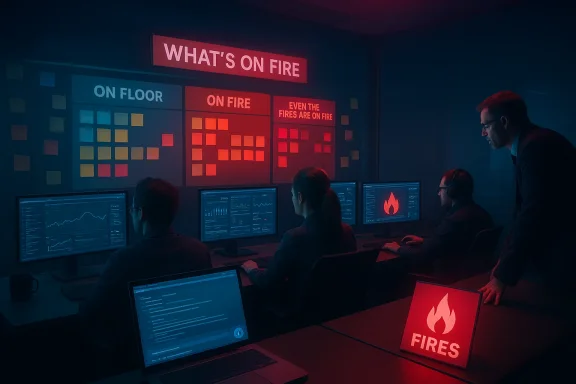
In the engineer’s account, internal language created a graded severity model:- “On the floor” — build or release infrastructure problems; likely isolated to CI/CD or packaging.
- “On fire” — a production‑grade crisis inside a branch or component; requires cross‑team firefighting and rapid fixes.
- “Even the fires are on fire” — meta escalation: firefighting processes themselves are overloaded and failing.
Formalizing the chaos: “What’s on Fire” meetings
To coordinate response to ongoing incidents, teams ran recurring “What’s on Fire” meetings that functioned as rapid status briefs. These weren’t ceremonial; they served as a central point to assign responsibilities, share telemetry, and decide containment actions. The existence of recurring, named meetings devoted to active incidents is a clear organizational choice: accept thappen and build dedicated structures for them.Why this matters now: the AI pivot, demos, and optics
Agentic OS, Copilot, and the stakes of public failure
Microsoft has been explicit about a strategic pivot toward system‑level AI: agentic capabilities inside Windows, deeper Copilot integration, and a new class of hardware called Copilot+ PCs that prioritize on‑device NPU power. Those moves raise both tremendous potential and enormous public scrutiny. A string of visible demo missteps — official promotional videos where Copilot offered incorrect guidance, or early hands‑on previews that produced brittle outputs — turned marketing moments into credibility problems. The cultural shorthand of “fires” is relevant here because these incidents require cross‑functional response from UI, AI, telemetry, and legal teams, odia and customer pressure.Analogies in the broader AI industry: OpenAI’s “code red”
The industry is no stranger to emergency rhetoric. OpenAI’s leadership publicly acknowledged periodic “code red” declarations — concentrated, company‑wide reallocations of engineering resources in response to competitive pressure (notably Google’s Gemini 3 and other rivals). Those moves have practical effects: pausing peripheral projects, accelerating core model quality work, and concentrating incident response at scale. The pattern is recognizably similar to Microsoft’s own triage rituals: rapid, public-facing emergencies that force prioritization trade‑offs. Multiple outlets reported that OpenAI moved into a “code red” mode and shipped GPT‑5.2 as part of that reprioritization.Verifying the technical claims
Copilot+ NPU guidance: the 40+ TOPS figure
One concrete technical number frequently cited in documentation and reporting is Microsoft’s guidance that Copilot+ PCs should include an NPU capable of 40+ TOPS (trillions of operations per second). This figure appears in official Microsoft product and developer materials and is repeated in independent coverage of Copilot+ hardware. The 40+ TOPS threshold is presented as a performance baseline for delivering the smoothest on‑device AI experiences (low‑latency voice, vision, and agentic actions). Independent outlets and Microsoft’s developer pages confirm the number. That’s a high‑level engineering spec — useful as a policy and procurement guideline — but real‑world performance will vary by workload, quantization, and runtime optimizations.GPT‑5.2 and the timing of “code red”
Reports that OpenAI shipped GPT‑5.2 in December 2025 as part of a concentrated “code red” effort have been widely circulated and corroborated by multiple sources. Those accounts describe the company pausing some feature experiments and refocusing staff to improve latency, reliability, and factual grounding — tactical steps that match the operational pattern described by Microsoft engineers for urgent incidents. Treat these timing claims as well‑reported but note that internal memos and their exact wording are typically not public; journalists reconstruct the intent and directives from sources.Strengths exposed by “chaos vocabulary”
Rapid escalation and focused attention
When a problem is immediately recognized and labeled — and when the label is understood across teams — response time shrinks. A “Fires” channel plus regular triage meetings concentrate decision rights and visibility and can prevent issues from lingering unnoticed. That capability is essential when software components are tightly coupled and failures cascade quickly.Shared situational awareness
Short phrases like “on fire” are a cultural shorthand that encodes assumptions about severity and required actions. That reduces ambiguity: an engineer on call knows what to do without receiving a long email thread. Ritualized practices (channels, meeting cadences, war rooms) institutionalize this awareness and make it repeatable across organizational changes.Incentive to fix root causes
When incidents become visible to leadership and peers, there’s poddress foundational problems — stronger test rigs, stricter staging, and more robust deployment gating (all lessons Microsoft incorporated after high‑profile demo failures). That pressure can accelerate engineering investment in reliability and observability.Risks and downsides
Reactive culture and opportunity cost
Frequent fires redirect engineering talent away from long‑term projects and cause organizations to prioritize immediate containment over sustainable design. The pattern of repeated “code red” cycles — whether inside OpenAI, Microsoft, or elsewhere — can produce a treadmill where tactical gains come at the expense of foundational work. Observers and reporting warn that doing this too often risks technical debt, missed monetization opportunities, and strategic incoherence.Burnout and morale hazards
There’s an emotional and physical cost to operating in an always‑on firefighting mode. Engineers subjected to consecutive high‑intensity sprints report exhaustion, reduced deep work time, and attrition. Cultural shorthand that normalizes crises (“we’re always on fire”) can mask structural problems and make it harder to recognize when processes — not people — are the real issue. Journalistic analysis of “code red” cycles cautions that these modes, while occasionally necessary, should not be the default operating rhythm.lic failures have outsized reputational consequences when the company is simultaneously marketing a new paradigm (an “agentic OS” or generative AI integrations). A flawed demo or a privacy scare can erode trust far faster than an internal incident would, and the media cycle amplifies those effects. Microsoft’s visible Copilot missteps underscore how internal firefighting must link with clearer customer communication and more conservative demo design.
Governance, safety, and privacy trade‑offs
Rerouting teams to address immediate product regressions sometimes compresses safety review cycles and telemetry audits. With agentic features that can read screens or act on users’ behalf, short‑circuiting governance processes is particularly risky. That’s why independent verification, transparent permissioning, and staged rollouts with strict opt‑in defaults matter more than ever. Coverage of industry “code red” moves highlights this tension: speed versus thoroughness.What’s verifiable and what isn’t
- Verifiable: Microsoft’s Copilot+ hardware guidance specifying a 40+ TOPS NPU baseline is published on Microsoft pages and reproduced in developer documentation; independent tech outlets corroborate that guidance.
- Verifiable: Multiple outlets reported that OpenAI declared a “code red” in late 2025 and that GPT‑5.2 shipped in early December; OpenAI executives have spokated emergency sprints. Those claims have cross‑ outlet corroboration.
- Less verifiable: The exact wording of internal memos, the detailed content of executive posts in internal Teams channels, and some anonymous internal quotes reproduced by journalists are inherently second‑hand. Treat reconstructions of internal messages as credible patterns but not verbatim primary documents unless published by the company. When reporting cites internal emails or unnamed staff, that material is useful context — but it should be flagged as contingent on source reliability.
Practical recommendations — for Microsoft, product teams, and IT leaders
- Prioritize transparent communication. When incidents hit public channels, a short, factual acknowledgment with timelines reduces speculation and preserves trust.
- Institutionalize a blameless postmortem rhythm. After each major “fire,” require documented root‑cause analyses and visible remediation plans to prevent repeated crises.
- Use staged rollouts and opt‑in defaults for agentic features. Give users control and clear privacy settings before promoting initiative‑taking agents widely.
- Safeguard safety cycles during emergency pivots. If engineering bandwidth is redirected, protect a safety and governance team that remains insulated from tactical switching.
- Invest in observability and canarying. Better telemetry and progressive delivery reduce the number of catastrophic failures that make it to broad release.
- Monitor and mitigate burnout. Rotate teams out of on‑call sprints, fund reinforcements, and publicize recovery plans to maintain morale.
Cultural diagnosis: what the jargon reveals about Microsoft — and modern tech companies
Microsoft’s “fire” vocabulary shows a company that learns fast and institutionalizes lessons: staging rooms after demo failures, channels for real‑time escalation, and meetings dedicated to ongoing incidents. Those are adaptive responses to complex engineering realities. At the same time, the volume of these practices signals persistent instability: product launches and demos continue to stretch reliability boundaries, and marketing narratives sometimes outrun polish.That tension — innovation versus reliability — is not unique to Microsoft. Tech companies operating at the frontier of AI face similar trade‑offs. The difference lies in governance, customer communication, and a willingness to frontload reliability work instead of repeatedly bailing out failures under the glare of public scrutiny. When the words “on fire” and “code red” become common parlance, it’s a sign that the organization depends on frenetic triage as a strategy rather than on systemic resilience as a property.
Final take
The colorful phrases that circulated inside Microsoft — “on fire,” “even the fires are on fire,” “What’s on Fire Meetings” — are more than internal humor. They are a pragmatic lexicon for rapid triage in a company managing an increasingly complex product stack and an AI‑driven strategic pivot. The language makes urgent problems legible and routable but also reveals how often the company finds itself in urgent mode.The record shows this approach can produce rapid responses and meaningful fixes: stricter staging rooms and improved test protocols grew out of painful demos, and a dedicated “Fires” channel can save minutes that matter during a cascading outage. But there’s a cost. Frequent emergency modes, whether at Microsoft or OpenAI, risk burning out engineers, compressing safety cycles, and eroding customer trust — especially when high‑visibility AI features are at stake.
If the goal is sustainable speed, companies must convert firefighting rituals into durable engineering practices: better observability, conservative public demos, opt‑in agentic features, and protected governance lanes. That’s how “on fire” stops being the default state and becomes, instead, the exception it should be.
Source: Windows Central At Microsoft, “on fire” doesn’t mean you’re crushing it. It means chaos.
