

Mustafa Suleyman’s plainspoken stewardship of Microsoft’s AI effort feels, at once, like an act of corporate damage control and a strategic masterstroke: while Copilot — Microsoft’s flagship assistant across Windows and Microsoft 365 — struggles to shake off skepticism, Suleyman is steadily converting credibility into traction by speaking plainly about what AI can and cannot do, by building pragmatic product pipelines, and by reframing safety as a feature rather than an afterthought. The result is a rare combination in Big Tech today: a visible AI leader who calms anxieties without shrinking ambition, and who is shaping Microsoft’s AI story in ways the marketing machine around Copilot has repeatedly failed to do.
But scale is not the only currency. Value in knowledge work comes from depth — accurate connectors, tightly scoped automation, auditability, and predictable outcomes. Without those, Copilot becomes an interesting experiment rather than a business process optimization tool.
This matters for two reasons. First, the technology is increasingly central to how companies work; if Microsoft can combine scale, auditability and conservative defaults, it will unlock enterprise value at volume. Second, public trust — once lost — is hard to regain. Suleyman’s human, candid approach reduces the friction that marketing hyperbole and product misfires create, giving Microsoft a chance to convert curiosity into durable adoption.
The contrast is striking: Copilot’s marketing often reads like a manifesto; Suleyman’s commentary reads like a roadmap. If Microsoft couples that roadmap with conservative product defaults, transparent metrics, and a relentless focus on the high‑value scenarios that enterprises need to automate, it will convert the current skepticism into sustained adoption. If it does not, the company risks the familiar pattern of hype, disappointment, and erosion of trust.
For now, Suleyman is doing the leadership work Copilot’s branding cannot — and that, more than any headline figure, explains why he is increasingly seen as Microsoft’s most valuable AI asset.
Source: Thurrott.com Microsoft AI Chief Succeeds Where Copilot Does Not
 Background
From DeepMind to Microsoft AI
Mustafa Suleyman arrived at Microsoft after high‑visibility stints as a DeepMind co‑founder and later as a founder of Inflection AI. His hire signaled more than a personnel move; it was a bet that the company needed a product-minded, safety‑focused leader to shepherd an ambitious push to embed AI across Windows, Office, Edge and consumer services. Under Suleyman, Microsoft organized a dedicated Microsoft AI (MAI) organization and began building first‑party models under the MAI brand, while still working closely with partners when it made sense.Copilot: promise, placement, and perception
Copilot is now baked into dozens of Microsoft surfaces — Windows, Edge, Teams, Office, GitHub and standalone mobile/web apps. The marketing narrative pitching Copilot as an always‑available assistant, a workflow accelerator, and an agentic companion has been relentless. But real‑world experience and enterprise pilots have repeatedly exposed a gap between ad scripts and practical reliability: inconsistent multimodal performance, governance worries, and sticky deployment costs have made Copilot a polarizing product rather than a universally loved upgrade.Where Suleyman Succeeds: Credibility, Clarity, and Concessions
Plainspoken leadership as a product advantage
One of Suleyman’s most valuable traits is rhetorical: he speaks like a product leader rather than a PR machine. He publicly acknowledges limitations — hallucinations, tooling immaturity, the need for conservatism in safety design — and frames those admissions as operational priorities rather than apologies. That — more than any splashy demo — is what builds trust with engineers, partners, and enterprise buyers.- He frames safety as a design constraint: public commitments to stop or pause development if systems reach uncontrollable risk thresholds make safety tangible, not rhetorical.
- He tolerates nuance: Suleyman avoids the extreme optimism of some marketing and the apocalyptic framing of some critics, which positions him as a reassuring realist.
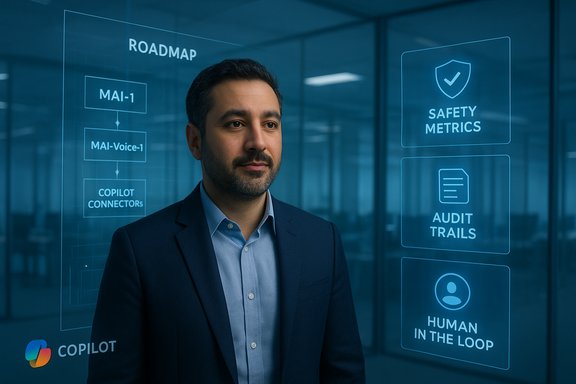
- He treats governance as product work: by articulating containment, auditability, and human‑in‑the‑loop defaults, he turns policy into engineering specs.
Bringing humanist design to consumer AI
Under Suleyman, Microsoft has repeatedly foregrounded a “humanist” approach: assistants that are helpful, auditable, opt‑in, and not designed to impersonate sentient companions. That design posture influences both product choices (opt‑in memory, explicit deletion controls, curated conversational modes) and marketing, and appeals to parents, educators, regulated industries, and IT leaders who have been wary of more sensational assistant designs.Tactical product moves that restore optionality
Suleyman’s team has moved to reduce Microsoft’s operational dependence on external frontier models by launching MAI models — efficient, in‑house text, voice and image models designed to power consumer Copilot experiences where cost, latency, and governance matter. This approach gives Microsoft the flexibility to route certain workloads to in‑house models and others to partner models, preserving choice and improving control.Where Copilot Stumbles: Product, Trust, and Value Realization
The perception gap: ads versus reality
Copilot’s demos have often promised fluid agentic behavior — doing multi‑step tasks, reasoning across apps, or reliably understanding video and images. Independent hands‑on testing and enterprise pilots have found those scenarios brittle. In short, many Copilot ad moments translate poorly into the messy, noisy real world where documents are incomplete, video frames are low‑quality, and corporate data governance is stringent.Adoption and ROI friction
The hard truth for IT leaders is that early pilots often fail to scale. While Microsoft reports large headline user numbers for “Copilot apps” and many AI‑enabled feature engagements across its product family, adoption at the enterprise scale is frequently constrained by governance concerns and measurable ROI gaps. Organizations routinely report pilots, not full rollouts, and many CIOs still struggle to justify per‑seat Copilot pricing without clear productivity metrics.- Common enterprise barriers:
- Data governance and risk of oversharing
- Lack of reproducible ROI or KPIs
- Elevated change management and onboarding overhead
- Concerns about agent sprawl and unexpected costs
Reliability, hallucinations, and the human verification problem
Hallucinations and inconsistent outputs are not just PR issues — they’re operational hazards for legal, financial, and healthcare workflows. Copilot’s value relies on trust. If outputs can’t be reliably traced and verified, the assistant becomes a source of risk rather than a productivity multiplier.The Business Reality: Scale Versus Depth
Microsoft’s impressive scale — and what it actually buys
Microsoft now operates at extraordinary scale for AI: massive cloud investments, new in‑house models, and a product footprint that touches billions of endpoints. These are real assets: lower latency, cheaper inference for high‑volume surfaces, and better integration with enterprise compliance stacks.But scale is not the only currency. Value in knowledge work comes from depth — accurate connectors, tightly scoped automation, auditability, and predictable outcomes. Without those, Copilot becomes an interesting experiment rather than a business process optimization tool.
Why pilot momentum doesn’t always turn into rollouts
Enterprises typically succeed when they:- Scope Copilot to well‑measured, repeatable tasks (e.g., standardized reporting, contract summarization).
- Lock down connectors, data flow, and audit trails.
- Institute sign‑off processes where Copilot suggestions are human‑verified for compliance‑sensitive outputs.
Safety as Strategy: The Public Pledge and Its Consequences
A clear safety posture
Suleyman has been explicit that Microsoft will halt development of systems that “have the potential to run away from us.” Whether or not one accepts the premise that such systems are imminent, the pledge matters for three reasons:- It differentiates Microsoft in a crowded market where aggressive capability races can look tone‑deaf.
- It obligates engineering teams to build in auditability, containment, and human‑in‑the‑loop pathways.
- It reduces reputational risk: when the company ties capability roadmaps to measurable safety criteria, regulators and enterprise customers can better trust product narratives.
Tradeoffs: safety slows but also unlocks adoption
Designing for safety imposes constraints that can delay deployable features. But for many customers — hospitals, schools, banks — those constraints are non‑negotiable requirements for adoption. The net effect is likely to be slower feature rollouts but deeper enterprise penetration where evidence of safety and auditability is filed.Technical Moves That Matter
MAI models: independence without isolation
Microsoft’s MAI‑1‑preview, MAI‑Voice‑1 and subsequent MAI‑Image‑1 builds are important technical choices. They’re aimed at being efficient — trained with design choices that reduce wasted compute — and at delivering features where Microsoft controls data and telemetry.- Benefits:
- Lower inference latency for on‑device and near‑edge scenarios.
- Better enterprise data governance and tenant isolation.
- Price efficiency for very high‑volume consumer features (voice, daily briefings, image generation).
- Limitations:
- In‑house models will likely lag the most cutting‑edge frontier models in raw capability initially.
- Maintaining multiple model families increases engineering complexity and verification burden.
Agent plumbing and on‑device inference
Microsoft’s push toward an “agentic OS” — Copilot baked into the shell with agent connectors and Copilot+ PCs — is ambitious. When implemented with conservative defaults and strong admin controls, it can offer real automation value; if shipped with aggressive opt‑ins or opaque telemetry, it will amplify trust erosion.Critical Analysis: Strengths, Weaknesses, and Strategic Risk
Strengths
- Leadership credibility: Suleyman’s candid tone and product focus have restored trust inside and outside the company.
- Operational control: Building MAI models and diversifying inference stacks gives Microsoft leverage over latency, costs, and governance.
- Safety framing: Public safety commitments and an emphasis on explainability are market differentiators in a trust‑sensitive enterprise segment.
Weaknesses and risks
- Product perception gap: Repeated high‑visibility demos followed by inconsistent live behavior creates cynicism that marketing alone cannot fix.
- Complexity of choice: Supporting both in‑house MAI models and partner models, plus agent APIs and on‑device workloads, multiplies verification, telemetry, and support demands.
- Economic calculus: Customers and IT leaders want clear ROI and measurable KPIs. If Copilot’s perceived value doesn’t scale to pricing, churn or limited adoption will persist.
- Regulatory exposure: The more agentic Windows becomes, the more Microsoft will be a regulatory target. Consent mechanics, data residency, and audit logs will be litigated policy areas.
Pragmatic tactical risks
- Shipping defaults that are opt‑out rather than opt‑in will provoke user backlash and escalate regulatory scrutiny.
- Failing to publish reproducible benchmarks and transparent accuracy metrics will leave IT teams unable to justify upgrades.
- Overpromising features (agentic autonomy, flawless multimodal understanding) risks repeating earlier cycles of hype and disappointment.
Practical Recommendations
For Microsoft (product + policy)
- Make conservative defaults the default: opt‑in memory, agent actions gated by IT policy, and explicit consent flows for multimodal data.
- Publish reproducible success metrics: scenario‑based accuracy rates, latency stats, and audit logs with reproducible test decks.
- Invest in verification tooling: tenant‑scoped provenance, signed audit trails, and SIEM‑friendly connectors.
- Prioritize predictable, measurable wins: focus on a few high‑ROI enterprise scenarios (e.g., contract review, regulatory reporting) where product can be tuned and audited.
For IT leaders and admins
- Pilot with narrow, measurable objectives: pick one high‑frequency task, define KPIs, and require human validation for any action that affects compliance.
- Lock connectors: define strict policies for data sources Copilot can access and limit agent creation to privileged teams.
- Build governance into procurement: require vendors to expose model provenance, audit formats, and red‑team results as part of contracting.
- Treat Copilot as a workflow tool, not a magician: assume outputs require verification until proven otherwise.
For Windows and power users
- Use staged rollouts: test Copilot features on non‑critical systems and monitor for regressions.
- Favor transparent settings: choose modes that show sources and provide deletion/inspection tools for saved context.
- Push for clarity: demand clear opt‑in/opt‑out choices and plain‑language explanations of what Copilot stores and why.
The Big Picture: Why Suleyman Matters More Than a Single Product
Mustafa Suleyman offers Microsoft an approach that blends the humility of engineering realism with the scale and urgency of product ambition. That combination is rare in an industry polarized between relentless hype and populist alarmism. By pushing for in‑house control where it matters, and by making safety and explainability non‑negotiable design goals, Suleyman reframes Microsoft’s AI roadmap from “feature chase” to “product stewardship.”This matters for two reasons. First, the technology is increasingly central to how companies work; if Microsoft can combine scale, auditability and conservative defaults, it will unlock enterprise value at volume. Second, public trust — once lost — is hard to regain. Suleyman’s human, candid approach reduces the friction that marketing hyperbole and product misfires create, giving Microsoft a chance to convert curiosity into durable adoption.
Conclusion
Copilot is a product caught between aspiration and operational reality: it promises a future of agentic assistants but will only earn that future by delivering reliable, auditable, and measurable outcomes today. Mustafa Suleyman’s leadership addresses precisely that gap. His blunt talk about limits and safety, his focus on building controllable in‑house capabilities, and his insistence on governance as product all point toward a pragmatic path forward.The contrast is striking: Copilot’s marketing often reads like a manifesto; Suleyman’s commentary reads like a roadmap. If Microsoft couples that roadmap with conservative product defaults, transparent metrics, and a relentless focus on the high‑value scenarios that enterprises need to automate, it will convert the current skepticism into sustained adoption. If it does not, the company risks the familiar pattern of hype, disappointment, and erosion of trust.
For now, Suleyman is doing the leadership work Copilot’s branding cannot — and that, more than any headline figure, explains why he is increasingly seen as Microsoft’s most valuable AI asset.
Source: Thurrott.com Microsoft AI Chief Succeeds Where Copilot Does Not
