

Microsoft UK’s “Beyond the Badge” spotlight on Kwadwo Benko lands at exactly the moment when AI skilling has shifted from a nice-to-have to a national priority. In his case, the story is bigger than one workshop or one community hall in South East London: it is a case study in how Copilot confidence can travel through churches, classrooms, and workplaces when it is taught in plain language and grounded in real life. It also shows why community-led digital inclusion matters as much as headline-grabbing infrastructure, because the people most likely to benefit from AI are often the people least likely to feel invited into it.
The UK has spent the past year accelerating its AI-skills agenda, and Microsoft has been a visible part of that push. Government and industry have framed the challenge in stark terms: millions of workers are expected to use AI in their day-to-day roles over the coming decade, and the country wants to close the skills gap before it becomes a drag on productivity and social mobility. The current AI Skills Boost effort is explicitly designed to reach 10 million workers by 2030, with Microsoft named among the founding partners and the company saying it has already trained more than 1.5 million people in AI skills in the UK over the past year.
That broader policy context is important, because it explains why Kojo’s work resonates beyond the walls of his church. Large-scale national programs can set the ambition, but they do not automatically generate trust, relevance, or local participation. A workshop in a familiar community setting can do something a corporate webinar often cannot: it can make AI feel usable, safe, and personally valuable to people who have been taught to see technology as something for someone else. This is where the “Beyond the Badge” series becomes more than employee storytelling and turns into a practical model for outreach.
Microsoft’s own UK skilling messaging has been consistent on one point: AI adoption is not only about tools, but about human capability. The company’s public UK digital skills pages emphasize scaling access to AI learning while also helping people understand how to apply those skills in work and daily life. In that sense, Kojo’s community session is not a side project; it is a micro-version of a much larger strategy that pairs product adoption with capability-building.
There is also a social dimension that deserves attention. Kojo’s mission to skill 100,000 Black people in Copilot and AI skills reflects a reality that many technology programs still struggle with: access is not the same as adoption, and adoption is not the same as empowerment. Communities can have licenses, logins, and even employer access to tools while still lacking the confidence to use them meaningfully. That gap is where local champions matter most, especially when they come from the same communities they are serving.
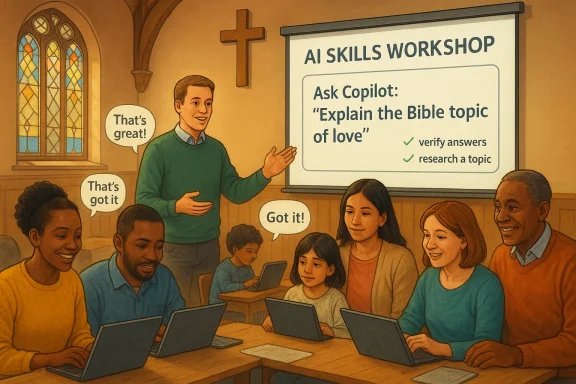
His workshop at the South East London Community Seventh-day Adventist Church was designed as a full-circle return to a place that shaped him. That emotional dimension is not cosmetic; it is part of the educational method. People tend to learn more readily from teachers who understand their context, and Kojo tailored the session around the lived realities of the room: Ghanaian immigrants, students, working parents, and church members with access to Copilot through employers but little confidence in using it. This is the kind of audience that often gets left behind by generic “AI for everyone” messaging.
He started with the basics: what AI is, what it is not, and how to use Copilot responsibly. That grounding is essential because many first-time users approach AI with a mix of curiosity and anxiety. Some fear they will use it incorrectly, while others worry it will produce bad information or make them seem less capable. Kojo’s workshop tried to lower the stakes by turning AI into a practical assistant rather than a mysterious authority. That distinction is crucial in building genuine confidence.
The workshop’s turning point came when participants used Copilot in a live challenge to research a Bible topic and present findings to the congregation. The format was clever because it turned abstract digital literacy into a shared, low-pressure activity. More importantly, it created a moment where participants could see that AI was not just a corporate productivity tool but a way to support learning, discussion, and community participation. The questions that followed were practical, not theatrical, which suggests the room moved from skepticism to curiosity quite quickly.
He also introduced a repeatable prompt structure designed for beginners. That may sound small, but prompt literacy is the gateway skill that determines whether AI feels chaotic or controllable. A well-taught beginner prompt framework can transform Copilot from a novelty into a dependable assistant, especially for users who are unfamiliar with how to ask for summaries, revisions, plans, or explanations. Small wins are the real engine of adoption here.
A few practical lessons stand out from the format:
The choice to include a Bible topic challenge also deserves attention. It linked AI use to a community activity that was already meaningful, which helped participants see Copilot as a support tool rather than a replacement for human judgment. That is a healthier framing than the hype-heavy versions of AI training that promise transformation without context.
This matters especially for workers and students who already feel stretched. Many people do not need another platform; they need a way to start tasks faster, organize information better, and reduce the mental burden of everyday work. Copilot’s appeal in those settings is not that it is magical, but that it can make routine work feel less punishing and more manageable. That makes adoption more likely among people who might otherwise dismiss AI as irrelevant or intimidating.
That broad framing has important implications:
The workshop also surfaced an important trust issue: people wanted to know how to use AI without making mistakes. That is the right question. It shows that users are already thinking about accuracy, responsibility, and verification rather than simply outsourcing judgment to the machine. Training that invites those concerns is more credible than training that pretends they do not exist.
The article emphasizes that Kojo navigated technology largely on his own while growing up. That detail helps explain why he sees the current gap so clearly. He knows what it feels like to figure things out without much support, and he also knows how much stress people carry when they are expected to do digital work with minimal guidance. This kind of first-hand understanding is what allows a trainer to connect pedagogy to dignity.
The emotional power of that return should not be underestimated. People who are used to being talked at often respond differently when they are being served by one of their own. The lesson, then, is not only about AI. It is about how institutions can cultivate people who later return with tools, knowledge, and confidence.
This is also why culturally fluent skilling programs matter. A workshop that understands the rhythms of a church community, the pressures on parents, the concerns of immigrants, and the anxieties of students can be more effective than a one-size-fits-all session. Relevance is a form of respect.
That alignment is not accidental. If AI becomes an everyday tool in office environments, education, and public services, then skilling becomes a strategic necessity rather than a corporate perk. Microsoft can point to training milestones, while policymakers can point to workforce readiness. In that sense, the company’s community stories are not merely feel-good content; they are evidence of how the skilling agenda is being operationalized at ground level.
That overlap is why community workshops have strategic value. They expand the funnel of comfortable users, not just licensed users. In practice, that can mean better adoption, lower support friction, and more credible word-of-mouth inside organizations.
Microsoft’s broader public-facing skilling material in the UK also reinforces the notion that AI training should be practical, accessible, and widely distributed. Kojo’s story is simply the most human-sized version of that ambition. It shows what it looks like when someone translates a national objective into a Saturday afternoon with real people and real tasks.
What Kojo adds to that policy debate is specificity. National targets are necessary, but they are often too abstract to tell us how skills actually spread. Community champions provide the missing mechanism. They show how the promise of broad AI access becomes something tangible: a prompt, a demo, a conversation, and a repeatable habit.
Kojo’s work suggests a sequence that policymakers and employers should study:
There is also a broader civic point here. AI adoption will feel fairer if people see that it is being introduced through institutions they already trust. Churches, schools, and community groups can do more than host events; they can legitimize a new technology by placing it inside familiar social structures. That is a powerful corrective to the idea that AI only belongs in boardrooms and labs.
That is why Kojo’s workshop emphasized small wins. Once people see that AI can help them write an email, summarize notes, or structure a task, the tool becomes less intimidating. Those early successes matter because they create the emotional and cognitive conditions for repeated use. The aim is not to wow people; it is to normalize the tool.
A further lesson is that responsible AI education should be iterative. One workshop is useful, but it is not enough to create durable fluency. Kojo’s plan to offer practical clinics where people bring real tasks to solve is a stronger model because it reinforces usage in context. The move from demonstration to coaching is where real transformation begins.
Finally, the broader policy narrative around AI skills can sometimes flatten differences between groups. Not every audience needs the same training, and not every community has the same starting point. One-size-fits-all skilling can miss the people who most need tailored support. Kojo’s story works precisely because it avoids that trap.
The real test will be whether this model can survive beyond the novelty of a first workshop. Sustainable community skilling needs continuity, measurable outcomes, and enough local champions to keep momentum alive. It also needs employers and institutions willing to treat AI training as a shared civic investment rather than a narrow HR program.
In the end, this is what makes the story compelling: it argues that the future of AI adoption will not be decided only by model capabilities or corporate strategy, but by whether ordinary people can see themselves in the technology and trust it enough to use it well. Kojo Benko’s work suggests that when training is human, local, and practical, digital confidence becomes more than a slogan. It becomes a community asset.
Source: Microsoft UK Stories 'Bringing digital confidence to the community that raised me'
 Background
The UK has spent the past year accelerating its AI-skills agenda, and Microsoft has been a visible part of that push. Government and industry have framed the challenge in stark terms: millions of workers are expected to use AI in their day-to-day roles over the coming decade, and the country wants to close the skills gap before it becomes a drag on productivity and social mobility. The current AI Skills Boost effort is explicitly designed to reach 10 million workers by 2030, with Microsoft named among the founding partners and the company saying it has already trained more than 1.5 million people in AI skills in the UK over the past year.That broader policy context is important, because it explains why Kojo’s work resonates beyond the walls of his church. Large-scale national programs can set the ambition, but they do not automatically generate trust, relevance, or local participation. A workshop in a familiar community setting can do something a corporate webinar often cannot: it can make AI feel usable, safe, and personally valuable to people who have been taught to see technology as something for someone else. This is where the “Beyond the Badge” series becomes more than employee storytelling and turns into a practical model for outreach.
Microsoft’s own UK skilling messaging has been consistent on one point: AI adoption is not only about tools, but about human capability. The company’s public UK digital skills pages emphasize scaling access to AI learning while also helping people understand how to apply those skills in work and daily life. In that sense, Kojo’s community session is not a side project; it is a micro-version of a much larger strategy that pairs product adoption with capability-building.
There is also a social dimension that deserves attention. Kojo’s mission to skill 100,000 Black people in Copilot and AI skills reflects a reality that many technology programs still struggle with: access is not the same as adoption, and adoption is not the same as empowerment. Communities can have licenses, logins, and even employer access to tools while still lacking the confidence to use them meaningfully. That gap is where local champions matter most, especially when they come from the same communities they are serving.
Why this story matters now
The timing matters because AI has moved from experimental curiosity to workplace expectation. Employers are increasingly assuming that staff can draft, summarize, search, and plan with AI assistance, even if no one has formally trained them to do so. That creates a risk of a silent divide between people who have learned to use tools well and people who are merely expected to keep up.- AI confidence is now a workplace skill, not a niche hobby.
- Local trust often determines whether training is adopted or ignored.
- Plain-language teaching can reduce fear faster than technical explanation.
- Community settings can make AI feel relevant to real obligations.
Overview
Kojo Benko, a Copilot Solution Engineer at Microsoft UK, frames his work around a simple conviction: digital empowerment is independence. That line matters because it places AI skills in the broader language of agency, opportunity, and community resilience rather than efficiency alone. When people can write better emails, prepare for interviews, revise for exams, and organize their schedules, they gain leverage over parts of life that once felt overwhelming.His workshop at the South East London Community Seventh-day Adventist Church was designed as a full-circle return to a place that shaped him. That emotional dimension is not cosmetic; it is part of the educational method. People tend to learn more readily from teachers who understand their context, and Kojo tailored the session around the lived realities of the room: Ghanaian immigrants, students, working parents, and church members with access to Copilot through employers but little confidence in using it. This is the kind of audience that often gets left behind by generic “AI for everyone” messaging.
He started with the basics: what AI is, what it is not, and how to use Copilot responsibly. That grounding is essential because many first-time users approach AI with a mix of curiosity and anxiety. Some fear they will use it incorrectly, while others worry it will produce bad information or make them seem less capable. Kojo’s workshop tried to lower the stakes by turning AI into a practical assistant rather than a mysterious authority. That distinction is crucial in building genuine confidence.
The workshop’s turning point came when participants used Copilot in a live challenge to research a Bible topic and present findings to the congregation. The format was clever because it turned abstract digital literacy into a shared, low-pressure activity. More importantly, it created a moment where participants could see that AI was not just a corporate productivity tool but a way to support learning, discussion, and community participation. The questions that followed were practical, not theatrical, which suggests the room moved from skepticism to curiosity quite quickly.
The local trust advantage
One of the strongest features of Kojo’s model is that he did not approach the community as an outside expert delivering a lecture. He returned as someone whose family history, church history, and personal history were intertwined with the audience. That matters because trust is often the scarcest ingredient in digital transformation.- Familiar settings reduce intimidation.
- Shared identity can increase participation.
- Practical examples make abstract tools concrete.
- Live demos can collapse the distance between “I’ve heard of it” and “I can do this.”
The Community Workshop Model
The workshop structure itself reveals a lot about what effective AI education looks like in 2026. Kojo did not lead with jargon, product architecture, or a parade of features. Instead, he started with use cases that were ordinary, urgent, and recognizable: late-night emails, exam pressure, family calendars, and job applications. That choice is smart because it aligns the lesson with immediate utility, which is often what converts interest into practice.He also introduced a repeatable prompt structure designed for beginners. That may sound small, but prompt literacy is the gateway skill that determines whether AI feels chaotic or controllable. A well-taught beginner prompt framework can transform Copilot from a novelty into a dependable assistant, especially for users who are unfamiliar with how to ask for summaries, revisions, plans, or explanations. Small wins are the real engine of adoption here.
How the session was built
The value of the workshop lay partly in sequencing. Kojo first explained AI in general terms, then distinguished Copilot from other tools, and only afterward moved into hands-on tasks. That order matters because beginners need a mental model before they need feature lists. Once they understand what the tool is for, they are far more likely to use it well.A few practical lessons stand out from the format:
- Start with daily tasks, not future fantasies.
- Teach a few prompts that can be used immediately.
- Use one live challenge to create momentum.
- Keep the room safe enough for honest questions.
- Leave people with a repeatable habit, not just inspiration.
The choice to include a Bible topic challenge also deserves attention. It linked AI use to a community activity that was already meaningful, which helped participants see Copilot as a support tool rather than a replacement for human judgment. That is a healthier framing than the hype-heavy versions of AI training that promise transformation without context.
- Practical relevance beats abstract enthusiasm.
- Community tasks create emotional buy-in.
- Hands-on practice increases retention.
- Shared purpose lowers fear.
Copilot as a Confidence Tool
Kojo’s story is ultimately about confidence, not software. The article repeatedly returns to the idea that people were not chasing hype; they were chasing clarity and capability. That is a useful phrase because it describes the difference between passive exposure to AI and active competence with it. Microsoft Copilot, in this framing, becomes a confidence tool that helps users produce better outcomes without requiring them to become technologists.This matters especially for workers and students who already feel stretched. Many people do not need another platform; they need a way to start tasks faster, organize information better, and reduce the mental burden of everyday work. Copilot’s appeal in those settings is not that it is magical, but that it can make routine work feel less punishing and more manageable. That makes adoption more likely among people who might otherwise dismiss AI as irrelevant or intimidating.
Work, study, and ministry
Kojo’s workshop deliberately crossed domains because real life does too. A single participant might need help with work emails, school revision, and church administration in the same week. By showing how Copilot can support all three, he positioned AI as a general-purpose aid rather than a one-off productivity trick.That broad framing has important implications:
- For workers, Copilot can support drafting, summarizing, planning, and communication.
- For students, it can help with revision, structure, brainstorming, and clarity.
- For churches and community groups, it can help with admin, ministry planning, and content preparation.
The workshop also surfaced an important trust issue: people wanted to know how to use AI without making mistakes. That is the right question. It shows that users are already thinking about accuracy, responsibility, and verification rather than simply outsourcing judgment to the machine. Training that invites those concerns is more credible than training that pretends they do not exist.
Responsible use still matters
Kojo’s focus on responsible use is not a side note. It is central to any serious AI-skilling effort because confidence without discernment can become overconfidence. Users need to know that AI can be helpful, but not infallible.- Verify outputs before relying on them.
- Treat prompts as instructions, not truth claims.
- Use AI to draft and organize, not to surrender judgment.
- Match the tool to the task.
- Keep sensitive information out of prompts when appropriate.
Why Identity and Representation Matter
Kojo’s mission to skill 100,000 Black people is significant because representation changes what people imagine to be possible. In technology, who teaches often matters almost as much as what is taught. When a technologist from within the community says, “This is for you,” that message can carry more weight than a polished marketing campaign.The article emphasizes that Kojo navigated technology largely on his own while growing up. That detail helps explain why he sees the current gap so clearly. He knows what it feels like to figure things out without much support, and he also knows how much stress people carry when they are expected to do digital work with minimal guidance. This kind of first-hand understanding is what allows a trainer to connect pedagogy to dignity.
Community, memory, and service
Returning to the church that helped shape him gives this story a strong sense of continuity. He is not simply “giving back” in a generic way; he is honoring a social ecosystem that supported him and his family. That makes the workshop feel less like outreach and more like reciprocity.The emotional power of that return should not be underestimated. People who are used to being talked at often respond differently when they are being served by one of their own. The lesson, then, is not only about AI. It is about how institutions can cultivate people who later return with tools, knowledge, and confidence.
This is also why culturally fluent skilling programs matter. A workshop that understands the rhythms of a church community, the pressures on parents, the concerns of immigrants, and the anxieties of students can be more effective than a one-size-fits-all session. Relevance is a form of respect.
- Representation expands who feels invited.
- Shared experience increases receptivity.
- Community memory strengthens credibility.
- Cultural fluency improves teaching outcomes.
Microsoft’s Bigger UK Skilling Push
Kojo’s work sits inside a much larger corporate and public effort. Microsoft’s UK digital-skills messaging has repeatedly emphasized AI enablement, while government has framed AI skills as essential to productivity and opportunity. The two narratives reinforce each other: the state wants labor-market readiness, and Microsoft wants broad AI adoption anchored in its ecosystem and products.That alignment is not accidental. If AI becomes an everyday tool in office environments, education, and public services, then skilling becomes a strategic necessity rather than a corporate perk. Microsoft can point to training milestones, while policymakers can point to workforce readiness. In that sense, the company’s community stories are not merely feel-good content; they are evidence of how the skilling agenda is being operationalized at ground level.
Enterprise and consumer impact
The enterprise angle is obvious. Employers want workers who can use AI responsibly, and Copilot is increasingly being sold as a work accelerator that lives inside familiar Microsoft workflows. The consumer and community angle is equally important, though, because people rarely confine digital habits to one domain. A parent who learns to organize tasks with AI at home may also use the same discipline at work.That overlap is why community workshops have strategic value. They expand the funnel of comfortable users, not just licensed users. In practice, that can mean better adoption, lower support friction, and more credible word-of-mouth inside organizations.
Microsoft’s broader public-facing skilling material in the UK also reinforces the notion that AI training should be practical, accessible, and widely distributed. Kojo’s story is simply the most human-sized version of that ambition. It shows what it looks like when someone translates a national objective into a Saturday afternoon with real people and real tasks.
- Employers gain more capable staff.
- Individuals gain practical autonomy.
- Communities gain local champions.
- The skilling ecosystem gains trust.
The AI Skills Boost Context
The UK Government’s AI Skills Boost initiative gives Kojo’s mission a useful backdrop. It is meant to help bring AI literacy to 10 million people by 2030, and the participation of firms like Microsoft signals that AI skills are now a public-policy priority as much as a commercial one. The government has also argued that better AI adoption could unlock substantial economic value, making the skills agenda a direct part of the growth story.What Kojo adds to that policy debate is specificity. National targets are necessary, but they are often too abstract to tell us how skills actually spread. Community champions provide the missing mechanism. They show how the promise of broad AI access becomes something tangible: a prompt, a demo, a conversation, and a repeatable habit.
From policy to practice
The challenge with any national skilling initiative is translation. A policy announcement can set direction, but it cannot ensure relevance for every demographic or neighborhood. That is where local workshops become essential.Kojo’s work suggests a sequence that policymakers and employers should study:
- Set a clear ambition.
- Partner with trusted institutions.
- Train local advocates.
- Ground lessons in daily tasks.
- Measure progress by usage, not just attendance.
There is also a broader civic point here. AI adoption will feel fairer if people see that it is being introduced through institutions they already trust. Churches, schools, and community groups can do more than host events; they can legitimize a new technology by placing it inside familiar social structures. That is a powerful corrective to the idea that AI only belongs in boardrooms and labs.
- National targets need local delivery.
- Trusted messengers increase uptake.
- Practical tasks beat abstract lessons.
- Repeat exposure builds competence.
The Realities of AI Adoption
The article’s strongest insight may be its quiet recognition that fear, not access, is often the real barrier. Many participants reportedly already had access to Copilot through work, but they had not turned access into everyday utility. That pattern is common across technology adoption: a license is not the same as a habit, and availability is not the same as confidence. Adoption is a behavioral problem as much as a technical one.That is why Kojo’s workshop emphasized small wins. Once people see that AI can help them write an email, summarize notes, or structure a task, the tool becomes less intimidating. Those early successes matter because they create the emotional and cognitive conditions for repeated use. The aim is not to wow people; it is to normalize the tool.
Adoption barriers that matter
Several barriers are visible in this story:- Intimidation around AI jargon.
- Low trust in machine-generated answers.
- Uncertainty about where the tool fits into daily life.
- Lack of practice even among licensed users.
- Fear of looking inexperienced in front of colleagues or peers.
A further lesson is that responsible AI education should be iterative. One workshop is useful, but it is not enough to create durable fluency. Kojo’s plan to offer practical clinics where people bring real tasks to solve is a stronger model because it reinforces usage in context. The move from demonstration to coaching is where real transformation begins.
Strengths and Opportunities
Kojo Benko’s approach has several strengths that make it a model worth noticing, not just a nice story. It combines trust, relevance, and repeatability in a way that many larger training programs struggle to achieve. Just as importantly, it aligns personal purpose with a broader national AI-skills agenda, which gives it both emotional weight and strategic relevance.- Authenticity: Kojo’s connection to the community makes the message credible.
- Practicality: The workshop focuses on everyday tasks, not abstract AI theory.
- Scalability: The format can be adapted for churches, schools, and small businesses.
- Inclusivity: The mission addresses a specific community that often faces digital barriers.
- Momentum: A live challenge creates immediate engagement and memory.
- Alignment: The effort fits neatly within the UK’s broader AI skills drive.
- Repeatability: Simple prompts and hands-on clinics can be reused at scale.
Risks and Concerns
Even strong community skilling programs carry real risks, especially when AI is involved. The most obvious is overconfidence: people may start relying on outputs without enough verification, particularly if the tool makes tasks feel easier than they actually are. Another concern is that enthusiasm for Copilot could outpace a sober understanding of its limits, bias, and occasional errors.- Overreliance on AI-generated answers without checking.
- Hallucinations or inaccuracies that can mislead new users.
- Uneven access to devices, licenses, and connectivity.
- Training fatigue if sessions are one-off and not reinforced.
- Privacy concerns when users experiment without guidance.
- Digital exclusion if the most vulnerable community members still cannot participate.
- Expectation gaps if people think AI will solve problems it cannot solve.
Finally, the broader policy narrative around AI skills can sometimes flatten differences between groups. Not every audience needs the same training, and not every community has the same starting point. One-size-fits-all skilling can miss the people who most need tailored support. Kojo’s story works precisely because it avoids that trap.
Looking Ahead
Kojo’s next step is to expand workshops to other churches, schools, community groups, and small businesses across the UK. That is the right direction because it turns a single story into a repeatable operating model. If done well, it could help shift AI skills from a top-down initiative into a grassroots habit.The real test will be whether this model can survive beyond the novelty of a first workshop. Sustainable community skilling needs continuity, measurable outcomes, and enough local champions to keep momentum alive. It also needs employers and institutions willing to treat AI training as a shared civic investment rather than a narrow HR program.
What to watch next
- More community workshops beyond South East London.
- Expansion of Kojo’s themes into Copilot for Work, Copilot for Students, and Church Admin & Ministry.
- Practical clinic formats where people bring real tasks to solve.
- Other Microsoft employees adopting similar Beyond the Badge outreach.
- Evidence that participants continue using Copilot after the first session.
- Broader uptake of AI-skills programs in underrepresented communities.
- How Microsoft balances product promotion with genuinely community-led enablement.
In the end, this is what makes the story compelling: it argues that the future of AI adoption will not be decided only by model capabilities or corporate strategy, but by whether ordinary people can see themselves in the technology and trust it enough to use it well. Kojo Benko’s work suggests that when training is human, local, and practical, digital confidence becomes more than a slogan. It becomes a community asset.
Source: Microsoft UK Stories 'Bringing digital confidence to the community that raised me'
