

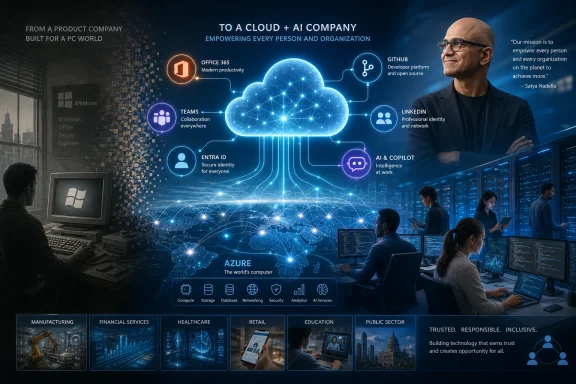
Satya Nadella became Microsoft’s chief executive on February 4, 2014, taking over from Steve Ballmer at a company still rich, still powerful, and still dangerously close to being defined by the computing era it had already won. His achievement was not that he made Microsoft successful; Microsoft already was. It was that he made Microsoft relevant again, by moving its center of gravity from Windows protectionism to cloud infrastructure, developer trust, enterprise software, and eventually artificial intelligence.
The Microsoft of early 2014 was not a failing company in the usual sense. Windows still sat at the center of the PC economy, Office remained the grammar of business productivity, and enterprise customers continued to write large checks. But the company’s strategic aura had dimmed.
Apple owned the emotional high ground in consumer devices. Google had won search, advertising, and mobile software at planetary scale. Amazon Web Services had made the cloud feel less like a hosting product and more like the next operating system for business. Microsoft, for all its cash and reach, looked increasingly like the landlord of yesterday’s platform.
That distinction matters because Microsoft’s problem was never simply financial. It was narrative, technical, and cultural. Developers increasingly built elsewhere first. Consumers associated the company with Windows baggage. Startups did not dream of becoming Microsoft partners. The company that had once made the future feel inevitable had become, in the eyes of many, the incumbent you integrated with because procurement required it.
Nadella’s task was therefore subtler than a turnaround. He did not need to rescue Microsoft from bankruptcy. He needed to rescue it from strategic rigidity.
That made his appointment easy to underestimate. The radicalism was not in his résumé but in what he understood about Microsoft’s future. Nadella knew that the company’s most durable advantage was not the Windows desktop alone, but its ability to serve businesses through software, infrastructure, identity, data, and developer platforms.
He also understood that the old Microsoft habit of treating every competitor as a moat-threatening enemy had become self-defeating. In a world of iPhones, Android devices, Linux servers, web apps, SaaS subscriptions, and public cloud infrastructure, Microsoft could no longer demand that the world come to Windows first. It had to go where users, developers, and businesses already were.
That insight now seems obvious because Nadella made it normal. At the time, it represented a genuine psychological break. Microsoft had spent decades shaping the software industry around platform control. Nadella’s Microsoft would compete fiercely, but it would also ship Office on iPad, embrace Linux in Azure, buy GitHub, and make peace with the idea that Windows was no longer the company’s only center of meaning.
The cloud did more than create a new revenue stream. It changed how Microsoft thought about software. The old model sold versions: Windows releases, Office releases, server licenses, upgrade cycles. The cloud model sold continuous operation, elastic capacity, developer services, security, analytics, databases, and managed platforms that had to improve every day.
That forced a different relationship with customers. If Windows was the toll road into personal computing, Azure was a trust business. Enterprises did not merely buy a box; they bet operations, compliance, data, and application strategy on Microsoft’s ability to run infrastructure reliably at global scale.
This is why Azure became the keystone of the Nadella reset. It allowed Microsoft to move from defending PC-era territory to competing for the next layer of digital infrastructure. It gave the company a credible answer to Amazon. It gave Office 365, Dynamics, Teams, GitHub, security products, and AI services a common commercial backbone. Most important, it gave Microsoft a future that did not require pretending the smartphone wars had gone differently.
The Ballmer-era dream of Windows everywhere had been bruised by reality. Windows Phone could not break the Apple-Google duopoly. Windows 8 tried to force a tablet future onto the desktop and pleased too few people on either side. The PC remained important, but it was no longer the gravitational center of computing.
Nadella’s practical answer was to stop measuring Microsoft’s relevance by Windows exclusivity. Office on rival platforms was not a surrender; it was an acknowledgment that Microsoft’s customers lived across devices. Azure support for Linux was not an ideological conversion; it was a recognition that enterprise workloads were heterogeneous. Developer tooling for macOS, Linux, containers, and open-source stacks was not charity; it was survival.
This changed the emotional weather around the company. Microsoft still made Windows, still monetized Windows, and still used Windows as a front door into its ecosystem. But it no longer behaved as though every non-Windows success was an insult. That lowered the temperature with developers and customers who had spent years seeing Microsoft as both necessary and obstructive.
Old Microsoft was famous for internal competition. Product groups fought for turf. Technical brilliance could coexist with bureaucratic drag. The company had enormous talent, but too often behaved like a federation of kingdoms.
Nadella’s emphasis on empathy was not soft decoration around hard strategy. It was a management tool for making a sprawling engineering company collaborate. A cloud-first, AI-infused, cross-platform Microsoft could not function if Windows, Office, Azure, Xbox, LinkedIn, GitHub, security, and developer tools all optimized for local empire-building.
The cultural argument also had product consequences. Accessibility moved closer to the center of Microsoft’s identity. Developer relations became less combative. Enterprise customers saw a company more willing to integrate rather than dictate. Microsoft’s public personality became less triumphalist and more useful.
There is a danger in overstating this. Microsoft did not become a monastery of enlightened cooperation. It remained a giant corporation with layoffs, politics, bundling controversies, licensing complexity, antitrust scrutiny, and all the hard edges that come with market power. But Nadella changed enough of the operating culture that Microsoft could once again learn from markets it did not control.
That plausibility was the story. Microsoft had already open-sourced major pieces of its developer stack, expanded Visual Studio Code, embraced Linux in Azure, and softened its old posture toward open-source communities. GitHub was not an isolated stunt; it was a capstone to a credibility campaign.
The acquisition gave Microsoft a privileged position in the daily workflow of modern software development. It also gave the company a bridge between individual developers, open-source projects, enterprise engineering teams, and cloud services. GitHub Copilot later made that bridge even more important in the AI era.
Critics were right to worry about concentration. When one of the world’s largest platform companies owns a central piece of developer infrastructure, independence becomes a live question. But the more interesting point is that Nadella’s Microsoft had earned enough trust to make the deal viable at all. That would have been hard to imagine during the company’s most combative platform years.
In hindsight, the logic is clearer. Nadella was assembling layers of work. Office described what people create. Azure described where businesses run. Dynamics described customer and business processes. LinkedIn described professional identity, hiring, sales relationships, and the social map of work.
That did not mean every integration became transformative overnight. Large acquisitions rarely work like clean diagrams. But LinkedIn expanded Microsoft’s understanding of the enterprise beyond documents and infrastructure. It gave the company data and reach in the labor market, sales intelligence, professional learning, and workplace networking.
The larger pattern was unmistakable. Nadella did not want Microsoft to be merely the vendor of operating systems and productivity apps. He wanted it embedded in the full lifecycle of modern work: identity, communication, collaboration, code, infrastructure, security, analytics, customer management, learning, and now AI assistance.
The key word is commercial. Many companies can produce dazzling AI demos. Microsoft’s advantage was distribution. It could push AI into Microsoft 365, GitHub, Azure, Windows, security products, Dynamics, Teams, Bing, and developer tooling. It had the enterprise sales force, compliance posture, cloud infrastructure, and installed base to make AI procurement feel like an extension of existing Microsoft relationships.
That strategy also carried risk. AI infrastructure is expensive. Data centers, GPUs, power, networking, and model partnerships require staggering capital investment. Customers are still sorting out which AI tools produce measurable productivity gains and which merely add subscription cost and administrative complexity.
Nadella has tried to frame AI less as a novelty and more as a new interface layer for computing. In that view, Copilot is not just a chatbot brand; it is Microsoft’s attempt to make natural-language assistance a default surface across work. Whether that becomes as foundational as the company hopes remains unsettled, but the direction is consistent with the Nadella playbook: attach the next platform shift to Microsoft’s enterprise base before rivals can define the market alone.
The Activision Blizzard deal pushed Microsoft deeper into gaming content and subscription economics. The Nuance acquisition strengthened its hand in healthcare AI and speech technologies. GitHub tightened its grip on developer workflows. LinkedIn extended its workplace graph. OpenAI made Microsoft one of the central commercial actors in generative AI.
This is not the behavior of a company content to be a humble tools vendor. It is the behavior of a platform company rebuilding power through a different architecture. The old Microsoft used Windows as the organizing layer. The new Microsoft uses Azure, identity, subscriptions, developer platforms, productivity software, security, and AI.
That distinction matters for regulators and customers. Nadella’s Microsoft is easier to like than the Microsoft of the browser wars, but it is not necessarily easier to compete with. Its power is more distributed, more deeply embedded in enterprise operations, and harder to reduce to a single monopoly product.
Some of this has been beneficial. Windows development now sits inside a company with stronger cloud infrastructure, better security investments, better developer tooling, and a more realistic view of cross-platform computing. Windows Subsystem for Linux, stronger terminal tooling, improved package management efforts, and better integration with modern developer workflows reflect a Microsoft that no longer treats non-Windows technologies as heresy.
But there is also friction. Microsoft’s enthusiasm for cloud accounts, telemetry, OneDrive integration, Edge promotion, Microsoft 365 upsells, and Copilot placement can make Windows feel less like a neutral personal computing environment and more like prime real estate in a subscription ecosystem. The company’s strategic coherence is not always the user’s preference.
This is the central tension of the Nadella reset for PC loyalists. Microsoft became healthier by making Windows less sacred. Yet Windows users still experience the consequences of Microsoft’s broader ambitions most directly. The OS is no longer the whole kingdom, but it remains one of the most valuable gateways into it.
The risk is equally obvious. Integration can become dependency. Licensing can become labyrinthine. Security tooling can reduce vendor sprawl while increasing reliance on Microsoft’s roadmap. AI features can arrive faster than governance frameworks. Cloud outages, identity misconfigurations, or tenant-level policy mistakes can have wider blast radii because so much now converges in one ecosystem.
Nadella’s Microsoft has mastered the enterprise bundle for the cloud era. It sells not just products but an operating environment for organizations. That is powerful for IT departments under pressure to modernize, secure, automate, and support hybrid work without multiplying vendors endlessly.
Yet the administrative burden has shifted rather than vanished. The modern Microsoft customer must understand licensing, compliance, data residency, endpoint policy, conditional access, retention, eDiscovery, AI governance, and cost management. Nadella made Microsoft strategically clearer, but not necessarily simpler.
That contrast is real and important. Tone at the top shapes what organizations reward. Nadella’s Microsoft has generally been more collaborative with competitors, more open to developers, and more fluent in the language of responsible technology than its predecessor.
But empathy should not be confused with institutional innocence. Microsoft remains a profit-maximizing corporation with immense leverage over customers, partners, and software markets. Its AI ambitions raise concerns about labor displacement, data use, copyright, security, and concentration of infrastructure. Its bundling strategies still draw scrutiny. Its enterprise dominance can leave customers feeling both well-served and boxed in.
The more accurate reading is that Nadella fused softer leadership language with extremely hard strategic execution. That is precisely why the reset worked. He did not replace capitalism with kindness. He made Microsoft more adaptive, and adaptation made it more formidable.
The difficulty is that this formula is much easier to describe than repeat. Microsoft had rare assets: decades of enterprise relationships, a massive developer ecosystem, deep research capacity, global data-center investment, productivity software dominance, and the financial patience to spend through transitions. Nadella used those assets well, but he did not conjure them from nothing.
His leadership also benefited from timing. The cloud market was still open enough for Azure to become a credible second giant. SaaS adoption was accelerating. Enterprises were ready to modernize. Developers were moving toward open-source workflows at scale. Later, generative AI created a new platform race just as Microsoft had the cloud, capital, and OpenAI relationship to move fast.
That does not diminish the accomplishment. Timing only helps leaders prepared to exploit it. Nadella’s Microsoft was prepared because it had stopped trying to make every future pass through the same old gate.
Customers wanted cloud services that worked across platforms. Developers wanted tools that respected open source. Enterprises wanted identity, security, collaboration, and compliance tied together. Users wanted productivity tools on the devices they actually owned. AI customers now want assistance inside workflows rather than science projects in isolation.
Nadella’s Microsoft did not satisfy all of those demands perfectly, but it oriented itself around them. That is the reset. Not a personality makeover. Not a slogan. A company that once asked the world to adapt to Windows learned, grudgingly and then profitably, to adapt itself to the world.
The result is a Microsoft that feels both familiar and fundamentally different. It is still a platform company. It still wants leverage. It still bundles, integrates, acquires, and competes with enormous force. But its strategic imagination is no longer trapped inside the PC era.
 Nadella Inherited a Giant That Had Forgotten How to Surprise People
The Microsoft of early 2014 was not a failing company in the usual sense. Windows still sat at the center of the PC economy, Office remained the grammar of business productivity, and enterprise customers continued to write large checks. But the company’s strategic aura had dimmed.Apple owned the emotional high ground in consumer devices. Google had won search, advertising, and mobile software at planetary scale. Amazon Web Services had made the cloud feel less like a hosting product and more like the next operating system for business. Microsoft, for all its cash and reach, looked increasingly like the landlord of yesterday’s platform.
That distinction matters because Microsoft’s problem was never simply financial. It was narrative, technical, and cultural. Developers increasingly built elsewhere first. Consumers associated the company with Windows baggage. Startups did not dream of becoming Microsoft partners. The company that had once made the future feel inevitable had become, in the eyes of many, the incumbent you integrated with because procurement required it.
Nadella’s task was therefore subtler than a turnaround. He did not need to rescue Microsoft from bankruptcy. He needed to rescue it from strategic rigidity.
The Quiet Insider Was the Radical Choice
On paper, Nadella looked like continuity. He had joined Microsoft in 1992, had spent more than two decades inside the company, and had risen through server, tools, online services, and cloud roles. He was not the celebrity outsider brought in to smash the furniture.That made his appointment easy to underestimate. The radicalism was not in his résumé but in what he understood about Microsoft’s future. Nadella knew that the company’s most durable advantage was not the Windows desktop alone, but its ability to serve businesses through software, infrastructure, identity, data, and developer platforms.
He also understood that the old Microsoft habit of treating every competitor as a moat-threatening enemy had become self-defeating. In a world of iPhones, Android devices, Linux servers, web apps, SaaS subscriptions, and public cloud infrastructure, Microsoft could no longer demand that the world come to Windows first. It had to go where users, developers, and businesses already were.
That insight now seems obvious because Nadella made it normal. At the time, it represented a genuine psychological break. Microsoft had spent decades shaping the software industry around platform control. Nadella’s Microsoft would compete fiercely, but it would also ship Office on iPad, embrace Linux in Azure, buy GitHub, and make peace with the idea that Windows was no longer the company’s only center of meaning.
The Cloud Was Not a Product Pivot but a Change in Religion
Nadella’s rise through Microsoft’s Cloud and Enterprise group was not incidental biography. It was the strategic preview. Before becoming CEO, he had helped push Azure from a defensive answer to Amazon into the foundation of Microsoft’s next era.The cloud did more than create a new revenue stream. It changed how Microsoft thought about software. The old model sold versions: Windows releases, Office releases, server licenses, upgrade cycles. The cloud model sold continuous operation, elastic capacity, developer services, security, analytics, databases, and managed platforms that had to improve every day.
That forced a different relationship with customers. If Windows was the toll road into personal computing, Azure was a trust business. Enterprises did not merely buy a box; they bet operations, compliance, data, and application strategy on Microsoft’s ability to run infrastructure reliably at global scale.
This is why Azure became the keystone of the Nadella reset. It allowed Microsoft to move from defending PC-era territory to competing for the next layer of digital infrastructure. It gave the company a credible answer to Amazon. It gave Office 365, Dynamics, Teams, GitHub, security products, and AI services a common commercial backbone. Most important, it gave Microsoft a future that did not require pretending the smartphone wars had gone differently.
Windows Became Less Sacred, and That Saved Microsoft
For Windows enthusiasts, Nadella’s Microsoft can feel paradoxical. Under his leadership, Windows became less central to Microsoft’s corporate identity even as the company became more powerful. That was not neglect so much as demotion from theology to product.The Ballmer-era dream of Windows everywhere had been bruised by reality. Windows Phone could not break the Apple-Google duopoly. Windows 8 tried to force a tablet future onto the desktop and pleased too few people on either side. The PC remained important, but it was no longer the gravitational center of computing.
Nadella’s practical answer was to stop measuring Microsoft’s relevance by Windows exclusivity. Office on rival platforms was not a surrender; it was an acknowledgment that Microsoft’s customers lived across devices. Azure support for Linux was not an ideological conversion; it was a recognition that enterprise workloads were heterogeneous. Developer tooling for macOS, Linux, containers, and open-source stacks was not charity; it was survival.
This changed the emotional weather around the company. Microsoft still made Windows, still monetized Windows, and still used Windows as a front door into its ecosystem. But it no longer behaved as though every non-Windows success was an insult. That lowered the temperature with developers and customers who had spent years seeing Microsoft as both necessary and obstructive.
Culture Was the Strategy Microsoft Could Not Put on a Datasheet
Nadella’s most quoted leadership language concerns empathy, learning, and the shift from a “know-it-all” culture to a “learn-it-all” culture. Corporate slogans usually deserve suspicion. In Microsoft’s case, the cultural shift mattered because the company’s strategic failures had been reinforced by internal habits.Old Microsoft was famous for internal competition. Product groups fought for turf. Technical brilliance could coexist with bureaucratic drag. The company had enormous talent, but too often behaved like a federation of kingdoms.
Nadella’s emphasis on empathy was not soft decoration around hard strategy. It was a management tool for making a sprawling engineering company collaborate. A cloud-first, AI-infused, cross-platform Microsoft could not function if Windows, Office, Azure, Xbox, LinkedIn, GitHub, security, and developer tools all optimized for local empire-building.
The cultural argument also had product consequences. Accessibility moved closer to the center of Microsoft’s identity. Developer relations became less combative. Enterprise customers saw a company more willing to integrate rather than dictate. Microsoft’s public personality became less triumphalist and more useful.
There is a danger in overstating this. Microsoft did not become a monastery of enlightened cooperation. It remained a giant corporation with layoffs, politics, bundling controversies, licensing complexity, antitrust scrutiny, and all the hard edges that come with market power. But Nadella changed enough of the operating culture that Microsoft could once again learn from markets it did not control.
GitHub Was the Symbolic Deal That Actually Meant Something
Microsoft’s 2018 acquisition of GitHub was the moment many developers realized the reset was not just marketing. Years earlier, Microsoft buying the world’s most important code-hosting platform would have provoked panic on a different scale. Under Nadella, it still produced skepticism, but it was also plausible.That plausibility was the story. Microsoft had already open-sourced major pieces of its developer stack, expanded Visual Studio Code, embraced Linux in Azure, and softened its old posture toward open-source communities. GitHub was not an isolated stunt; it was a capstone to a credibility campaign.
The acquisition gave Microsoft a privileged position in the daily workflow of modern software development. It also gave the company a bridge between individual developers, open-source projects, enterprise engineering teams, and cloud services. GitHub Copilot later made that bridge even more important in the AI era.
Critics were right to worry about concentration. When one of the world’s largest platform companies owns a central piece of developer infrastructure, independence becomes a live question. But the more interesting point is that Nadella’s Microsoft had earned enough trust to make the deal viable at all. That would have been hard to imagine during the company’s most combative platform years.
LinkedIn Turned Microsoft Into a Workplace Graph Company
The 2016 LinkedIn acquisition looked odd to some observers at the time. Microsoft was a software infrastructure and productivity company. LinkedIn was a professional network with advertising, recruiting, identity, and content businesses. The price was large, and the strategic fit was not as visually obvious as buying a cloud company or developer platform.In hindsight, the logic is clearer. Nadella was assembling layers of work. Office described what people create. Azure described where businesses run. Dynamics described customer and business processes. LinkedIn described professional identity, hiring, sales relationships, and the social map of work.
That did not mean every integration became transformative overnight. Large acquisitions rarely work like clean diagrams. But LinkedIn expanded Microsoft’s understanding of the enterprise beyond documents and infrastructure. It gave the company data and reach in the labor market, sales intelligence, professional learning, and workplace networking.
The larger pattern was unmistakable. Nadella did not want Microsoft to be merely the vendor of operating systems and productivity apps. He wanted it embedded in the full lifecycle of modern work: identity, communication, collaboration, code, infrastructure, security, analytics, customer management, learning, and now AI assistance.
AI Gave the Reset Its Second Act
If cloud was the first great test of Nadella’s Microsoft, AI became the second. The company’s partnership with OpenAI, beginning before the public explosion of generative AI and expanding dramatically afterward, gave Microsoft a lead in turning large language models into commercial software.The key word is commercial. Many companies can produce dazzling AI demos. Microsoft’s advantage was distribution. It could push AI into Microsoft 365, GitHub, Azure, Windows, security products, Dynamics, Teams, Bing, and developer tooling. It had the enterprise sales force, compliance posture, cloud infrastructure, and installed base to make AI procurement feel like an extension of existing Microsoft relationships.
That strategy also carried risk. AI infrastructure is expensive. Data centers, GPUs, power, networking, and model partnerships require staggering capital investment. Customers are still sorting out which AI tools produce measurable productivity gains and which merely add subscription cost and administrative complexity.
Nadella has tried to frame AI less as a novelty and more as a new interface layer for computing. In that view, Copilot is not just a chatbot brand; it is Microsoft’s attempt to make natural-language assistance a default surface across work. Whether that becomes as foundational as the company hopes remains unsettled, but the direction is consistent with the Nadella playbook: attach the next platform shift to Microsoft’s enterprise base before rivals can define the market alone.
The Reset Made Microsoft Bigger, but Not Smaller in Its Ambitions
One of the myths about Nadella is that he made Microsoft gentler. In tone, yes. In ambition, no. The company under his leadership has been expansive, acquisitive, and strategically aggressive.The Activision Blizzard deal pushed Microsoft deeper into gaming content and subscription economics. The Nuance acquisition strengthened its hand in healthcare AI and speech technologies. GitHub tightened its grip on developer workflows. LinkedIn extended its workplace graph. OpenAI made Microsoft one of the central commercial actors in generative AI.
This is not the behavior of a company content to be a humble tools vendor. It is the behavior of a platform company rebuilding power through a different architecture. The old Microsoft used Windows as the organizing layer. The new Microsoft uses Azure, identity, subscriptions, developer platforms, productivity software, security, and AI.
That distinction matters for regulators and customers. Nadella’s Microsoft is easier to like than the Microsoft of the browser wars, but it is not necessarily easier to compete with. Its power is more distributed, more deeply embedded in enterprise operations, and harder to reduce to a single monopoly product.
Windows Users Live With the Trade-Offs
For the WindowsForum audience, the Nadella era is not an abstract business-school case. It shows up in the operating system, the account prompts, the cloud hooks, the subscription nudges, the AI integrations, the security defaults, and the uneasy feeling that Windows is now both a local OS and a front end for Microsoft’s services strategy.Some of this has been beneficial. Windows development now sits inside a company with stronger cloud infrastructure, better security investments, better developer tooling, and a more realistic view of cross-platform computing. Windows Subsystem for Linux, stronger terminal tooling, improved package management efforts, and better integration with modern developer workflows reflect a Microsoft that no longer treats non-Windows technologies as heresy.
But there is also friction. Microsoft’s enthusiasm for cloud accounts, telemetry, OneDrive integration, Edge promotion, Microsoft 365 upsells, and Copilot placement can make Windows feel less like a neutral personal computing environment and more like prime real estate in a subscription ecosystem. The company’s strategic coherence is not always the user’s preference.
This is the central tension of the Nadella reset for PC loyalists. Microsoft became healthier by making Windows less sacred. Yet Windows users still experience the consequences of Microsoft’s broader ambitions most directly. The OS is no longer the whole kingdom, but it remains one of the most valuable gateways into it.
Enterprise IT Got the Microsoft It Asked For, Then Had to Manage It
For administrators, Nadella’s Microsoft is both more useful and more complicated. The company now offers an enormous integrated stack: Entra identity, Intune device management, Defender security, Microsoft 365, Teams, Azure, Purview, Power Platform, Dynamics, GitHub, Windows, and Copilot-branded AI services. The appeal is obvious. One vendor can cover a vast amount of operational ground.The risk is equally obvious. Integration can become dependency. Licensing can become labyrinthine. Security tooling can reduce vendor sprawl while increasing reliance on Microsoft’s roadmap. AI features can arrive faster than governance frameworks. Cloud outages, identity misconfigurations, or tenant-level policy mistakes can have wider blast radii because so much now converges in one ecosystem.
Nadella’s Microsoft has mastered the enterprise bundle for the cloud era. It sells not just products but an operating environment for organizations. That is powerful for IT departments under pressure to modernize, secure, automate, and support hybrid work without multiplying vendors endlessly.
Yet the administrative burden has shifted rather than vanished. The modern Microsoft customer must understand licensing, compliance, data residency, endpoint policy, conditional access, retention, eDiscovery, AI governance, and cost management. Nadella made Microsoft strategically clearer, but not necessarily simpler.
The Empathy Story Has a Hard Corporate Edge
Nadella’s personal story and leadership vocabulary have become central to his public image. He speaks often about empathy, accessibility, and learning. His calm style contrasts with the more performative aggression associated with some technology executives.That contrast is real and important. Tone at the top shapes what organizations reward. Nadella’s Microsoft has generally been more collaborative with competitors, more open to developers, and more fluent in the language of responsible technology than its predecessor.
But empathy should not be confused with institutional innocence. Microsoft remains a profit-maximizing corporation with immense leverage over customers, partners, and software markets. Its AI ambitions raise concerns about labor displacement, data use, copyright, security, and concentration of infrastructure. Its bundling strategies still draw scrutiny. Its enterprise dominance can leave customers feeling both well-served and boxed in.
The more accurate reading is that Nadella fused softer leadership language with extremely hard strategic execution. That is precisely why the reset worked. He did not replace capitalism with kindness. He made Microsoft more adaptive, and adaptation made it more formidable.
The Nadella Model Is Now the Template Rivals Study
Nadella’s Microsoft has become one of the defining corporate reinvention stories of the modern technology industry. The formula is widely admired: preserve the profitable core, stop worshiping it, find the next infrastructure shift, rebuild developer trust, change internal culture, and use enterprise distribution to commercialize emerging technology.The difficulty is that this formula is much easier to describe than repeat. Microsoft had rare assets: decades of enterprise relationships, a massive developer ecosystem, deep research capacity, global data-center investment, productivity software dominance, and the financial patience to spend through transitions. Nadella used those assets well, but he did not conjure them from nothing.
His leadership also benefited from timing. The cloud market was still open enough for Azure to become a credible second giant. SaaS adoption was accelerating. Enterprises were ready to modernize. Developers were moving toward open-source workflows at scale. Later, generative AI created a new platform race just as Microsoft had the cloud, capital, and OpenAI relationship to move fast.
That does not diminish the accomplishment. Timing only helps leaders prepared to exploit it. Nadella’s Microsoft was prepared because it had stopped trying to make every future pass through the same old gate.
The Reset’s Real Lesson Is Discipline, Not Niceness
The easy version of the Nadella story says that empathy saved Microsoft. The more useful version says empathy helped Microsoft become disciplined enough to listen. Listening then allowed the company to see where the market had already gone.Customers wanted cloud services that worked across platforms. Developers wanted tools that respected open source. Enterprises wanted identity, security, collaboration, and compliance tied together. Users wanted productivity tools on the devices they actually owned. AI customers now want assistance inside workflows rather than science projects in isolation.
Nadella’s Microsoft did not satisfy all of those demands perfectly, but it oriented itself around them. That is the reset. Not a personality makeover. Not a slogan. A company that once asked the world to adapt to Windows learned, grudgingly and then profitably, to adapt itself to the world.
The result is a Microsoft that feels both familiar and fundamentally different. It is still a platform company. It still wants leverage. It still bundles, integrates, acquires, and competes with enormous force. But its strategic imagination is no longer trapped inside the PC era.
The Receipts Tell a Cleaner Story Than the Myth
The concrete record of the Nadella era is less sentimental than the leadership profiles and more persuasive than the slogans.- Satya Nadella became Microsoft CEO on February 4, 2014, after leading major cloud and enterprise work inside the company.
- Azure became the commercial and technical foundation of Microsoft’s post-Windows growth strategy.
- Microsoft acquired LinkedIn in 2016 and GitHub in 2018, expanding its reach into professional identity and developer infrastructure.
- The company rebuilt much of its developer credibility by embracing open source, Linux, cross-platform tooling, and cloud-first services.
- Microsoft’s AI push rests on a combination of OpenAI partnership, Azure infrastructure, enterprise distribution, and Copilot integration across existing products.
- The same strategy that made Microsoft more relevant also made customers more dependent on a sprawling subscription, identity, cloud, and AI ecosystem.
References
- Primary source: Analytics Insight
Published: 2026-06-01T10:30:34.778360
Loading…
www.analyticsinsight.net - Official source: blogs.microsoft.com

Introducing Microsoft’s new CEO: Satya Nadella - The Official Microsoft Blog
Microsoft today named Satya Nadella its next Chief Executive Officer. Formerly executive vice president of the company’s Cloud and Enterprise group, Nadella led the development of one of the largest cloud infrastructures in the world. “The opportunity ahead for Microsoft is vast, but to seize... blogs.microsoft.com
- Related coverage: techspot.com
Loading…
www.techspot.com - Official source: opensource.microsoft.com
Loading…
opensource.microsoft.com - Related coverage: techcrunch.com

Microsoft Names Satya Nadella Its New CEO | TechCrunch
Microsoft has made official what we all pretty much expected: Its new CEO, replacing Steve Ballmer, is Satya Nadella. Nadella has spent 22 years at techcrunch.com
- Related coverage: ceo.wiki
Loading…
ceo.wiki
- Related coverage: news.linkedin.com
Loading…
news.linkedin.com - Related coverage: theguardian.com
Loading…
www.theguardian.com - Related coverage: cnbc.com
Loading…
www.cnbc.com - Related coverage: pcworld.com
Loading…
www.pcworld.com - Official source: news.microsoft.com
Loading…
news.microsoft.com - Related coverage: windowscentral.com
Satya Nadella claims Copilot is popular — but investors aren't convinced
Satya Nadella says Copilot's adoption is strong, but investors worry that Azure and Microsoft 365 growth is staggering. www.windowscentral.com
- Related coverage: time.com
Loading…
time.com - Related coverage: techradar.com
Loading…
www.techradar.com - Official source: cdn-dynmedia-1.microsoft.com
Loading…
cdn-dynmedia-1.microsoft.com - Related coverage: phys.org
Loading…
phys.org