

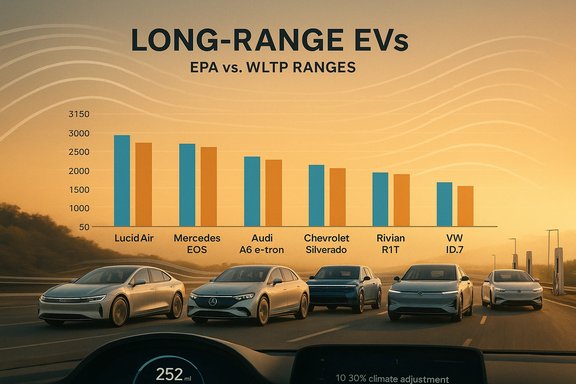
MSN’s roundup of “The 15 electric cars with the longest range” is a useful one‑stop gallery for the current crop of headline‑grabbing EVs — but the piece mixes test cycles, manufacturer claims and demonstration runs in ways that can seriously overstate how far a U.S. buyer should expect to go on a single charge. The gallery correctly identifies the engineering leaders — large battery packs, efficient aerodynamics and high‑voltage architectures dominate the top slots — yet it too often fails to say whether a quoted figure is an EPA rating, a WLTP estimate, or a manufacturer target, a lapse that distorts direct comparisons and buyer expectations.
Background / Overview
Electric vehicle range is not a single number. Confusion arises from three different realities that every buyer must understand.- Different test cycles yield different numbers. The U.S. EPA, European WLTP and China’s CLTC each use different protocols and assumptions. WLTP and CLTC tend to produce higher (more optimistic) figures than EPA for the same car and configuration. That means a 450‑mile WLTP claim can translate to something materially lower under EPA.
- Range depends on trim and usable energy. Maximum range usually applies only to specific trims with the largest usable battery capacity and the most efficient motorization. Manufacturers sometimes quote gross pack size (kWh) while others quote usable energy; the distinction can change expected range in the real world.
- Real‑world conditions matter. Speed, ambient temperature, payload, roof racks, high‑speed sustained highway driving and accessory loads (air conditioning, heating, infotainment) all reduce achievable range. A practical rule of thumb for many long highway trips or cold conditions is a 10–30% reduction from optimistic cycle numbers.
What the MSN list actually says — and what it leaves unsaid
At a glance the gallery highlights vehicles that achieve the longest headline figures. Key patterns in the entries are consistent:- Luxury sedans and vehicles built on large battery platforms dominate the top spots (Lucid Air variants, Mercedes‑Benz EQS, Audi A6 e‑tron).
- Large pickups and SUVs now appear competitively on range lists — examples include the Chevrolet Silverado EV and Rivian R1 series — reflecting much larger pack capacities and focus on highway efficiency.
- Some of the highest figures in the gallery appear to originate from WLTP numbers or manufacturer claims rather than U.S. EPA labels; the gallery rarely flags this clearly. That omission is the single largest interpretive risk for U.S. buyers.
Deep dive: the headline vehicles and how to read their claims
Below are the gallery’s most visible entrants and the practical context you need. Each model’s placement in the gallery is accurate as a discovery list, but the meaning of the quoted number varies.Lucid Air — range leader by engineering, but read the fine print
The Lucid Air (certain Long Range / Grand Touring trims) consistently appears at or near the top of long‑range leaderboards. The model’s combination of a very large usable battery, extremely efficient aerodynamics and carefully tuned thermal management has produced EPA‑rated range figures that sit well above most competitors when configured with the highest‑capacity pack. That engineering reality supports Lucid’s top‑slot headlines — but the top numbers apply only to specific trims and options. Buyers must verify the EPA label for the exact trim and year they are purchasing.Why this matters: the Air’s headline is earned engineering‑wise, but if you pick a different axle configuration, wheel size, or a lower battery option, the real range falls away from the headline figure quickly.
Mercedes‑Benz EQS — WLTP optimism vs EPA reality
The EQS is often quoted with very large range figures in the mid‑400s, but many of those numbers reflect WLTP measurements used in Europe rather than U.S. EPA ratings. In U.S. comparisons, EPA numbers for the EQS are typically lower than some of the WLTP claims the gallery picks up. That difference is why the EQS can appear to leap ahead in a Europe‑centric list yet sit behind Lucid and certain Tesla configurations when judged by EPA stickers.Practical takeaway: if you live in the U.S., look for the EPA label for the specific EQS trim you plan to buy rather than relying on a WLTP‑based headline.
Chevrolet Silverado EV — extreme demonstrations and real labels
The Silverado EV’s headline numbers in the gallery are eye‑catching: Chevrolet advertises very large battery options and ambitious EPA ranges for its most efficient specs. The gallery also references a high‑profile endurance demonstration in which a Silverado EV covered over 1,000 miles on a single charge under hypermiling conditions. That record run is a demonstration of possibilities under controlled and optimized driving, not a representative consumer expectation. Always treat such endurance demonstrations as showcases of engineering rather than as normal use metrics.Tesla Model S, Rivian R1T/R1S, Audi A6 e‑tron, Volkswagen ID.7, Porsche Taycan
These familiar names reappear on many long‑range lists when configured with the largest battery packs or the most efficient drive layouts. Independent outlets and consolidated EV resources typically confirm they are among the long‑range contenders, but again the test cycle and chosen trim matter. Real‑world tests from trusted publications usually record lower figures than the most optimistic manufacturer or WLTP claims.Verification and cross‑checks: what the files reveal
The uploaded material we reviewed cross‑checks several of the gallery’s load‑bearing claims and highlights where further checking is essential.- The Lucid Air’s top position is supported by EPA ratings for certain trims and independent EV aggregate lists, but only for specific configurations; the files note that EPA figures vary by trim and that buyer diligence is required.
- The EQS’s headline range is often a WLTP figure; U.S. EPA numbers for EQS trims are lower. The gallery does not consistently label which cycle is being reported, which is a critical omission for U.S. consumers.
- The Silverado EV record run is real and notable, but it was an engineered hypermiling exercise, not a general benchmark; the files caution readers not to equate that demonstration with normal everyday range.
- Aggregated lists that compile WLTP, manufacturer and EPA numbers without explicit labeling are the root of most consumer confusion; the gallery reflects that common industry practice.
Strengths of the MSN gallery — what it got right
- Timely snapshot of engineering leaders. The gallery successfully captures the vehicles and manufacturers that are pushing range capability forward: large battery platforms, optimized aerodynamics, and advanced thermal systems feature strongly across the list. That gives readers a useful starting shortlist.
- Cross‑segment shift visibility. The inclusion of pickups and SUVs alongside sedans accurately reflects the industry trend where trucks like the Silverado EV and Rivian models now compete on range, a major change from earlier EV generations.
- Discovery value. For readers who want to see who to research next, the gallery does what a gallery should: it compiles the names and headline numbers in one place that prompts further investigation.
Weaknesses, omissions and risks — where the gallery misleads
- Mixed test cycles without transparent labeling. The gallery frequently places WLTP, EPA and manufacturer claims side‑by‑side without telling readers which is which — an omission that systematically inflates perceived parity between vehicles. This is the primary interpretive hazard for U.S. buyers.
- Context for extreme demonstrations missing. Demonstrations (endurance runs, manufacturer goal figures) sometimes appear beside EPA labels, which blurs the line between demonstrable engineering feats and consumer expectations. The Silverado EV’s 1,000‑mile demonstration is an exemplar of this issue.
- Battery capacity vs usable capacity not clarified. Gross pack size versus usable kWh is a subtle but material distinction for range and charging; the gallery rarely makes the distinction.
- Charging rates and energy consumption absent. Range is only one axis of long‑distance usability. The gallery does not consistently include sustained DC charging capability, energy consumption per mile or network access — all of which determine how practical a vehicle is for long trips.
How to read any “longest range” list like a pro: a practical checklist
Treat the gallery as a starting point. Use this checklist to convert headline figures into realistic expectations.- Confirm the test cycle. If the article doesn’t say whether a number is EPA, WLTP or CLTC, treat it as optimistic for U.S. driving.
- Check the exact trim and battery. Range figures usually reflect the largest usable pack and the most efficient motors. If you’ll buy a lower trim, expect materially less range.
- Use independent road tests. Trusted outlets publish real‑world tests that are usually closer to buyer experience than WLTP numbers. Verify headline claims against at least two independent road tests where possible.
- Plan for climate and speed. Cold weather and sustained high‑speed driving reduce range more than mixed or city driving. Budget a 10–30% reduction on long highway trips.
- Factor charging architecture. Prioritize vehicles with strong sustained DC charging rates and fast‑charging network access if you plan frequent long trips. Range without usable charging speed limits long‑distance usability.
Practical guidance for buyers and fleet managers
- Prioritize EPA ratings and sustained DC charging capability over WLTP headlines when shopping in the U.S.; a larger EPA‑rated number plus fast sustained charging beats a headline WLTP figure every time for practical road‑trip usability.
- If you rely on frequent coast‑to‑coast trips, model a real route with your chosen chargers, accounting for charging speeds and station uptime. A long‑range EV with poor network integration can still be worse for long trips than a slightly shorter‑range model with a dense, reliable fast‑charging network.
- For cold climates, weight battery thermal management more heavily than pack size: some thermal systems preserve range far better in winter than simply having more kilowatt‑hours.
- Fleets should model duty cycles. Heavy loads, rooftop carriers, repeated high‑speed driving and trailer towing reduce range dramatically. Don’t assume an advertised headline is a fleet’s everyday reality.
A frank word on “range racing” and demonstration runs
Range records and hypermiling demonstrations are excellent PR and instructive engineering showcases, but they are not consumer benchmarks. The Silverado EV’s 1,000‑mile demonstration used optimized driving techniques and specific conditions to produce an extraordinary result — useful to show what the platform can do under ideal conditions, but not a number to rely on for trip planning. Treat such runs as demonstrations of potential rather than as expected daily performance.Conclusion — how to use the MSN gallery responsibly
The MSN gallery of “The 15 electric cars with the longest range” is an effective discovery tool that brings together the current marquee long‑range EVs and the headline numbers that draw attention. It captures a real, industry‑wide range race: better battery chemistry, higher pack capacities, 800‑volt architectures and more aerodynamic designs have pushed range into previously unattained bands. That technical progress is real and important for prospective buyers.But the gallery’s strongest weakness is presentation: it too often mixes WLTP, EPA and manufacturer numbers without transparent labeling, and it places demonstration runs beside EPA labels without sufficient context. For U.S. buyers the practical path is clear and unchanged by any list:
- Use the gallery to shortlist models.
- Confirm the test cycle and the exact trim on the manufacturer’s U.S. page and on the EPA label.
- Read independent real‑world tests and perform route planning using real chargers and realistic weather assumptions.
Source: MSN https://www.msn.com/en-ae/news/othe...18b8a8e4103c42cad2bf43c296b&ocid=mailsignout]
