

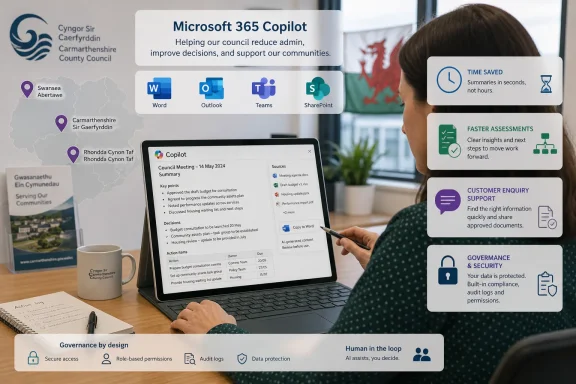
Microsoft 365 Copilot is being used by Swansea, Carmarthenshire, and Rhondda Cynon Taf councils in Wales to cut administrative work, speed up assessments, support customer enquiries, and help staff make better use of Microsoft 365 tools in public services. The headline numbers are eye-catching: thousands of hours saved in weeks, assessments completed nearly four times faster, and staff reporting better morale and higher-quality work. But the more important story is not that AI has arrived in local government. It is that the first serious public-sector gains are coming from the least glamorous part of the AI boom: disciplined deployment inside the software estate councils already own.
The Welsh council examples land differently from the usual enterprise AI case study because they do not depend on a futuristic reinvention of government. Nobody is claiming that a chatbot is replacing a social worker, planning officer, complaints handler, or customer service team. The promise is narrower and more credible: take the minutes, summarize the notes, draft the first version, find the policy language, turn the mess of institutional paperwork into something a human can review.
That matters because public-sector productivity is not an abstraction. In local government, administrative drag is paid for in slower responses, longer queues, delayed assessments, tired staff, and residents who experience the state as a form to be filled out rather than a service to be delivered. If AI can reduce that drag without weakening accountability, it has a more defensible role than the hype cycle usually allows.
The reported results from Swansea are the sort of metric vendors love and finance directors notice: 5,400 staff hours saved in four weeks. Rhondda Cynon Taf’s claim that assessments can be created almost four times faster is even more interesting, because it applies AI to a core workflow rather than a generic office task. Carmarthenshire’s Copilot agent, meanwhile, is aimed at a familiar local-government pain point: repetitive customer enquiries and complaints handling.
Still, these are early adoption stories, and early adoption stories tend to arrive polished. Microsoft has an obvious commercial interest in making Copilot look like the public sector’s safest route into generative AI. Councils have an understandable interest in presenting digital transformation as service improvement rather than austerity by another name. The truth is likely both more mundane and more useful: Copilot is not magic, but in document-heavy organisations, mundane automation can be a big deal.
That gives Microsoft an advantage that smaller AI vendors can envy but not easily copy. Local authorities are not short of niche software, pilot projects, or digital transformation roadmaps. What they often lack is the operational bandwidth to make another tool stick. Copilot’s sales pitch is that staff do not have to leave the Microsoft environment to get help drafting, summarising, searching, and structuring information.
That does not make adoption effortless. Swansea’s experience reportedly exposed a gap that many organisations will recognise: leaders often assume staff are more digitally confident than they are. A workforce can use Teams every day and still struggle to understand how to prompt an AI system, when to trust it, what data it can access, and how to turn a draft output into usable work.
This is where the Welsh examples become more persuasive than a vendor demo. The councils did not simply switch on Copilot and wait for productivity to appear. They seeded the tool among enthusiastic users, created internal champions, shared prompts, and attached the technology to recognisable workflows. The lesson for IT leaders is blunt: Copilot is not a licence; it is a change programme wearing the clothes of a licence.
That balance is important. Generative AI is strongest when producing a first pass, compressing a long input, or reformatting existing information. It is weaker when asked to act as an independent authority. In the council setting, the best use cases therefore keep the human as the accountable decision-maker while reducing the clerical load that surrounds the decision.
Rhondda Cynon Taf’s social care example illustrates the point. The value is not that Copilot “does social care.” It is that staff can spend less time turning notes, histories, meetings, and assessments into formal documentation. If that means practitioners are more present during visits and less buried in write-up afterward, the technology’s value is measured not only in hours saved but in the quality of attention given to residents.
Carmarthenshire’s complaints and customer-enquiry work shows another pattern. Many councils sit on large public websites full of policy pages, forms, deadlines, and FAQs, yet residents still struggle to find the right answer. A Copilot agent that draws on approved website content can reduce repetitive handling and help staff meet response targets. The risk, of course, is that bad grounding, stale content, or unclear escalation rules can turn a helpful assistant into a confident misdirection engine.
Swansea’s reported need for a support partner and one-to-one help is not a failure of the deployment. It is the deployment. Organisations that budget only for licences and not enablement will get patchy usage, uneven quality, and a noisy gap between executive expectations and front-line reality. Copilot makes it easy to ask a question; it does not make it obvious which question is worth asking.
Rhondda Cynon Taf’s phrase about bringing people into a “middle band” of Copilot use captures the public-sector challenge especially well. Councils cannot rely on a handful of enthusiasts producing spectacular demos while everyone else muddles through. Service quality has to be consistent, auditable, and fair. In that environment, the target is not heroics. It is a common baseline.
That has practical consequences for Windows and Microsoft 365 administrators. Prompt libraries, internal guidance, sensitivity labels, SharePoint hygiene, Teams governance, and role-based training all become part of the AI programme. Copilot exposes the condition of the Microsoft 365 tenant underneath it. If permissions are messy, files are duplicated, naming conventions are chaotic, and staff do not know where authoritative information lives, AI will surface the mess faster than it fixes it.
The danger is that the hero-user model can become a comfort blanket. Early adopters are not representative. They are more patient with rough edges, more likely to experiment, and more forgiving when the output is imperfect. Their enthusiasm can obscure the barriers faced by staff who are anxious, overloaded, sceptical, or simply not paid to become amateur prompt engineers.
For a council, that distinction matters. Public services cannot be redesigned around the habits of the most digitally confident employees. If Copilot is going to move from pilot to infrastructure, it has to work for the average user under ordinary pressure, not just the internal evangelist with time to explore new features.
The more mature phase will be less exciting and more important. Councils will need to decide which Copilot workflows are recommended, which are prohibited, which require human sign-off, and which should be measured formally. The work will shift from discovery to standardisation. That is where the productivity claims will either harden into operational practice or fade into another pile of transformation slides.
Rhondda Cynon Taf’s reported concern about whether AI use might affect social workers’ registrations is exactly the sort of question that should appear early in a deployment, not after a scandal. Professional staff need clarity about what Copilot is doing, what it is not doing, and where accountability remains. If the answer is “the human decides,” that still leaves a second question: how does the organisation prove that the human meaningfully reviewed the output?
The safest framing is to treat Copilot output as a draft or assistant-generated working note, not as a decision. That sounds simple, but it requires policy, training, and audit discipline. Staff need to understand that fluency is not accuracy. A confident summary can omit nuance, flatten uncertainty, or misstate context. In social care, those are not cosmetic errors.
The upside is equally real. If AI reduces the amount of time practitioners spend translating human interactions into bureaucratic artefacts, residents may get more focused attention and staff may experience less burnout. That is a better public-sector AI story than job replacement. But it only holds if councils resist the temptation to turn time saved into workload intensification by stealth.
For years, office productivity software has assumed a certain kind of worker: comfortable with long documents, rapid context switching, dense email threads, and polished written output. Generative AI can lower some of those barriers. It can help turn rough thoughts into structured prose, compress a sprawling document into digestible points, or offer a rewrite that makes workplace communication less effortful.
That benefit should not be oversold as a substitute for proper workplace adjustments, accessibility design, or inclusive management. AI tools can introduce their own frustrations and risks. But if staff with ADHD or dyslexia are finding genuine value in Copilot, that suggests generative AI may become part of the accessibility stack, not merely the productivity stack.
This is also a reminder that efficiency metrics miss some of the point. The value of a tool is not only whether it saves ten minutes. It may reduce anxiety before sending an email, make a meeting transcript easier to process, or help a capable employee navigate a documentation-heavy environment that was never designed with them in mind. Public-sector employers should pay attention to that signal.
But vendor assurances do not eliminate local responsibility. Copilot can only respect permissions that are correctly configured. If a SharePoint site exposes documents too broadly, if old Teams channels contain sensitive files, or if staff have access they no longer need, Copilot may make that overexposure more visible. AI does not create every governance problem, but it can make existing problems easier to exploit accidentally.
That is why councils using Copilot need strong information architecture. Data retention, sensitivity labels, access reviews, audit logs, and Purview policies become part of the AI control plane. The old habit of treating document storage as a background IT chore becomes untenable once a natural-language assistant can search, summarize, and recombine material at speed.
Agents add another layer. Carmarthenshire’s website-based FAQ agent sounds sensible because it can be grounded in public, approved content. But as organisations build more agents, they will need to inspect where each one gets information, what it is allowed to do, how it handles personal data, and when it escalates to a human. “It’s inside Microsoft 365” is not a governance strategy. It is the start of one.
That can be good for users in the short term. Integrated tools are easier to deploy than fragmented ones. A council already paying for Microsoft 365 can plausibly argue that Copilot is the most governable way to introduce generative AI, especially compared with unsanctioned public chatbots or scattered departmental experiments.
But the long-term trade-off is lock-in. Once AI-generated workflows are embedded in Teams, SharePoint, Outlook, and Word, switching costs rise. Data governance, staff training, process redesign, and internal support models begin to orbit Microsoft’s roadmap. That does not make Copilot a bad choice, but it does make procurement discipline more important.
Public bodies should be especially alert to this. A successful pilot can quietly become a dependency. Councils need to ask not only whether Copilot saves time this quarter, but how pricing, licensing, model changes, data residency commitments, agent frameworks, and audit capabilities will evolve over the next five years. The AI assistant may feel lightweight; the platform politics are not.
The Welsh council examples are strongest when they frame Copilot as a way to improve work rather than simply extract more from workers. Rhondda Cynon Taf’s reported staff sentiment — more positive about roles and improved perceived work quality — is important because it suggests the tool is not merely compressing labour. Carmarthenshire’s neurodiversity feedback points in the same direction.
Still, public-sector AI adoption will be judged by outcomes, not slogans. If saved time simply becomes higher caseloads, faster churn, or fewer staff expected to handle the same complexity, the social licence for AI will erode. Workers are far more likely to trust Copilot if they can see that it reduces toil rather than becoming a surveillance-adjacent productivity ratchet.
This is where unions, professional bodies, scrutiny committees, and data protection officers have a role. The question is not whether councils should use AI. The question is how they document its effects, protect professional judgment, and make sure residents benefit. Public trust will depend on whether AI is seen as improving services or disguising cuts.
There are several concrete takeaways for WindowsForum readers watching Copilot move from pilot to policy:
Source: IT Pro How Welsh councils are improving services with Microsoft Copilot
 The Public Sector Has Found AI’s Least Flashy Sweet Spot
The Welsh council examples land differently from the usual enterprise AI case study because they do not depend on a futuristic reinvention of government. Nobody is claiming that a chatbot is replacing a social worker, planning officer, complaints handler, or customer service team. The promise is narrower and more credible: take the minutes, summarize the notes, draft the first version, find the policy language, turn the mess of institutional paperwork into something a human can review.That matters because public-sector productivity is not an abstraction. In local government, administrative drag is paid for in slower responses, longer queues, delayed assessments, tired staff, and residents who experience the state as a form to be filled out rather than a service to be delivered. If AI can reduce that drag without weakening accountability, it has a more defensible role than the hype cycle usually allows.
The reported results from Swansea are the sort of metric vendors love and finance directors notice: 5,400 staff hours saved in four weeks. Rhondda Cynon Taf’s claim that assessments can be created almost four times faster is even more interesting, because it applies AI to a core workflow rather than a generic office task. Carmarthenshire’s Copilot agent, meanwhile, is aimed at a familiar local-government pain point: repetitive customer enquiries and complaints handling.
Still, these are early adoption stories, and early adoption stories tend to arrive polished. Microsoft has an obvious commercial interest in making Copilot look like the public sector’s safest route into generative AI. Councils have an understandable interest in presenting digital transformation as service improvement rather than austerity by another name. The truth is likely both more mundane and more useful: Copilot is not magic, but in document-heavy organisations, mundane automation can be a big deal.
Copilot Wins Because Microsoft 365 Is Already the Workplace
The strongest explanation for Copilot’s momentum is not that it is the most capable AI model on the market. It is that it lives where office work already happens. For organisations already standardised on Outlook, Teams, Word, SharePoint, OneDrive, and the Microsoft 365 identity stack, Copilot does not arrive as a strange new platform demanding a parallel workflow. It appears inside the daily machinery of work.That gives Microsoft an advantage that smaller AI vendors can envy but not easily copy. Local authorities are not short of niche software, pilot projects, or digital transformation roadmaps. What they often lack is the operational bandwidth to make another tool stick. Copilot’s sales pitch is that staff do not have to leave the Microsoft environment to get help drafting, summarising, searching, and structuring information.
That does not make adoption effortless. Swansea’s experience reportedly exposed a gap that many organisations will recognise: leaders often assume staff are more digitally confident than they are. A workforce can use Teams every day and still struggle to understand how to prompt an AI system, when to trust it, what data it can access, and how to turn a draft output into usable work.
This is where the Welsh examples become more persuasive than a vendor demo. The councils did not simply switch on Copilot and wait for productivity to appear. They seeded the tool among enthusiastic users, created internal champions, shared prompts, and attached the technology to recognisable workflows. The lesson for IT leaders is blunt: Copilot is not a licence; it is a change programme wearing the clothes of a licence.
The Time-Saving Story Is Really a Workflow Story
The most credible Copilot benefits are not the broad claims that “AI saves time.” They are the narrower cases where a council can point to a repeatable administrative burden and show how AI changes the shape of it. A social care assessment, a meeting summary, a complaints response, or a customer-service FAQ has enough structure for AI to be useful and enough human consequence to require review.That balance is important. Generative AI is strongest when producing a first pass, compressing a long input, or reformatting existing information. It is weaker when asked to act as an independent authority. In the council setting, the best use cases therefore keep the human as the accountable decision-maker while reducing the clerical load that surrounds the decision.
Rhondda Cynon Taf’s social care example illustrates the point. The value is not that Copilot “does social care.” It is that staff can spend less time turning notes, histories, meetings, and assessments into formal documentation. If that means practitioners are more present during visits and less buried in write-up afterward, the technology’s value is measured not only in hours saved but in the quality of attention given to residents.
Carmarthenshire’s complaints and customer-enquiry work shows another pattern. Many councils sit on large public websites full of policy pages, forms, deadlines, and FAQs, yet residents still struggle to find the right answer. A Copilot agent that draws on approved website content can reduce repetitive handling and help staff meet response targets. The risk, of course, is that bad grounding, stale content, or unclear escalation rules can turn a helpful assistant into a confident misdirection engine.
Digital Literacy Is the Hidden Cost Centre
The Welsh councils’ comments about training are a useful corrective to the lazy idea that generative AI is self-explanatory. Chat interfaces feel simple, but workplace AI is not just a chat interface. It is a new layer over permissions, data classification, institutional knowledge, professional judgment, and risk.Swansea’s reported need for a support partner and one-to-one help is not a failure of the deployment. It is the deployment. Organisations that budget only for licences and not enablement will get patchy usage, uneven quality, and a noisy gap between executive expectations and front-line reality. Copilot makes it easy to ask a question; it does not make it obvious which question is worth asking.
Rhondda Cynon Taf’s phrase about bringing people into a “middle band” of Copilot use captures the public-sector challenge especially well. Councils cannot rely on a handful of enthusiasts producing spectacular demos while everyone else muddles through. Service quality has to be consistent, auditable, and fair. In that environment, the target is not heroics. It is a common baseline.
That has practical consequences for Windows and Microsoft 365 administrators. Prompt libraries, internal guidance, sensitivity labels, SharePoint hygiene, Teams governance, and role-based training all become part of the AI programme. Copilot exposes the condition of the Microsoft 365 tenant underneath it. If permissions are messy, files are duplicated, naming conventions are chaotic, and staff do not know where authoritative information lives, AI will surface the mess faster than it fixes it.
The “Hero User” Model Is Sensible, But It Has a Shelf Life
Starting with enthusiastic users is a smart way to reduce fear and discover practical use cases. Swansea’s initial allocation of 100 licences, split between pilot users and senior leadership, reflects a familiar but effective tactic: let willing staff find the value, and make sure leaders understand the tool well enough to sponsor it credibly. Carmarthenshire’s prompt sharing in Teams is another sign of a living adoption culture rather than a top-down memo.The danger is that the hero-user model can become a comfort blanket. Early adopters are not representative. They are more patient with rough edges, more likely to experiment, and more forgiving when the output is imperfect. Their enthusiasm can obscure the barriers faced by staff who are anxious, overloaded, sceptical, or simply not paid to become amateur prompt engineers.
For a council, that distinction matters. Public services cannot be redesigned around the habits of the most digitally confident employees. If Copilot is going to move from pilot to infrastructure, it has to work for the average user under ordinary pressure, not just the internal evangelist with time to explore new features.
The more mature phase will be less exciting and more important. Councils will need to decide which Copilot workflows are recommended, which are prohibited, which require human sign-off, and which should be measured formally. The work will shift from discovery to standardisation. That is where the productivity claims will either harden into operational practice or fade into another pile of transformation slides.
Social Care Is Where the Stakes Get Real
Using AI to summarize a meeting or rewrite an email is one thing. Using it around social care assessments is another. The administrative burden may be obvious, but the ethical stakes are higher because records and assessments can influence real decisions about support, safeguarding, vulnerability, and professional accountability.Rhondda Cynon Taf’s reported concern about whether AI use might affect social workers’ registrations is exactly the sort of question that should appear early in a deployment, not after a scandal. Professional staff need clarity about what Copilot is doing, what it is not doing, and where accountability remains. If the answer is “the human decides,” that still leaves a second question: how does the organisation prove that the human meaningfully reviewed the output?
The safest framing is to treat Copilot output as a draft or assistant-generated working note, not as a decision. That sounds simple, but it requires policy, training, and audit discipline. Staff need to understand that fluency is not accuracy. A confident summary can omit nuance, flatten uncertainty, or misstate context. In social care, those are not cosmetic errors.
The upside is equally real. If AI reduces the amount of time practitioners spend translating human interactions into bureaucratic artefacts, residents may get more focused attention and staff may experience less burnout. That is a better public-sector AI story than job replacement. But it only holds if councils resist the temptation to turn time saved into workload intensification by stealth.
Neurodiverse Staff May Be the Most Important Adoption Signal
One of the most striking details from Carmarthenshire is the feedback from neurodiverse colleagues, particularly staff with ADHD and dyslexia, who reportedly found Copilot helpful for processing information, written communication, rewriting, and summarising large documents. This is not a side note. It may be one of the most practical and humane uses of workplace AI.For years, office productivity software has assumed a certain kind of worker: comfortable with long documents, rapid context switching, dense email threads, and polished written output. Generative AI can lower some of those barriers. It can help turn rough thoughts into structured prose, compress a sprawling document into digestible points, or offer a rewrite that makes workplace communication less effortful.
That benefit should not be oversold as a substitute for proper workplace adjustments, accessibility design, or inclusive management. AI tools can introduce their own frustrations and risks. But if staff with ADHD or dyslexia are finding genuine value in Copilot, that suggests generative AI may become part of the accessibility stack, not merely the productivity stack.
This is also a reminder that efficiency metrics miss some of the point. The value of a tool is not only whether it saves ten minutes. It may reduce anxiety before sending an email, make a meeting transcript easier to process, or help a capable employee navigate a documentation-heavy environment that was never designed with them in mind. Public-sector employers should pay attention to that signal.
Security Promises Do Not Remove Governance Obligations
Microsoft’s enterprise pitch for Copilot rests heavily on data protection. Microsoft says Microsoft 365 Copilot works within the Microsoft 365 service boundary, uses Microsoft Graph data according to existing user permissions, and does not use prompts, responses, or Graph-accessed data to train foundation models. For councils handling sensitive resident information, those commitments are not optional decoration; they are the basis on which adoption becomes politically and legally plausible.But vendor assurances do not eliminate local responsibility. Copilot can only respect permissions that are correctly configured. If a SharePoint site exposes documents too broadly, if old Teams channels contain sensitive files, or if staff have access they no longer need, Copilot may make that overexposure more visible. AI does not create every governance problem, but it can make existing problems easier to exploit accidentally.
That is why councils using Copilot need strong information architecture. Data retention, sensitivity labels, access reviews, audit logs, and Purview policies become part of the AI control plane. The old habit of treating document storage as a background IT chore becomes untenable once a natural-language assistant can search, summarize, and recombine material at speed.
Agents add another layer. Carmarthenshire’s website-based FAQ agent sounds sensible because it can be grounded in public, approved content. But as organisations build more agents, they will need to inspect where each one gets information, what it is allowed to do, how it handles personal data, and when it escalates to a human. “It’s inside Microsoft 365” is not a governance strategy. It is the start of one.
Microsoft’s Public-Sector Advantage Comes With Lock-In Gravity
There is a strategic angle here that Microsoft will not mind anyone noticing. Copilot makes Microsoft 365 stickier. If councils build prompt libraries, workflows, training programmes, agents, and internal habits around Copilot, the productivity suite becomes more than email and documents. It becomes the interface to institutional knowledge.That can be good for users in the short term. Integrated tools are easier to deploy than fragmented ones. A council already paying for Microsoft 365 can plausibly argue that Copilot is the most governable way to introduce generative AI, especially compared with unsanctioned public chatbots or scattered departmental experiments.
But the long-term trade-off is lock-in. Once AI-generated workflows are embedded in Teams, SharePoint, Outlook, and Word, switching costs rise. Data governance, staff training, process redesign, and internal support models begin to orbit Microsoft’s roadmap. That does not make Copilot a bad choice, but it does make procurement discipline more important.
Public bodies should be especially alert to this. A successful pilot can quietly become a dependency. Councils need to ask not only whether Copilot saves time this quarter, but how pricing, licensing, model changes, data residency commitments, agent frameworks, and audit capabilities will evolve over the next five years. The AI assistant may feel lightweight; the platform politics are not.
The Productivity Dividend Must Not Become an Austerity Alibi
Whenever a public-sector technology story includes saved hours, a shadow question follows: who gets the dividend? Staff may hope that less admin means more time for residents, better casework, less stress, and fewer evenings catching up on documentation. Budget holders may see a chance to absorb demand without hiring. Politicians may see a line about efficiency.The Welsh council examples are strongest when they frame Copilot as a way to improve work rather than simply extract more from workers. Rhondda Cynon Taf’s reported staff sentiment — more positive about roles and improved perceived work quality — is important because it suggests the tool is not merely compressing labour. Carmarthenshire’s neurodiversity feedback points in the same direction.
Still, public-sector AI adoption will be judged by outcomes, not slogans. If saved time simply becomes higher caseloads, faster churn, or fewer staff expected to handle the same complexity, the social licence for AI will erode. Workers are far more likely to trust Copilot if they can see that it reduces toil rather than becoming a surveillance-adjacent productivity ratchet.
This is where unions, professional bodies, scrutiny committees, and data protection officers have a role. The question is not whether councils should use AI. The question is how they document its effects, protect professional judgment, and make sure residents benefit. Public trust will depend on whether AI is seen as improving services or disguising cuts.
The Welsh Pattern Gives IT Leaders a More Useful Playbook Than the Hype Cycle
The clearest lesson from Swansea, Carmarthenshire, and Rhondda Cynon Taf is that successful Copilot adoption looks less like a moonshot and more like careful operational gardening. Councils started small, found credible use cases, trained staff, leaned on champions, and shared learning across organisations. That is less glamorous than an AI transformation keynote, but it is how enterprise technology usually becomes real.There are several concrete takeaways for WindowsForum readers watching Copilot move from pilot to policy:
- Councils are finding the strongest early returns in document-heavy, repeatable workflows where AI can draft, summarize, or reformat information for human review.
- Digital literacy and confidence are as important as licensing, because staff need practical use cases and support before Copilot becomes useful in daily work.
- Microsoft 365 governance becomes more important after Copilot adoption, because existing permissions and information architecture shape what the assistant can surface.
- Internal champions help discovery, but organisations need standardised practices before AI use can be consistent across front-line teams.
- Public-sector AI is most defensible when saved time is reinvested in service quality, staff wellbeing, and resident outcomes rather than treated only as a cost-cutting metric.
- Agents grounded in approved organisational content may offer practical value, but they require clear escalation paths, data controls, and ongoing content maintenance.
Source: IT Pro How Welsh councils are improving services with Microsoft Copilot
