

Hubtel IT’s recent hiring push — three targeted appointments that expand the team by a quarter — is more than a local personnel story: it’s a concise case study of how smallall, Microsoft‑centric IT consultancies are repositioning around AI-driven services, Copilot integration and heightened cybersecurity needs as they chase growth in the SME market. The Midlands firm has publicly linked the hires to an explicit revenue target and to a repositioning of its service mix, framing AI as both a growth engine and a new attack vector that must be managed, not merely adopted.
The announcement from Hubtel IT — a West Midlands consultancy founded in 2002 and operating from Nether Whitacre — says the business has added three roles (Marketing Manager, Tech Help Desk Manager and IT Support Engineer), bringing headcount to 15 and representing a 25% increase. The company publicly stated a turnover figure of just under £2.3m for 2025 and set a target of more than £2.5m for 2026. The hires were explicitly tied to an AI‑led growth strategy that mixes Microsoft 365/Copilot integration, agentic automation and strengthened cyber resilience offerings for SMEs. Companies House records confirm the company’s legal presence and leadership (Neil Bayliss is listed as a director), providing a public registry entry that supports basic corporate claims. That registry is the right first stop for verifying long‑running factual statements about company structure, registration and official filings.
Independent analyst commentary and industry surveys also show steady growth in spending on cloud and generative AI services, driving a rebalancing of the IT services market toward outcomes, automation and outcome‑based pricing models. That macro tailwind makes AI‑led positioning commercially sensible — but not automatically profitable without disciplined execution.
For buyers and partners, the right response is pragmatic: treat press releases as a beginning, not an end. Validate claims with documented case studies, request technical artefacts and third‑party security attestations, and structure procurements around staged pilots with clear KPIs and contractual protections. For consultancies in this position, the road to durable growth runs through productisation, demonstrable governance, and investment in retention and operational assurance — not just headcount. The sector’s current momentum around AI and cloud creates opportunity, but it also raises expectations for transparency and measurable outcomes; the firms that meet both will build sustainable advantage.
Source: TheBusinessDesk.com https://www.thebusinessdesk.com/wes...xpands-workforce-with-ai-led-growth-strategy/
 Background / Overview
The announcement from Hubtel IT — a West Midlands consultancy founded in 2002 and operating from Nether Whitacre — says the business has added three roles (Marketing Manager, Tech Help Desk Manager and IT Support Engineer), bringing headcount to 15 and representing a 25% increase. The company publicly stated a turnover figure of just under £2.3m for 2025 and set a target of more than £2.5m for 2026. The hires were explicitly tied to an AI‑led growth strategy that mixes Microsoft 365/Copilot integration, agentic automation and strengthened cyber resilience offerings for SMEs. Companies House records confirm the company’s legal presence and leadership (Neil Bayliss is listed as a director), providing a public registry entry that supports basic corporate claims. That registry is the right first stop for verifying long‑running factual statements about company structure, registration and official filings. What exactly was announced?
- Three new hires: Craig Potts (Marketing Manager), Michelle Loveland (Tech Help Desk Manager) and Jake Barwell (IT Support Engineer).
- Headcount increase from 12 to 15 employees (described as a 25% expansion).
- Reported turnover of “just under £2.3m” for 2025 and a public target to exceed £2.5m in 2026.
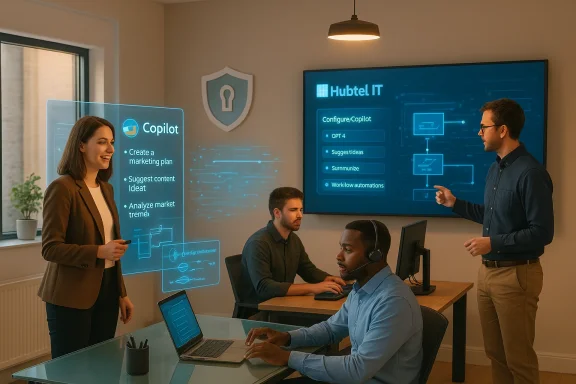
- Strategic pivot: two main AI tracks — (1) integration of tools such as ChatGPT and Microsoft Copilot into Microsoft 365 productivity stacks, and (2) AI agent solutions and automation in business processes. The company explicitly couples this with expanded cyber security advisory and managed‑service offerings to counter AI‑enabled threats like social engineering.
Why the move matters: context in plain terms
- AI is now both a business opportunity and a cyber threat vector. Hubtel’s public framing — that AI can automate processes and lift unconvincing social engineering and phishing campaigns — mirrors what many security and advisory firms are saying. That duality justifies a combined sales motion of productivity enablement plus protective controls for customers.
- SMEs are a large, underserved market for managed AI adoption. The firm points to widely cited UK SME statistics to justify its addressable market focus; SMEs make up the vast majority of UK businesses, and many lack in‑house skills for secure AI rollout. This is an sultancy that can package Copilot enablement, governance and 24×7 support.
- The labour market dynamic. Smaller consultancies cannot match global systems integrators on scale, so they are using targeted hiring and productised services (e.g., Copilot enablement workshops, agent templates, managed detection tuned for AI threats) to differentiate. This model is consistent with sector moves we see in other consultancies scaling AI capability or shifting delivery models.
Industry context: this is a common pattern, not an anomaly
Hubtel’s announcement aligns with a broader trend: consultancies and systems integrators are increasingly reshaping headcount and service portfolios around AI. Larger firms are creating "AI Workforces" and opening regional hubs to staff ML ops, Copilot integration and security benches; smaller firms are productising services to serve SMEs and public sector buyers. Recent company‑level moves in the sector show the same logic: expand delivery capacity, formalise product/IP, and marry AI enablement with governance and security offerings.Independent analyst commentary and industry surveys also show steady growth in spending on cloud and generative AI services, driving a rebalancing of the IT services market toward outcomes, automation and outcome‑based pricing models. That macro tailwind makes AI‑led positioning commercially sensible — but not automatically profitable without disciplined execution.
Strengths in Hubtel’s approach
- Clear, focused hires: The company recruited for distinct capability gaps: marketing/commercial reach, day‑to‑day operations and technical delivery. This mix is the minimum viable team for a small consultancy to professionalise sales, scale delivery, and raise service quality.
- SME playbook: Targeting the SME segment is a rational go‑to‑market choice. SMEs are numerous, often lagging on AI readiness, and typically need packaged, low‑risk offerings rather than bespoke, high‑cost projects. A clearly defined SME product stack improves repeatability and margin potential.
- Honest risk framing: Publicly discussing AI as a cyber risk is an asset. It positions the firm as a pragmatic advisor, not a gullible evangelist. Buyers in small businesses are sensitive to both promises and risks; messaging that couples enablement with protection is more credible.
- Local credibility and political engagement: Mention of local MPs and community impact helps with regional procurement and trust‑building among local SMEs that value face‑to‑face relationships and visible local presence.
Risks and gaps: what the announcement does not prove (and how to treat the claims)
- Compa numbers and customer counts are not a substitute for audited accounts. The turnover figure cited in press coverage is company‑reported and should be validated via official filings or accounts before any commercial commitment. Companies House confirms company registration but not the specific turnover figure quoted; procurement teams should request audited or management accounts to verify revenue and capacity claims.
- Small headcount expansions scale only so far. Adding three people to a 12‑person shop is meaningful for local capacity, but it does not transform delivery capability overnight. Delivery risk remains real if the firm takes on simultaneous, larger projects that compete for the same engineers. Ask for reference customers and staged delivery plans.
- AI technical depth is not established by a publicity statement alone. Integrating Copilot, connecting ChatGPT or building agentic workflows requires data engineering, identity controls, connectors and operational governance. The press release does not describe technical certifications, partner badges or audited security posture — items that matter when Copilot will have access to corporate data. Insist on documented technical capabilities.
- Talent retention and skills: the broader market demonstrates fierce competition for AI talent. Smaller consultancies may feed initial growth but then face attrition to larger employers unless clear career paths and compensation strategies exist. Sector examples show rapid hiring often needs to be paired with retention commitments and third‑party validation of delivery maturity.
- Regulatory and data residency concerns: when AI agents or copilots access customer data, governance, audit trails and data residency rules become critical. SMEs can be poor guardians of regulatory consultancy must be prescriptive about controls, not merely advisory. Ask for data flow diagrams, audit logs, and evidence of secure configuration.
Technical checklist for buyers and partners
When evaluating a small consultancy offering Copilot/integration services, require the following minimum evidence:- Evidence of technical competence:
- Staff CVs showing relevant Azure/Microsoft 365/Copilot experience and certifications.
- Case studies with measurable outcomes (time saved, error rates reduced, adoption metrics).
- Security and governance artefacts:
- SOC 2, ISO 27001, or equivalent attestations, or a plan to obtain them.
- Data processing agreements and clear delineation of responsibilities for data access and retention.
- Operational runbook and SLA:
- Clear SLAs for response, remediation and rollback.
- Defined incident escalation paths and test results for disaster recovery.
- Data handling and compliance:
- Data flow diagrams that show where prompts, logs and outputs are stored.
- Model‑use policies, human‑in‑the‑loop controls and Procurement protections:
- Milestone‑based payments tied to demonstrable outcomes.
- Source or configuration escrow for critical automation components in long‑running engagements.
Customer adoption patterns and recommended approach for SMEs
- Start small and measure. Run a two‑week AI readiness sprint, identify one low‑risk use case (e.g., meeting summarisation, email triage), instrument clear KPIs p. This controls scope and exposes operational work required to keep an agent safe and useful.
- Treat AI services as a combined product + managed service. Sell a packaged, repeatable offering (Copilot onboarding + governance baseline + 3 months of managed support). This reduces implementation risk and improves recurring revenue prospects for the consultancy. Hubtel’s hires — marketing, desk management and technical delivery — are consistent with this pattern, but buyers should require a clear product spec and post‑go‑live support terms.
- Demand proof of cyber maturity and regular audits. AI raises new social engineering risks; penetration testing should include AI‑augmented phishing scenarios and staff awareness programmes. Monitoring and anomaly detection must be part of any AI enablement package.
Commercial and market implications for regional IT sectors
- Practical route to scale: for local consultancies, the playbookuctise repeatable AI features (templates for document summarisation, agent‑enabled workflows, Copilot prompts tuned to industry verticals) and sell these as managed subscriptions. That expands margin and lowers reliance on expensive billable hours. Hubtel appears to be moving in this direction.
- Partnership leverage: Microsoft partner channels, Copilot seat economics and Azure consumption are critical levers. Smaller consultancies can use platform partnerships to access technology but must still own integration, governance and ongoing support. Buyers should ask where the consultancy’s license and vendor relationships create dependencies and what contingency plans exist.
- Consolidation and M&A pressure: the market is consolidating as larger integrators buy specialist shops to bulk up AI capabilities. For small firms, that can create lucrative exit options but also short‑term disruption. Hubtel’s choice to grow organically is lower risk for clients concerned about service continuity, but the firm must demonstrate operational maturity to remain independent as competition intensifies.
Practical recommendations for Hubtel (and similar consultancies)
- Publish measurable case studies: anonymised before/after KPIs that show time saved, incidents prevented or productivity uplift will turn the narrative into verifiable proof. This is essential for closing SME deals where budgets are tight and risk aversion is high.
- Obtain third‑party attestations: security and operational maturity badges (SOC 2, ISO 27001) are often decisive in procurement decisions, even for SMEs.
- Build a product catalogue: package Copilot enablement, agent templates and managed detection as tiered offerings with clear limits and upgrade paths.
- Invest in staff pathways: offer explicit training, certification support and career ladders so the firm retains the skilled practitioners it needs to deliver higher‑value projects.
- Define governance playbooks: publish a short AI Charter for customers that spells out data handling, human‑in‑the‑loop rules and decommissioning pathways for agents.
Where claims remain unverified or require caution
- Turnover and customer counts quoted in local press are company statements and should be verified against audited accounts if material to procurement or investment decisions. Companies House confirms the legal registration and director appointments, but the press turnover figure is a management disclosure not an audited fact. Treat these numbers as management‑reported until formal accounts are reviewed.
- The depth of Copilot/agent technical work is not detailed in the announcement. Integration complexity varies dramatically by legacy environment, data sensitivity and regulatory posture. Ask for technical architecture notes and a sandbox demonstration before committing to a full rollout.
- Long‑term operational costs for AI services — including monitoring, logging, retraining and incident response — can exceed initial expectations. Buyers should insist on a 12‑ to 24‑month TCO (total cost of ownership) forecast that includes ongoing monitoring and traceability work. This prevents surprises in renewals and ensures sustainable relationships.
Conclusion
Hubtel IT’s AI‑led hiring and repositioning is a credible microcosm of the broader market shift: firms are moving from one‑off projects to productised AI enablement + governance offers, and smaller consultancies are targeting underserved SME customers with packaged services. The firm’s stated ambitions — incremental headcount increases, Copilot and agent focus, and a modest revenue target bump — are logical and defensible as a strategy for regional growth. But the announcement is a signal of intent rather than proof of delivery capability.For buyers and partners, the right response is pragmatic: treat press releases as a beginning, not an end. Validate claims with documented case studies, request technical artefacts and third‑party security attestations, and structure procurements around staged pilots with clear KPIs and contractual protections. For consultancies in this position, the road to durable growth runs through productisation, demonstrable governance, and investment in retention and operational assurance — not just headcount. The sector’s current momentum around AI and cloud creates opportunity, but it also raises expectations for transparency and measurable outcomes; the firms that meet both will build sustainable advantage.
Source: TheBusinessDesk.com https://www.thebusinessdesk.com/wes...xpands-workforce-with-ai-led-growth-strategy/
