

Irish organisations are moving from emergency-era digital fixes to deliberate design: hybrid work is now an operational baseline, and the real conversation has shifted to how artificial intelligence can be woven into that hybrid fabric to raise productivity, protect data, and reshape jobs.
Hybrid work is no longer a policy experiment; it is the dominant way many Irish companies operate, with a growing focus on delivering a seamless, consistent user experience across home, office and mobile contexts. Practical implementations — from Microsoft Teams Rooms to device standardisation and modern identity controls — are being deployed not just to enable remote attendance but to unify the meeting and collaboration experience for all participants.
At the same time, AI is moving from pilot projects into mainstream workflows. Tools such as Microsoft 365 Copilot are bringing generative AI into everyday apps, prompting organisations to ask whether their Microsoft 365 estates are secure, governed and configured to support safe, business-grade AI adoption. The most common path IT teams report follows three phases: readiness (securing foundations), structured adoption (small controlled cohorts), and scale (broader deployment once governance and ROI are proven).
These two shifts—hybrid work and AI—are not separate trends. They depend on the same digital foundations: unified identity, consistent device management, integrated collaboration platforms, and robust governance. The choices organisations make about configuration, governance, and procurement today will determine whether AI becomes an accelerant for productivity or a source of risk and fragmentation.
Caution: while modelling and telemetry indicate strong potential, these projections depend on policy coordination, SME uptake, energy and infrastructure planning, and disciplined governance. Treat macro projections as directional scenarios rather than precise forecasts.
But this prize is conditional. Large-scale uplift depends on:
Ireland’s workplaces are at an inflection point: hybrid work has reset expectations, and the arrival of practical, in-app AI means the next wave of productivity gains will come from how organisations design workflows, govern data and train people—not merely from buying the latest tools. The choice now is between disciplined, governance-led adoption that spreads benefits broadly, and rushed, siloed deployments that concentrate risks. The cautious, staged path is not the slow one; it is the way to capture durable advantage.
Source: Business Post How hybrid work and AI are shaping Ireland’s workplaces
 Background / Overview
Hybrid work is no longer a policy experiment; it is the dominant way many Irish companies operate, with a growing focus on delivering a seamless, consistent user experience across home, office and mobile contexts. Practical implementations — from Microsoft Teams Rooms to device standardisation and modern identity controls — are being deployed not just to enable remote attendance but to unify the meeting and collaboration experience for all participants.At the same time, AI is moving from pilot projects into mainstream workflows. Tools such as Microsoft 365 Copilot are bringing generative AI into everyday apps, prompting organisations to ask whether their Microsoft 365 estates are secure, governed and configured to support safe, business-grade AI adoption. The most common path IT teams report follows three phases: readiness (securing foundations), structured adoption (small controlled cohorts), and scale (broader deployment once governance and ROI are proven).
These two shifts—hybrid work and AI—are not separate trends. They depend on the same digital foundations: unified identity, consistent device management, integrated collaboration platforms, and robust governance. The choices organisations make about configuration, governance, and procurement today will determine whether AI becomes an accelerant for productivity or a source of risk and fragmentation.
Why hybrid work has moved from adaptation to optimisation
Hybrid as default, not exception
For many organisations the question moved years ago from “if” to “how.” The workforce now includes cohorts who have only ever worked in hybrid or remote environments and expect polished, intuitive digital experiences. That expectation pushes companies to design meeting spaces and digital services that feel consistent regardless of location. Deployments such as Microsoft Teams Rooms and integrated calendars, conferencing hardware, and shared collaboration surfaces are common investments to close the user-experience gap between the boardroom and the kitchen table.Experience matters more than tools
Having many tools isn’t enough. Success depends on how those tools are configured, governed and combined to support real work. Organisations are prioritising:- Consistent device profiles and management.
- Single-sign-on and identity-first security.
- Meeting room design to equalise remote and in-person participation.
- End-to-end governance for content and collaboration.
Why AI matters for hybrid teams — and why Microsoft 365 matters too
AI as a productivity binder for distributed work
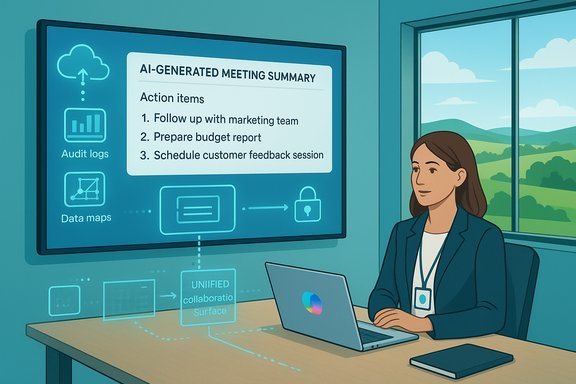
Generative AI embedded in favourite productivity apps reduces context switching and surfaces actionable summaries and next steps directly where teams work. For hybrid teams, this can mean:- Intelligent meeting recaps and searchable action items to keep remote and office participants aligned.
- Copilot-generated first drafts of emails and documents to reduce repetitive drafting.
- Agent-driven micro-workflows (Copilot Actions / Copilot Studio) that perform routine tasks on behalf of users.
The configuration-first approach
Leading adopters do not start with generative AI; they start with governance. Typical readiness activities include:- Strengthening access controls and permissions.
- Establishing tenant-level governance and audit trails.
- Mapping where sensitive data lives and which apps can access it.
Only after these foundations are validated do organisations grant AI tools access at scale, usually via staged rollouts and a cross‑departmental pilot cohort to prove use cases and ROI.
Verifying the headline claims: what’s supported — and what needs caution
Claim: Ireland is rapidly adopting AI and could see large GDP benefits
Multiple industry and vendor reports referenced in recent Irish commentary stress rapid AI uptake in enterprise settings and highlight prominent deployments (for example, large financial institutions launching Copilot projects). Academic modelling exercises have produced headline estimates for potential GDP uplift from AI, but those figures are cumulative and scenario-based rather than guaranteed short-term windfalls. The €250 billion figure frequently cited is a projected cumulative uplift under optimistic adoption scenarios and should be read with that caveat.Caution: while modelling and telemetry indicate strong potential, these projections depend on policy coordination, SME uptake, energy and infrastructure planning, and disciplined governance. Treat macro projections as directional scenarios rather than precise forecasts.
Claim: Copilot and agentic AI are now ready for mainstream use
Evidence shows Copilot-style assistants are being embedded across Office apps and piloted for routine, high-frequency tasks like meeting summaries, inbox triage and first-draft generation. Organisations that instrument pilots and apply governance report measurable time savings. However, the novelty effect can inflate early perceived benefits — durable gains require telemetry, role-by-role measurement and integration with business processes.Claim: On-device AI (Copilot+ PCs) will substantially shift performance and privacy
Microsoft’s Copilot+ PC concept places emphasis on devices with significant on‑device neural processing (the spec often quoted is a 40+ TOPS NPU baseline). That hardware can enable lower-latency, privacy-sensitive inference for certain use cases, but widespread real-world adoption depends on OEM availability, IT management policy, and cost trade-offs. This hardware trend is credible as a vendor roadmap, but organisations should avoid treating device refreshes as a short-term cure-all for AI latency or privacy.Strengths: why Irish organisations are betting on hybrid + AI now
- Rapid access to platform capabilities: Platform-integrated assistants lower the activation energy for teams to experiment with AI in familiar apps.
- Measurable, focused wins: Early pilots show clear time savings for repetitive tasks (summaries, triage, draft generation) when accompanied by governance and measurement.
- Skills and ecosystem readiness: National initiatives and vendor skilling programmes (e.g., Skill Up Ireland) are lowering barriers to base-level AI literacy and creating role-based learning pathways.
- Platform convergence for governance: Using a single productivity stack can centralise tenant controls, audit trails and policy enforcement, simplifying compliance for many organisations.
Risks and blind spots that demand active mitigation
1. Shadow AI and data leakage
Unofficial use of consumer AI tools without tenant governance is pervasive and dangerous. When employees paste corporate data into public LLMs or use unapproved agents, organisations lose control over data flow and face compliance and IP risk. Preventing this requires tenant-level restrictions, logging and a culture of controlled experimentation.2. Vendor concentration and lock-in
Embedding agentic AI deeply into a single productivity stack increases switching costs and may limit future model choice. Procurement strategies should prioritise interoperability, data portability and contractual audit rights to reduce lock-in risk.3. Infrastructure and energy constraints
Significant AI compute growth raises demand for data‑centre power. Ireland has already experienced grid stress around large-scale data-centre builds; policymakers and companies must align infrastructure expansion with renewable capacity and resilience planning. Economic gains from AI could be constrained if energy and permitting bottlenecks are not addressed.4. Uneven ROI and the novelty effect
Early pilots often show impressive improvements in perceived productivity, but these can partially reflect novelty and enthusiastic early-adopter behaviour. Durable ROI requires:- Instrumented pilots with concrete KPIs (time saved, error rates, rework).
- Independent validation (time-and-motion studies where possible).
- Clear linkage to business outcomes, not just tool usage metrics.
5. Workforce disruption and reskilling gaps
AI changes task mixes more than it abolishes roles. However, large numbers of employees may need reskilling to work effectively with AI, and poorly designed automation can lead to unintended deskilling. National and company-level skilling programmes must focus on role-adjacent skills (AI literacy, data provenance, prompt management) and create pathways that convert training into promotions or redeployments.Practical checklist for IT leaders and business decision-makers
Start with the foundations. The following roadmap synthesises best practices from Irish deployments and global pilots:- Readiness: Harden the foundations
- Audit data classification and map where sensitive information resides.
- Lock down tenant-level controls and enforce conditional access policies.
- Configure non-training guarantees where possible and define clear model usage policies.
- Pilot: Run targeted, measurable pilots
- Select 6–12 week pilots focused on high-frequency, low-risk tasks (meeting recaps, templated reports, accounts payable triage).
- Form a cross-functional pilot cohort that includes IT, legal, HR and business owners.
- Define telemetry up front: time reclaimed per user, error/rework rates, and employee sentiment.
- Govern: Bake governance into rollout
- Maintain audit logs of prompts, outputs and human sign-offs for regulated outputs.
- Register and centrally govern agents and custom copilots to avoid runaway automation.
- Require human-in-the-loop for decisions with legal, safety or compliance implications.
- Scale: Expand once outcomes are validated
- Use pilot learnings to build role-based adoption playbooks.
- Invest in continuous learning (microlearning / on-the-job coaching) rather than one-off training.
- Ensure procurement contracts include model-choice and auditability clauses to reduce future lock-in.
- Measure and iterate
- Combine platform telemetry with independent verification (time-and-motion studies) where possible.
- Track promotion/internal mobility of reskilled employees as a social ROI metric.
- Monitor energy and infrastructure impacts as part of deployment scaling.
Sector-specific notes: where AI + hybrid work deliver fastest returns
Financial services
High-frequency, templated work (reporting, regulatory filings, internal audits) is a strong fit for Copilot-style assistants. Several large Irish banks have piloted broad Copilot rollouts for thousands of employees, reporting productivity improvements when governance and role redesign were included.Healthcare
AI can accelerate administrative tasks and summarise clinical notes, but outputs must be tightly validated. Regulatory and privacy safeguards are non-negotiable — pilot designs must include clinician oversight and explicit data provenance. Real-world claims of clinical modernisation are promising but in many cases require independent validation.SMEs and startups
SMEs benefit from accessible, cloud-hosted copilots without needing to build models. Pragmatic pilots in customer response automation, accounts payable triage and market-content generation can yield quick wins. SME rollouts should prioritise an “AI steward” role to centralise vendor configuration and audit trails.Governance, ethics and public policy: an Irish priority
Public policy must keep pace with organisational adoption. Key areas where coordination is needed:- Energy and infrastructure planning aligned with projected AI compute demand.
- Funding and accreditation for transferable AI credentials that are not vendor‑locked.
- Procurement rules that mandate auditability, human sign-off for critical decisions, and model-choice guarantees for public-sector AI projects.
- Investment in regional skilling hubs that prioritise employer-backed learning time so credentials convert into workplace roles.
A sober verdict: opportunity with responsibilities
The combined force of a mature hybrid workplace and embedded AI represents a credible pathway to greater productivity for Irish organisations when pursued deliberately. The strengths are tangible: platform-integrated assistants reduce context switching, standardised hybrid experiences increase employee satisfaction, and targeted pilots can return measurable time savings when governance and training are present.But this prize is conditional. Large-scale uplift depends on:
- disciplined governance to stop shadow AI and data leakage;
- transparent procurement to avoid concentration and lock‑in;
- skilling programmes that convert training into career progression; and
- infrastructure planning that aligns energy, resilience and environmental goals with compute demand.
Practical next steps — an executive summary for IT and HR leaders
- Treat hybrid + AI as a single transformation problem: design devices, identity, meetings and AI together rather than in silos.
- Start with a readiness audit: data maps, tenant controls, and conditional access must be settled before broad Copilot access.
- Run measured pilots with cross-functional cohorts and clear KPIs (time saved, error rates, employee sentiment). Scale only on validated outcomes.
- Build role-based skilling and link credentials to promotion pathways; fund an internal “AI steward” per business unit to govern agents and copilots.
- Insist on procurement clauses that protect auditability and model choice; plan for energy and infrastructure impacts as part of scale decisions.
Ireland’s workplaces are at an inflection point: hybrid work has reset expectations, and the arrival of practical, in-app AI means the next wave of productivity gains will come from how organisations design workflows, govern data and train people—not merely from buying the latest tools. The choice now is between disciplined, governance-led adoption that spreads benefits broadly, and rushed, siloed deployments that concentrate risks. The cautious, staged path is not the slow one; it is the way to capture durable advantage.
Source: Business Post How hybrid work and AI are shaping Ireland’s workplaces
