

Hyland announced on June 1, 2026, that it is partnering with Microsoft to bring the Hyland Content Innovation Cloud to Microsoft Azure, making its enterprise content platform available through Azure regions, Microsoft Marketplace, and Microsoft’s co-sell motion. The announcement is not simply another cloud availability note dressed up with AI language. It is a signal that the next enterprise AI contest is moving away from model demos and toward the duller, harder machinery of governed content, procurement channels, data residency, and workflow control. For WindowsForum readers, the interesting part is not that Hyland has found another hyperscaler route; it is that Microsoft’s cloud ecosystem keeps absorbing the systems of record that enterprises need before Copilot-style automation can become operational reality.
The last two years of enterprise AI have been sold as a model story. Bigger models, cheaper tokens, richer copilots, smarter agents: the industry’s marketing departments have trained customers to look upward, toward the foundation model layer, as if that is where the entire transformation will be decided. But inside most large organizations, the blockage is usually lower down and far less glamorous.
The documents are scattered. The permissions are uneven. The metadata is unreliable. The workflows exist partly in content management systems, partly in email, partly in line-of-business applications, and partly in the institutional memory of employees who know which spreadsheet actually matters.
That is where Hyland’s Microsoft deal earns its relevance. Hyland is not trying to compete with Azure as a cloud platform or with Microsoft as an AI infrastructure vendor. It is positioning its Content Innovation Cloud as a governed content layer that can make enterprise information usable by automated systems without pretending that decades of records management, case files, forms, images, contracts, and departmental repositories can simply be thrown into a vector database and blessed as digital transformation.
Microsoft, for its part, benefits from having more of that messy enterprise substrate adjacent to Azure. The company already has the operating system footprint, the productivity suite, the identity layer, the developer platform, and a widening set of AI services. What it does not automatically have is clean, permission-aware, industry-specific access to every customer’s high-value content estate. Partnerships like this are how Microsoft widens the aperture without building or buying every vertical content platform itself.
The result is an alliance that sounds predictable on the surface and strategic underneath. Hyland gets Azure reach, marketplace access, and Microsoft sales gravity. Microsoft gets another reason for regulated enterprises to treat Azure as the place where their content, AI, and workflow plans converge.
That makes Azure availability more than a hosting detail. Hyland is explicitly framing the Microsoft partnership around regional reach, data residency options, and the ability to support customers across cloud environments. That language matters because the customers most likely to care about Hyland’s platform are not startups free to chase the cheapest GPU region. They are hospitals, insurers, banks, public agencies, universities, and large enterprises whose records are entangled with statutes, retention schedules, audit trails, and sovereignty expectations.
For those buyers, “cloud” has never meant “anywhere.” It means a set of acceptable places, controls, and contractual assurances. A platform that can run in more Azure geographies gives procurement and compliance teams more room to say yes, especially when the alternative is a custom exception process or a stalled AI pilot that cannot cross the line into production.
The practical significance is easy to underestimate. An AI proof of concept can run on sanitized data in a friendly region and produce a convincing demo. A production deployment has to ingest real documents, honor real permissions, survive audits, and fit a disaster recovery plan. It has to answer whether patient records, loan files, claims correspondence, student documents, or government case material can be stored and processed in a specific jurisdiction.
Hyland’s bet is that customers will not separate those questions from AI adoption. In that reading, Azure is not merely compute capacity. It is a compliance and operations envelope that makes the content layer easier to buy.
That is especially true when customers have committed cloud spend with Microsoft. Marketplace procurement can let organizations apply existing cloud commitments to third-party software purchases, which gives a Hyland deal a different internal shape than a standalone vendor contract. For a CIO, procurement officer, or enterprise architect trying to consolidate cloud spending, that matters.
It also aligns Hyland with Microsoft’s partner machinery. Co-sell is not just a press-release phrase. It means Microsoft account teams can have a reason to bring Hyland into conversations where the customer’s AI ambition is blocked by content sprawl, document-heavy workflows, or governance requirements. For Hyland, that is access to a sales channel few independent enterprise software companies can reproduce on their own.
For Microsoft, marketplace expansion has a cumulative effect. The more serious industry software that becomes purchasable and deployable through Microsoft’s commercial ecosystem, the more Azure looks less like an infrastructure choice and more like the default enterprise procurement rail. That is a powerful form of lock-in because it is procedural rather than purely technical.
This is where administrators should pay attention. A marketplace purchase may be easier to approve, but it also tightens the relationship between cloud commitments, identity decisions, security controls, and vendor governance. The convenience is real. So is the need for disciplined tenant management, permissions review, cost allocation, and lifecycle oversight.
That context is usually buried in unstructured content. Contracts, invoices, claims packets, medical documents, transcripts, HR forms, engineering files, case notes, scanned records, and emails often contain the facts that determine what a business process should do next. Traditional systems of record hold structured data, but the reasoning trail often lives in documents.
Hyland’s Content Innovation Cloud is pitched as a way to connect, govern, enrich, and automate around that content. The company has been expanding the platform with content federation, intelligent document processing, workflow automation, and AI-oriented context services. The Microsoft partnership gives that strategy a larger cloud stage.
The key phrase from Hyland’s side is “governed content.” It is doing a lot of work. In enterprise AI, governance is not a decorative compliance layer added after a system starts producing output. It is the difference between an assistant that can summarize a brochure and an automation system that can move a claim, a permit, a loan, or a patient record through a process without violating policy.
That is why document management vendors suddenly sound more strategically relevant than they did during the first wave of generative AI hype. The industry spent 2023 and 2024 asking what models could generate. The harder 2026 question is what systems can safely do with the information an organization already owns.
They are also the sectors least likely to accept vague answers about training data, residency, access control, retention, or auditability. A hospital cannot treat clinical documentation as generic enterprise text. An insurer cannot let an automated workflow mishandle claims evidence. A public agency cannot make sensitive records globally fluid just because a cloud service is technically capable of moving them.
This is where Azure’s regional footprint and Microsoft’s enterprise compliance posture become part of Hyland’s value proposition. The content platform still has to prove itself on implementation details, but Azure gives it a recognizable operating environment for customers already standardized on Microsoft identity, security, management, and procurement tools.
For Windows-heavy organizations, the fit is obvious. Microsoft Entra ID, Microsoft 365, SharePoint, Teams, Purview, Defender, and Azure services are already embedded in many enterprise estates. A content platform that can sit more naturally in that orbit has a better chance of becoming part of production architecture rather than another isolated AI experiment.
Still, there is a caution buried in the promise. Regulated industries do not need more disconnected AI pilots. They need fewer systems that create new governance blind spots. The success of this partnership will depend less on whether Hyland and Microsoft can describe agent-driven workflows and more on whether customers can map those workflows to existing controls without inventing a parallel compliance universe.
But “multicloud” often means different things depending on who is speaking. To a CIO, it can mean avoiding concentration risk. To an application vendor, it can mean supporting enough deployment models to keep sales conversations alive. To a hyperscaler, it can mean allowing the customer to bring other systems into its orbit while keeping the strategic control plane close.
In this case, Azure clearly gains weight. Hyland’s software being available through Azure, connected to Microsoft’s marketplace and co-sell channels, gives Microsoft a stronger hand in accounts where content governance and AI deployment are becoming linked. Even if Hyland continues to support broader cloud strategies, the Microsoft route now has commercial and operational advantages that customers will notice.
That does not make the partnership hostile to multicloud. In fact, it may make multicloud more practical for some organizations by giving them a governed content platform with wider deployment choice. But it does make Azure harder to ignore when AI plans intersect with enterprise content.
The question for IT leaders is whether this centralization simplifies architecture or quietly narrows future choices. Azure-native convenience can be a gift when teams are under pressure to deliver. It can also become a long-term dependency if content workflows, AI services, identity assumptions, and procurement incentives all converge in one vendor’s ecosystem.
The desktop is no longer the boundary of Microsoft’s influence. It is one endpoint in a broader system where identity, policy, content, security telemetry, and automation travel across cloud services. When a vendor like Hyland moves closer to Azure, it strengthens that system because more enterprise content can participate in Microsoft-centered workflows.
That matters for administrators who live with the consequences. A user may experience AI as a button in a productivity app, but IT has to answer where the underlying documents came from, whether the user had rights to them, whether the retention label followed, whether the action was logged, and whether the result can be explained later. Those are not model questions. They are platform questions.
Hyland’s role is to bring business content management and workflow automation into that discussion. Microsoft’s role is to provide the cloud, identity, AI, marketplace, and sales structure around it. Together, they are making the case that enterprise AI becomes real only when it is attached to managed content and operational process.
This is also why Windows administrators should resist treating AI strategy as someone else’s problem. The same directory groups, conditional access policies, endpoint controls, information protection labels, and audit expectations that shaped the Microsoft stack before generative AI will shape it afterward. The tooling changes, but the governance burden does not disappear.
That is a compelling vision. It is also exactly where enterprise IT tends to become conservative, and for good reason. Automation that reads content is useful; automation that acts on content can create liability if the rules, permissions, and failure modes are not well understood.
Hyland and Microsoft are pitching the partnership as a way to move AI from pilots into day-to-day workflows. The phrase is right, but the operational path is steep. Production AI in content-heavy environments requires testing, policy mapping, integration with existing records systems, monitoring, exception handling, and user training. It also requires sober decisions about where humans remain in the loop.
That last point is often softened in vendor language. “Agentic” suggests autonomy, but most regulated enterprises will begin with constrained automation rather than open-ended agents. The more sensitive the workflow, the more likely the first deployments will be assistive, supervised, and narrowly scoped.
This is not a failure of the technology. It is how durable enterprise systems are introduced. The organizations that benefit most will be the ones that treat agents not as magic employees but as software components that need permissions, logs, rollback paths, and accountability.
Microsoft already has a formidable position in collaboration and productivity content through Microsoft 365. But the enterprise content universe is larger and stranger than SharePoint and OneDrive. Hyland’s installed base and product portfolio reach into specialized document and process environments that Microsoft cannot simply assume are native to its stack.
By bringing Hyland’s Content Innovation Cloud to Azure, Microsoft is effectively expanding the set of enterprise content that can be made AI-adjacent without demanding an immediate rip-and-replace migration. Hyland’s federation-oriented messaging is important here. Customers do not want to move every repository before they can start extracting value from content.
That is also why the partnership speaks to unstructured data so directly. AI vendors often describe unstructured data as an untapped gold mine, but unstructured content is not valuable merely because it exists. It becomes valuable when it is connected to permissions, business meaning, process state, and governance rules.
The winners in this market will not be the vendors that can ingest the most files in a demo. They will be the vendors that can preserve the enterprise meaning of those files while making them useful to automation. Hyland is arguing that this is its home turf. Microsoft is giving that argument a larger cloud venue.
For Hyland, Microsoft Marketplace can reduce the overhead of selling into large accounts, particularly those already deep into Azure commitments. For customers, it may simplify legal review, billing, and budget application. For Microsoft, it increases the amount of third-party software gravity flowing through its commercial platform.
This creates a feedback loop. If a customer can buy Hyland through Microsoft, deploy it on Azure, integrate it with Microsoft identity and AI services, and justify it as part of an enterprise AI modernization effort, the deal becomes easier to package. That ease does not guarantee success, but it can accelerate adoption.
The danger is that procurement simplicity can obscure architectural complexity. Buying through Marketplace does not automatically solve data classification, tenant design, identity boundaries, integration debt, or records retention. It just makes the purchase easier. The work still lands on enterprise architects, security teams, records managers, and application owners.
That is why this announcement should be read as an opportunity, not a shortcut. The commercial route may be smoother. The implementation still deserves the same skepticism IT pros apply to any platform that touches sensitive business content.
Content management vendors are trying to step into that gap. Hyland’s message is that AI readiness depends on making enterprise content governed, connected, enriched, and actionable. That is a more grounded claim than the idea that a general-purpose assistant can simply hover over the organization and understand it.
The Microsoft partnership strengthens that claim because it places the content readiness layer inside a cloud ecosystem that many enterprises already trust. If Hyland can connect content repositories, apply governance, enrich context, and enable workflow automation on Azure, it becomes easier for customers to assign ownership to a platform rather than a loose committee.
But ownership will still be contested. Business units will want speed. Compliance teams will want proof. Security teams will want containment. Users will want convenience. Vendors will want expansion. The hard part is not getting everyone to agree that AI-ready content is good; it is getting them to agree on the operating model.
That is the hidden enterprise work behind the announcement. Bringing Hyland to Azure may solve some deployment and procurement constraints. It does not automatically solve organizational fragmentation. In many companies, that will remain the hardest migration.
Hyland and Microsoft are selling a more plausible version of the future, even if they are using the same fashionable vocabulary as everyone else. The premise is that automation at scale requires governed content, regional deployment options, procurement alignment, and integration with everyday workflows. That is less cinematic than a chatbot, but it is much closer to how enterprises actually change.
The value for customers will depend on execution. If the partnership produces a clean Azure deployment path, meaningful marketplace availability, strong identity and governance integration, and practical patterns for regulated industries, it could help organizations move AI projects out of the lab. If it becomes mostly co-branded positioning, customers will still be left stitching together content, permissions, and workflows themselves.
Microsoft has every incentive to make the former happen. Azure’s competition with AWS and Google Cloud is no longer just about infrastructure services. It is about becoming the place where enterprise AI becomes operational. That requires partners with domain-specific systems and content expertise.
Hyland has every incentive as well. Enterprise content management is being redefined by AI, and legacy document storage is not a growth story by itself. By leaning into governed content, agentic workflows, and Azure reach, Hyland is trying to make itself part of the AI operating layer rather than a repository vendor defending old territory.
The challenge is that many customers have heard similar transformation language before. ECM vendors have spent years promising modernization, workflow efficiency, and unified content. What is different now is the pressure from executives to show AI progress and the realization that AI progress stalls when content is inaccessible or ungoverned.
Azure gives Hyland a distribution engine for that argument. Microsoft’s enterprise account presence, marketplace channel, and cloud commitments can put Hyland into more AI strategy conversations than it could reach alone. That is particularly valuable when the buyer is not only a records manager or departmental application owner, but a CIO, chief data officer, security leader, or AI transformation office.
Still, Hyland will need to translate the broad promise into concrete deployment patterns. Customers will want to know which repositories can be federated, how permissions are preserved, how content is enriched, how agents are constrained, how audit trails work, and how costs scale. The more Hyland and Microsoft can answer those questions with reference architectures rather than slogans, the stronger the partnership becomes.
For IT pros, the right posture is neither cynicism nor credulity. This is a logical move by both companies. It is also a reminder that enterprise AI is becoming a platform integration problem, and platform integration is where hidden costs, governance gaps, and long-term dependencies usually appear.
That has practical implications for architecture planning. Content platforms can no longer be evaluated only as repositories or workflow tools. They need to be assessed as AI context providers, governance enforcement points, and automation substrates. The questions admins ask during procurement should evolve accordingly.
The most important shift is mental. If AI systems are going to act on enterprise content, then content management becomes security infrastructure. It becomes identity infrastructure. It becomes compliance infrastructure. It becomes part of the operational fabric that determines whether AI can be trusted outside a sandbox.
That is the unglamorous but necessary reading of the Hyland-Microsoft deal. The future being sold is agent-driven work. The future that has to be built is permission-aware, region-conscious, auditable workflow automation.
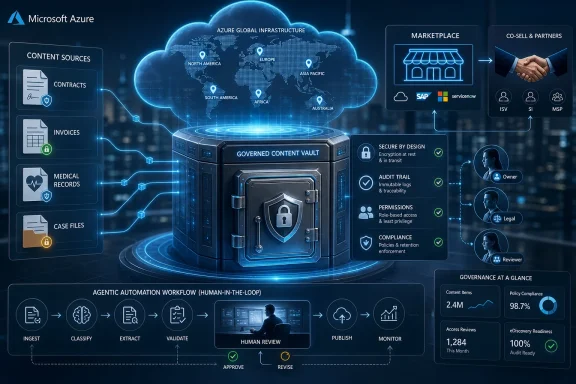 Microsoft’s AI Ambition Needs Somebody Else’s Filing Cabinets
The last two years of enterprise AI have been sold as a model story. Bigger models, cheaper tokens, richer copilots, smarter agents: the industry’s marketing departments have trained customers to look upward, toward the foundation model layer, as if that is where the entire transformation will be decided. But inside most large organizations, the blockage is usually lower down and far less glamorous.The documents are scattered. The permissions are uneven. The metadata is unreliable. The workflows exist partly in content management systems, partly in email, partly in line-of-business applications, and partly in the institutional memory of employees who know which spreadsheet actually matters.
That is where Hyland’s Microsoft deal earns its relevance. Hyland is not trying to compete with Azure as a cloud platform or with Microsoft as an AI infrastructure vendor. It is positioning its Content Innovation Cloud as a governed content layer that can make enterprise information usable by automated systems without pretending that decades of records management, case files, forms, images, contracts, and departmental repositories can simply be thrown into a vector database and blessed as digital transformation.
Microsoft, for its part, benefits from having more of that messy enterprise substrate adjacent to Azure. The company already has the operating system footprint, the productivity suite, the identity layer, the developer platform, and a widening set of AI services. What it does not automatically have is clean, permission-aware, industry-specific access to every customer’s high-value content estate. Partnerships like this are how Microsoft widens the aperture without building or buying every vertical content platform itself.
The result is an alliance that sounds predictable on the surface and strategic underneath. Hyland gets Azure reach, marketplace access, and Microsoft sales gravity. Microsoft gets another reason for regulated enterprises to treat Azure as the place where their content, AI, and workflow plans converge.
The Cloud Region Is Now a Product Feature
The old enterprise software pitch was about functionality. The cloud pitch added elasticity, managed operations, and subscription economics. The AI pitch now adds a new requirement: where the data lives, where it is processed, and whether the organization can prove that both choices satisfy internal and external rules.That makes Azure availability more than a hosting detail. Hyland is explicitly framing the Microsoft partnership around regional reach, data residency options, and the ability to support customers across cloud environments. That language matters because the customers most likely to care about Hyland’s platform are not startups free to chase the cheapest GPU region. They are hospitals, insurers, banks, public agencies, universities, and large enterprises whose records are entangled with statutes, retention schedules, audit trails, and sovereignty expectations.
For those buyers, “cloud” has never meant “anywhere.” It means a set of acceptable places, controls, and contractual assurances. A platform that can run in more Azure geographies gives procurement and compliance teams more room to say yes, especially when the alternative is a custom exception process or a stalled AI pilot that cannot cross the line into production.
The practical significance is easy to underestimate. An AI proof of concept can run on sanitized data in a friendly region and produce a convincing demo. A production deployment has to ingest real documents, honor real permissions, survive audits, and fit a disaster recovery plan. It has to answer whether patient records, loan files, claims correspondence, student documents, or government case material can be stored and processed in a specific jurisdiction.
Hyland’s bet is that customers will not separate those questions from AI adoption. In that reading, Azure is not merely compute capacity. It is a compliance and operations envelope that makes the content layer easier to buy.
Marketplace Is the Quiet Weapon in the Deal
The Microsoft Marketplace angle may turn out to be as important as the technical integration. Enterprise software buyers do not only choose products; they choose purchasing paths. If a vendor can be bought through an existing Microsoft commercial agreement, the friction drops, the budget conversation changes, and the sales cycle can shorten.That is especially true when customers have committed cloud spend with Microsoft. Marketplace procurement can let organizations apply existing cloud commitments to third-party software purchases, which gives a Hyland deal a different internal shape than a standalone vendor contract. For a CIO, procurement officer, or enterprise architect trying to consolidate cloud spending, that matters.
It also aligns Hyland with Microsoft’s partner machinery. Co-sell is not just a press-release phrase. It means Microsoft account teams can have a reason to bring Hyland into conversations where the customer’s AI ambition is blocked by content sprawl, document-heavy workflows, or governance requirements. For Hyland, that is access to a sales channel few independent enterprise software companies can reproduce on their own.
For Microsoft, marketplace expansion has a cumulative effect. The more serious industry software that becomes purchasable and deployable through Microsoft’s commercial ecosystem, the more Azure looks less like an infrastructure choice and more like the default enterprise procurement rail. That is a powerful form of lock-in because it is procedural rather than purely technical.
This is where administrators should pay attention. A marketplace purchase may be easier to approve, but it also tightens the relationship between cloud commitments, identity decisions, security controls, and vendor governance. The convenience is real. So is the need for disciplined tenant management, permissions review, cost allocation, and lifecycle oversight.
Hyland Is Selling Governance as the Missing AI Layer
Hyland’s public language around the deal leans hard into “agentic” work. That term is already at risk of becoming another enterprise AI buzzword, stretched to cover everything from scripted automation to semi-autonomous assistants. But underneath the branding is a real architectural point: agents are only useful in business workflows if they can act on trusted context.That context is usually buried in unstructured content. Contracts, invoices, claims packets, medical documents, transcripts, HR forms, engineering files, case notes, scanned records, and emails often contain the facts that determine what a business process should do next. Traditional systems of record hold structured data, but the reasoning trail often lives in documents.
Hyland’s Content Innovation Cloud is pitched as a way to connect, govern, enrich, and automate around that content. The company has been expanding the platform with content federation, intelligent document processing, workflow automation, and AI-oriented context services. The Microsoft partnership gives that strategy a larger cloud stage.
The key phrase from Hyland’s side is “governed content.” It is doing a lot of work. In enterprise AI, governance is not a decorative compliance layer added after a system starts producing output. It is the difference between an assistant that can summarize a brochure and an automation system that can move a claim, a permit, a loan, or a patient record through a process without violating policy.
That is why document management vendors suddenly sound more strategically relevant than they did during the first wave of generative AI hype. The industry spent 2023 and 2024 asking what models could generate. The harder 2026 question is what systems can safely do with the information an organization already owns.
Regulated Industries Are the Real Test Case
The partnership’s stated targets include healthcare, insurance, financial services, education, and government. That is not accidental. These sectors have large volumes of content, strict rules about handling it, and workflow bottlenecks that AI vendors love to cite in demos.They are also the sectors least likely to accept vague answers about training data, residency, access control, retention, or auditability. A hospital cannot treat clinical documentation as generic enterprise text. An insurer cannot let an automated workflow mishandle claims evidence. A public agency cannot make sensitive records globally fluid just because a cloud service is technically capable of moving them.
This is where Azure’s regional footprint and Microsoft’s enterprise compliance posture become part of Hyland’s value proposition. The content platform still has to prove itself on implementation details, but Azure gives it a recognizable operating environment for customers already standardized on Microsoft identity, security, management, and procurement tools.
For Windows-heavy organizations, the fit is obvious. Microsoft Entra ID, Microsoft 365, SharePoint, Teams, Purview, Defender, and Azure services are already embedded in many enterprise estates. A content platform that can sit more naturally in that orbit has a better chance of becoming part of production architecture rather than another isolated AI experiment.
Still, there is a caution buried in the promise. Regulated industries do not need more disconnected AI pilots. They need fewer systems that create new governance blind spots. The success of this partnership will depend less on whether Hyland and Microsoft can describe agent-driven workflows and more on whether customers can map those workflows to existing controls without inventing a parallel compliance universe.
Multicloud Survives, But Azure Gains the Center of Gravity
Hyland is careful to frame the Microsoft agreement as an expansion of cloud options, not an exclusive turn toward Azure. That distinction is important. Enterprise software vendors know that the biggest customers rarely want a single-cloud ultimatum, especially when geography, acquisitions, legacy deployments, and regulatory constraints create mixed environments.But “multicloud” often means different things depending on who is speaking. To a CIO, it can mean avoiding concentration risk. To an application vendor, it can mean supporting enough deployment models to keep sales conversations alive. To a hyperscaler, it can mean allowing the customer to bring other systems into its orbit while keeping the strategic control plane close.
In this case, Azure clearly gains weight. Hyland’s software being available through Azure, connected to Microsoft’s marketplace and co-sell channels, gives Microsoft a stronger hand in accounts where content governance and AI deployment are becoming linked. Even if Hyland continues to support broader cloud strategies, the Microsoft route now has commercial and operational advantages that customers will notice.
That does not make the partnership hostile to multicloud. In fact, it may make multicloud more practical for some organizations by giving them a governed content platform with wider deployment choice. But it does make Azure harder to ignore when AI plans intersect with enterprise content.
The question for IT leaders is whether this centralization simplifies architecture or quietly narrows future choices. Azure-native convenience can be a gift when teams are under pressure to deliver. It can also become a long-term dependency if content workflows, AI services, identity assumptions, and procurement incentives all converge in one vendor’s ecosystem.
The Windows Angle Is Bigger Than Windows
At first glance, this is a cloud software story rather than a Windows story. But for WindowsForum’s audience, the connection is not hard to find. Microsoft’s enterprise strategy increasingly treats Windows, Microsoft 365, Azure, Entra, Defender, Purview, Power Platform, and Copilot as pieces of a single operating environment for work.The desktop is no longer the boundary of Microsoft’s influence. It is one endpoint in a broader system where identity, policy, content, security telemetry, and automation travel across cloud services. When a vendor like Hyland moves closer to Azure, it strengthens that system because more enterprise content can participate in Microsoft-centered workflows.
That matters for administrators who live with the consequences. A user may experience AI as a button in a productivity app, but IT has to answer where the underlying documents came from, whether the user had rights to them, whether the retention label followed, whether the action was logged, and whether the result can be explained later. Those are not model questions. They are platform questions.
Hyland’s role is to bring business content management and workflow automation into that discussion. Microsoft’s role is to provide the cloud, identity, AI, marketplace, and sales structure around it. Together, they are making the case that enterprise AI becomes real only when it is attached to managed content and operational process.
This is also why Windows administrators should resist treating AI strategy as someone else’s problem. The same directory groups, conditional access policies, endpoint controls, information protection labels, and audit expectations that shaped the Microsoft stack before generative AI will shape it afterward. The tooling changes, but the governance burden does not disappear.
Agentic Automation Is a Sales Pitch Until It Meets Change Control
The phrase “agentic automation” is everywhere now because it promises a step beyond dashboards and chatbots. Instead of asking a model a question, the enterprise wants systems that can take action: classify a document, route an exception, assemble a case file, trigger a workflow, escalate a risk, or prepare a decision for human review.That is a compelling vision. It is also exactly where enterprise IT tends to become conservative, and for good reason. Automation that reads content is useful; automation that acts on content can create liability if the rules, permissions, and failure modes are not well understood.
Hyland and Microsoft are pitching the partnership as a way to move AI from pilots into day-to-day workflows. The phrase is right, but the operational path is steep. Production AI in content-heavy environments requires testing, policy mapping, integration with existing records systems, monitoring, exception handling, and user training. It also requires sober decisions about where humans remain in the loop.
That last point is often softened in vendor language. “Agentic” suggests autonomy, but most regulated enterprises will begin with constrained automation rather than open-ended agents. The more sensitive the workflow, the more likely the first deployments will be assistive, supervised, and narrowly scoped.
This is not a failure of the technology. It is how durable enterprise systems are introduced. The organizations that benefit most will be the ones that treat agents not as magic employees but as software components that need permissions, logs, rollback paths, and accountability.
The Content Wars Are Becoming the AI Wars
There is a broader market pattern here. The first AI infrastructure wave rewarded companies with models, GPUs, cloud capacity, and developer platforms. The next wave will reward companies that control the business context those models need. That context lives in content systems, collaboration platforms, data warehouses, CRM systems, ERP platforms, ticketing queues, and vertical applications.Microsoft already has a formidable position in collaboration and productivity content through Microsoft 365. But the enterprise content universe is larger and stranger than SharePoint and OneDrive. Hyland’s installed base and product portfolio reach into specialized document and process environments that Microsoft cannot simply assume are native to its stack.
By bringing Hyland’s Content Innovation Cloud to Azure, Microsoft is effectively expanding the set of enterprise content that can be made AI-adjacent without demanding an immediate rip-and-replace migration. Hyland’s federation-oriented messaging is important here. Customers do not want to move every repository before they can start extracting value from content.
That is also why the partnership speaks to unstructured data so directly. AI vendors often describe unstructured data as an untapped gold mine, but unstructured content is not valuable merely because it exists. It becomes valuable when it is connected to permissions, business meaning, process state, and governance rules.
The winners in this market will not be the vendors that can ingest the most files in a demo. They will be the vendors that can preserve the enterprise meaning of those files while making them useful to automation. Hyland is arguing that this is its home turf. Microsoft is giving that argument a larger cloud venue.
Procurement May Decide the Pace More Than Technology
One of the less glamorous truths of enterprise IT is that technology is often ready before the organization is ready to buy it. Marketplace availability is designed to attack that problem. It gives vendors a way to meet customers inside purchasing structures they already use, and it gives customers a way to consolidate spend through familiar agreements.For Hyland, Microsoft Marketplace can reduce the overhead of selling into large accounts, particularly those already deep into Azure commitments. For customers, it may simplify legal review, billing, and budget application. For Microsoft, it increases the amount of third-party software gravity flowing through its commercial platform.
This creates a feedback loop. If a customer can buy Hyland through Microsoft, deploy it on Azure, integrate it with Microsoft identity and AI services, and justify it as part of an enterprise AI modernization effort, the deal becomes easier to package. That ease does not guarantee success, but it can accelerate adoption.
The danger is that procurement simplicity can obscure architectural complexity. Buying through Marketplace does not automatically solve data classification, tenant design, identity boundaries, integration debt, or records retention. It just makes the purchase easier. The work still lands on enterprise architects, security teams, records managers, and application owners.
That is why this announcement should be read as an opportunity, not a shortcut. The commercial route may be smoother. The implementation still deserves the same skepticism IT pros apply to any platform that touches sensitive business content.
The AI Readiness Problem Finally Gets a Business Owner
A recurring problem in enterprise AI is that everyone agrees the organization needs better data, but no one owns the ugly middle layer between raw information and usable intelligence. Data teams own warehouses and lakes. Security teams own controls. Legal owns risk. Business units own process. IT owns platforms. Records teams own retention. The AI team, if it exists, owns the demo.Content management vendors are trying to step into that gap. Hyland’s message is that AI readiness depends on making enterprise content governed, connected, enriched, and actionable. That is a more grounded claim than the idea that a general-purpose assistant can simply hover over the organization and understand it.
The Microsoft partnership strengthens that claim because it places the content readiness layer inside a cloud ecosystem that many enterprises already trust. If Hyland can connect content repositories, apply governance, enrich context, and enable workflow automation on Azure, it becomes easier for customers to assign ownership to a platform rather than a loose committee.
But ownership will still be contested. Business units will want speed. Compliance teams will want proof. Security teams will want containment. Users will want convenience. Vendors will want expansion. The hard part is not getting everyone to agree that AI-ready content is good; it is getting them to agree on the operating model.
That is the hidden enterprise work behind the announcement. Bringing Hyland to Azure may solve some deployment and procurement constraints. It does not automatically solve organizational fragmentation. In many companies, that will remain the hardest migration.
The Real Win Is Less AI Theater and More Boring Control
The industry’s AI narrative has been inflated by demos that make hard problems look like interface problems. Ask a question, get an answer. Upload a document, receive a summary. Tell an agent what you want, watch it go. Enterprise reality is not so clean.Hyland and Microsoft are selling a more plausible version of the future, even if they are using the same fashionable vocabulary as everyone else. The premise is that automation at scale requires governed content, regional deployment options, procurement alignment, and integration with everyday workflows. That is less cinematic than a chatbot, but it is much closer to how enterprises actually change.
The value for customers will depend on execution. If the partnership produces a clean Azure deployment path, meaningful marketplace availability, strong identity and governance integration, and practical patterns for regulated industries, it could help organizations move AI projects out of the lab. If it becomes mostly co-branded positioning, customers will still be left stitching together content, permissions, and workflows themselves.
Microsoft has every incentive to make the former happen. Azure’s competition with AWS and Google Cloud is no longer just about infrastructure services. It is about becoming the place where enterprise AI becomes operational. That requires partners with domain-specific systems and content expertise.
Hyland has every incentive as well. Enterprise content management is being redefined by AI, and legacy document storage is not a growth story by itself. By leaning into governed content, agentic workflows, and Azure reach, Hyland is trying to make itself part of the AI operating layer rather than a repository vendor defending old territory.
The Azure Deal Gives Hyland’s AI Story a Distribution Engine
Hyland’s announcement arrives alongside a broader push around its Content Innovation Cloud, including agentic automation, enterprise context, and content federation messaging. That timing is important. The Microsoft partnership is not a standalone infrastructure decision; it is part of a campaign to recast enterprise content management as the foundation for AI-native work.The challenge is that many customers have heard similar transformation language before. ECM vendors have spent years promising modernization, workflow efficiency, and unified content. What is different now is the pressure from executives to show AI progress and the realization that AI progress stalls when content is inaccessible or ungoverned.
Azure gives Hyland a distribution engine for that argument. Microsoft’s enterprise account presence, marketplace channel, and cloud commitments can put Hyland into more AI strategy conversations than it could reach alone. That is particularly valuable when the buyer is not only a records manager or departmental application owner, but a CIO, chief data officer, security leader, or AI transformation office.
Still, Hyland will need to translate the broad promise into concrete deployment patterns. Customers will want to know which repositories can be federated, how permissions are preserved, how content is enriched, how agents are constrained, how audit trails work, and how costs scale. The more Hyland and Microsoft can answer those questions with reference architectures rather than slogans, the stronger the partnership becomes.
For IT pros, the right posture is neither cynicism nor credulity. This is a logical move by both companies. It is also a reminder that enterprise AI is becoming a platform integration problem, and platform integration is where hidden costs, governance gaps, and long-term dependencies usually appear.
The Practical Reading for Microsoft-Centric IT Shops
For organizations already committed to Microsoft’s stack, the Hyland partnership should be viewed as another sign that Azure is becoming the default landing zone for serious enterprise AI adjuncts. It does not mean every Hyland customer should move immediately, and it does not mean Azure is the only viable cloud for content-heavy AI. It does mean the path of least resistance may increasingly run through Microsoft’s commercial and technical ecosystem.That has practical implications for architecture planning. Content platforms can no longer be evaluated only as repositories or workflow tools. They need to be assessed as AI context providers, governance enforcement points, and automation substrates. The questions admins ask during procurement should evolve accordingly.
The most important shift is mental. If AI systems are going to act on enterprise content, then content management becomes security infrastructure. It becomes identity infrastructure. It becomes compliance infrastructure. It becomes part of the operational fabric that determines whether AI can be trusted outside a sandbox.
That is the unglamorous but necessary reading of the Hyland-Microsoft deal. The future being sold is agent-driven work. The future that has to be built is permission-aware, region-conscious, auditable workflow automation.
The Deal’s Meaning Is Written in the Deployment Details
The Hyland-Microsoft partnership is best understood through the concrete changes it could bring to customers rather than the broad language of transformation. The strategic direction is clear, but the operational value will be measured in implementation specifics.- Hyland’s Content Innovation Cloud is being brought to Microsoft Azure to expand deployment choice, geographic reach, and data residency options for enterprise customers.
- Microsoft Marketplace availability could make Hyland easier to buy for organizations that already use Microsoft commercial agreements and cloud commitments.
- The co-sell arrangement gives Hyland access to Microsoft’s enterprise sales motion while giving Microsoft another content governance partner for Azure-based AI adoption.
- The most relevant customers are likely to be regulated or document-heavy organizations where AI cannot move into production without strong controls over content, permissions, and location.
- The partnership reinforces a larger market shift in which enterprise AI depends less on model novelty and more on governed access to business context.
- IT teams should treat the deal as a platform integration opportunity that still requires careful planning around identity, compliance, auditability, cost, and long-term cloud dependency.
References
- Primary source: IT Brief UK
Published: Mon, 01 Jun 2026 13:06:00 GMT
Loading…
itbrief.co.uk - Related coverage: hyland.com
Hyland continues the accelerated expansion of the Content Innovation Cloud | Hyland
With customer adoption intensifying, Hyland unveils significant updates across its platform, including rapid agent creation, smarter document intelligence, and seamless content federationwww.hyland.com
- Related coverage: prnewswire.com

Hyland Collaborates with Microsoft to Power the Agentic Enterprise with the Content Innovation Cloud on Microsoft Azure
/PRNewswire/ -- Hyland, a global leader in enterprise content management (ECM) and the pioneer of the content-powered agentic enterprise, today announced a... www.prnewswire.com
- Official source: partner.microsoft.com
Loading…
partner.microsoft.com - Related coverage: microland.com
Loading…
www.microland.com
