

Hyland announced on June 1, 2026, that it is partnering with Microsoft to bring the Hyland Content Innovation Cloud to Microsoft Azure, expand availability through Microsoft Marketplace, and create a joint go-to-market motion for enterprise content and AI deployments. The move is not merely another cloud listing in a crowded marketplace. It is a bet that the next phase of enterprise AI will be won less by model choice than by control over the documents, records, workflows, and permissions that decide whether those models can be trusted in production. For WindowsForum readers, the interesting part is not the branding around “agentic” work; it is how deeply the Microsoft cloud is becoming the default procurement, deployment, and governance layer for enterprise software that used to sit closer to the line-of-business stack.
The enterprise AI story has spent two years talking as if the bottleneck were raw intelligence. Bigger models, longer context windows, better copilots, and faster inference have dominated the conversation. But inside large organizations, the problem is often more mundane and more stubborn: the business knows where the answers are, but those answers live in unstructured content spread across document stores, records systems, case files, emails, scanned forms, images, legacy ECM repositories, and workflow platforms.
Hyland’s pitch to Microsoft’s Azure base lands squarely in that gap. The company is not claiming to be the model provider of record. It is arguing that AI systems need a governed content foundation before they can safely automate work that touches regulated data, customer files, clinical records, claims, student records, public-sector documents, or financial workflows.
That is a less glamorous position than building the AI assistant everyone sees on screen, but it may be the more durable one. Enterprises can experiment with a chatbot in a sandbox using a sanitized knowledge base. They cannot let an agent approve a claim, route a medical record, summarize a legal packet, or trigger a government workflow unless the underlying content is current, permission-aware, auditable, and stored in the right jurisdiction.
This is where the Microsoft angle matters. Azure is not simply compute capacity in this deal; it is the cloud substrate many enterprises already use for identity, security policy, compliance tooling, procurement, data residency planning, and AI infrastructure. By bringing the Content Innovation Cloud onto Azure, Hyland is trying to meet customers where their architects, finance teams, and compliance officers already have leverage.
Content management has always been the unglamorous infrastructure of enterprise work. It stores the intake forms, invoices, claims packets, medical images, correspondence, approval chains, retention rules, and audit trails that keep companies and agencies functioning. In the AI era, those systems become even more important because they hold the raw material that agents are expected to reason over.
That changes the value of old ECM assets. A scanned document repository that once looked like a compliance burden may become part of the context layer for a workflow agent. A records policy that once existed to satisfy auditors may become a control boundary for what AI can retrieve, summarize, or act upon. A metadata model that once looked like administrative overhead may become the difference between a useful answer and a hallucinated one.
Hyland’s advantage, if it can execute, is that it already speaks the language of document-heavy industries. Healthcare, insurance, financial services, education, and government are not waiting for AI because they lack enthusiasm. They are moving cautiously because errors are expensive, privacy rules are real, and data sovereignty cannot be waved away with a demo.
Data residency used to be a procurement checkbox. In the AI era, it becomes a design constraint. If an organization uses AI to process business content, it must understand not only where the stored files reside, but also where indexing, enrichment, model calls, embeddings, workflow actions, logs, and derived outputs are created and retained.
That is especially important outside the United States, but it is not only an international issue. Public-sector agencies, healthcare systems, insurers, banks, and universities increasingly want deployment patterns that match local law, contractual commitments, and internal risk policy. The ability to say “we can deploy this content platform in Azure regions that align with your geography and governance model” is therefore more than a technical feature. It is a sales accelerator.
For Microsoft, this reinforces Azure’s role as the enterprise landing zone for regulated AI workloads. The company has spent years positioning Azure as the place where customers can combine cloud infrastructure, identity, security, compliance, and AI services. Hyland gives Microsoft another industry-specific content layer to attach to that proposition.
For Hyland, Azure access lowers a familiar enterprise barrier. A CIO or chief data officer may not want to introduce another isolated cloud relationship just to modernize content services. But if the deployment can ride on an existing Azure architecture, existing security practices, and existing Microsoft commercial commitments, the internal argument becomes easier.
Making Hyland products available through Microsoft Marketplace gives customers a route to buy using commercial machinery they may already have in place. That can matter for organizations with Azure consumption commitments, standardized vendor review processes, or cloud procurement governance that strongly favors marketplace transactions over bespoke contracting.
This is one reason cloud marketplaces have become strategic assets for the hyperscalers. They are not just app stores. They are procurement channels, partner ecosystems, and consumption engines. If a customer can apply existing cloud spend commitments to a third-party solution, the sales conversation changes from “approve a new vendor and a new budget line” to “allocate existing cloud commitment toward a workload we already need.”
That is good for Microsoft because it makes Azure stickier. It is good for Hyland because it reduces friction. It is good for customers only if the marketplace route does not obscure the hard questions: data architecture, long-term cost, contractual lock-in, regional availability, support boundaries, and whether the product’s Azure deployment has feature parity with other cloud options.
The procurement shortcut is useful, but it is not a substitute for architecture review. IT teams should treat marketplace availability as a way to simplify buying, not as proof that a deployment is automatically aligned with internal policy.
A clean “all-in on Azure” story would be attractive to Microsoft but less credible to customers who already live in fragmented environments. Content platforms often sit across departmental and historical boundaries. One part of the organization may be modernizing aggressively while another still depends on legacy repositories or regulated archives that cannot be moved without a multi-year program.
The multicloud language is therefore not just diplomatic. It reflects how enterprise content actually behaves. Documents and records accumulate over decades. They are embedded in workflows, retention schedules, integrations, and user habits. Even when the strategic direction is cloud-first, the operational reality is hybrid for a long time.
That is why Hyland’s Azure move should be read as additive rather than exclusive. The company gains a stronger Microsoft path without abandoning customers who need other deployment models. Microsoft gains a partner whose customers may be easier to pull toward Azure-adjacent modernization without forcing a disruptive migration on day one.
The more enterprise software lands on Azure and sells through Microsoft Marketplace, the more Microsoft becomes the control plane for organizational technology decisions. That has real advantages. Identity integration can become cleaner. Security policy can become more consistent. Procurement can become faster. Admins can standardize monitoring, access, and compliance processes around a smaller number of platforms.
But there is also a gravitational cost. Once content platforms, AI tools, workflow engines, and procurement commitments converge around Azure, switching paths becomes harder. The decision to deploy one content platform through Microsoft’s ecosystem may be perfectly rational. The cumulative effect of dozens of similar decisions is a deeper dependency on Microsoft’s commercial and technical roadmap.
That is not inherently bad. Microsoft has earned enterprise trust in many areas, and Azure’s global footprint is a serious asset. But IT leaders should name the trade-off plainly. Azure alignment can reduce operational complexity while increasing strategic dependency.
This is especially relevant for organizations that want to keep AI governance portable. If an enterprise’s document intelligence, content services, identity policy, marketplace billing, and agent workflows all become tightly coupled to one hyperscaler, it may gain speed but lose negotiating flexibility. The question is not whether Azure is capable. The question is how much optionality the organization wants to preserve.
That is a sensible thesis, but it should be handled carefully. Many of the workflows now being rebranded as agentic automation have existed for years in less fashionable form: document capture, classification, routing, extraction, exception handling, approval chains, case management, and robotic process automation. AI can improve these workflows, but it does not repeal the need for process design.
The risk is that organizations hear “agent” and imagine a general-purpose digital employee. The more realistic near-term value is narrower and more useful. An agent might classify incoming documents, summarize a case file, detect missing information, recommend a next action, or draft a response for human review. Those are meaningful improvements, especially at scale, but they still require controls.
Hyland’s content governance pitch is relevant precisely because agentic systems are dangerous when detached from policy. A workflow agent that cannot distinguish between draft and approved content is a liability. An AI assistant that retrieves records a user should not see is a security incident waiting to happen. A summarization system that ignores retention or jurisdictional rules can create compliance exposure even if its language sounds plausible.
The practical question for customers is not whether Hyland and Microsoft can say “agentic” convincingly. It is whether the resulting platform can enforce permissions, preserve auditability, expose data lineage, support human review, and operate within the regions and regulations that govern the customer’s business.
By bringing a regulated-content specialist into the Azure ecosystem, Microsoft expands the set of enterprise workloads that can be tied to its cloud and AI platform. The value is not limited to compute consumption. Marketplace transactions, co-sell motions, identity integration, security alignment, and AI service adjacency all reinforce Azure’s position in the account.
This is why the joint go-to-market language matters. A co-sell arrangement can put Hyland into conversations where Microsoft account teams are already discussing AI modernization, cloud migration, data governance, or industry transformation. That gives Hyland reach it would be expensive to build alone and gives Microsoft a more complete answer when customers ask how to operationalize AI against regulated content.
The result is an ecosystem flywheel. Microsoft attracts partners because enterprises already buy Azure. Partners attract customers because Microsoft can simplify procurement and deployment. Customers deepen Azure consumption because more of their business applications become available there. The technical partnership is only one part of the loop; the commercial machinery may be just as important.
The first question is availability. Customers should confirm which Hyland products and services are available on Azure, in which regions, under what deployment model, and with what feature parity compared with other Hyland cloud offerings. “Available through Azure” can mean several different things depending on architecture, hosting, integration, support, and commercial packaging.
The second question is data flow. In AI-enabled content systems, the storage location is only one piece of the puzzle. Teams should map how content is indexed, processed, embedded, summarized, logged, retained, and exposed to workflow agents. They should also understand whether Microsoft AI services, Hyland services, or third-party components are involved at each stage.
The third question is governance. If the platform is meant to support regulated industries, customers need evidence around access control, audit trails, encryption, retention, eDiscovery, data residency, disaster recovery, and administrative separation of duties. The best AI demo in the world will not survive a compliance review if the control model is vague.
The fourth question is operational fit. Many Hyland customers have complex existing deployments. Migration strategy, coexistence with on-premises repositories, integration with Microsoft 365 and SharePoint, identity federation, backup strategy, and admin tooling will decide whether the Azure option accelerates modernization or simply adds another cloud layer to manage.
Hyland’s angle is that the enterprise memory is not just chat history, email, or CRM fields. It is the body of governed content that records what the organization has done and what it is allowed to do next. That is a powerful position if customers accept it.
Content is messy, but it is also sticky. Once a platform becomes responsible for the records that drive clinical, financial, legal, educational, or public-sector decisions, it becomes difficult to displace. If AI makes those records more valuable by turning them into operational intelligence, the content platform’s strategic importance rises.
This is why the partnership is bigger than a deployment announcement. It reflects a broader market shift from AI as a standalone application to AI as an embedded capability inside governed systems of work. The companies that control those systems will shape what enterprise AI can actually do.
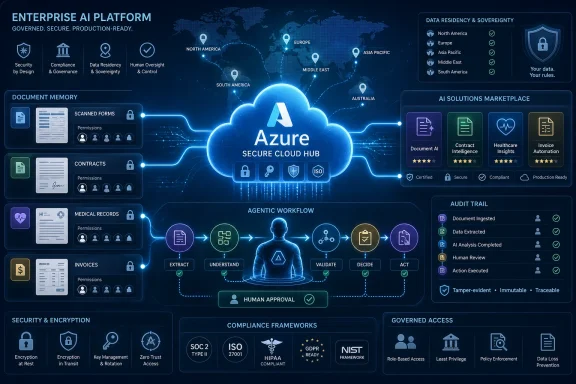 Microsoft’s AI Platform Needs Governed Content, Not Just Bigger Models
The enterprise AI story has spent two years talking as if the bottleneck were raw intelligence. Bigger models, longer context windows, better copilots, and faster inference have dominated the conversation. But inside large organizations, the problem is often more mundane and more stubborn: the business knows where the answers are, but those answers live in unstructured content spread across document stores, records systems, case files, emails, scanned forms, images, legacy ECM repositories, and workflow platforms.Hyland’s pitch to Microsoft’s Azure base lands squarely in that gap. The company is not claiming to be the model provider of record. It is arguing that AI systems need a governed content foundation before they can safely automate work that touches regulated data, customer files, clinical records, claims, student records, public-sector documents, or financial workflows.
That is a less glamorous position than building the AI assistant everyone sees on screen, but it may be the more durable one. Enterprises can experiment with a chatbot in a sandbox using a sanitized knowledge base. They cannot let an agent approve a claim, route a medical record, summarize a legal packet, or trigger a government workflow unless the underlying content is current, permission-aware, auditable, and stored in the right jurisdiction.
This is where the Microsoft angle matters. Azure is not simply compute capacity in this deal; it is the cloud substrate many enterprises already use for identity, security policy, compliance tooling, procurement, data residency planning, and AI infrastructure. By bringing the Content Innovation Cloud onto Azure, Hyland is trying to meet customers where their architects, finance teams, and compliance officers already have leverage.
Hyland Is Selling the Boring Part of AI Because the Boring Part Is Where Production Breaks
The announcement’s language leans hard into “agentic automation,” “actionable intelligence,” and production-scale AI. That vocabulary is now unavoidable in enterprise software, and some skepticism is healthy. But beneath the marketing layer is a real operational problem: most organizations do not fail at AI because they cannot call an API; they fail because they cannot reliably connect AI to the business context that makes an answer useful.Content management has always been the unglamorous infrastructure of enterprise work. It stores the intake forms, invoices, claims packets, medical images, correspondence, approval chains, retention rules, and audit trails that keep companies and agencies functioning. In the AI era, those systems become even more important because they hold the raw material that agents are expected to reason over.
That changes the value of old ECM assets. A scanned document repository that once looked like a compliance burden may become part of the context layer for a workflow agent. A records policy that once existed to satisfy auditors may become a control boundary for what AI can retrieve, summarize, or act upon. A metadata model that once looked like administrative overhead may become the difference between a useful answer and a hallucinated one.
Hyland’s advantage, if it can execute, is that it already speaks the language of document-heavy industries. Healthcare, insurance, financial services, education, and government are not waiting for AI because they lack enthusiasm. They are moving cautiously because errors are expensive, privacy rules are real, and data sovereignty cannot be waved away with a demo.
Azure Turns a Content Platform Into a Regional Deployment Argument
The strongest part of the Microsoft partnership is not that Hyland will run on another hyperscaler. It is that Azure gives Hyland a bigger regional and compliance story at exactly the moment customers are demanding more precise control over where data lives and how it is processed.Data residency used to be a procurement checkbox. In the AI era, it becomes a design constraint. If an organization uses AI to process business content, it must understand not only where the stored files reside, but also where indexing, enrichment, model calls, embeddings, workflow actions, logs, and derived outputs are created and retained.
That is especially important outside the United States, but it is not only an international issue. Public-sector agencies, healthcare systems, insurers, banks, and universities increasingly want deployment patterns that match local law, contractual commitments, and internal risk policy. The ability to say “we can deploy this content platform in Azure regions that align with your geography and governance model” is therefore more than a technical feature. It is a sales accelerator.
For Microsoft, this reinforces Azure’s role as the enterprise landing zone for regulated AI workloads. The company has spent years positioning Azure as the place where customers can combine cloud infrastructure, identity, security, compliance, and AI services. Hyland gives Microsoft another industry-specific content layer to attach to that proposition.
For Hyland, Azure access lowers a familiar enterprise barrier. A CIO or chief data officer may not want to introduce another isolated cloud relationship just to modernize content services. But if the deployment can ride on an existing Azure architecture, existing security practices, and existing Microsoft commercial commitments, the internal argument becomes easier.
Marketplace Is the Procurement Story Hiding in Plain Sight
The Microsoft Marketplace piece deserves more attention than it usually gets. Enterprise software partnerships often lead with technology integration and bury procurement in the final paragraph. In practice, procurement can be the difference between a promising platform and a stalled pilot.Making Hyland products available through Microsoft Marketplace gives customers a route to buy using commercial machinery they may already have in place. That can matter for organizations with Azure consumption commitments, standardized vendor review processes, or cloud procurement governance that strongly favors marketplace transactions over bespoke contracting.
This is one reason cloud marketplaces have become strategic assets for the hyperscalers. They are not just app stores. They are procurement channels, partner ecosystems, and consumption engines. If a customer can apply existing cloud spend commitments to a third-party solution, the sales conversation changes from “approve a new vendor and a new budget line” to “allocate existing cloud commitment toward a workload we already need.”
That is good for Microsoft because it makes Azure stickier. It is good for Hyland because it reduces friction. It is good for customers only if the marketplace route does not obscure the hard questions: data architecture, long-term cost, contractual lock-in, regional availability, support boundaries, and whether the product’s Azure deployment has feature parity with other cloud options.
The procurement shortcut is useful, but it is not a substitute for architecture review. IT teams should treat marketplace availability as a way to simplify buying, not as proof that a deployment is automatically aligned with internal policy.
The Multicloud Message Is a Necessary Hedge
Hyland is careful to frame the Microsoft deal as an expansion of cloud choice rather than a single-cloud conversion. That caveat matters. Many of Hyland’s customers are large, slow-moving, and heterogeneous by design. They may run Microsoft 365, Azure, AWS workloads, legacy on-premises systems, private cloud infrastructure, and industry-specific applications that are not moving anywhere quickly.A clean “all-in on Azure” story would be attractive to Microsoft but less credible to customers who already live in fragmented environments. Content platforms often sit across departmental and historical boundaries. One part of the organization may be modernizing aggressively while another still depends on legacy repositories or regulated archives that cannot be moved without a multi-year program.
The multicloud language is therefore not just diplomatic. It reflects how enterprise content actually behaves. Documents and records accumulate over decades. They are embedded in workflows, retention schedules, integrations, and user habits. Even when the strategic direction is cloud-first, the operational reality is hybrid for a long time.
That is why Hyland’s Azure move should be read as additive rather than exclusive. The company gains a stronger Microsoft path without abandoning customers who need other deployment models. Microsoft gains a partner whose customers may be easier to pull toward Azure-adjacent modernization without forcing a disruptive migration on day one.
The Windows Angle Is Identity, Governance, and the Microsoft Gravity Well
For WindowsForum readers, the immediate connection is not the Windows desktop. It is the Microsoft enterprise stack that surrounds it: Entra ID, Microsoft 365, SharePoint, Teams, Purview, Defender, Azure, Power Platform, and the broader set of services that now define many Windows-centric organizations.The more enterprise software lands on Azure and sells through Microsoft Marketplace, the more Microsoft becomes the control plane for organizational technology decisions. That has real advantages. Identity integration can become cleaner. Security policy can become more consistent. Procurement can become faster. Admins can standardize monitoring, access, and compliance processes around a smaller number of platforms.
But there is also a gravitational cost. Once content platforms, AI tools, workflow engines, and procurement commitments converge around Azure, switching paths becomes harder. The decision to deploy one content platform through Microsoft’s ecosystem may be perfectly rational. The cumulative effect of dozens of similar decisions is a deeper dependency on Microsoft’s commercial and technical roadmap.
That is not inherently bad. Microsoft has earned enterprise trust in many areas, and Azure’s global footprint is a serious asset. But IT leaders should name the trade-off plainly. Azure alignment can reduce operational complexity while increasing strategic dependency.
This is especially relevant for organizations that want to keep AI governance portable. If an enterprise’s document intelligence, content services, identity policy, marketplace billing, and agent workflows all become tightly coupled to one hyperscaler, it may gain speed but lose negotiating flexibility. The question is not whether Azure is capable. The question is how much optionality the organization wants to preserve.
“Agentic Automation” Is the New Wrapper Around Old Workflow Ambitions
The term “agentic” is now doing a lot of work in enterprise announcements. It implies that AI systems will not merely answer questions but take actions, coordinate tasks, and drive workflows with some degree of autonomy. In Hyland’s framing, the governed content layer is what lets those agents operate with confidence.That is a sensible thesis, but it should be handled carefully. Many of the workflows now being rebranded as agentic automation have existed for years in less fashionable form: document capture, classification, routing, extraction, exception handling, approval chains, case management, and robotic process automation. AI can improve these workflows, but it does not repeal the need for process design.
The risk is that organizations hear “agent” and imagine a general-purpose digital employee. The more realistic near-term value is narrower and more useful. An agent might classify incoming documents, summarize a case file, detect missing information, recommend a next action, or draft a response for human review. Those are meaningful improvements, especially at scale, but they still require controls.
Hyland’s content governance pitch is relevant precisely because agentic systems are dangerous when detached from policy. A workflow agent that cannot distinguish between draft and approved content is a liability. An AI assistant that retrieves records a user should not see is a security incident waiting to happen. A summarization system that ignores retention or jurisdictional rules can create compliance exposure even if its language sounds plausible.
The practical question for customers is not whether Hyland and Microsoft can say “agentic” convincingly. It is whether the resulting platform can enforce permissions, preserve auditability, expose data lineage, support human review, and operate within the regions and regulations that govern the customer’s business.
The Deal Shows How Microsoft Wins Without Owning Every Layer
Microsoft does not need to build every vertical application or content platform to benefit from the AI infrastructure boom. It needs partners to make Azure the natural place where those applications run, transact, and integrate. Hyland’s announcement is a textbook example of that strategy.By bringing a regulated-content specialist into the Azure ecosystem, Microsoft expands the set of enterprise workloads that can be tied to its cloud and AI platform. The value is not limited to compute consumption. Marketplace transactions, co-sell motions, identity integration, security alignment, and AI service adjacency all reinforce Azure’s position in the account.
This is why the joint go-to-market language matters. A co-sell arrangement can put Hyland into conversations where Microsoft account teams are already discussing AI modernization, cloud migration, data governance, or industry transformation. That gives Hyland reach it would be expensive to build alone and gives Microsoft a more complete answer when customers ask how to operationalize AI against regulated content.
The result is an ecosystem flywheel. Microsoft attracts partners because enterprises already buy Azure. Partners attract customers because Microsoft can simplify procurement and deployment. Customers deepen Azure consumption because more of their business applications become available there. The technical partnership is only one part of the loop; the commercial machinery may be just as important.
Customers Should Ask Hard Questions Before the AI Gloss Takes Over
The announcement is directionally important, but it does not answer every implementation question. That is normal for a partnership launch, especially one tied to a broader platform and marketplace motion. Still, IT teams should avoid treating strategic alignment as a substitute for due diligence.The first question is availability. Customers should confirm which Hyland products and services are available on Azure, in which regions, under what deployment model, and with what feature parity compared with other Hyland cloud offerings. “Available through Azure” can mean several different things depending on architecture, hosting, integration, support, and commercial packaging.
The second question is data flow. In AI-enabled content systems, the storage location is only one piece of the puzzle. Teams should map how content is indexed, processed, embedded, summarized, logged, retained, and exposed to workflow agents. They should also understand whether Microsoft AI services, Hyland services, or third-party components are involved at each stage.
The third question is governance. If the platform is meant to support regulated industries, customers need evidence around access control, audit trails, encryption, retention, eDiscovery, data residency, disaster recovery, and administrative separation of duties. The best AI demo in the world will not survive a compliance review if the control model is vague.
The fourth question is operational fit. Many Hyland customers have complex existing deployments. Migration strategy, coexistence with on-premises repositories, integration with Microsoft 365 and SharePoint, identity federation, backup strategy, and admin tooling will decide whether the Azure option accelerates modernization or simply adds another cloud layer to manage.
The Real Contest Is Over the Enterprise Content Memory
Every major enterprise software company now wants to become the interface through which employees interact with business knowledge. Microsoft has Copilot across Microsoft 365 and Windows-adjacent workflows. Salesforce wants business context through CRM. ServiceNow wants it through work management. OpenAI, Google, AWS, Oracle, SAP, and a long list of vertical vendors are all chasing their own version of the same prize.Hyland’s angle is that the enterprise memory is not just chat history, email, or CRM fields. It is the body of governed content that records what the organization has done and what it is allowed to do next. That is a powerful position if customers accept it.
Content is messy, but it is also sticky. Once a platform becomes responsible for the records that drive clinical, financial, legal, educational, or public-sector decisions, it becomes difficult to displace. If AI makes those records more valuable by turning them into operational intelligence, the content platform’s strategic importance rises.
This is why the partnership is bigger than a deployment announcement. It reflects a broader market shift from AI as a standalone application to AI as an embedded capability inside governed systems of work. The companies that control those systems will shape what enterprise AI can actually do.
The Useful Reading for IT Teams Is Hidden Beneath the Partnership Language
Hyland’s Azure expansion is a meaningful signal for organizations that already depend on Microsoft’s cloud, but it should be read as a starting point rather than a finished answer.- Hyland is bringing the Content Innovation Cloud to Microsoft Azure as part of a partnership announced on June 1, 2026.
- The arrangement includes Microsoft Marketplace availability and a joint go-to-market motion intended to make enterprise procurement and sales alignment easier.
- The strongest customer argument is not generic AI acceleration, but governed access to unstructured content in regulated industries.
- Azure gives Hyland a broader regional deployment and data residency story, especially for customers with sovereignty and compliance constraints.
- The deal expands Hyland’s cloud options rather than replacing its multicloud positioning.
- IT leaders should validate architecture, data flows, regional availability, governance controls, and commercial terms before treating marketplace availability as deployment readiness.
References
- Primary source: ChannelLife Australia
Published: Mon, 01 Jun 2026 13:06:00 GMT
Loading…
channellife.com.au - Related coverage: hyland.com
Loading…
www.hyland.com - Related coverage: prnewswire.com
Loading…
www.prnewswire.com - Official source: blogs.microsoft.com
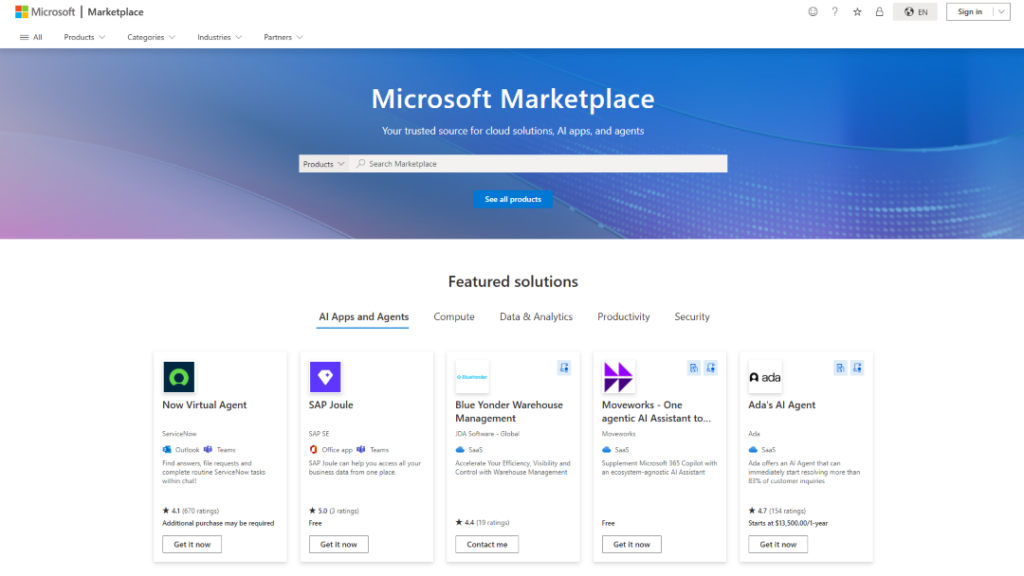
Introducing Microsoft Marketplace — Thousands of solutions. Millions of customers. One Marketplace. - The Official Microsoft Blog
A new breed of industry-leading company is taking shape — Frontier Firms. These organizations blend human ambition with AI-powered technology to reshape how innovation is scaled, work is orchestrated and value is created. They’re accelerating AI transformation to enrich employee experiences... blogs.microsoft.com
- Official source: azure-int.microsoft.com
Sign in to your account
azure-int.microsoft.com
- Official source: marketplace.microsoft.com
Loading…
marketplace.microsoft.com
- Related coverage: connect.hyland.com
Loading…
connect.hyland.com