

Over the past two weeks the cloud’s convenience suddenly felt brittle: two back‑to‑back outages at the largest hyperscale providers — an AWS disruption rooted in DNS/DynamoDB in the US‑EAST‑1 region and a configuration error in Microsoft Azure’s Front Door fabric — produced widespread service stoppages that grounded bank flows, delayed airline check‑ins, and left millions of consumers staring at error screens.
The technical headlines were straightforward: on October 20, an AWS regional failure tied to DNS resolution for DynamoDB endpoints amplified into EC2 and NLB impairments that throttled launches and queued operations; services recovered after a multistage mitigation, but not before large swathes of the internet experienced outages. Less than two weeks later, on October 29, Azure suffered a control‑plane configuration propagation error in Azure Front Door that temporarily blocked administrative access and customer traffic for multiple services, in some cases forcing manual fallbacks at airports and retail outlets. These incidents matter not only because of the engineering details, but because hyperscale cloud platforms now host mission‑critical workloads for banking, healthcare, transportation, and government services. The concentration of control planes, identity fabrics and managed databases in a handful of global providers creates correlated systemic risk: a single misstep or latent defect can ripple across sectors and geographies.
Proponents say regulation would reduce moral hazard — the tendency for providers to treat resilience as an optional engineering discipline because failure externalizes cost onto customers, telcos, and the public. Opponents warn that heavy‑handed mandates risk slowing innovation, introducing compliance complexity, and producing perverse incentives. Both points have technical and economic merit.
Key technical lessons here are familiar to resilience engineers: when core discovery primitives (DNS) and managed database endpoints are tightly coupled into upstream control logic, a localized fault can behave like a cascading failure. The presence of automated orchestration and retry storms (excessive simultaneous retries) further amplifies these conditions.
A balanced policy approach pairs targeted transparency (structured RCAs, dependency disclosure), procurement muscles (testable failover requirements for public services), and behavioral remedies (egress transparency and porting assistance) rather than wholesale command‑and‑control. At the same time, enterprises must move quickly: map dependencies, test failovers, and harden client and admin paths now.
Finally, treat headline figures and commissioned advocacy reports with care. Public trackers showed millions of reports during the AWS incident and tens of thousands at Azure’s peak; the exact numeric totals vary by snapshot and methodology. And while policy groups argue that cloud providers should face telecom‑style obligations, the precise design of those obligations — what to mandate, how to measure compliance, who enforces — will determine whether regulation improves resilience or merely reshapes incentives in unintended ways. The immediate imperative is not ideology but engineering: pair the cloud’s scale with verifiable, testable resilience so that the next major failure causes less harm and recovers faster.
Source: CXOToday.com AWS, Azure Outages: Should These Services Have Telecom-style Regulations?
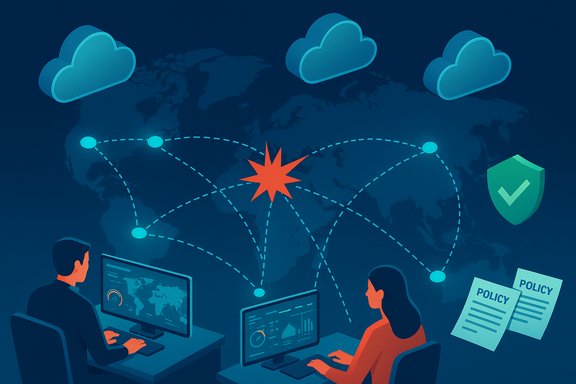 Background / Overview
The technical headlines were straightforward: on October 20, an AWS regional failure tied to DNS resolution for DynamoDB endpoints amplified into EC2 and NLB impairments that throttled launches and queued operations; services recovered after a multistage mitigation, but not before large swathes of the internet experienced outages. Less than two weeks later, on October 29, Azure suffered a control‑plane configuration propagation error in Azure Front Door that temporarily blocked administrative access and customer traffic for multiple services, in some cases forcing manual fallbacks at airports and retail outlets. These incidents matter not only because of the engineering details, but because hyperscale cloud platforms now host mission‑critical workloads for banking, healthcare, transportation, and government services. The concentration of control planes, identity fabrics and managed databases in a handful of global providers creates correlated systemic risk: a single misstep or latent defect can ripple across sectors and geographies.Why the debate about regulation started (and why it matters)
The scale and the economics
Hyperscalers have become enormous business engines. AWS reported revenue of roughly $33 billion in the quarter cited around these outages — a 20.2% year‑over‑year increase — while Microsoft’s cloud reported roughly $49.1 billion and mid‑20s percent growth. Those sums explain why critical public and private services run on these platforms: scale, feature breadth, and global reach are commercial magnets. At the same time, outage telemetry and tracker snapshots showed millions of user‑reported incidents during the AWS event and tens of thousands at Azure’s peak according to Downdetector and independent monitors. Exact counts vary across trackers and collection windows, but the public evidence is clear: the blast radius was large. Reported totals for the AWS incident range from several million to double‑digit millions depending on which aggregator and time slice is cited; the Azure Front Door event peaked at roughly 18,000 Downdetector reports before falling. Treat these public tracker figures as directional rather than precise measures of unique customers affected.The accountability gap: why telecom‑style rules are on the table
Analysts and policy groups argue that the Big Three cloud providers — AWS, Microsoft Azure, Google Cloud — operate infrastructure functionally similar to telecommunications carriers: they run global networks, manage routing and identity services, and deliver connectivity that underpins public life. Yet, unlike telcos in many jurisdictions, cloud providers are typically not subject to universal service obligations, mandated minimum availability standards, or structured post‑incident disclosure rules that apply to carriers. That asymmetry is now generating debate about whether telecom‑style regulatory guardrails should be adapted for designated cloud services.Proponents say regulation would reduce moral hazard — the tendency for providers to treat resilience as an optional engineering discipline because failure externalizes cost onto customers, telcos, and the public. Opponents warn that heavy‑handed mandates risk slowing innovation, introducing compliance complexity, and producing perverse incentives. Both points have technical and economic merit.
The technical anatomy of the outages — what actually failed
AWS: DNS resolution and control‑plane coupling
Public signals and vendor statements identify DNS resolution issues affecting DynamoDB regional endpoints as the proximate symptom of the October AWS event. That DNS failure cascaded into internal EC2 subsystems, network load balancer health checks, and queued asynchronous workloads (Lambda, SQS), creating amplified backlogs that took hours to drain. AWS mitigations included disabling the automation that wrote the problematic DNS records, throttling certain operations, and sequentially clearing backlogs. The vendor has acknowledged the broad outlines and committed to post‑incident analysis.Key technical lessons here are familiar to resilience engineers: when core discovery primitives (DNS) and managed database endpoints are tightly coupled into upstream control logic, a localized fault can behave like a cascading failure. The presence of automated orchestration and retry storms (excessive simultaneous retries) further amplifies these conditions.
Azure: control‑plane configuration propagation
Microsoft’s Azure Front Door outage was traced to an inadvertent tenant configuration change that propagated through a global control plane, preventing administrative and customer access to services routed through the fabric. Microsoft’s response — to freeze the change, rollback and restore — was standard operational practice, but the incident revealed two fragility points: shared management planes that can affect both data flow and administrative access, and insufficient out‑of‑band admin paths for some tenants. Both incidents underscore a common theme: control planes are the new single points of failure. When identity, ingress, or managed‑database control flows are centralized without robust multi‑region isolation, the blast radius of an error explodes.Verifying the claims: what’s solid and what’s provisional
- AWS and Azure technical causes: vendor statements and independent technical write‑ups align on DNS/managed database issues for AWS and a configuration propagation in Azure Front Door for Microsoft. These high‑level causal attributions are corroborated by multiple major outlets and independent monitoring analyses.
- User‑report aggregates: Downdetector and similar trackers logged millions of reports for the AWS incident and tens of thousands for the Azure event at peak. However, public tracker totals are noisy — they capture social and user‑submitted signals rather than unique affected transactions — so any single headline number (for example “16 million reports”) should be treated as an estimate, not a precise engineering metric. Multiple publications reported different totals depending on the snapshot used.
- Financial scale: AWS and Microsoft cloud revenue figures cited in the public market coverage (AWS: ~$33B that quarter; Microsoft Cloud: ~$49.1B) are confirmed by company earnings disclosures and analyst coverage. These are load‑bearing facts that help explain concentration and why mission‑critical systems run on these platforms.
- Strand Consult and policy claims: commentary attributing specific lobbying campaigns, policy positions, or national critiques to AWS (for example, opposition to internet levies in Europe or a public campaign against South Korea’s usage‑fee model) appears in some industry summaries and in the opinion piece that prompted this analysis. The original Strand Consult report is cited by those summaries, but public access to the full primary report or its raw evidence is limited in many summaries; therefore some of the more pointed assertions should be read as policy commentary rather than independently verified legal findings. Flag these as claims that require direct inspection of the primary report before becoming prescriptive regulatory input.
The arguments for telecom‑style regulation — strong points
- Accountability and transparency: mandatory post‑incident reporting, governed timelines for forensic RCAs, and structured disclosure of service dependencies would force hyperscalers to surface failure modes, remediation plans, and root causes in a way that benefits the entire ecosystem.
- Public‑interest protection: when cloud outages cascade into hospital reroutes, flight disruptions, or frozen payment rails, the impact is societal. Minimum availability obligations or contractual protections for designated critical workloads could reduce the chance of catastrophic service loss.
- Economic alignment: behavioral remedies (egress cost transparency, peering commitments, or network‑usage contributions) would realign incentives where hyperscalers currently internalize scale benefits while downstream broadband operators shoulder disproportionate transit and last‑mile costs.
- Procurement leverage: treating key cloud services as “critical third‑party infrastructure” for regulated sectors (finance, utilities, health, government) would enable procurement authorities to demand demonstrable, testable resilience outcomes — multi‑region failovers, auditable RCAs, and enforceable exit assistance — rather than optimistic assurances.
The counterarguments and real risks of regulation
- Overreach and obsolescence: mandating technology specifics risks rapid obsolescence in a fast‑moving cloud and AI landscape. Regulators should aim for measurable outcomes (availability targets, disclosure formats, time-to-RCA) rather than prescriptive engineering rules.
- Unintended concentration: telecom regulation historically sometimes entrenched incumbents by erecting compliance barriers that smaller competitors struggled to meet. A poorly calibrated cloud rulebook could inadvertently strengthen the hyperscalers instead of opening competitive pathways.
- Enforcement complexity: meaningful post‑incident reviews require technical competence. Regulators must build or acquire deep engineering expertise to evaluate vendor RCAs and remediation plans credibly; otherwise rules become bureaucratic theatre.
- International fragmentation: cloud infrastructure is global. Divergent national rules that aren’t interoperable could create compliance costs and operational fragmentation that harm customers and suppliers alike. Coordinated, interoperable standards — or at least aligned reporting formats — would mitigate this risk.
Practical policy options that balance resilience and innovation
Regulators and procurement agencies have a range of calibrated tools that avoid utility‑style nationalization while improving public safety and accountability:- Mandatory, structured post‑incident reporting for designated critical services, with standardized templates (timeline, causal chain, mitigations) and a short enforceable window for delivery.
- Service dependency disclosures for public procurement and regulated industries: suppliers must publish a dependency map for the small set of primitives (identity, DNS, ingress, managed database endpoints) that support critical service journeys.
- Minimum, testable resilience outcomes in public contracts: require multi‑region or multi‑provider failovers for services where public welfare is at stake, verified by independent auditors or periodic drills.
- Behavioral remedies first: transparency around egress pricing, porting/export toolkits, and anti‑lock‑in provisions that lower switching costs and foster real competition.
- Pilot programs and international coordination: test remedies in limited pilots (egress transparency pilots, post‑incident disclosure trials) and coordinate standards across jurisdictions to avoid fragmentation.
What enterprises and IT leaders should do now — a resilient playbook
The policy debate will take time; organizations cannot wait. Adopt a pragmatic, prioritized resilience program:- Map: catalogue dependencies on managed identity, DNS, global front‑doors, and managed databases for mission‑critical flows.
- Test: run quarterly cross‑region and, where feasible, cross‑provider failover exercises for essential user journeys.
- Harden: implement exponential backoff, jitter, caching, and client fallbacks for heavy read operations and authentication flows.
- Contract: negotiate enforceable post‑incident RCAs, runbook review rights, and exit/porting assistance as part of SLAs for critical workloads.
- Operate: maintain out‑of‑band admin paths (CLI tokens, bastion hosts, cached credentials) that do not depend on the public management portal.
- Communicate: prepare pre‑approved customer communications and fraud‑resilience plans (phishing spikes during outages are common).
Critical analysis: strengths, trade‑offs and what regulators should watch for
Telecom‑style measures offer a coherent framework to make resilience a public good, but they must be narrowly tailored. The strongest policy levers are those that increase transparency and lower vendor lock‑in — not attempts to freeze technology through regulation.- Strength: Mandatory RCAs and dependency maps create public goods of knowledge and reduce repeated failure modes across the ecosystem.
- Risk: Heavy compliance costs could favor incumbents if smaller providers cannot meet expensive regulatory regimes; this would exacerbate concentration rather than alleviate it.
- Trade‑off: Enforceable availability targets must be accompanied by realistic measurement and auditing capability; regulators should avoid one‑size‑fits‑all uptime benchmarks and instead tie obligations to the criticality of the workload.
- Watch‑out: Political capture or regulatory collusion could produce capture‑style outcomes. Transparent processes, public consultations, and independent technical reviews reduce that risk.
Longer‑term technical fixes the industry should pursue now
- Decouple control planes: isolate identity, DNS, and ingress control so a misconfiguration in a global fabric cannot simultaneously impair data delivery and administrative access.
- Make multi‑region the default for critical primitives: reduce the friction of distributing identity and database state across regions by offering tested, low‑latency replication patterns.
- Harden discovery and caching layers: aggressive client‑side DNS caching strategies (with secure, rotating fallbacks) and origin‑direct access patterns can lower immediate blast radius during control‑plane faults.
- Transparent canarying and staged rollouts: require vendors and large tenants to adopt canary deployment standards and automatic rollback triggers tied to health signals for global control‑plane changes.
- Independent post‑incident audits: enable qualified third parties to validate RCAs and remediation plans, thereby building public trust in forensic claims.
Conclusion — a pragmatic way forward
Hyperscale clouds have enabled astonishing innovation and economic value; the aim here is not to hobble them but to fold resilience into their operating fabric in enforceable ways. The October AWS and late‑October Azure incidents are concrete reminders that the internet’s convenience can mask structural fragility when control planes are concentrated.A balanced policy approach pairs targeted transparency (structured RCAs, dependency disclosure), procurement muscles (testable failover requirements for public services), and behavioral remedies (egress transparency and porting assistance) rather than wholesale command‑and‑control. At the same time, enterprises must move quickly: map dependencies, test failovers, and harden client and admin paths now.
Finally, treat headline figures and commissioned advocacy reports with care. Public trackers showed millions of reports during the AWS incident and tens of thousands at Azure’s peak; the exact numeric totals vary by snapshot and methodology. And while policy groups argue that cloud providers should face telecom‑style obligations, the precise design of those obligations — what to mandate, how to measure compliance, who enforces — will determine whether regulation improves resilience or merely reshapes incentives in unintended ways. The immediate imperative is not ideology but engineering: pair the cloud’s scale with verifiable, testable resilience so that the next major failure causes less harm and recovers faster.
Source: CXOToday.com AWS, Azure Outages: Should These Services Have Telecom-style Regulations?
