

Western Digital and Seagate have quietly handed the storage market to the hyperscalers — and ordinary buyers are about to feel it in their wallets. In recent earnings calls and corporate briefings, both Western Digital (WDC) and Seagate (STX) described a market in which nearline capacity and high-capacity HDD/SSD production are largely committed to a handful of cloud and AI customers for calendar 2026, with multi‑year long‑term agreements already stretching the visibility window into 2027 and even 2028. The practical outcome: fewer drives on the open market, stronger pricing power for suppliers and buyers who miss the allocation window facing rapidly rising costs for terabytes of storage.
Hyperscalers — think Amazon Web Services, Microsoft Azure, Google Cloud and Meta among others — are racing to build AI infrastructure at an unprecedented scale. Generative AI training and, increasingly, inference workloads require not only compute accelerators and specialized memory (HBM, DDR) but also vast quantities of persistent storage. For deep learning workflows, a mix of high-performance NVMe SSDs and massively dense HDDs is typical: SSDs for hot data and model parameters, HDDs for cold/cool storage where the economics per terabyte dominate.
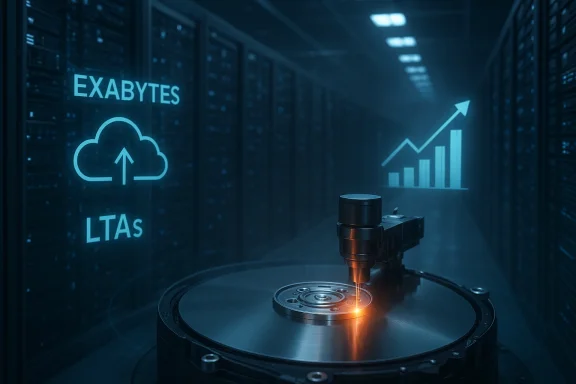
Over the last quarter, both major disk manufacturers described the same market dynamic during investor calls: advanced purchase orders and long‑term agreements with a small set of major customers have effectively booked nearly all available nearline capacity for calendar 2026. Those agreements specify volumes in exabytes — an exabyte equals one billion gigabytes — and in several cases lock in pricing and delivery cadence. That leaves little room for spot buyers, channel partners and retail customers who rely on the open market or short‑term supply.
What’s new is the scope and longevity of these commercial commitments. These are no longer isolated annual deals; they are multi‑year arrangements that prioritize supply assurance for cloud builders who cannot tolerate delivery uncertainty. The result is a structural shift in how high‑capacity storage is allocated and priced.
Higher margins incentivize suppliers to prioritize LTAs and long‑term customers who offer predictable volumes and favorable pricing structures. The economics of committed orders — less inventory risk, predictable factory loading, and higher average selling prices — make it logical for vendors to allocate constrained production to hyperscalers first.
Key consumer impacts:
The consequence is a two‑front supply squeeze: specialized memory for accelerators is constrained, and mass‑capacity storage is pre‑booked — leaving the mid‑market (PC builders, gamers, SMBs) to compete for the leftovers. Several major semiconductor firms reported record profitability tied to this shift and explicitly signaled they will prioritize enterprise/HBM production over consumer lines.
That limited surplus — when and if it appears — will likely be sold at favorable prices, not at pre‑crisis discount levels. In short, don’t expect a sudden flood of cheap drives to relieve consumer pain.
For everyday buyers, that means a period — likely measured in quarters, not weeks — where high‑capacity HDDs and enterprise SSDs are scarcer and costlier on the open market. The corrective paths exist: faster density ramps, increased allocations to channels, or demand moderation by cloud providers. But none are instantaneous.
If you build, buy or manage storage, the practical takeaway is straightforward: plan purchases deliberately, prioritize critical upgrades, consider hybrid approaches (local + cloud cold tiers), and prepare for elevated prices until the densification cycle begins to deliver materially more exabytes into the broader market.
Source: Neowin Thanks to AI, WD and Seagate SSDs are about to get much more expensive
 Background: what changed and why it matters
Hyperscalers — think Amazon Web Services, Microsoft Azure, Google Cloud and Meta among others — are racing to build AI infrastructure at an unprecedented scale. Generative AI training and, increasingly, inference workloads require not only compute accelerators and specialized memory (HBM, DDR) but also vast quantities of persistent storage. For deep learning workflows, a mix of high-performance NVMe SSDs and massively dense HDDs is typical: SSDs for hot data and model parameters, HDDs for cold/cool storage where the economics per terabyte dominate.Over the last quarter, both major disk manufacturers described the same market dynamic during investor calls: advanced purchase orders and long‑term agreements with a small set of major customers have effectively booked nearly all available nearline capacity for calendar 2026. Those agreements specify volumes in exabytes — an exabyte equals one billion gigabytes — and in several cases lock in pricing and delivery cadence. That leaves little room for spot buyers, channel partners and retail customers who rely on the open market or short‑term supply.
What’s new is the scope and longevity of these commercial commitments. These are no longer isolated annual deals; they are multi‑year arrangements that prioritize supply assurance for cloud builders who cannot tolerate delivery uncertainty. The result is a structural shift in how high‑capacity storage is allocated and priced.
Overview: the announcements in plain language
- Western Digital told investors it has firm purchase orders with its top seven customers that consume most of its calendar‑year 2026 HDD capacity. The company also confirmed long‑term agreements (LTAs) with several of those customers that extend into 2027 and 2028.
- Seagate reported that its nearline capacity is fully allocated for 2026, that demand visibility is strengthening into 2027 and that cloud customers are already discussing 2028 needs. Seagate emphasized that additional exabyte supply will come from areal‑density improvements (denser disks), not by significantly increasing unit production.
- Both companies signaled that product roadmaps (HAMR, EPMR/Ultra‑SMR, Mozaic platforms) and densification strategies are the primary paths to increase delivered exabytes rather than adding more factory throughput.
Why hyperscalers are locking capacity
1) Predictability at exabyte scale
Cloud providers are building infrastructure measured in exabytes. For them, unpredictability is unacceptable: a late shipment or shortfall can stall a data center build, push back service launches and materially increase operating costs. Locking supply with LTAs provides predictability and pricing certainty for budgeting massive projects.2) Total cost of ownership (TCO) economics
HDDs remain the lowest‑cost storage medium per terabyte for long‑term retention. For datasets that are large but infrequently accessed — archived logs, historical training corpora, raw media and cold inference datasets — HDDs are the rational economic choice. Hyperscalers prefer to pay for a predictable fleet of cheaper terabytes rather than rely entirely on costlier SSD tiers.3) Data gravity and architectural choices
AI pipelines create new classes of persistent data (inference caches, model shards, telemetry) that require a rethinking of storage tiers. The scale of data generated by generative models and augmented video/image workloads drives storage demand that outstrips typical enterprise consumption by orders of magnitude.The technology playbook: densification, not raw capacity expansion
Both vendors made it clear that the near‑term path to more exabytes is densification — squeezing more data onto each disk — rather than rapid expansion of manufacturing capacity.- Seagate’s HAMR (Heat‑Assisted Magnetic Recording) / Mozaic roadmap is focused on boosting areal density and delivering higher terabytes per spindle. That approach raises effective supply without adding a proportional number of new drives.
- Western Digital is accelerating its own high‑density programs (EPMR, Ultra‑SMR and its HAMR roadmap), along with targeted acquisitions or IP moves to speed qualification and manufacturability of laser‑assisted heads.
Financial context: profits, margins and the incentive to favor hyperscalers
The current market dynamics are very profitable for suppliers. Western Digital, for example, reported strong quarterly results tied to nearline demand and a richer product mix, with high single‑digit to double‑digit improvements in revenue and margins in the most recent reporting period. Seagate, too, is seeing increasing gross and operating margins as high‑capacity products become a larger portion of sales.Higher margins incentivize suppliers to prioritize LTAs and long‑term customers who offer predictable volumes and favorable pricing structures. The economics of committed orders — less inventory risk, predictable factory loading, and higher average selling prices — make it logical for vendors to allocate constrained production to hyperscalers first.
What this means for consumers, SMBs and enthusiasts
The short answer: expect prices to rise for high‑capacity storage in the open market, and expect longer lead times on the drives that most hobbyists and small businesses want.Key consumer impacts:
- Higher on‑shelf prices for large HDDs and enterprise SSDs. With most capacity allocated, vendors and resellers can command premium pricing in the spot market when demand spikes.
- Longer lead times and lower availability for 12TB–36TB HDDs and high‑end SSDs outside hyperscaler supply chains.
- Secondary market inflation. Bidding activity from storage integrators and resellers who failed to secure LTAs can push retail channels toward higher price points.
- Pressure on DIY and homelab ecosystems. Large NAS upgrades, archival projects and media farms will face steeper costs; some buyers may postpone upgrades or seek smaller capacity increments.
The technical and supply risks vendors acknowledged
Both manufacturers and analysts highlighted several risks and constraints in the near term:- Yield and qualification risk for new technologies. HAMR and other heat/energy‑assisted recording techniques are complex. Early qualification and ramp phases may produce lower yields, limiting any surplus that could reach the open market.
- Constrained component supply chains. Heads, precision actuators, media alloys and laser components for HAMR are specialized. Tightness in these upstream parts can bottleneck disk rollouts.
- Manufacturing lead times. Building new factory capacity for HDDs is expensive, long lead‑time work. Suppliers signaled they do not plan large capex increases to expand spindle counts quickly; growth will come from denser spindles instead.
- Concentration risk. Reliance on a small number of vendors and a handful of major customers amplifies systemic risk if a single factory or partner experiences issues.
Strategic consequences: market structure and bargaining power
The new operating model — supply discipline + densification + LTAs — flows into several structural changes:- Greater bargaining power for cloud buyers. Hyperscalers use LTAs to guarantee supply and control pricing volatility; they also gain influence over product roadmaps (e.g., tailored HAMR/SMR mixes and JBOD/stack optimizations).
- Fewer spot‑market opportunities. Channel buyers and small integrators cannot easily compete with multi‑exabyte LTAs when volumes are limited.
- Higher profitability for suppliers. Margins expand with higher‑value products and better cost per terabyte; that flows into improved earnings and investor expectations.
- Potential for regulatory or competition scrutiny. If most nearline capacity is booked by an oligopoly of buyers and suppliers, regulators could take notice—especially if this leads to sustained price distortion for enterprise and consumer markets.
Practical advice for readers and system builders
If you’re a home user, small business, systems builder or storage integrator, here’s an actionable playbook to navigate the squeeze:- Prioritize purchases now if you need capacity soon. If an upgrade is non‑optional and you can afford it, buy sooner rather than later; waiting tends to mean paying a premium.
- Right‑size rather than over‑provision. Reassess your data lifecycle: can older data be archived, deduplicated, or compressed to lower your immediate capacity needs?
- Consider mixed storage strategies. Use a combination of consumer SSDs for performance‑sensitive tiers and smaller, denser HDDs for cheaper bulk storage. Cloud cold‑storage tiers can be an interim option for infrequently accessed archives.
- Watch the secondary market cautiously. Used enterprise drives can be a stopgap, but buyer beware: warranty, reliability and remaining useful life vary widely.
- Keep an eye on new density waves. As HAMR/EPMR ramps, per‑spindle capacity will rise — but qualification cycles may delay broad availability. If you can wait, higher density HDDs may offer better cost per terabyte down the line.
- Negotiate with suppliers if you’re a mid‑sized buyer. Some distributors still have allocation channels or parity programs; establish relationships early and seek volume discounts.
Broader industry moves: memory makers and the HBM story
This is not only about disks. Memory and NAND suppliers are prioritizing higher‑value product lines for the AI market. Large memory manufacturers have publicly stated they will focus on high‑bandwidth memory (HBM) and enterprise NVMe SSDs rather than consumer parts, reflecting where the highest margins and demand are.The consequence is a two‑front supply squeeze: specialized memory for accelerators is constrained, and mass‑capacity storage is pre‑booked — leaving the mid‑market (PC builders, gamers, SMBs) to compete for the leftovers. Several major semiconductor firms reported record profitability tied to this shift and explicitly signaled they will prioritize enterprise/HBM production over consumer lines.
Competitive dynamics and longer‑term scenarios
What happens next depends on several interlocking variables:- If HAMR and other density technologies ramp quickly with high yields, available exabytes will increase even without building more factories — this could calm the market over 12–24 months.
- If densification encounters yield setbacks or component shortages (lasers, media alloys), LTAs will continue to hoard capacity and the open market will remain tight, prolonging higher prices.
- Hyperscalers could respond by investing directly in vendor capacity, expanding their vertical integration, or enhancing data hygiene (more aggressive cold‑tiering, compression and selective retention policies).
- New storage mediums (tape, optical, or emerging cold‑storage technologies) could regain some share for ultra‑cold archival data if economics and access latency permit.
Risks to the hyperscaler‑first model
What the market has not eliminated are systemic risks that could make LTAs and densification brittle:- Single‑point failures in critical supply chains (a parts shortage, factory outage, or trade disruption) would ripple through hyperscaler fleets and the open market.
- Regulatory intervention could constrain how vendors allocate capacity or require minimum open‑market distribution if monopolistic behavior is alleged.
- Technology transition risk. If a next‑generation recording method underperforms expectations, the industry could face a multi‑year capacity shortage while retooling occurs.
- Customer concentration risk. Over‑reliance on a few hyperscalers exposes vendors to sudden demand shifts if those customers alter procurement strategies.
What the vendors said about pricing and spare volumes
Both companies were candid in investor calls: pricing for calendar 2026 is largely defined for committed volumes, and if any unexpected production upside occurs (better yields, minor run‑rate improvements), a small amount of exabytes may be sold into the open market. But company executives were explicit that the vast majority of high‑capacity volume is already allocated to LTAs or firm purchase orders.That limited surplus — when and if it appears — will likely be sold at favorable prices, not at pre‑crisis discount levels. In short, don’t expect a sudden flood of cheap drives to relieve consumer pain.
Conclusion: a structural shift, not a short blip
The storage market is undergoing a structural rebalancing. Hyperscalers have moved from being one of several large customers to being the dominant force that shapes allocation, pricing and product roadmaps. Vendors are responding rationally: lock in predictable, high‑margin demand from the hyperscalers and invest in densification rather than risky, long lead‑time capacity expansion.For everyday buyers, that means a period — likely measured in quarters, not weeks — where high‑capacity HDDs and enterprise SSDs are scarcer and costlier on the open market. The corrective paths exist: faster density ramps, increased allocations to channels, or demand moderation by cloud providers. But none are instantaneous.
If you build, buy or manage storage, the practical takeaway is straightforward: plan purchases deliberately, prioritize critical upgrades, consider hybrid approaches (local + cloud cold tiers), and prepare for elevated prices until the densification cycle begins to deliver materially more exabytes into the broader market.
Source: Neowin Thanks to AI, WD and Seagate SSDs are about to get much more expensive
