

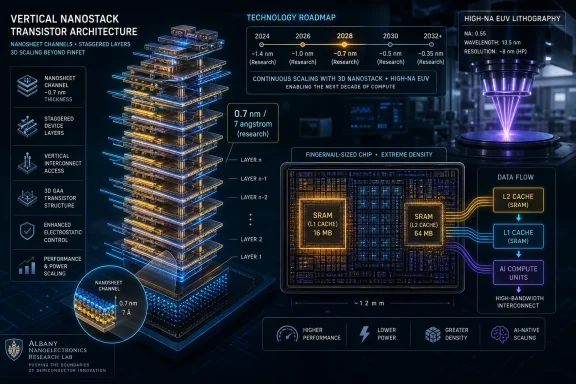
The more interesting story is not the number “0.7 nm,” seductive as it is. Modern node names stopped being literal measurements long ago, and anyone reading a process-node announcement as a ruler measurement is being invited into a marketing trap. The real story is that IBM is trying to keep the semiconductor roadmap alive by going vertical, mixing materials, and treating transistor architecture as a three-dimensional systems problem rather than a smaller-two-dimensional-patterning contest.
IBM’s 7 Angstrom Claim Is a Roadmap Marker, Not a Product Launch
IBM says the new technology can pack nearly 100 billion transistors onto a chip roughly the size of a fingernail, almost twice the density of the 2 nm chip technology it showed in 2021. The company is also projecting up to 50 percent more performance or 70 percent greater energy efficiency compared with that earlier 2 nm node. Those are classic research-announcement numbers: impressive, directional, and conditional on an eventual manufacturing process that does not yet exist at scale.
That distinction matters. Semiconductor history is full of laboratory milestones that took years to become shipping products, and some never did in their original form. IBM itself is now more of a research and intellectual-property force in leading-edge silicon than a mass-market chip manufacturer in the TSMC or Samsung sense. When IBM demonstrates a new device structure, the immediate audience is not retail PC buyers; it is foundry partners, equipment makers, hyperscalers, government agencies, and every design team trying to understand whether the post-2 nm decade has a credible path.
Still, it would be a mistake to dismiss the announcement as mere branding. The company is not simply slapping a smaller node name on an old transistor. IBM is describing a transistor architecture called nanostack, a three-dimensional, nanosheet-based design that vertically stacks and staggers devices. If nanosheet transistors were the industry’s answer to the limitations of FinFETs, nanostack is IBM’s bet that the next answer is to build upward with more intentional layering.
The phrase “world’s first sub-1 nanometer chip technology” is doing a lot of work. It blends a research proof point, a node label, and an industry milestone into a single headline-ready package. The careful reading is that IBM has demonstrated key building blocks for a future 7 angstrom node, not that it has completed the industrial ecosystem required to manufacture consumer CPUs or AI accelerators at that node.
The Node Name Is the Least Literal Part of the Announcement
The semiconductor industry has trained the public to treat smaller nanometer numbers as shorthand for progress. That was once a useful approximation. It is now a ritual, and sometimes a misleading one.
A 7 angstrom node does not mean every relevant feature on the chip is seven angstroms wide. Current node names are generational labels that bundle density, performance, power, materials, lithography, layout rules, and device architecture into a marketable number. The “nanometer” has become less like a measurement and more like a model year.
That does not make the label meaningless. A node name still signals where a technology sits in the competitive roadmap and what class of scaling challenge it is trying to solve. But it does mean IBM’s announcement should be read as a statement about architectural direction, not a claim that silicon engineering has somehow made atoms optional.
This is especially important at sub-1 nm branding, because the numbers begin to collide with ordinary intuition. Silicon atoms are not infinitely divisible pixels. Gate stacks, channels, contacts, interconnects, dielectrics, and power delivery structures all impose constraints that cannot be waved away by better lithography alone. At this scale, “smaller” is only part of the game; leakage, variability, heat, yield, and memory locality become equally central.
IBM’s value proposition is that nanostack gives designers another scaling axis. Instead of relying purely on lateral shrink, it stacks transistors vertically and staggers channels in a way that can increase density while preserving performance options. That is the kind of idea the industry needs if it wants to keep selling generational leaps in an era when planar scaling is mostly gone and even nanosheets will eventually run out of room.
Nanostack Is IBM’s Attempt to Make Going Vertical Look Inevitable
The nanostack pitch is conceptually simple: if the chip cannot keep shrinking sideways fast enough, build a more sophisticated vertical structure. IBM says its design uses three-dimensional sequential integration to place transistor layers above one another, while allowing different material combinations in different layers. That last point is important because future chips may not be built from one uniform transistor recipe.
This is a shift from node scaling as an exercise in making everything uniformly smaller to node scaling as a discipline of selective optimization. Some transistors may need maximum speed. Others may need low leakage. Some logic may benefit from one channel material, while another layer may favor a different combination. In a vertically integrated design, the chip becomes more like a carefully zoned city than a flat suburban grid.
The term nanostack also arrives at a useful moment for IBM. The company has long claimed leadership in nanosheet research, including its 2 nm demonstration in 2021. By presenting nanostack as the next step beyond nanosheet, IBM is positioning its prior work not as an isolated milestone but as a foundation for a decade-long scaling roadmap. That is exactly the narrative a research leader wants: yesterday’s breakthrough becomes today’s platform.
The hard part is manufacturing. Stacking active devices is not just a layout trick. It demands bonding, alignment, thermal management, process compatibility, defect control, and design tools that can reason about new constraints. IBM says the architecture has been experimentally validated through ultra-thin dielectric bonding, dual-channel engineering, and functional CMOS inverter operation. That is meaningful, but it is still closer to a technology platform than a finished foundry offering.
For WindowsForum readers, the practical translation is straightforward: do not expect “0.7 nm” client CPUs to suddenly appear in the next hardware refresh cycle. Expect this work to influence the transistor and memory strategies that eventually shape server CPUs, AI accelerators, edge inference chips, and maybe the high-end laptop silicon of the 2030s.
SRAM Scaling Is the Quiet Detail That Makes the AI Angle Credible
The flashiest number in IBM’s announcement is the 0.7 nm node. The more revealing one may be the reported 40 percent SRAM scaling demonstrated in research presented at VLSI 2026. SRAM is not glamorous, but it is one of the places where modern chip scaling has become most stubborn.
Logic transistors can improve while memory arrays refuse to shrink at the same pace. That imbalance matters because modern processors, especially AI accelerators, are often limited not by raw arithmetic but by how quickly they can feed data to the compute units. More transistors are useful only if the chip can keep them busy without burning absurd power moving data around.
That is why SRAM density matters for AI. On-chip memory reduces the need to fetch data from farther away, where latency and energy costs rise. If nanostack can materially improve SRAM density, then IBM’s claim is not merely “we can put more switches on silicon.” It becomes “we can build chips with more local data capacity where the compute actually happens.”
This also explains why the announcement speaks to cloud infrastructure and generative AI as much as to traditional computing. The AI boom has turned power delivery, memory bandwidth, and packaging into boardroom issues. Data centers are no longer asking only how many operations a chip can perform; they are asking how much electricity, cooling, rack space, and capital expenditure each useful token or inference consumes.
A 70 percent energy-efficiency projection, if realized in production, would be strategically enormous. But it must survive the journey from lab result to manufacturable design rules, then from design rules to yields, then from yields to real workloads. The gap between a projected node advantage and a deployed system advantage is where many semiconductor dreams become footnotes.
The Albany Ecosystem Is the Real Factory Behind the Announcement
IBM’s semiconductor credibility increasingly rests on its ability to convene an ecosystem, not just invent a device. The company’s work in Albany, New York, ties together IBM Research, public-private semiconductor initiatives, equipment vendors, materials companies, and process specialists. That is the environment where a nanostack idea can be turned from a diagram into a wafer-level experiment.
The announcement name-checks High NA EUV lithography, the next major step in extreme ultraviolet patterning, as part of the future logic-scaling toolkit. High NA EUV is not magic either, but it offers more precise patterning that can reduce some of the complexity of multi-patterning at advanced nodes. It is expensive, difficult, and strategically important enough that access to the tools themselves has become part of national industrial policy.
IBM’s collaboration with companies such as Lam Research, Tokyo Electron, SCREEN Semiconductor Solutions, and ASML is therefore not background color. It is the story. No company, not even a giant with IBM’s history, can carry leading-edge process development alone anymore. The edge of silicon has become a coalition exercise.
That coalition aspect also explains why IBM’s announcement has an American industrial-policy subtext. Wccftech framed the development as evidence that U.S. semiconductor innovation still leads the world, and IBM’s Albany-centered roadmap certainly fits Washington’s desire to rebuild domestic chip capacity. But research leadership and manufacturing leadership are not identical things. The United States can lead in device architecture while still depending on global supply chains for production, tools, materials, packaging, and volume execution.
This is where triumphalism should give way to realism. IBM’s nanostack announcement is a strong signal that American labs remain vital to semiconductor progress. It is not, by itself, proof that the U.S. has solved the foundry-scale manufacturing gap with Taiwan, South Korea, or the broader Asian semiconductor supply chain.
IBM Is Selling a Decade of Scaling Because the Industry Needs One
The semiconductor industry is desperate for credible long-range stories. Moore’s Law in its old form is no longer a metronome, but the economic expectation it created still governs hardware planning. Cloud companies, PC OEMs, phone makers, automakers, defense contractors, and software vendors all build roadmaps on the assumption that compute will keep getting better.
IBM says nanostack could support at least another decade of scaling. That sentence is doing strategic work. It tells customers and governments that the end of conventional shrink does not mean the end of progress. It tells equipment partners that there is a reason to keep investing in extreme lithography, deposition, etch, bonding, metrology, and packaging. It tells chip designers that the next generation will be more complex, but not necessarily a dead end.
The software world should pay attention, too. Windows users often experience semiconductor advances indirectly: longer laptop battery life, quieter fans, better local AI features, faster compile times, smoother gaming, denser servers, and more capable edge devices. If energy efficiency becomes the dominant gain from future nodes, software platforms will need to exploit that efficiency rather than merely wait for higher clocks.
That has been the story of computing for years now. The old desktop-era fantasy of a simple clock-speed bump is gone. Performance comes from heterogeneous cores, accelerators, cache design, memory hierarchy, packaging, scheduling, compilers, and operating-system awareness. A nanostack transistor is only one ingredient in a much larger meal.
For Microsoft and the Windows ecosystem, the long-term implications are obvious. The company is pushing AI features into the client OS, developer tools, cloud services, and endpoint management stack. If advanced nodes deliver better performance per watt, they will help make local AI more realistic on laptops and mini PCs. If they do not, more of that intelligence will remain tethered to the cloud, with all the cost, privacy, latency, and bandwidth trade-offs that implies.
The Physics Is Hard, but the Economics May Be Harder
Every advanced-node announcement invites the same question: can anyone afford to use it? The cost of leading-edge chip design has climbed so steeply that only a small club of companies can justify taping out at the most advanced nodes. Even if nanostack technology works, the first customers will likely be the ones with the most valuable workloads and the deepest pockets.
That means AI accelerators, hyperscale infrastructure, networking silicon, defense applications, and flagship mobile or client processors may get first access. Ordinary mainstream hardware will see the benefits later, and often indirectly. The path from research milestone to affordable consumer device is neither quick nor democratic.
There is also the issue of yield. A transistor architecture can work beautifully in controlled demonstrations and still struggle when scaled across large die sizes, high-volume production, and aggressive cost targets. Three-dimensional device structures may improve density, but they can also introduce new failure modes. More layers mean more process steps, and more process steps mean more opportunities for defects.
Heat is another constraint that refuses to disappear. Stacking devices vertically can improve density, but dense circuitry still has to move heat out of the chip. In advanced systems, thermal design is not just a packaging problem; it shapes frequency, reliability, sustained performance, and form factor. A sub-1 nm roadmap that does not solve power density is a roadmap to throttling.
This is why IBM’s efficiency claims are more important than its performance claims. A 50 percent performance gain sounds exciting, but a 70 percent energy-efficiency gain speaks to the actual bottleneck in data centers and mobile devices alike. The future of computing is increasingly constrained by watts, not imagination.
The PC Won’t Be First, but It Will Feel the Aftershock
Windows enthusiasts naturally want to know when this affects client hardware. The honest answer is: not soon, and not directly. IBM says it sees a path to production as early as the next five years, which would put earliest adoption around the early 2030s if the roadmap holds. Even then, first production does not mean mass-market Windows laptops immediately follow.
The PC market typically receives advanced process benefits after the technology has been proven in higher-margin segments. Apple, Qualcomm, AMD, Intel, Nvidia, and others all make different trade-offs depending on foundry access, design goals, volume, and cost. IBM’s role may be upstream: proving concepts, licensing technology, shaping research partnerships, and influencing the process options available to commercial foundries.
Still, the aftershock could be substantial. If nanostack-style technology makes denser, more efficient logic and SRAM practical, client devices could eventually benefit from larger on-die caches, better neural processing units, more efficient integrated graphics, and more capable always-on compute islands. Those changes would matter more to daily users than the node label printed in a spec sheet.
The future Windows PC is likely to be judged less by peak benchmark bragging rights and more by how well it sustains mixed workloads. Video calls with background effects, local language models, security scanning, browser workloads, endpoint management agents, gaming overlays, and battery constraints all compete for the same thermal envelope. Better transistor efficiency can make that contention less painful.
But operating systems and software vendors will have to earn the benefit. Hardware efficiency that is squandered by bloated background services, poorly scheduled AI tasks, or telemetry-heavy software stacks will not feel like progress. The chip industry can provide better tools; the platform ecosystem still has to use them responsibly.
The Foundry Question Hangs Over Every IBM Breakthrough
IBM’s modern chip announcements always carry a slight tension. The company has deep semiconductor research credentials, but it is no longer the company that will single-handedly mass-produce the world’s leading client CPUs. Its breakthroughs tend to move through partnerships, alliances, licensing, and ecosystem influence.
That makes the foundry question central. Which manufacturing partners will turn nanostack into a production technology? How will it align with the roadmaps of Intel Foundry, Samsung Foundry, TSMC, Rapidus, or future U.S.-backed fabrication efforts? Will the architecture be adopted wholesale, adapted selectively, or remain primarily a research reference point?
IBM’s Albany hub gives the company leverage because it sits at the precompetitive intersection of research and manufacturing development. Equipment vendors can test process flows. Materials companies can validate new approaches. Government-backed programs can claim progress toward domestic capability. IBM can remain a central player even if it is not the final high-volume manufacturer.
That model is powerful, but it also makes causality messy. Years from now, a commercial “angstrom-era” chip may incorporate ideas that look like nanostack without carrying IBM branding. The industry often absorbs research breakthroughs into a broader toolkit, then argues later about who deserves credit. For users, the branding will matter less than whether the resulting products are faster, cooler, cheaper, and more secure.
The security angle deserves mention because hardware density changes attack surfaces as well as performance envelopes. More complex chips mean more complex validation. New materials, new stacking methods, and new power-delivery schemes all require careful reliability and security testing. The industry cannot afford another era where speculative performance tricks outrun threat modeling.
The AI Boom Gives IBM’s Timing a Convenient Tailwind
IBM’s announcement lands at a moment when AI has made semiconductor capacity feel like national infrastructure. Generative AI has transformed GPUs, accelerators, memory, networking, and power systems into strategic resources. Every company with a chip roadmap now frames its work against AI, because AI is where capital is flowing.
That does not make IBM’s AI framing cynical. Advanced AI workloads genuinely need better performance per watt and more local memory. Training and inference both punish inefficient data movement. On-device AI, meanwhile, will not become broadly useful if it drains batteries, spins fans, or forces every meaningful task back to a remote data center.
Nanostack’s promise maps neatly onto those needs. Denser logic can increase compute capability. Better SRAM scaling can keep more data near the compute units. Material flexibility can let designers tune layers for different performance and power targets. If those advantages survive production, they will be highly relevant to AI silicon.
But the industry should be wary of assuming that transistor scaling alone will solve AI’s economics. Model efficiency, software optimization, memory architecture, packaging, networking, cooling, and workload selection all matter. Throwing more transistors at inefficient software can delay the bill, not eliminate it.
For enterprise IT, the practical question is not whether IBM’s 7 angstrom research sounds futuristic. It is whether the next decade of hardware will lower the total cost of running AI safely and reliably. If nanostack helps bend that cost curve, it will matter even to organizations that never buy an IBM-branded chip.
The Angstrom Era Will Reward Systems Thinkers, Not Spec-Sheet Shoppers
The lesson of IBM’s announcement is that semiconductor progress is becoming more architectural and less linear. The industry is no longer simply shrinking the same transistor over and over. It is redesigning the transistor, the memory cell, the power network, the package, and the software assumptions above them.
That makes spec-sheet literacy harder. A smaller node number may indicate genuine progress, but it will not tell the whole story. Two chips on nominally similar nodes can behave very differently depending on cache size, memory bandwidth, voltage curves, packaging, firmware, scheduler support, and workload mix. The angstrom era will punish anyone who treats node branding as destiny.
This is already visible in today’s hardware. Some laptop processors win short benchmarks and lose sustained workloads. Some AI accelerators look spectacular on dense matrix math and weak on real deployment economics. Some chips achieve excellent efficiency only under carefully bounded conditions. Future nodes will amplify these differences rather than erase them.
For sysadmins and IT buyers, the right posture is skepticism without cynicism. IBM’s research is meaningful, but procurement decisions will still depend on shipping products, platform support, software compatibility, lifecycle guarantees, security updates, and power budgets. The best hardware technology in the world is only useful if it arrives in systems that can be deployed, managed, patched, and justified.
For enthusiasts, the fun is in watching the roadmap regain some drama. After years of grim talk about the end of Moore’s Law, IBM is arguing that there is still room below 1 nm if the industry is willing to stack, bond, mix, and rethink. That is not a return to the easy days. It is a more complicated form of progress.
The Fingernail-Sized Future Comes With Fine Print
IBM’s 0.7 nm nanostack announcement is best read as a serious research milestone wrapped in an understandably aggressive headline. The technology points toward a future where density gains continue through vertical transistor architecture, improved SRAM scaling, and more flexible material choices, but it does not change the near-term reality of commercial chip availability.
- IBM announced its 0.7 nm, or 7 angstrom, nanostack technology on June 25, 2026, as a research breakthrough rather than a shipping processor family.
- The company says the design could place nearly 100 billion transistors on a fingernail-sized chip and deliver up to 50 percent more performance or 70 percent greater energy efficiency than its 2 nm technology.
- The nanostack architecture builds beyond nanosheets by vertically stacking and staggering transistors, giving designers another axis for scaling as lateral shrink becomes harder.
- The reported 40 percent SRAM scaling is especially important because AI and modern processors are increasingly limited by memory locality and data movement.
- IBM’s Albany research ecosystem and its equipment partnerships are central to the story, because sub-1 nm technology will require coordinated advances in lithography, bonding, deposition, etching, metrology, and packaging.
- The earliest production path IBM describes is still years away, which means Windows PCs and mainstream client devices would feel the effects indirectly and later, if the technology reaches volume manufacturing.
IBM has not repealed physics, and it has not delivered a 0.7 nm chip you can buy. What it has done is show that the industry’s next chapter may be written in stacked devices, denser SRAM, and ecosystem-scale process engineering rather than in a simple shrink of yesterday’s transistor. If that roadmap holds, the angstrom era will not feel like a single revolutionary product launch; it will feel like a gradual rewiring of the hardware assumptions beneath AI, cloud infrastructure, and eventually the Windows machines on our desks.