
That distinction matters far beyond the usual AI coding-assistant debate. A developer demo can make a 20-minute investigation of legacy report logic look transformative. For a chief data officer, CISO, internal auditor, or Windows infrastructure leader recovering from an incident, however, the key question is whether the organization can demonstrate the chain of decision-making behind the change. The speed is useful. The defensible control trail is the product.
IBM made Bob generally available on April 28, 2026, positioning it as an AI-first development partner that spans planning, coding, testing, deployment, modernization, and operations rather than functioning as a narrowly scoped autocomplete tool. IBM’s launch announcement emphasizes the same enterprise concerns at the core of this story: security controls, human approval, policy enforcement, multi-model orchestration, and traceability across the software development lifecycle.
For Windows and IBM i shops alike, the appeal is obvious. These are organizations with extensive codebases, long-lived applications, hybrid estates, identity systems, business rules embedded in programs, and a mounting need to modernize without breaking what keeps the business operating. The harder question is whether an agentic development platform can improve that work without becoming another opaque layer in the risk register.
 The Real Story Is Governance at Runtime
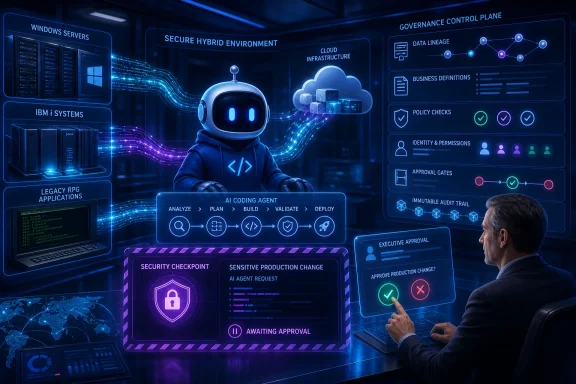
The headline feature of IBM Bob may be its ability to accelerate development and modernization tasks, but its most consequential claim is more specific: governance context should shape the agent’s actions while work is under way.
That is a significant shift from the familiar retrieval pattern in enterprise AI. In a typical setup, an assistant is given documentation, repository context, snippets from a data catalog, and perhaps a prompt with some policy instructions. It may produce a recommendation or proposed change, but a human still has to interpret policy, find the right system, make the change, and later reconstruct what happened.
The model described in the CDOTrends report is intended to close that operational gap. Bob can work with watsonx.data through a Model Context Protocol (MCP) server, retrieving business definitions, lineage, data-protection rules, and related governance information as it works. In the strongest version of IBM’s pitch, the agent does not merely display a rule for a developer to remember later; the rule becomes a condition affecting the execution path.
That is the difference between governance as documentation and governance as control logic.
Why reference-only governance falls short
Most established enterprises have already invested heavily in data governance. They may have:
- A data catalog containing business definitions and asset ownership.
- Data classification labels for confidential, regulated, or sensitive information.
- Lineage maps covering important reporting and integration flows.
- Approval processes for schema changes, data access, and production releases.
- Security policies that govern identity, privileged access, secrets, and retention.
- Development standards documented in portals, wikis, tickets, and code-review templates.
The problem is not always the absence of information. It is the fact that information often sits outside the tools performing the work.
A developer can receive a helpful recommendation from an AI assistant, then manually consult the catalog, search for lineage, open a change request, find the owner, get an approval, apply the update, run tests, and document the result. That process can be sound, but it is also slow, fragmented, and prone to inconsistency. Under schedule pressure, people may skip steps that feel administrative but later prove essential during an incident review.
IBM’s watsonx.data intelligence announcement describes the intended alternative: agents access business definitions, lineage, ownership, data-quality signals, and governance policies dynamically at runtime. In principle, that makes the context current rather than copied into a stale prompt or hand-maintained reference file.
For a Windows enterprise, this could matter in scenarios such as a developer modifying an application that writes into SQL Server, changes an API used by a line-of-business system, adjusts an ETL process, or modernizes a legacy integration that has dependencies across on-premises Windows servers and cloud services. The agent should not have to infer whether an asset is sensitive, who owns it, or what downstream reports could be disrupted. Those signals should arrive through governed systems and influence the next step.
The approval checkpoint is the pivotal feature
The most valuable part of the reported IBM Bob workflow is not the lookup. It is the potential for a rule to create an automatic approval checkpoint.
If an action affects a governed asset and the applicable policy requires sign-off, the agent should stop and route the request for approval rather than merely note the condition in prose. If there is no restriction, it can continue while recording the definition and policy checks that cleared the work. CDOTrends’ account characterizes this as the point at which metadata begins “steering” the agent rather than simply informing it.
That is precisely the behavior enterprises should demand from an AI development agent. A fast agent that only generates a policy warning still leaves the control decision to memory, judgment, and urgency. A constrained agent that cannot proceed without an appropriate approval turns policy into an operational gate.
The important caveat is that the policy layer must itself be accurate and consistently maintained. An approval workflow cannot save an organization if the affected data asset is uncataloged, ownership records are wrong, lineage is incomplete, or a sensitive field is misclassified. Runtime governance is only as trustworthy as the governance data supplied at runtime.
Why This Matters After a Windows Security Incident
The story begins with M.R. Williams, a family-owned distributor that contained ransomware after it arrived through a Windows server and spread through the environment. The company subsequently hardened its systems and revisited RPG applications on IBM i that had long supported mission-critical operations. The reported example is compelling because it connects three enterprise realities often treated as separate problems:
- Windows security and recovery
- Legacy application understanding
- Data governance and modernization
In practice, they are deeply connected.
A ransomware event does not merely expose weak endpoints or insufficient backups. It forces an organization to ask which applications are indispensable, what systems exchange data, which service accounts have broad permissions, which reports guide daily decisions, and where critical business rules actually live. In mixed Windows and IBM i environments, the answers are rarely contained in one platform team’s documentation.
Legacy code is often institutional memory
The reported six-hour-to-20-minute comparison involved tracing field logic in a report. It is a useful illustration, not a complete return-on-investment model. A single task can vary dramatically by code quality, documentation, surrounding systems, developer expertise, and how much context the agent was given.
Still, the underlying problem is real: RPG, COBOL, older Java services, PowerShell automation, batch jobs, SQL stored procedures, and bespoke Windows applications often contain years of business decisions that were never formally documented. A field calculation may embed contract terms, customer exceptions, tax treatment, inventory rules, or operational workarounds added long after the original design.
An agent can help surface these rules quickly. But the strategic opportunity is bigger than translation or refactoring. The organization should use the discovery process to extract and formalize the rules into governed artifacts:
- Business glossary terms.
- Data-product definitions.
- Process documentation.
- Testable acceptance criteria.
- Data lineage and dependency maps.
- Ownership assignments.
- Policy classifications.
- Reusable engineering standards.
Without that step, modernization risks moving inscrutable business logic into a newer language or platform while preserving the same knowledge concentration problem. With it, the modernization program creates an institutional record that remains useful after the original subject-matter experts retire or move on.
Incident hardening and agent enablement must be connected
A company that has just dealt with ransomware should be especially cautious about deploying an agent capable of interacting with production-adjacent systems. It should not treat AI-driven modernization as a separate innovation initiative that bypasses the security lessons of the incident.
The proper sequencing is more disciplined:
- Contain and recover affected infrastructure, identities, applications, and data flows.
- Review trust boundaries, especially service accounts, administrative credentials, remote access paths, and integration endpoints.
- Inventory the application estate and identify systems whose business logic is poorly understood.
- Classify data and establish ownership before granting an agent broad access to context or tools.
- Introduce agents in constrained workflows, beginning with read-only analysis, code explanation, test generation, and documentation.
- Add controlled write actions only where approval gates, rollback procedures, audit logging, and test coverage are mature.
- Continuously review agent activity alongside ordinary security telemetry and change-management records.
This is where the “testify” framing becomes practical. During a post-incident review, an organization does not need another system that says it acted intelligently. It needs records that show the inputs, policy state, approvals, change scope, code changes, test results, identities involved, and final deployment outcome.
MCP Is the Bridge—And Also a New Security Boundary
IBM’s technical mechanism for bringing governed context to Bob is the Model Context Protocol, or MCP. IBM documents that its watsonx.data MCP server can provide natural-language access to lakehouse data and metadata, catalog operations, data ingestion capabilities, query-engine interaction, and data-security controls. The same IBM documentation identifies Bob as one of the supported MCP clients, alongside Claude Desktop and other MCP-compatible clients. IBM Cloud’s MCP server documentation makes clear that the architecture is not exclusive to one assistant.
That interoperability is a strength. It means the governance investment can be made useful across multiple AI tools rather than locked entirely into a single coding agent.
But it also means MCP deserves the same disciplined security treatment enterprises already apply to APIs, service accounts, automation platforms, and privileged integrations.
What IBM’s documentation says about access
IBM’s documentation notes that the watsonx.data MCP server is currently available only to instance administrators; users with non-admin roles cannot access MCP tools or the MCP functionality even if they have been granted access to engines. The access limitation is explicitly documented by IBM. That is a consequential detail for security teams.
It suggests that early deployments may require highly privileged access at the MCP layer. Such a design can simplify setup, but it also raises the stakes for credential management, separation of duties, and environment segmentation. An enterprise should not assume that “governed” automatically means “least privilege.”
The same documentation says write access can allow INSERT and UPDATE operations while restricting DELETE operations. IBM’s capability description is a welcome sign that the platform recognizes different classes of risk. Yet blocking deletes is not a complete safety model. Incorrect inserts and updates can cause material damage, especially in financial, inventory, healthcare, HR, and customer systems.
The configuration itself requires governance
IBM provides instructions for registering a watsonx.data intelligence MCP server in IBM Bob through Visual Studio Code, using an API key and a configured server endpoint. The setup process also allows users to select which tools are available to the agent. IBM’s Bob configuration guidance specifically advises limiting the selected tools to the subset considered useful.
That final detail should become a deployment principle, not merely a setup tip.
Tool minimization is agentic least privilege. If a coding task requires catalog search and lineage analysis, do not expose ingestion, engine-management, or write-capable data tools. If the agent only needs to inspect a repository and generate a migration plan, it should not be able to execute changes against production-connected systems.
A practical enterprise policy should distinguish at least four agent capability tiers:
| Tier | Appropriate capabilities | Typical use |
|---|---|---|
| Observe | Repository search, documentation retrieval, catalog lookup, lineage review | Code explanation, impact analysis, knowledge recovery |
| Propose | Generate patches, tests, migration plans, tickets, documentation | Developer-reviewed improvements |
| Execute in non-production | Create branches, run test suites, update approved development data | Controlled automation with logging |
| Execute in production | Narrowly scoped, policy-gated actions with approvals and rollback | Mature, high-confidence workflows only |
This approach is particularly relevant for Windows administrators and developers who already manage privileged automation through PowerShell, Azure automation, deployment pipelines, service principals, and infrastructure-as-code tools. An AI agent should be integrated into those existing trust models—not granted an informal exception because it appears conversational.
Multi-Model Routing: Useful Automation, Legitimate Skepticism
IBM Bob’s multi-model orchestration is another core feature. IBM says Bob routes work among frontier models, open-source models, IBM Granite models, and specialized models based on accuracy, latency, performance, and cost. Simpler tasks can go to lighter models while more complex tasks are assigned to stronger ones. IBM’s launch materials present this as a way to improve outcomes while controlling spend.
This is a sensible design objective. Most organizations do not want developers manually selecting a model for every unit test, code review, architecture analysis, security scan, or modernization task. Model choice has become a distracting operational burden, and intelligent routing can reduce it.
However, multi-model routing creates a new form of opacity. If a critical refactoring, security assessment, or data-related change was influenced by a particular model, the organization needs visibility into that decision.
Auditability must include the routing decision
A credible evidence trail should record more than the final code diff. It should include:
- The user request and assigned task.
- The repositories, files, tickets, and documentation consulted.
- The governed data definitions and lineage context retrieved.
- The MCP tools invoked.
- The applicable policies and control decisions.
- The model or models selected for each subtask.
- The rationale or routing criteria used.
- The generated output, edits, and test results.
- The human approvals, rejections, overrides, and escalations.
- The identity and permissions under which each action occurred.
- The final deployment or rollback result.
IBM says BobShell creates self-documenting agentic processes in real time so that actions are traceable from beginning to end. IBM’s description of BobShell auditability is promising, but enterprises should test the record against their own control requirements rather than accepting a generic assurance statement.
The critical test is simple: can the organization reconstruct a consequential change without relying on someone’s memory or a vendor dashboard?
If the answer is no, the agent may be productive but is not yet governable enough for sensitive workflows.
The Case for Bob Is Strongest in Modernization
IBM’s early positioning is most compelling in legacy modernization, where the work is repetitive enough to benefit from automation but context-heavy enough to punish superficial code generation.
IBM cites a Blue Pearl Java upgrade that reportedly fell from a typical 30-day task to three days, saving more than 160 engineering hours. The figure appears in IBM’s launch announcement. The CDOTrends report also cites examples involving EY Tax Americas, CrushBank, BNP Paribas, and IBM Consulting deployments. Those reported customer and deployment figures should be read as vendor- and customer-reported outcomes rather than universal benchmarks.
That caution is not a dismissal. It is a recognition that modernization outcomes depend on the starting point.
A clean Java upgrade with robust test coverage is not comparable to an undocumented RPG application connected to Windows-based reporting, file shares, scheduled tasks, external partner exchanges, and informal operational workarounds. Nor is a pilot result equivalent to a scaled production program involving security review, release management, and business-owner acceptance.
Where Bob should perform well
IBM Bob should be most useful where the organization can supply rich, reliable context and clearly bounded goals:
- Explaining unfamiliar code and generating documentation.
- Mapping dependencies across application components.
- Producing tests for known behavior.
- Identifying repetitive modernization patterns.
- Refactoring code under established architectural standards.
- Generating migration checklists and implementation plans.
- Drafting pull requests for human review.
- Analyzing lineage and downstream impact before an approved change.
- Turning embedded rules into documented business concepts.
These tasks benefit from speed without demanding that the agent make an unbounded business decision.
Where human judgment remains essential
The CDOTrends report also identifies a sensible boundary: genuinely novel architecture decisions remain human-led work. That is not a weakness unique to Bob; it is a general limitation of systems optimized to use existing patterns, specifications, policies, and code context.
An agent can propose architecture alternatives, identify trade-offs, and accelerate prototype work. It should not quietly decide strategic questions such as:
- Whether to replace a core system or extend it.
- Whether a business rule remains valid.
- Which regulatory interpretation should control a design.
- How much operational risk the organization is willing to accept.
- Whether a system should be moved from on-premises Windows infrastructure to cloud-native services.
- Which data should be retained, retired, shared, or made available to automated systems.
These are governance decisions, not merely implementation details.
Measuring More Than Activity
IBM’s Bobalytics platform offers three primary enterprise metrics: adoption rate, Bob factor, and Bobcoin spend. IBM defines adoption rate as daily active users divided by licensed seats, while Bob factor measures the percentage of committed lines of code attributed to Bob. Bobcoin spend tracks consumption over the selected period. IBM’s Bobalytics documentation describes these metrics and their intended use.
This is more mature than treating chat messages or accepted suggestions as proof of value. It recognizes that AI tooling needs both outcome and cost measures.
What the metrics can reveal
Used together, the three measures can help a technology leader identify useful patterns:
- High adoption, rising Bob factor, stable spend may indicate teams are finding productive, repeatable uses.
- High spend, low Bob factor may indicate exploratory work, expensive research behavior, poor workflow fit, or inadequate enablement.
- Low adoption may signal weak onboarding, distrust, insufficient repository context, or a mismatch between the tool and the work.
- A high Bob factor in one repository may identify a successful modernization candidate worth replicating elsewhere.
- Cost spikes in a sensitive team may signal uncontrolled model usage or workflows that need tighter limits.
IBM itself warns that high spend paired with a low Bob factor may mean Bob is being heavily used for research, explanation, or exploration without producing committed code. The Bobalytics guidance correctly suggests looking at usage and contribution together rather than assuming consumption equals value.
What the metrics cannot prove
A high percentage of AI-assisted committed code is not automatically a sign of quality, maintainability, or business value. An agent could generate many lines of code, tests, comments, or boilerplate that inflate contribution without reducing operational risk. Conversely, a small agent-generated change that uncovers a critical dependency may have far greater value than thousands of generated lines.
For that reason, a serious IBM Bob scorecard should add measures that Bobalytics alone cannot supply:
- Production defect and rollback rates.
- Security findings introduced versus prevented.
- Mean time to review and approve changes.
- Percentage of agent actions with complete policy evidence.
- Number of changes blocked or escalated by governance controls.
- Test coverage improvements and test-pass rates.
- Time spent recovering business rules from legacy code.
- Reduction in undocumented system dependencies.
- Audit exceptions related to AI-assisted changes.
- Business-owner acceptance of modernized functionality.
The metric that matters most is not whether Bob wrote code. It is whether the organization can scale trusted change without expanding its control burden at the same rate.
A Practical Adoption Model for Windows and IBM i Enterprises
IBM Bob should not enter a complex environment as an all-powerful autonomous operator. The strongest deployments will treat it as a governed engineering capability that earns more authority over time.
Start with read-heavy modernization work
The lowest-risk, highest-learning use cases are analysis-oriented:
- Explain a legacy RPG program or.NET component.
- Trace report-field calculations.
- Create documentation from existing code.
- Identify dependencies before a Windows server migration.
- Summarize SQL stored procedures and scheduled job behavior.
- Generate regression-test candidates.
- Map data fields to catalog definitions and owners.
These activities can create immediate productivity gains while improving the organization’s documentation and governance maturity.
Establish approval boundaries before write access
Before Bob is allowed to modify data, pipelines, deployment configuration, or production-adjacent systems, teams should define:
- Which actions require developer review.
- Which changes require data-owner approval.
- Which changes require security approval.
- What policy conditions trigger mandatory escalation.
- Which environments are eligible for autonomous execution.
- How a rejected action is recorded and learned from.
- What rollback path applies if an approved action has an unexpected result.
The objective is not to make every agent action cumbersome. It is to distinguish genuinely low-risk automation from actions that affect regulated data, customer outcomes, financial reporting, identity, or production resilience.
Validate the evidence trail through drills
An audit log that looks adequate in a product demonstration may fail under pressure if it cannot be correlated with the organization’s own systems. Teams should run controlled exercises in which they ask:
- What code did the agent change?
- What data definitions did it rely on?
- Which lineage relationships were identified?
- What policy was evaluated?
- Who approved the action?
- Which tools and credentials were used?
- What model handled each significant subtask?
- What tests ran, and what were the results?
- Where was the result deployed?
- How would the organization roll it back?
If these answers require manual detective work across multiple disconnected tools, the environment has not yet achieved the promised governance advantage.
The Bottom Line: Speed Must Be Able to Explain Itself
IBM Bob’s central idea is stronger than the usual AI coding-assistant pitch because it focuses on a problem enterprises genuinely have: the gap between knowing a governance rule and enforcing it at the moment an agent takes action.
IBM’s MCP-based approach is designed to bring catalog data, business definitions, lineage, ownership, quality signals, and policy controls into the agent’s runtime context. IBM’s watsonx.data intelligence materials describe that ambition across Bob, watsonx Orchestrate, Claude, GitHub Copilot, custom applications, and other agent-compatible tools. The openness is valuable because a durable governance layer should outlive any one model or development assistant.
The risks are equally clear. MCP endpoints, API keys, admin-level privileges, write-capable tools, incomplete data catalogs, stale lineage, and black-box model routing all create failure modes that an enterprise must address deliberately. Governance metadata can steer the agent only when it is accurate, accessible, scoped correctly, and backed by real approval and identity controls.
For organizations managing Windows infrastructure, IBM i workloads, and years of embedded business logic, the immediate opportunity is not to hand an agent the keys to production. It is to use governed AI to recover institutional knowledge, document dependencies, generate tests, accelerate routine modernization, and build evidence into the workflow from the beginning.
The 20-minute legacy-code investigation makes an excellent demonstration. The more important achievement is the record behind it: what the agent consulted, which policy governed the work, what it was allowed to do, what it stopped itself from doing, and who ultimately accepted the result. In enterprise AI, that is the difference between a useful assistant and a system that can withstand testimony.
