

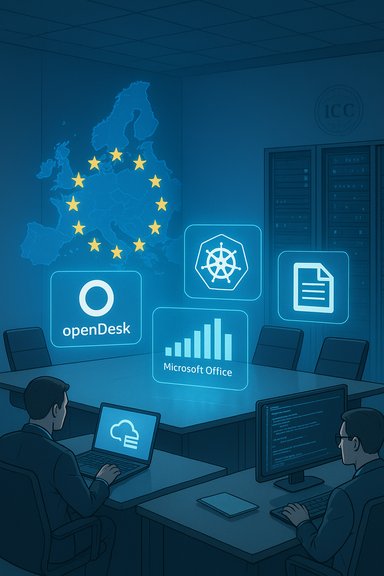
The International Criminal Court has quietly begun replacing Microsoft Office with openDesk, a European open‑source office and collaboration stack, in a move that crystallises a broader political and technical push across Europe to reduce dependence on U.S. cloud and productivity vendors. The decision — confirmed to a press outlet by court representatives but not fully detailed by the ICC — comes amid heightened fear in Brussels that U.S. executive orders and sanctions can be used to interrupt services provided by American technology companies, an anxiety sharpened when the ICC’s chief prosecutor faced service disruption after U.S. sanctions were announced. This is not just a change of apps on desktops; it is a strategic gambit about digital sovereignty, legal risk, and the resilience of institutions that handle sensitive international prosecutions.
The immediate context for the ICC’s change is political and legal friction between the United States and the court. In February 2025 the U.S. president issued an executive order imposing sanctions linked to the ICC’s investigations of high‑profile Israeli and other actors — a move that resurrected old tensions between the U.S. and the court and prompted immediate operational consequences for international bodies that use U.S. technology services. Independent reporting documented the executive order and its stated measures, which included asset freezes and travel restrictions potentially affecting ICC officials. Shortly thereafter, reporting emerged that the ICC’s chief prosecutor, Karim Khan, experienced disruption to a Microsoft‑hosted email account in connection with the U.S. sanctions. That episode amplified worries among European governments and civil servants that a Washington‑directed order — or a U.S. vendor’s interpretation of its legal obligations — could create a “kill switch” that interferes with mission‑critical work performed on European soil. Microsoft’s president publicly disputed the notion that the company had ceased providing services to the ICC, saying the company had been in contact with the court “throughout the process” and that “at no point did Microsoft cease or suspend its services to the ICC.” The conflicting accounts left observers with a mixture of facts, interpretations, and fear. At the same time, European governments and new public bodies such as Germany’s Centre for Digital Sovereignty (ZenDiS) have been actively developing and promoting open‑source, sovereign alternatives for office productivity, collaboration and cloud services. ZenDiS — established to reduce critical vendor dependencies for public administration — has been developing and packaging openDesk as a sovereign, Kubernetes‑native stack that integrates mature open‑source components and aims to be deployable in national or regional clouds. ZenDiS and related federal projects have already announced pilots and large migrations of public sector users to openDesk in 2025, strengthening the product’s profile as a real, deployable alternative.
But limits remain. Not every feature of Microsoft 365 has a drop‑in equivalent; advanced spreadsheet and Outlook/Exchange semantics are still a pain point. Self‑hosting requires sustained investment in operations. There is also the potential for fragmentation: if too many jurisdictions choose incompatible stacks, cross‑border collaboration may become harder. The realistic path for many organisations will be a controlled hybrid environment and a staged reduction of vendor dependency rather than an abrupt cutover.
That question does not have a single, tidy answer yet. Early signs show that openDesk and ZenDiS are credible technical efforts with production deployments in German public services, and that the political impetus driving adoption is strong. But the ICC episode also illustrates a fundamental trade‑off: reducing vendor dependence buys sovereignty but costs governance, operations and careful interoperability engineering.
For public sector technologists, the practical takeaway is straightforward and immediate:
Source: theregister.com International Criminal Court dumps Microsoft Office
 Background
The immediate context for the ICC’s change is political and legal friction between the United States and the court. In February 2025 the U.S. president issued an executive order imposing sanctions linked to the ICC’s investigations of high‑profile Israeli and other actors — a move that resurrected old tensions between the U.S. and the court and prompted immediate operational consequences for international bodies that use U.S. technology services. Independent reporting documented the executive order and its stated measures, which included asset freezes and travel restrictions potentially affecting ICC officials. Shortly thereafter, reporting emerged that the ICC’s chief prosecutor, Karim Khan, experienced disruption to a Microsoft‑hosted email account in connection with the U.S. sanctions. That episode amplified worries among European governments and civil servants that a Washington‑directed order — or a U.S. vendor’s interpretation of its legal obligations — could create a “kill switch” that interferes with mission‑critical work performed on European soil. Microsoft’s president publicly disputed the notion that the company had ceased providing services to the ICC, saying the company had been in contact with the court “throughout the process” and that “at no point did Microsoft cease or suspend its services to the ICC.” The conflicting accounts left observers with a mixture of facts, interpretations, and fear. At the same time, European governments and new public bodies such as Germany’s Centre for Digital Sovereignty (ZenDiS) have been actively developing and promoting open‑source, sovereign alternatives for office productivity, collaboration and cloud services. ZenDiS — established to reduce critical vendor dependencies for public administration — has been developing and packaging openDesk as a sovereign, Kubernetes‑native stack that integrates mature open‑source components and aims to be deployable in national or regional clouds. ZenDiS and related federal projects have already announced pilots and large migrations of public sector users to openDesk in 2025, strengthening the product’s profile as a real, deployable alternative. What’s been announced (and what’s still unverified)
- The core announcement: The ICC has told press that it will move internal productivity and collaboration workflows away from Microsoft Office to openDesk, the open‑source office and collaboration suite developed and offered through ZenDiS. The initial report was published by a tech outlet and subsequently echoed in several aggregators; the ICC has reportedly confirmed the migration to at least one outlet but declined to provide detailed comment or financial figures. This sequence — press report, a brief confirmation, and an institutional silence on specifics — is consistent with other sensitive procurement moves in government and international institutions. (Flag: full independent public disclosure from the ICC has not been published at time of writing; the claim rests on media reporting and the ICC’s partial confirmation.
- Why the ICC says it did this: publicly stated motives and the broader political backdrop suggest digital sovereignty, the desire to reduce reliance on U.S. corporate platforms, and a wish to preserve operational independence from geopolitical instruments such as sanctions. While the ICC has not released a procurement white paper publicly describing the migration in full, the move aligns with a wider European strategy to build supply‑chain resilience and sovereign alternatives to dominant U.S. cloud and productivity vendors. ZenDiS itself positions openDesk explicitly as an offering designed for public administration to “break critical dependencies” and to run in locally controlled infrastructure.
- Microsoft’s posture: Microsoft has publicly insisted that it did not stop providing services to the ICC in the sense of wholesale suspension, while acknowledging interaction with the court during the period when one sanctioned individual’s access was removed. That nuance — between suspending all services to an organisation and disconnecting a sanctioned individual account — is critical, but it does not fully dispel the strategic concern: U.S. vendors operate under U.S. law, including provisions that can force compliance with sanctions or requests, and European customers are sensitive to that legal overlay.
- Verification gap: beyond the press coverage and ZenDiS’s public positioning, there is limited publicly available, independently verifiable documentation of the ICC’s migration timeline, scope, or contract value. For readers and procurement watchers that matters: the headline — “ICC ditches Microsoft” — is real in its political significance, but the exact technical and contractual contours remain partly opaque. This piece flags where claims remain unverified and treats those elements appropriately cautiously.
Why this matters: five practical and political implications
- Digital sovereignty is moving from theory to operations.
- Governments and international organisations are translating policy language about sovereignty into operational projects: cloud re‑architecting, open‑source platforms, and procurement of locally hosted stacks. ZenDiS and openDesk are concrete examples of that translation — they are not academic exercises but production‑oriented toolchains designed for real workloads. The ICC move, if fully implemented, would be a highly visible validation of that effort and could accelerate adoption among other international bodies and member states.
- Vendor legal exposure and compliance obligations are now strategic risks.
- U.S. vendors must obey U.S. law. When a vendor’s obligations under the Cloud Act, sanctions regimes, or export controls intersect with a European customer’s operational needs, the result is a risk that goes beyond technical outages. Organisations handling sensitive investigations or prosecutions — where confidentiality, chain‑of‑custody and access continuity are paramount — face a unique set of stakes. The ICC episode underlines that compliance‑driven account actions can have outsized geopolitical consequences.
- Interoperability and work continuity will define success or failure.
- Replacing Microsoft Office in an international organisation is not solely about Word/Excel/PPT parity. It involves email, calendaring, directory services, eDiscovery, legal holds, secure evidence transfer, macros and complex Excel sheets, bespoke templates, and integrations with case management and evidence systems. A migration that fails to replicate these processes will degrade prosecutorial capacity. Realistic migration plans must map features, identify gaps, and retain fallbacks for high‑risk workflows. Field evidence from public sector migrations shows that operational pitfalls — not pure technical capability — are the principal cause of friction.
- Costs are not just license line items — they are organisational.
- The fiscal calculus of moving off a dominant commercial platform includes migration professional services, staff retraining, support contracts, security hardening, middleware or protocol translation layers, and ongoing operational staffing. Open‑source alternatives reduce vendor license fees but shift operational and governance burdens to local operators or contracted service providers. Procurement teams must budget for total cost of ownership, not only sticker price.
- The political signal may be as important as the technical benefits.
- For many European governments and organisations, moving to a sovereign stack is a policy statement: it signals an intent to build independent capabilities and to assert regulatory and operational control over public infrastructure. That signal has diplomatic spillovers: it pressures vendors to negotiate stronger contractual guarantees and raises the profile of the European open‑source ecosystem. But it also risks fragmentation if interoperability across jurisdictions is not managed thoughtfully.
What openDesk is — capabilities and architecture
openDesk is not a monolithic “one vendor” productivity suite in the Microsoft sense; it is a curated, integrable platform assembled by ZenDiS that packages a set of open‑source components into a deployable, hardened stack aimed at the public sector. Key characteristics:- Cloud‑native, Kubernetes‑based architecture that supports scalability and isolation for multi‑tenant or dedicated deployments.
- Composability: rather than rewriting office apps from scratch, openDesk integrates mature open‑source projects for document handling, collaboration and messaging, and places them behind consistent policy, authentication and hosting layers.
- Sovereign delivery model: deployable on national clouds, private datacentres or managed sovereign hosting providers, designed to keep data under local legal control.
- Focus on standards and interoperability, including ODF and other open formats, plus mechanisms to export/import MS‑formats where required for external collaboration.
Strengths
- Local control over data, logs, and access policies.
- Uses well‑understood open‑source building blocks rather than a single proprietary codebase.
- Can be contractualised with local hosting and SLAs to limit legal exposure to U.S. orders.
Shortcomings and operational risks
- Document fidelity: complex Word templates, advanced Excel macros, and certain PowerPoint features can behave differently in non‑Microsoft editors. Mission‑critical files must be validated.
- Active Directory and Exchange integration gaps: deep calendaring semantics, delegation, Teams integration and Exchange‑native features may not map perfectly.
- Operational burden: public bodies must staff operations, patching, incident response and capacity planning or contract for managed services.
How an organisation should plan a migration like the ICC’s
Large organisations contemplating a move away from Microsoft’s ecosystem should treat this as an organisational transformation, not simply an application swap. A practical checklist:- Inventory and classify: map mailboxes, shared resources, legal retention, and templates.
- Feature mapping: document feature parity requirements for mail, calendar, storage, macros, and eDiscovery.
- Pilot and vertical rollouts: run realistic pilots that include cross‑organisation invite scenarios and external partner testing.
- Interoperability middleware: where Exchange‑specific semantics are required, deploy or procure translation layers.
- Legal and compliance runbooks: ensure legal holds, chain‑of‑custody, and audit logs meet prosecutorial standards.
- Contingency and rollback: maintain parallel runs and a tested rollback path during initial waves.
- Training and communications: build role‑specific documentation and on‑call support during cutover.
- Monitor and validate: define metrics for document fidelity, mail delivery, calendar interoperability and user experience defects.
Security, legal and forensic considerations
- Evidence integrity: legal prosecutions demand unequivocal chain‑of‑custody and admissibility. Any new stack must maintain cryptographic timestamps, immutable audit trails, and verifiable logs. Open‑source components can be audited, which is an advantage, but auditability must be operationalised through policies and tooling.
- Sanctions compliance and vendor behavior: U.S. legal obligations (sanctions, Cloud Act, export controls) can place vendors in difficult positions. The ICC episode illustrates the perception risk: even if a vendor argues it did not cease services, the political optics can force organisations to seek alternatives. Organisations must therefore choose vendors and contracts that specify dispute resolution, local data controls and, where feasible, judicial or arbitration remedies.
- Insider and misconfiguration risk: moving to self‑hosted or sovereign stacks shifts a portion of security risk from vendor to operator. Strong patching regimes, hardened CI/CD pipelines, and independent security audits are mandatory. Open‑source is not a security panacea; maintaining a secure operational posture costs effort and money.
Political economy: why this will accelerate European projects
The ICC story is both a symptom and an accelerant. European institutions have struggled for years over the economics and governance of cloud and productivity software. Two political dynamics are now reinforcing each other:- Regulatory and procurement pressure: procurement rules and political appetite are shifting to favour “open by default” or at least to require stronger contractual sovereignty guarantees for public procurement.
- Vendor commercial response: major cloud vendors are offering sovereign cloud options and stronger contractual clauses; Microsoft announced commitments to push back on certain orders and to include contractual protections for European governments — but activism by states and organisations increases negotiation leverage.
Practical guidance for Windows administrators and IT teams
- Pilot first: use VMs or sandboxes to verify compatibility for critical Word, Excel and PowerPoint templates and macros.
- Maintain a small Microsoft fallback: keep a controlled, audited Windows/Office environment for documents that absolutely require Microsoft fidelity.
- Automate conversions and tests: build automated checks that validate converted documents for layout and macro behavior.
- Contract for support: open‑source stacks require support; plan budgets for managed hosting, third‑party support or in‑house engineering.
- Preserve legal tools: ensure the new stack provides eDiscovery, legal holds, and auditable exports that legal teams can accept.
Strengths, limits and the future
The ICC’s move — if completed — is a notable case study in how geopolitics intersects with software procurement. The strengths of such a migration are clear: decreased jurisdictional exposure to U.S. orders, improved local control over data and infrastructure, and the potential to stimulate a European ecosystem of vendors and integrators.But limits remain. Not every feature of Microsoft 365 has a drop‑in equivalent; advanced spreadsheet and Outlook/Exchange semantics are still a pain point. Self‑hosting requires sustained investment in operations. There is also the potential for fragmentation: if too many jurisdictions choose incompatible stacks, cross‑border collaboration may become harder. The realistic path for many organisations will be a controlled hybrid environment and a staged reduction of vendor dependency rather than an abrupt cutover.
Final assessment
The ICC’s reported switch to openDesk captures a turning point in European digital policy. The story combines geopolitics, legal risk and operational IT realities into a single test case: can an international court — one that relies on continuity, confidentiality and legal rigor — operate on a sovereign, open‑source stack without harming its prosecutorial mission?That question does not have a single, tidy answer yet. Early signs show that openDesk and ZenDiS are credible technical efforts with production deployments in German public services, and that the political impetus driving adoption is strong. But the ICC episode also illustrates a fundamental trade‑off: reducing vendor dependence buys sovereignty but costs governance, operations and careful interoperability engineering.
For public sector technologists, the practical takeaway is straightforward and immediate:
- Treat migrations as institutional transformations, not application swaps.
- Validate mission‑critical documents and workflows before wholesale cuts.
- Build rollback and hybrid options into procurement and cutover plans.
- Budget for operational staff, managed services and rigorous security practices.
Source: theregister.com International Criminal Court dumps Microsoft Office
