

Tomorrow’s milestone anniversary of the Individuals with Disabilities Education Act arrives under a cloud of policy turmoil: federal staff who enforce the nation’s special-education guarantees have been driven from their desks, the Biden-era framework that sustained IDEA is under active review by the executive branch, and parents and advocates are preparing to escalate a fight to preserve services that serve more than seven million students. The immediate trigger is a wave of reductions-in-force and firings inside the U.S. Department of Education’s disability and civil‑rights offices that left the Office of Special Education Programs (OSEP) largely empty, and administration plans to explore transferring special‑education authority to the Department of Health and Human Services — a shift critics say would recast an education law as a health‑care program and weaken enforcement.
The Individuals with Disabilities Education Act — signed originally as the Education for All Handicapped Children Act on Nov. 29, 1975 — established that children with disabilities are entitled to a free, appropriate public education (FAPE) in the least restrictive environment, and it created the Individualized Education Program (IEP) process that guides services and accommodations today. The landmark law remedied a system in which most children with disabilities were excluded from school; by several contemporary estimates, only one in five children with disabilities attended public school before federal protections took hold. IDEA was last reauthorized in 2004, and many advocates have argued for updates to reflect modern practice and demographics. Federal responsibility under IDEA is not just symbolic. Today roughly 7 to 7.5 million students receive services under IDEA — about 14–15% of public‑school enrollment — spanning speech, occupational and physical therapy, specialized instruction, assistive technology, and transition supports that enable post‑school employment and independence. Those services are funded through a combination of local, state and federal dollars; the original federal commitment to pay roughly 40% of the extra costs of educating students with disabilities has never been met, and the federal share has fallen to the low‑teens percentage in recent years, leaving districts and families to shoulder growing burdens.
Potential legal and structural consequences include:
For school districts
But there are risks: adversarial public battles can create adversary dynamics that slow negotiation and could accelerate short‑term operational disruption if executed without parallel legal and technical strategies. For example, public campaigns that demand immediate reversal may prompt defensive agency legal postures, while litigation can take months and does not restore day‑to‑day casework. The most durable strategy combines public pressure with targeted legal and congressional actions that restore staffing and bind any reorganization to explicit protections for IDEA’s enforcement architecture.
Two long‑term remedies deserve consideration:
Restoring functioning federal capacity, clarifying where responsibilities lie, and ensuring that any interagency realignment preserves the legal and procedural protections of IDEA are urgent public‑policy priorities. In the meantime, school districts and families must document, prepare and press their elected representatives for concrete assurances: staff restored, funding stabilized, and a public plan that protects the educational rights that IDEA was created to guarantee.
Source: Cleveland.com Parents are ready to fight gutting of special education support: Jonathan Salazar
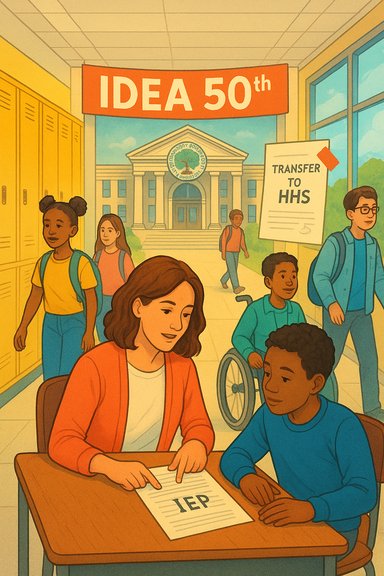 Background: IDEA’s promise, funding gap, and why this matters now
The Individuals with Disabilities Education Act — signed originally as the Education for All Handicapped Children Act on Nov. 29, 1975 — established that children with disabilities are entitled to a free, appropriate public education (FAPE) in the least restrictive environment, and it created the Individualized Education Program (IEP) process that guides services and accommodations today. The landmark law remedied a system in which most children with disabilities were excluded from school; by several contemporary estimates, only one in five children with disabilities attended public school before federal protections took hold. IDEA was last reauthorized in 2004, and many advocates have argued for updates to reflect modern practice and demographics. Federal responsibility under IDEA is not just symbolic. Today roughly 7 to 7.5 million students receive services under IDEA — about 14–15% of public‑school enrollment — spanning speech, occupational and physical therapy, specialized instruction, assistive technology, and transition supports that enable post‑school employment and independence. Those services are funded through a combination of local, state and federal dollars; the original federal commitment to pay roughly 40% of the extra costs of educating students with disabilities has never been met, and the federal share has fallen to the low‑teens percentage in recent years, leaving districts and families to shoulder growing burdens. What happened: layoffs, organizational upheaval, and an administrative pivot
In October 2025, a series of reduction‑in‑force actions and mass personnel decisions inside the U.S. Department of Education removed hundreds of employees across the agency and wiped out nearly all staff in the offices responsible for special education and civil rights enforcement. Union officials, disability‑rights groups and multiple news outlets reported that OSEP and other units were left with only a handful of senior officials and no functioning workforce to handle monitoring, technical assistance, and complaint investigations. The impact was immediate: guidance lines went dark, routine monitoring and federally required compliance reviews were interrupted, and the small network of federal experts who support state education agencies was effectively dismantled. At the same time, Department leadership has publicly and privately signaled an intent to explore moving the federal centerpiece of special‑education administration out of the Department of Education and into the Department of Health and Human Services (HHS) or other federal partners. Multiple reports and education stakeholders indicate the administration has discussed repositioning IDEA‑related activities to a health‑oriented agency, with the stated rationale of “bringing resources closer to states and families” and aligning services delivered through medically oriented programs. Congressional Democrats and disability‑rights organizations have demanded answers and pushed back, arguing the move would change IDEA’s legal framing, reduce enforcement, and risk conflating educational rights with medical care. Key facts to keep in mind- OSEP and the Department of Education’s disability enforcement arm provide monitoring, technical assistance, grants, and civil‑rights investigations tied to IDEA’s legal guarantees. Removing or relocating that capacity would materially change how those activities are administered.
- More than 7 million U.S. students rely on IDEA services; disruptions to federal oversight or funding pipelines would have nationwide operational consequences for school districts and families.
Why moving special education into HHS would be consequential (and legally awkward)
IDEA is authored and enforced as an education law. Its statutory language, regulatory rules, and decades of case law are built around educational rights, procedural due process (including IEP teams and parental participation), and federal–state funding relationships. Shifting operational responsibility into HHS — a department structured around public‑health delivery, clinical services and Medicaid programs — would not automatically change IDEA itself (only Congress can rewrite the law), but it would change the institutional frame through which services are administered.Potential legal and structural consequences include:
- A shift in underlying priorities. HHS’s mission centers on health outcomes and clinical service delivery; an HHS‑run IDEA apparatus could privilege medical assessments, Medicaid‑eligible therapies, and clinical pathways over school‑based instructional remedies and education‑rights enforcement.
- Accountability and enforcement gaps. The Department of Education’s Office for Civil Rights and OSEP have existing authorities and protocols to enforce FAPE and investigate discrimination. Moving administrative functions to HHS could fracture investigative pathways and slow or reduce the use of education‑specific enforcement tools.
- Confusion for families and states. States contract with both education and health agencies for different supports. Relocating federal oversight would require new memoranda of understanding, procurement changes, and reworking of grant administration — a process likely to create service interruptions and legal challenges.
- Funding stream reallocation. Even if Congress does not change IDEA’s entitlement structure, shifting program infrastructure into HHS could alter budget priorities and funding mechanisms in practice, incentivizing different spending patterns and perhaps increasing reliance on Medicaid for educationally necessary therapies.
What the administration says — and what’s still unverified
Public Department statements frame personnel reductions and organizational reviews as part of broader cost‑saving and devolution efforts: the stated goal is to move decision‑making “closer to states, localities, and students” and to streamline federal functions. Department spokespeople have described “exploring partnerships” and emphasized commitments to preserve IDEA funding flows during any transition. But the real‑world consequences — which grants will be adjusted, how monitoring and enforcement will continue, and whether civil‑rights investigations will be paused — remain partially undocumented in publicly available executive orders or signed interagency agreements. Several reputable reporting outlets note that no formal transfer has been executed; rather, the Department has been “exploring” options while simultaneously reducing staff capacity. That timing is what alarms advocates: capacity is being removed before an alternate structure has been concretely established. A caution about specific characterizations: some opinion columns and activist statements interpret the administration’s motives in moral terms — asserting, for example, that HHS leadership “sees our kids as patients needing to be cured.” That phrase captures a real policy worry (medicalization of educational services) but is an attribution of motive that is not found as a verbatim policy statement from HHS leadership in public records; it should therefore be treated as interpretive critique rather than a direct quote from HHS officials. Where direct quotes or policy memoranda exist, they are best cited specifically; otherwise, careful reporting must separate documented moves from rhetorical framing. (No reliable record has been found of HHS Secretary Robert F. Kennedy Jr. using the specific phrase cited above as an official policy justification.Immediate practical risks for families, schools, and districts
Schools and districts operate on tight margins and rely on a predictable federal compliance and grant ecosystem to plan services. The current upheaval creates several operational hazards:- Interrupted compliance monitoring and complaint resolution. Families use federal complaint processes and OCR investigations to secure services when local negotiations fail. With OSEP and OCR staffing reduced, complaint backlogs will grow and families’ rights to timely remedy may be impaired.
- Grant‑administration chaos. IDEA Part B grants and related discretionary program funding flow through the Department of Education’s grant machinery. Staffing cuts that reach grant officers and program specialists create a risk of delayed award notices, paused discretionary competitions, and slower technical assistance to states and districts.
- Programmatic confusion at the local level. District special‑education directors rely on federal guidance (Dear Colleague letters, compliance charts, monitoring rubrics) to interpret regulatory requirements. An organizational transfer or a prolonged review process will leave districts operating with uncertain federal expectations at the same time they must meet legal obligations under IDEA.
- Equity pressures and access gaps. Smaller or underresourced districts that depend on federal technical assistance — or that lack robust local capacity for complex IEP services — will be disproportionately affected if centralized federal support is reduced. That could widen disparities within states and between urban and rural districts.
How parents, advocates, and lawmakers are responding
Across the political spectrum, parents of students with disabilities have shown the capacity to mobilize around concrete administrative decisions that threaten services. In Ohio and other states, parent groups, civil‑rights organizations, state special‑education directors and bipartisan congressional members have demanded transparency, restoration of staff, and explicit assurances that IDEA’s enforcement functions will be preserved. Several members of Congress have sent letters questioning the legality of firing OSEP staff and seeking immediate explanations and timelines from Department leadership. Disability‑rights organizations and university centers that support developmental disabilities have issued statements condemning the dismantling of the Department’s disability offices and warning of long‑term harm to students. What advocates are doing practically- Public pressure campaigns and coordinated letters to secretaries and appropriators.
- Litigation threats or filings asserting that mass firings were unlawful or that procedural requirements for changes were not followed.
- Legislative options, including hearings, holdbacks on Department reorganization plans, and appropriations riders to protect funding and staff positions.
- Local organizing: parents are meeting with members of Congress, forming coalitions, and preparing to seek expedited oversight hearings.
A checklist for districts and parents: practical, short‑term steps
The uncertainty will not be resolved overnight. While advocates press for systemic solutions, school leaders and families can take steps to protect continuity of services.For school districts
- Audit records and document compliance. Build airtight IEP documentation, service logs, and communication archives so families and districts have a clear record if federal monitoring is paused.
- Strengthen state partnerships. Coordinate with state education agencies and state special‑education leaders to ensure local plans align with state guidance and to tap any available state technical assistance resources.
- Preserve grant continuity. Maintain meticulous fiscal records for IDEA Part B and discretionary grants; prepare contingency plans for delayed federal awards.
- Communicate proactively with families. Publish clear notices about any temporary procedural changes, appeal timelines and local dispute‑resolution options.
- Request written explanations of any changes to IEP services and timelines. Federal law protects parental rights to participation and written notices; enforce those rights at the district level.
- Preserve your case file. Keep copies of IEPs, progress reports, therapy notes and all correspondence; these are critical if remedies are required.
- Connect to statewide parent centers and disability‑rights legal services for advice about filing complaints or requesting mediations.
- Stay engaged with elected officials. Calls, emailed requests for oversight, and coordinated advocacy are effective levers to prompt hearings and public accountability.
Policy options: what Congress and states can do (and what they can’t)
Because IDEA is statutory, only Congress can change the law’s core entitlements. Several practical legislative and oversight tools are available immediately:- Emergency appropriations and staff protections. Appropriations riders or targeted funding can restore essential staffing and grant continuity while oversight is conducted.
- Oversight hearings. House and Senate committees can subpoena Department records and compel testimony to clarify whether layoffs were lawful and whether any formal interagency transfer plans exist.
- Statutory clarifications. Congress can pass explicit language defining where IDEA’s administrative functions must reside, or require that any interagency transfers preserve enforcement, monitoring and civil‑rights obligations.
- State action. States can step in to shore up technical assistance and monitoring capacity through state special‑education offices or through regional consortia if federal capacity is unavailable.
Strengths of the parent-led response — and the risks of escalation
The reaction from parents and disability‑rights allies is a policy strength: it’s a rapid, grassroots, bipartisan mobilization grounded in lived experience of navigating IEPs and contested services. That direct political pressure is often effective at generating hearings, restoring staff, or obtaining temporary funding protections. It also reframes the debate around children’s rights rather than bureaucratic reorganization.But there are risks: adversarial public battles can create adversary dynamics that slow negotiation and could accelerate short‑term operational disruption if executed without parallel legal and technical strategies. For example, public campaigns that demand immediate reversal may prompt defensive agency legal postures, while litigation can take months and does not restore day‑to‑day casework. The most durable strategy combines public pressure with targeted legal and congressional actions that restore staffing and bind any reorganization to explicit protections for IDEA’s enforcement architecture.
The long view: preserving IDEA’s promise in a shifting federal landscape
The current episode is a test of institutional resilience: IDEA’s rights are statutory and backed by decades of litigation and administrative regulation, but rights require administrative capacity to be meaningful in practice. A federal office that cannot investigate complaints, cannot award or monitor grants, and cannot produce up‑to‑date guidance cannot fulfill the law’s promise — no matter what the statute says on paper.Two long‑term remedies deserve consideration:
- Reinvest in federal capacity and modernize enforcement tools to handle contemporary caseloads, including digital complaints and cross‑agency coordination for medically complex students.
- Build statutory firewalls that prevent mission‑creep from shifting education entitlements into medical or social‑service domains without congressional approval, while allowing sensible collaboration with HHS when clinical services are medically necessary and Medicaid‑eligible.
Conclusion
The 50th anniversary of IDEA is an occasion for celebration, but that celebration is now tempered by a political and administrative crisis. Mass firings at the Department of Education’s disability offices have reduced federal enforcement capacity, and exploratory plans to move special‑education functions toward HHS raise fundamental questions about whether the nation treats IDEA as an education right or a medical entitlement. Families and advocates are mobilizing — rightly — because the stakes are the day‑to‑day services that allow millions of children to learn, communicate and participate in school.Restoring functioning federal capacity, clarifying where responsibilities lie, and ensuring that any interagency realignment preserves the legal and procedural protections of IDEA are urgent public‑policy priorities. In the meantime, school districts and families must document, prepare and press their elected representatives for concrete assurances: staff restored, funding stabilized, and a public plan that protects the educational rights that IDEA was created to guarantee.
Source: Cleveland.com Parents are ready to fight gutting of special education support: Jonathan Salazar