

Idemia Public Security’s elevation to a Microsoft Entra Verified ID launch partner marks a deliberate step in the identity industry's pivot from brittle, password-centric workflows to cryptographically anchored, verification-driven credentials—and the move highlights both immediate operational benefits and thorny governance questions organizations must face when they adopt biometric-backed identity proofing at scale.
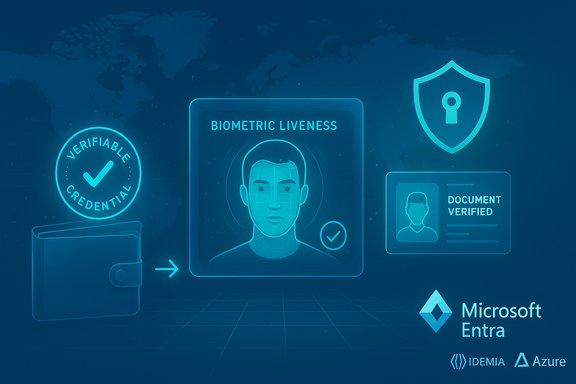
Microsoft has been positioning Entra Verified ID as the company’s answer to verifiable, privacy-preserving digital credentials: a standards-based approach that lets organizations issue tamper-evident credentials, allow users to hold those credentials in wallets, and verify attributes without repeatedly re-exposing sensitive personal data. That capability has matured from early previews into a broader production posture that Microsoft is now rolling out with partner integrations and marketplace availability. IDEMIA Public Security (Idemia PS), a long-established provider of biometric liveness and document verification systems, announced it will be one of Microsoft’s launch partners for Entra Verified ID. The expanded collaboration was unveiled during Microsoft Ignite and frames Idemia PS as a supplier of the identity-proofing step that precedes credential issuance—remote onboarding, password and account recovery, contact-center identity checks, and similar high-value touchpoints. The announcement follows an earlier integration between the companies in February 2024 and positions Idemia PS as a production-grade proofing option in Verified ID flows. At the same time, other vendors in the identity space are aligning with Entra Verified ID: ID Dataweb announced integration to add risk and fraud signals at credential issuance, while 1Kosmos published availability of its identity platform in the Microsoft Azure Marketplace, emphasizing biometric liveness, FIDO2 compatibility, and NIST-conformant proofing. These partner additions make it clear that Microsoft’s Verified ID is being treated as an extensible ecosystem rather than a monolithic replacement for upstream identity proofing.
For organizations that treat identity as a security perimeter, the combination of cryptographic credentials and robust proofing materially reduces some of the most pernicious fraud vectors. But doing it well requires competent procurement, clear technical design, and a focus on resilience and privacy from day one.
In short: Idemia PS’s role as a Verified ID launch partner is evidence that Microsoft’s credential-first strategy is moving from experimentation into real-world, production deployments—with multiple vendors now offering the complementary proofing and risk signals enterprises need to make verifiable credentials trustworthy at scale. The technology delivers clear security benefits, but those benefits will only be realized when proofing is implemented with strong privacy controls, diverse vendor choices, and rigorous operational practices.
Source: Biometric Update Idemia PS to be a biometric tech launch partner for Microsoft Entra Verified ID | Biometric Update
 Background
Microsoft has been positioning Entra Verified ID as the company’s answer to verifiable, privacy-preserving digital credentials: a standards-based approach that lets organizations issue tamper-evident credentials, allow users to hold those credentials in wallets, and verify attributes without repeatedly re-exposing sensitive personal data. That capability has matured from early previews into a broader production posture that Microsoft is now rolling out with partner integrations and marketplace availability. IDEMIA Public Security (Idemia PS), a long-established provider of biometric liveness and document verification systems, announced it will be one of Microsoft’s launch partners for Entra Verified ID. The expanded collaboration was unveiled during Microsoft Ignite and frames Idemia PS as a supplier of the identity-proofing step that precedes credential issuance—remote onboarding, password and account recovery, contact-center identity checks, and similar high-value touchpoints. The announcement follows an earlier integration between the companies in February 2024 and positions Idemia PS as a production-grade proofing option in Verified ID flows. At the same time, other vendors in the identity space are aligning with Entra Verified ID: ID Dataweb announced integration to add risk and fraud signals at credential issuance, while 1Kosmos published availability of its identity platform in the Microsoft Azure Marketplace, emphasizing biometric liveness, FIDO2 compatibility, and NIST-conformant proofing. These partner additions make it clear that Microsoft’s Verified ID is being treated as an extensible ecosystem rather than a monolithic replacement for upstream identity proofing. What Microsoft Entra Verified ID is and why it matters
The technical concept in plain terms
Microsoft Entra Verified ID leverages decentralized identity primitives—DIDs (decentralized identifiers) and verifiable credentials—to let organizations issue digitally signed credentials and for relying parties to cryptographically verify those credentials without needing to query a central authority each time. The credential schema can represent workplace affiliation, a vetted government ID, or any attribute the issuer chooses to assert. Because the credential is signed and user-held, it reduces repeated transfers of raw identity evidence across systems. This model decouples credential issuance (who verifies and signs identity evidence) from credential presentation (who checks the signature), enabling reuse of a single proof across multiple services—streamlining onboarding, reducing repeated document handling, and lowering friction in zero-trust and passwordless scenarios.Why launching with proofing partners is strategically important
The security and trust model for Verifiable Credentials depends critically on proper identity proofing at issuance. A tamper-resistant credential is useless if it was issued to an impostor. That’s why Microsoft’s Verified ID program emphasizes vetted proofing partners for the “last meter” of identity: capturing a government ID, verifying the document’s authenticity, and performing liveness checks to bind a real person to the presented evidence. Idemia PS, with its decades of identity work and existing document/liveness tooling, slots into that role: supply verified claims at the moment of issuance so the credential lifecycle begins with a high-confidence assertion.What Idemia Public Security brings to Entra Verified ID
Technology and pedigree
Idemia PS supplies two core capabilities that are directly relevant to credential issuance:- Document verification: automated OCR and authenticity checks for government IDs, passports, and other identity documents.
- Biometric liveness detection: modalities that ensure the selfie or facial capture used in proofing is from a live person rather than a replay or synthetic generation.
The narrative from Idemia leadership
Matt Cole, CEO of Idemia Public Security, emphasized trust and long experience in identity verification in the launch messaging—underscoring that enterprises and regulated industries rely on accurate proofing to confidently onboard users and issue credentials that downstream systems will accept. That leadership message matters for risk-aware buyers in finance, government, and enterprise who will treat credential issuance as an auditable transaction.The expanding Verified ID ecosystem: ID Dataweb, 1Kosmos and others
ID Dataweb: adding risk signals at issuance
ID Dataweb announced an integration that places risk and identity-threat signals into the credential issuance process. The company positions itself as preventing credential issuance to attackers by validating identity attributes and checking device and behavioral signals before a verifiable credential is minted. That complements document- and liveness-based proofing by adding cross-channel fraud intelligence to stop synthetic identity and account-opening fraud at the source. ID Dataweb’s CEO framed the capability succinctly: decentralized credentials “hold enormous promise, but only if they are issued to the right person.”1Kosmos: marketplace availability and standards compliance
1Kosmos’ platform—now available in the Microsoft Azure Marketplace—focuses on verifying government-issued credentials, matching them to a selfie with liveness detection, and supporting passwordless authentication standards such as FIDO2 and NIST 800-63-3 IAL2/AAL2. Their marketplace availability lowers deployment friction for Azure customers and signals Microsoft-aligned provisioning and billing channels for enterprises assessing identity proofing options.Why multiple vendors matter
- Competition and choice let organizations map proofing strategy to risk appetite and regulatory constraints.
- Diversity of approaches (document + liveness, behavioral risk signals, cryptographic binding) increases operational resilience: no single vendor’s failure should invalidate the entire trust chain.
- Multiple vendors create an ecosystem model where different trust anchors (government ID, employer attestation, financial records) can coexist as issuance inputs.
Security analysis: strengths and measurable gains
Stronger account protections at the moment that matters
By shifting high-assurance verification to the point of credential issuance, Verified ID reduces downstream reliance on passwords, shared secrets, and repeated ID exchanges—major vectors for account takeover. Where implemented correctly, organizations can:- Reduce fraudulent account openings and credential stuffing opportunities.
- Lower helpdesk load from password recovery (since verifiable credentials can be used for recovery flows).
- Improve contact-center validation with cryptographic assertions instead of knowledge-based or scriptable checks.
Operational advantages for IT and security teams
- Standardized issuance and revocation mechanics reduce bespoke work across applications.
- Interoperability with Entra’s existing conditional access and zero‑trust controls makes it simpler to bake credential checks into access policies.
- Auditability: issuance events, signature chains and revocation records create an evidentiary trail suitable for compliance and incident response.
Risks, unknowns and potential pitfalls
Proofing is not infallible—attackers will adapt
Biometric verification and liveness checks raise the bar, but they are not perfect. Adversaries will continue to probe weak collection flows (unsecure SDKs, poor anti-replay measures), exploit social-engineering recovery channels, or attempt to subvert downstream systems that accept credentials without adequate policy checks. Recent industry research into identity-layer vulnerabilities—such as cross-tenant or federation flaws in complex identity deployments—illustrates that credential lifecycles remain attackable if vendors and integrators do not rigorously harden all surfaces. Organizations should pair credential issuance with continuous risk evaluation and monitoring.Privacy, retention and regulatory exposure
Collecting images of government IDs and biometric templates carries regulatory and privacy obligations that differ across jurisdictions. Key considerations:- Data minimization: insist that vendors return attestations rather than storing raw biometric evidence long-term.
- Ephemeral processing: where possible, use designs that perform verification and discard raw data, keeping only cryptographic attestations.
- Cross-border constraints: document flows involving passports or national IDs may trigger data-transfer restrictions or local consent requirements.
False acceptance versus false rejection trade-offs
Liveness and document checks have tunable thresholds. A lower threshold improves user convenience but increases the risk of false acceptance (bad actors passing checks); a higher threshold reduces fraud at the cost of user friction and possible exclusion of legitimate users who cannot produce ideal photos or who have accessibility needs. Organizations should pilot with representative populations and measure both security and inclusion metrics before broad rollout.Vendor lock-in and operational dependency
Relying on a small set of proofing vendors could create friction if an enterprise needs to switch providers or run cross-jurisdictional operations. Ensure contracts include portability clauses, clear SLAs around resilience and incident response, and support for multi-vendor proofing strategies.Practical guidance for adopters: rollout, governance, and risk controls
Recommended technical and process checklist
- Start with a scoped pilot targeting non-critical or new user cohorts to validate user experience and reliability.
- Require vendors to provide ephemeral processing modes and to return signed attestations, not raw images.
- Test recovery and exception workflows thoroughly (for example, lost-wallet scenarios, revoked credentials).
- Integrate credential checks into conditional access policies rather than relying on unilateral decisions at a single service.
- Conduct tabletop exercises that simulate compromised credentials and vendor outages to gauge operational readiness.
Contractual and procurement recommendations
- Demand machine-readable data-lifecycle and retention statements from vendors.
- Require independent security assessments and regular penetration testing.
- Specify incident response timeframes and liability terms for breaches involving proofing data.
- Ensure FIDO2, NIST SP 800-63, or comparable standard compliance is documented where relevant to the assurance level being purchased. 1Kosmos and others explicitly cite such standards in their product claims.
Privacy-by-design and inclusion safeguards
- Implement alternatives for users unable to present standard documents or biometrics (supervised in-person proofing, trusted attestations from employers).
- Publish a clear privacy notice for end users describing what is processed, for how long, and their redress options.
- Monitor false-reject rates across demographics to detect unintended exclusion early in the deployment.
Market and vendor dynamics: what the launch means
An ecosystem forming around Verified ID
The Idemia PS launch partnership—together with ID Dataweb’s fraud-risk integration and 1Kosmos’ marketplace availability—signals that Entra Verified ID is being treated as a platform extensible through third-party proofing and risk services. Vendors are positioning themselves to capture the proofing, risk-scoring, and wallet-integration stages of the credential lifecycle. This arrangement mirrors other platform ecosystems where specialized vendors compete to supply the highest-assurance inputs into a central issuer/presenter architecture.Strategic implications for enterprise buyers
- Enterprises with global operations will want to evaluate proofing vendors by geography, regulatory posture, and language support.
- Regulated sectors (finance, healthcare, public sector) should insist on independent validation of proofing technology and on contractual limits to data retention.
- Organizations should consider hybrid strategies that combine automated proofing with human-reviewed escalation for high-risk cases.
Closing assessment: strengths, weaknesses, and the road ahead
The arrival of Idemia PS as a Verified ID launch partner is meaningful because it aligns a legacy biometrics vendor with Microsoft’s cryptographic credential model—bridging the gap between physical-document identity evidence and modern verifiable credentials. That bridge is precisely the weak link many decentralized identity advocates have warned about: a secure credential is only as trustworthy as the proofing that issued it. Idemia’s scale and experience help reduce that risk in many contexts, and companion integrations from ID Dataweb and 1Kosmos show the market maturing toward layered proofing and risk management. Nevertheless, this is not a panacea. Adoption creates new governance questions, cross-border privacy challenges, inclusion trade-offs, and a need to harden end-to-end flows against identity-layer vulnerabilities. Enterprises should approach Verified ID deployments with a program mindset: pilot, measure, govern, and iterate—prioritizing vendor diversity, contractual protections, and operational readiness.For organizations that treat identity as a security perimeter, the combination of cryptographic credentials and robust proofing materially reduces some of the most pernicious fraud vectors. But doing it well requires competent procurement, clear technical design, and a focus on resilience and privacy from day one.
In short: Idemia PS’s role as a Verified ID launch partner is evidence that Microsoft’s credential-first strategy is moving from experimentation into real-world, production deployments—with multiple vendors now offering the complementary proofing and risk signals enterprises need to make verifiable credentials trustworthy at scale. The technology delivers clear security benefits, but those benefits will only be realized when proofing is implemented with strong privacy controls, diverse vendor choices, and rigorous operational practices.
Source: Biometric Update Idemia PS to be a biometric tech launch partner for Microsoft Entra Verified ID | Biometric Update
