

The idea that identity governance is “just compliance” is rapidly becoming obsolete. In Microsoft’s latest framing, governance is now one of the operational foundations of Zero Trust, because access decisions have to be continuously justified, time-bound, and revocable across cloud, hybrid, and increasingly AI-driven environments. Microsoft’s own Entra materials describe identity governance as part of a unified Zero Trust user-access model that applies least privilege across public and private networks, while newer guidance extends those controls to agents and workload identities as well.
Identity governance used to be treated as an audit trail problem: who got access, when, and whether the paperwork checked out. That model was adequate when businesses had relatively static employees, predictable application stacks, and long refresh cycles for permissions. But cloud-first architecture, SaaS sprawl, remote work, and automation have turned access into a living system that changes by the minute, not by the quarter. Microsoft’s current positioning makes that shift explicit by tying Entra ID Governance to least privilege, lifecycle controls, and Zero Trust execution rather than retrospective compliance alone.
The practical implication is simple but profound: granting access is no longer the hard part; controlling its accumulation is. Microsoft’s Zero Trust guidance and Entra documentation repeatedly emphasize that the security failure mode is not just an outsider breaching the perimeter, but an insider or workload that retains permissions long after they are needed. That is why access reviews, entitlement management, privileged access workflows, and automated lifecycle actions are now framed as security controls, not administrative conveniences.
This also explains why the conversation around governance is expanding beyond human users. Microsoft has recently introduced documentation for AI agents and service principals that can request access packages, participate in Conditional Access policies, and be governed through lifecycle controls. In other words, the identity perimeter is no longer just about employees and contractors; it now includes software actors that can act on behalf of humans or business processes.
For Windows and Microsoft-heavy enterprises, that is a major strategic evolution. It means governance is not a bolt-on to the security stack but a control plane that links HR events, provisioning, app assignment, policy enforcement, and recertification. And because Microsoft is pushing these capabilities through SaaS delivery, the product story is increasingly about time to value, incremental adoption, and coverage across both cloud and on-premises estates.
That matters because access bloat tends to happen quietly. Employees move roles, contractors change projects, teams are restructured, and applications accumulate permissions through one-off exceptions and legacy group memberships. Without active governance, that access becomes institutional residue, and residue is exactly what attackers exploit. Stale privilege is not merely messy; it is often the shortest path to lateral movement.
That shift is subtle but important for practitioners. If security teams only harden sign-in, they leave a huge opening for privilege persistence. Governance closes that gap by forcing access to be intentional, explainable, and revocable. It is the difference between a locked door and a house where everyone keeps copying the key.
That packaging matters because it reflects the market’s shift away from sprawling legacy IGA deployments. Traditional identity governance systems often required long implementation cycles, custom integrations, and large amounts of upfront process work. Microsoft is instead emphasizing faster deployment, incremental adoption, and patterns that can start with the most manual or riskiest workflows first.
Microsoft’s materials also suggest a broader architectural ambition: governance should not be a separate bureaucratic layer but part of the access system itself. In practice, that means access packages, review workflows, Conditional Access, and workload identity controls can increasingly be designed as one policy story. That is a much stronger Zero Trust posture than security-after-the-fact reporting.
The enterprise implication is obvious. Organizations do not need to wait for a perfect identity maturity model before improving security. They can begin where manual work is most expensive, automate the repeatable cases, and let the governance platform become the place where access is both granted and continuously justified.
That structure is far more powerful than a simple group. A group can give access, but an access package can also define who can request access, who approves it, how long it lasts, and when it should be reviewed or removed. That is why Microsoft and related Entra materials increasingly position these features as the operational embodiment of least privilege.
Access reviews complete the loop. They help organizations periodically validate whether the current assignment is still justified and remove stale permissions without relying on someone to remember to clean up. In a Zero Trust model, that kind of periodic revalidation is essential because access should decay unless there is a renewed business need.
That is important because a security strategy that only protects the new cloud layer leaves the old estate exposed. If HR-driven joins, moves, and leaves are governed in one place but the actual entitlements still live in local AD, the organization ends up with split-brain identity management. The result is not simplification but duplication, which is often worse than the original problem.
The bigger lesson is that modernization does not have to be binary. A company can improve governance materially without ripping out its existing directory architecture. That is a more realistic path for large enterprises, especially those with compliance-sensitive workloads, older line-of-business applications, or phased cloud migration programs.
That “start small, scale later” model is attractive because governance failures are rarely uniform. In most organizations, a handful of processes absorb a disproportionate amount of admin time and create a disproportionate amount of risk. Offboarding, orphaned accounts, privileged roles, and application access reviews are obvious candidates because they are repetitive, error-prone, and security-critical.
The key is to resist the urge to reproduce legacy governance habits inside a newer platform. Too many enterprises digitize a broken process instead of simplifying it. Entra’s cloud delivery model makes it easier to rethink the workflow itself, which is where the real productivity gain comes from.
Why does this matter? Because agentic workflows blur the old boundary between “user” and “application.” An AI tool may act on behalf of an employee, operate under delegated permissions, and touch sensitive data without ever looking like a traditional account in the old sense. If governance models do not evolve, organizations will end up with powerful non-human actors that are under-governed by default.
The enterprise opportunity is obvious. If AI agents are going to perform support actions, discovery tasks, or automation workflows, they need constrained permissions and reviewable lifecycles. Otherwise, organizations risk creating a new class of shadow privilege: software that is highly capable but poorly supervised.
For enterprises, the benefits are much more direct. Governance reduces manual workload, strengthens audit readiness, and improves the organization’s ability to enforce least privilege at scale. Microsoft’s own materials emphasize productivity, stronger security, and simplified deployment as core outcomes, which tells you the product is being positioned as both a security and operations tool.
The enterprise side also has a broader attack surface. A single compromised privileged account can affect thousands of users or systems, while a consumer account usually has a narrower blast radius. That is why enterprise governance is increasingly judged as a security control, not a back-office administrative feature.
There is also a danger of overconfidence in hybrid and AI-era governance. As organizations add workload identities, service principals, and agentic workflows, they may expand the number of identities faster than they mature the processes around them. That is why identity governance has to be treated as a living program, not a one-time rollout.
For organizations planning their next identity investment, the strategic question is no longer whether governance matters. The real question is whether they will treat governance as a security primitive early enough to avoid expensive cleanup later. The companies that do will likely see stronger Zero Trust outcomes, cleaner operations, and a better foundation for AI adoption. The companies that delay will probably spend the next few years retrofitting controls onto a much larger problem.
In the end, this is less a product story than a security philosophy shift. Access can no longer be treated as a static permission set that gets reviewed once in a while. It must be governed continuously, across people, applications, devices, and now agents, because that is what the threat landscape already demands.
Source: Petri IT Knowledgebase Why Identity Governance Is Core to Zero Trust
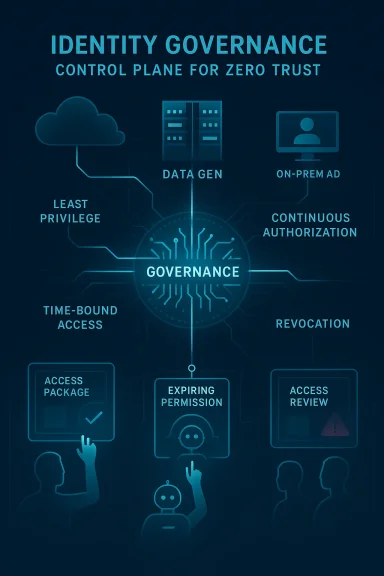 Overview
Identity governance used to be treated as an audit trail problem: who got access, when, and whether the paperwork checked out. That model was adequate when businesses had relatively static employees, predictable application stacks, and long refresh cycles for permissions. But cloud-first architecture, SaaS sprawl, remote work, and automation have turned access into a living system that changes by the minute, not by the quarter. Microsoft’s current positioning makes that shift explicit by tying Entra ID Governance to least privilege, lifecycle controls, and Zero Trust execution rather than retrospective compliance alone.The practical implication is simple but profound: granting access is no longer the hard part; controlling its accumulation is. Microsoft’s Zero Trust guidance and Entra documentation repeatedly emphasize that the security failure mode is not just an outsider breaching the perimeter, but an insider or workload that retains permissions long after they are needed. That is why access reviews, entitlement management, privileged access workflows, and automated lifecycle actions are now framed as security controls, not administrative conveniences.
This also explains why the conversation around governance is expanding beyond human users. Microsoft has recently introduced documentation for AI agents and service principals that can request access packages, participate in Conditional Access policies, and be governed through lifecycle controls. In other words, the identity perimeter is no longer just about employees and contractors; it now includes software actors that can act on behalf of humans or business processes.
For Windows and Microsoft-heavy enterprises, that is a major strategic evolution. It means governance is not a bolt-on to the security stack but a control plane that links HR events, provisioning, app assignment, policy enforcement, and recertification. And because Microsoft is pushing these capabilities through SaaS delivery, the product story is increasingly about time to value, incremental adoption, and coverage across both cloud and on-premises estates.
Why governance is now a security control
At the center of the shift is a redefinition of what “secure access” means. If a user signs in from a trusted device, on a compliant network, with strong authentication, that still does not solve the problem of whether that user should have the entitlement in the first place. Zero Trust cannot stop at verifying the login; it has to validate ongoing authorization and continuously reduce excess privilege. Microsoft’s own Zero Trust positioning for Entra ID Governance explicitly links the product to least privilege and unified user access.That matters because access bloat tends to happen quietly. Employees move roles, contractors change projects, teams are restructured, and applications accumulate permissions through one-off exceptions and legacy group memberships. Without active governance, that access becomes institutional residue, and residue is exactly what attackers exploit. Stale privilege is not merely messy; it is often the shortest path to lateral movement.
The difference between authentication and authorization
Authentication answers “who are you?” Authorization answers “what can you do?” Identity governance sits squarely in the second category, which is why it matters so much to Zero Trust outcomes. Microsoft’s guidance for entitlement management makes clear that access packages can bundle groups, apps, sites, Entra roles, and API permissions into governed assignments rather than ad hoc entitlements.That shift is subtle but important for practitioners. If security teams only harden sign-in, they leave a huge opening for privilege persistence. Governance closes that gap by forcing access to be intentional, explainable, and revocable. It is the difference between a locked door and a house where everyone keeps copying the key.
- Authentication alone is incomplete
- Authorization must be continuously reviewed
- Access should expire unless renewed
- Exceptions must be visible and bounded
- Governance converts access into an accountable process
The Microsoft Entra approach
Microsoft’s Entra ID Governance strategy is built around a unified control plane rather than isolated point features. The company positions the product as a way to automate access across cloud and on-premises applications, improve user experience, and simplify deployment through a SaaS model. It also ties governance directly to the broader Microsoft Entra Suite, which Microsoft says delivers unified Zero Trust user access across public and private networks.That packaging matters because it reflects the market’s shift away from sprawling legacy IGA deployments. Traditional identity governance systems often required long implementation cycles, custom integrations, and large amounts of upfront process work. Microsoft is instead emphasizing faster deployment, incremental adoption, and patterns that can start with the most manual or riskiest workflows first.
A single model for access, workflow, and policy
The power of the Entra model is that provisioning, reviews, lifecycle workflows, and policy can all be aligned around the same identity fabric. That reduces the mismatch that often exists between HR records, app ownership, and security expectations. When those systems drift apart, organizations create blind spots where nobody is truly responsible for whether access remains valid.Microsoft’s materials also suggest a broader architectural ambition: governance should not be a separate bureaucratic layer but part of the access system itself. In practice, that means access packages, review workflows, Conditional Access, and workload identity controls can increasingly be designed as one policy story. That is a much stronger Zero Trust posture than security-after-the-fact reporting.
The enterprise implication is obvious. Organizations do not need to wait for a perfect identity maturity model before improving security. They can begin where manual work is most expensive, automate the repeatable cases, and let the governance platform become the place where access is both granted and continuously justified.
Access packages and access reviews
Among the most important Entra governance features are access packages and access reviews. Access packages are designed to bundle related resources into a single assignable unit, which lets administrators grant coherent sets of permissions instead of stitching together multiple entitlements by hand. Microsoft’s documentation describes them as a structured way to manage groups, apps, sites, roles, and API permissions under one governed workflow.That structure is far more powerful than a simple group. A group can give access, but an access package can also define who can request access, who approves it, how long it lasts, and when it should be reviewed or removed. That is why Microsoft and related Entra materials increasingly position these features as the operational embodiment of least privilege.
Why “groups plus plus” is not marketing fluff
The often-quoted idea that access packages are “groups plus plus” is directionally accurate because the real value is governance context. The system is not just about grouping identities; it is about applying policy to the lifecycle of the access itself. That makes access packages especially useful for birthright access, project-based access, and external collaboration where time-limited permissions are preferable to permanent entitlements.Access reviews complete the loop. They help organizations periodically validate whether the current assignment is still justified and remove stale permissions without relying on someone to remember to clean up. In a Zero Trust model, that kind of periodic revalidation is essential because access should decay unless there is a renewed business need.
The governance cycle in practice
A healthy access lifecycle generally follows a simple sequence:- Request
- Approval
- Assignment
- Review
- Expiration or renewal
- Revocation if no longer justified
- Access becomes time-bound
- Approval becomes auditable
- Review becomes routine
- Revocation becomes automatic
- Least privilege becomes enforceable
Hybrid reality still matters
One of the more pragmatic aspects of Microsoft’s message is its acknowledgment that most organizations are not cloud-only. Many enterprises still run critical workloads, directory services, and application dependencies on-premises, especially around Active Directory. Microsoft’s Entra messaging says it aims to meet customers where they are, which means governance must work across hybrid environments rather than require a clean-slate migration.That is important because a security strategy that only protects the new cloud layer leaves the old estate exposed. If HR-driven joins, moves, and leaves are governed in one place but the actual entitlements still live in local AD, the organization ends up with split-brain identity management. The result is not simplification but duplication, which is often worse than the original problem.
Why hybrid governance is still hard
Hybrid governance is technically difficult because it has to integrate multiple systems of record, multiple protocols, and different operational cadences. A cloud-native identity platform can trigger provisioning into on-premises AD, govern groups through cloud workflows, and push policy-driven assignments back into local directories, but only if the surrounding processes are disciplined. Microsoft’s documented capabilities reflect that reality by supporting provisioning and governance across cloud and legacy environments.The bigger lesson is that modernization does not have to be binary. A company can improve governance materially without ripping out its existing directory architecture. That is a more realistic path for large enterprises, especially those with compliance-sensitive workloads, older line-of-business applications, or phased cloud migration programs.
- Cloud and on-premises need one governance story
- Hybrid identity creates more opportunities for drift
- On-premises AD remains a major dependency
- Automation must span both environments
- Migration should not be a prerequisite for better security
Time to value beats legacy IGA
Legacy identity governance and administration systems earned their reputation by being powerful but cumbersome. They often demanded extensive process redesign, custom connectors, and lengthy deployment phases before real value appeared. Microsoft’s current pitch to customers is essentially the opposite: begin with the highest-friction manual process, automate it, and realize benefits quickly without a monumental program launch.That “start small, scale later” model is attractive because governance failures are rarely uniform. In most organizations, a handful of processes absorb a disproportionate amount of admin time and create a disproportionate amount of risk. Offboarding, orphaned accounts, privileged roles, and application access reviews are obvious candidates because they are repetitive, error-prone, and security-critical.
The best first use cases
Microsoft’s product guidance and broader market posture suggest a pragmatic entry strategy. The smartest projects are the ones where manual work already hurts, not the ones that look impressive in a steering committee deck. That is also why joiner-mover-leaver automation remains such a strong starting point: it maps directly to HR, reduces human latency, and creates visible value quickly.The key is to resist the urge to reproduce legacy governance habits inside a newer platform. Too many enterprises digitize a broken process instead of simplifying it. Entra’s cloud delivery model makes it easier to rethink the workflow itself, which is where the real productivity gain comes from.
- Offboarding
- Orphaned account cleanup
- Privileged role reviews
- Project-based access requests
- External collaboration access
- Group sprawl reduction
AI agents change the identity model
The most forward-looking part of Microsoft’s current governance message is its expansion into AI agents and workload identities. Microsoft has published materials showing that agents can be treated as first-class identities, can request access packages, and can be governed using familiar lifecycle and Conditional Access concepts. That is a significant signal about where the identity market is headed.Why does this matter? Because agentic workflows blur the old boundary between “user” and “application.” An AI tool may act on behalf of an employee, operate under delegated permissions, and touch sensitive data without ever looking like a traditional account in the old sense. If governance models do not evolve, organizations will end up with powerful non-human actors that are under-governed by default.
Governance for non-human identities
Microsoft’s newer documentation is especially notable because it frames access as something that must be intentional, auditable, and time-bound for agent identities as well. That means the same basic logic used to govern employees increasingly applies to service principals and AI entities. In practical terms, this is where Zero Trust becomes future-proof rather than merely current.The enterprise opportunity is obvious. If AI agents are going to perform support actions, discovery tasks, or automation workflows, they need constrained permissions and reviewable lifecycles. Otherwise, organizations risk creating a new class of shadow privilege: software that is highly capable but poorly supervised.
Why this is a market inflection point
This trend also changes vendor expectations. Identity platforms can no longer stop at SSO, MFA, and role assignment. They must now govern workload identities, agent identities, and delegated permissions with the same seriousness as human access. That expands the strategic value of governance and raises the bar for every competitor in the identity space.- Agents need intentional access
- Service principals need lifecycle controls
- Delegated permissions must be reviewable
- Non-human identities should be time-bound
- AI security is now an identity-governance problem
Enterprise vs consumer impact
Identity governance is clearly an enterprise-first story, but the downstream effects are not limited to large organizations. Consumers may not see “access reviews” in their daily lives, yet they benefit indirectly when enterprises reduce overexposure, tighten account recovery, and limit the blast radius of compromised credentials. Security improvements in the enterprise often show up as fewer breaches, better service reliability, and cleaner data handling in the products people use.For enterprises, the benefits are much more direct. Governance reduces manual workload, strengthens audit readiness, and improves the organization’s ability to enforce least privilege at scale. Microsoft’s own materials emphasize productivity, stronger security, and simplified deployment as core outcomes, which tells you the product is being positioned as both a security and operations tool.
Different priorities, same control logic
Consumers care about frictionless access and minimal account drama. Enterprises care about proving that access was valid, approved, and removed at the right time. Governance helps both worlds, but it does so in different ways: convenience on one side, control on the other. That asymmetry is easy to miss but important to remember.The enterprise side also has a broader attack surface. A single compromised privileged account can affect thousands of users or systems, while a consumer account usually has a narrower blast radius. That is why enterprise governance is increasingly judged as a security control, not a back-office administrative feature.
- Enterprise governance reduces systemic risk
- Consumer benefit is mostly indirect
- Auditability matters more in regulated sectors
- Scale magnifies the value of automation
- Access lifecycle mistakes are more expensive in enterprises
Strengths and Opportunities
The strongest argument for identity governance as a Zero Trust pillar is that it solves a real, growing problem: access accumulation. Microsoft’s current Entra direction gives organizations a way to automate lifecycle events, clean up stale permissions, and extend control into hybrid and AI-driven scenarios. Done well, this can shrink attack surfaces while also reducing admin toil and creating a more predictable access model.- Automates joiner-mover-leaver workflows
- Reduces stale and orphaned access
- Supports hybrid cloud and on-premises environments
- Aligns with least privilege and Zero Trust
- Improves auditability and recertification
- Scales to workload identities and AI agents
- Can deliver value incrementally instead of through a big-bang rollout
Risks and Concerns
The biggest risk is assuming that a governance product can fix broken identity processes without organizational discipline. If HR data is inaccurate, application ownership is unclear, or approval chains are badly designed, automation will simply scale the mess. A sophisticated tool cannot compensate for poor identity hygiene; it can only make the consequences more visible.There is also a danger of overconfidence in hybrid and AI-era governance. As organizations add workload identities, service principals, and agentic workflows, they may expand the number of identities faster than they mature the processes around them. That is why identity governance has to be treated as a living program, not a one-time rollout.
- Bad source data creates bad access decisions
- Poorly designed approvals can slow the business
- Automation can magnify mistakes if policy is weak
- Hybrid complexity increases integration burden
- AI agents create new identity sprawl
- Legacy exceptions may linger longer than expected
- Tool adoption can outpace governance maturity
Looking Ahead
The next stage of identity governance will likely be defined by three forces: broader automation, deeper integration with AI-driven operations, and tighter coupling between identity and security posture. Microsoft’s recent documentation already points in that direction, with access review agents, workload identity controls, and agent-focused access packages all moving into the conversation. That suggests governance is no longer a sidecar to identity management; it is becoming the policy layer for both human and machine actors.For organizations planning their next identity investment, the strategic question is no longer whether governance matters. The real question is whether they will treat governance as a security primitive early enough to avoid expensive cleanup later. The companies that do will likely see stronger Zero Trust outcomes, cleaner operations, and a better foundation for AI adoption. The companies that delay will probably spend the next few years retrofitting controls onto a much larger problem.
What to watch next
- More agent governance features
- Broader workload identity coverage
- Deeper access review automation
- Tighter integration with Conditional Access
- More hybrid identity controls
- Better turnkey deployment guidance
- Further consolidation of identity and security workflows
In the end, this is less a product story than a security philosophy shift. Access can no longer be treated as a static permission set that gets reviewed once in a while. It must be governed continuously, across people, applications, devices, and now agents, because that is what the threat landscape already demands.
Source: Petri IT Knowledgebase Why Identity Governance Is Core to Zero Trust
