

A newly published industrial cybersecurity advisory has put MZ Automation libIEC61850 users on notice: versions 1.0.0 through 1.6.1 contain multiple flaws that could let an unauthenticated, network-adjacent attacker crash IEC 61850 services or potentially execute arbitrary code. For operators of substations, energy networks, industrial plants, transportation systems, and the Windows-based engineering environments that support them, the key immediate action is clear: identify every product, custom application, and embedded device that bundles the library, then move to the newly available libIEC61850 1.6.2 release after appropriate operational validation.
The advisory assigns a CVSS v3 base score of 8.1, reflecting a high-severity risk profile in software used to implement communications central to protection, monitoring, automation, and control workflows. While there are no known reports of public exploitation specifically targeting these newly disclosed issues, that should not be confused with a low-priority problem. Industrial protocol libraries often sit beneath the visible application layer, making vulnerable deployments difficult to inventory and easy to overlook.
This is also a supply-chain security issue. Organizations may not recognize the name libIEC61850 even when they rely on it indirectly through an engineering workstation tool, a gateway, an Intelligent Electronic Device (IED), a protocol converter, a test platform, or custom supervisory software compiled years ago.
libIEC61850 is a C-based, open-source implementation of IEC 61850 communication capabilities. It supports major technologies associated with the standard, including:
The affected range is unusually broad:
The newly released version 1.6.2 is the critical remediation milestone. Its published change record identifies a substantial set of vulnerability and robustness fixes affecting MMS, IEC 61850 mapping, BER decoding, ISO session handling, COTP parsing, R-Session processing, and related error-handling paths.
A failed IEC 61850 client may lose visibility into device state. A failed server could deny monitoring or engineering access. A compromised component might expose sensitive operational information, disrupt communications between systems, or create a foothold inside a segmented operational technology environment.
The advisory identifies deployments across several critical infrastructure sectors:
An attacker generally needs access to a network path where they can communicate with a vulnerable endpoint or, in certain client-side scenarios, manipulate protocol traffic. In a properly designed industrial environment, this should require breaching segmentation controls or gaining access to an authorized operational segment first.
However, real-world industrial environments often include:
Modern Windows and Linux builds can include mitigations such as stack cookies, address-space layout randomization, and data execution prevention. Those controls are valuable, but they do not eliminate the underlying flaw. They can turn some exploitation attempts into crashes, while other conditions may still permit more serious outcomes.
For industrial operators, a crash alone is not benign. A crash in a protocol service may interrupt monitoring, break an engineering session, prevent event retrieval, or create a cascading availability issue in a system that was not designed for frequent restarts.
One disclosed issue fixed in the 1.6.2 release concerns a malformed MMS response that can drive an out-of-bounds read during processing of an object reference. In that scenario, a malicious MMS server—or an active attacker capable of altering a legitimate server response—could crash a libIEC61850 client application during normal browsing or data-set directory activity.
This detail is important because it highlights a frequently underestimated risk: client-side industrial protocol exposure. Security teams often focus on protecting servers and field devices, while engineering tools and client applications are treated as trusted consumers. If a client assumes that a responding device or server will always deliver structurally valid protocol data, a malicious or compromised endpoint can become an attack vector.
Improper handling of invalid structures can lead to several outcomes:
Several fixes in version 1.6.2 address NULL pointer conditions triggered by malformed or unexpected protocol data, including MMS server write paths, file directory behavior, malformed application errors, and object-reference processing.
The operational impact can still be substantial. An attacker who can repeatedly trigger a service crash may be able to create a sustained denial-of-service condition, particularly if the target device restarts slowly, requires manual intervention, or recovers into a degraded operational state.
Among the notable security-related corrections are safeguards for:
IEC 61850 software changes can affect interoperability, generated models, protocol behavior, certificate handling, and application assumptions. The update should be prioritized, but it should also be tested against representative equipment and workflows.
This is particularly important for systems using:
The library supports Windows and provides C and C#/.NET-facing capabilities. As a result, it can appear in Windows-based products such as engineering workstations, protocol test utilities, monitoring applications, gateway services, desktop configuration tools, and custom operational technology applications.
Windows teams should coordinate with OT engineering and application owners rather than relying exclusively on endpoint scans.
Useful search targets include:
Validation should include:
Important defensive measures include:
TLS can reduce exposure to network manipulation when certificate validation, trust stores, cipher suites, endpoint identity, and lifecycle management are correctly handled. It will not help if attackers already control an authorized endpoint, if certificates are accepted too broadly, or if the vulnerable software processes malicious data from a trusted peer.
Security architecture must account for both hostile network traffic and compromised-but-authenticated devices.
Potential implementation risks include:
The appropriate approach is neither panic nor complacency. It is a measured but urgent program of identification, containment, validation, and upgrade.
Protocol parsing is particularly unforgiving. Every externally supplied length, tag, object identifier, nested element, and state transition should be treated as untrusted until validated.
The vulnerability categories in this advisory are a reminder that robust parsing requires:
Client-side parsing flaws can enable a malicious device, rogue simulator, compromised gateway, or network attacker with traffic-modification capability to crash or potentially compromise the software connecting to it. Engineering workstations deserve the same rigor as servers: segmentation, patching, application control, logging, secure remote access, and controlled privilege.
The release of libIEC61850 1.6.2 provides the essential remediation path, but successful response depends on more than downloading an update. Organizations must find the library in direct integrations and vendor products, assess which Windows systems and OT assets process IEC 61850 traffic, apply compensating network controls, test the corrected release under real operational conditions, and complete a controlled rollout.
No known public exploitation has been reported specifically against these vulnerabilities. That window should be used to reduce exposure now—before public disclosure, patch analysis, and attacker research turn an avoidable industrial control system weakness into an operational incident.
The advisory assigns a CVSS v3 base score of 8.1, reflecting a high-severity risk profile in software used to implement communications central to protection, monitoring, automation, and control workflows. While there are no known reports of public exploitation specifically targeting these newly disclosed issues, that should not be confused with a low-priority problem. Industrial protocol libraries often sit beneath the visible application layer, making vulnerable deployments difficult to inventory and easy to overlook.
This is also a supply-chain security issue. Organizations may not recognize the name libIEC61850 even when they rely on it indirectly through an engineering workstation tool, a gateway, an Intelligent Electronic Device (IED), a protocol converter, a test platform, or custom supervisory software compiled years ago.
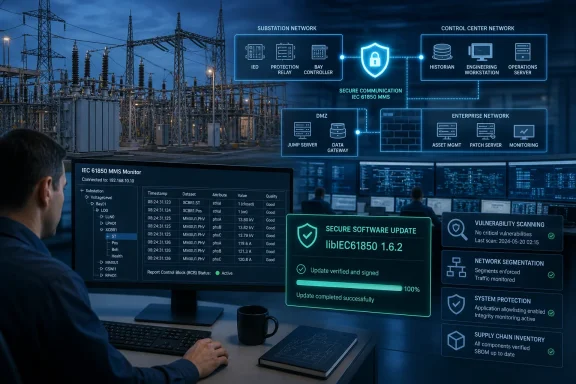 Overview: What the libIEC61850 Advisory Means
libIEC61850 is a C-based, open-source implementation of IEC 61850 communication capabilities. It supports major technologies associated with the standard, including:- Manufacturing Message Specification (MMS) client and server communications
- GOOSE messaging
- Sampled Values (SV)
- Reporting, logging, file services, and data-set functions
- TLS-enabled communications when built with compatible components
- C, C#/.NET, and experimental Python-facing APIs
The affected range is unusually broad:
That scope spans years of deployments, legacy builds, static-linking scenarios, and applications that may have been copied from one project to another without a formal software bill of materials. The practical exposure is therefore determined not just by installed version numbers, but by whether an organization can reliably identify the library inside compiled software and appliances.libIEC61850 versions 1.0.0 through 1.6.1 are affected.
The newly released version 1.6.2 is the critical remediation milestone. Its published change record identifies a substantial set of vulnerability and robustness fixes affecting MMS, IEC 61850 mapping, BER decoding, ISO session handling, COTP parsing, R-Session processing, and related error-handling paths.
Why IEC 61850 Library Vulnerabilities Carry Elevated Risk
IEC 61850 is not ordinary office-network middleware. It is used in environments where communications can influence operational visibility, alarms, data collection, engineering activity, and—in some designs—control behavior. The exact operational impact depends on how a device or application uses the library, but disruption in this space can have consequences beyond an individual system crash.A failed IEC 61850 client may lose visibility into device state. A failed server could deny monitoring or engineering access. A compromised component might expose sensitive operational information, disrupt communications between systems, or create a foothold inside a segmented operational technology environment.
The advisory identifies deployments across several critical infrastructure sectors:
- Energy
- Critical manufacturing
- Transportation systems
Network-Adjacent Is Not the Same as Internet-Exposed
The advisory describes the attacker as network-adjacent and unauthenticated. That distinction matters.An attacker generally needs access to a network path where they can communicate with a vulnerable endpoint or, in certain client-side scenarios, manipulate protocol traffic. In a properly designed industrial environment, this should require breaching segmentation controls or gaining access to an authorized operational segment first.
However, real-world industrial environments often include:
- Flat or partially segmented engineering networks
- Remote-access systems connected to operational assets
- Shared jump hosts
- Vendor laptops and temporary maintenance connections
- Misconfigured firewall rules
- Legacy devices with broad network access
- Unencrypted protocol paths where traffic modification is possible
The Four Vulnerability Classes Identified
The advisory groups the flaws into four familiar but serious categories:- Stack-based buffer overflow
- Heap-based buffer overflow
- Improper handling of syntactically invalid structures
- NULL pointer dereference
Stack-Based Buffer Overflow
A stack-based buffer overflow occurs when software writes more data into a stack-allocated memory area than it was designed to hold. Depending on the precise code path, compiler protections, operating system hardening, and attacker control over input, the result may range from a crash to control-flow manipulation.Modern Windows and Linux builds can include mitigations such as stack cookies, address-space layout randomization, and data execution prevention. Those controls are valuable, but they do not eliminate the underlying flaw. They can turn some exploitation attempts into crashes, while other conditions may still permit more serious outcomes.
For industrial operators, a crash alone is not benign. A crash in a protocol service may interrupt monitoring, break an engineering session, prevent event retrieval, or create a cascading availability issue in a system that was not designed for frequent restarts.
Heap-Based Buffer Overflow
A heap-based buffer overflow involves memory dynamically allocated while a program runs. Heap corruption vulnerabilities can be particularly complex because the affected object, allocation state, and surrounding memory layout may vary across platforms and builds.One disclosed issue fixed in the 1.6.2 release concerns a malformed MMS response that can drive an out-of-bounds read during processing of an object reference. In that scenario, a malicious MMS server—or an active attacker capable of altering a legitimate server response—could crash a libIEC61850 client application during normal browsing or data-set directory activity.
This detail is important because it highlights a frequently underestimated risk: client-side industrial protocol exposure. Security teams often focus on protecting servers and field devices, while engineering tools and client applications are treated as trusted consumers. If a client assumes that a responding device or server will always deliver structurally valid protocol data, a malicious or compromised endpoint can become an attack vector.
Improper Handling of Syntactically Invalid Structures
Industrial protocols frequently use complex encodings, nested structures, length fields, identifiers, and message components. A parser must verify not only that data exists, but also that it is internally consistent before using length values, offsets, pointers, or type-specific assumptions.Improper handling of invalid structures can lead to several outcomes:
- Infinite processing loops
- Out-of-bounds reads
- Out-of-bounds writes
- Integer overflows
- Resource exhaustion
- Unexpected state transitions
- Service crashes
NULL Pointer Dereference
A NULL pointer dereference occurs when the application attempts to access memory through a pointer that does not refer to a valid object. In many cases, the result is a process crash and denial of service rather than code execution.Several fixes in version 1.6.2 address NULL pointer conditions triggered by malformed or unexpected protocol data, including MMS server write paths, file directory behavior, malformed application errors, and object-reference processing.
The operational impact can still be substantial. An attacker who can repeatedly trigger a service crash may be able to create a sustained denial-of-service condition, particularly if the target device restarts slowly, requires manual intervention, or recovers into a degraded operational state.
Why Version 1.6.2 Is the Essential Update
The timing of the release is significant. libIEC61850 1.6.2 was published on July 23, 2026, the same day as the industrial advisory. The release is described as a maintenance update for the 1.6 branch and explicitly includes vulnerability fixes.Among the notable security-related corrections are safeguards for:
- Out-of-bounds reads in MMS connection and IEC 61850 object-reference handling
- NULL pointer dereferences in MMS server and client paths
- Malformed protocol response processing
- R-Session length validation
- ISO presentation and ISO session validation
- COTP option parsing
- BER decoder integer and shift overflow conditions
- Unbounded recursion during GOOSE data parsing
- Message size handling and buffer-limit enforcement
Do Not Treat “Latest” as Automatically Safe Without Validation
For most users in the affected range, 1.6.2 is the available fixed version to evaluate. But industrial environments should not equate a security upgrade with an automatic production deployment.IEC 61850 software changes can affect interoperability, generated models, protocol behavior, certificate handling, and application assumptions. The update should be prioritized, but it should also be tested against representative equipment and workflows.
This is particularly important for systems using:
- Static data models
- Custom MMS integrations
- GOOSE or Sampled Values processing
- .NET wrappers or bindings
- TLS-enabled deployments
- R-GOOSE or R-SV features
- Legacy application code built around older library behavior
The Windows Angle: Engineering Workstations and Custom Applications
Windows administrators may be tempted to view this as a firmware or Linux appliance issue. That would be a mistake.The library supports Windows and provides C and C#/.NET-facing capabilities. As a result, it can appear in Windows-based products such as engineering workstations, protocol test utilities, monitoring applications, gateway services, desktop configuration tools, and custom operational technology applications.
Where Windows Environments May Be Exposed
Potential Windows-based deployment points include:- Substation engineering workstations
- Test and commissioning laptops
- SCADA-adjacent protocol gateways
- Custom C++ applications using the native library
- C#/.NET applications using wrappers or APIs
- Virtual machines used for lab simulation and device configuration
- Build servers that compile or package IEC 61850 components
- Vendor-supplied maintenance tools
Why Inventory Is Difficult
Open-source libraries are commonly included in several ways:- Dynamically linked as a shared library
- Statically compiled into a larger executable
- Embedded inside a vendor application bundle
- Included through a source-code snapshot
- Pulled in through a legacy build system
- Modified locally and maintained as a private fork
libiec61850.dll may find some deployments but miss statically linked binaries entirely. Likewise, a product inventory showing only vendor product names may not reveal which protocol libraries are included under the hood.Windows teams should coordinate with OT engineering and application owners rather than relying exclusively on endpoint scans.
Immediate Actions for Security and OT Teams
The most effective response is a structured process that joins cyber defense with operational safety.1. Identify Direct and Indirect Use of libIEC61850
Start with a broad inventory exercise. Look for the library name, repository references, build artifacts, source directories, package manifests, dependency records, and vendor documentation.Useful search targets include:
libIEC61850libiec61850iec61850MZ AutomationIedConnectionIedServerMmsConnectionGOOSESampled Values
2. Prioritize Systems by Operational Exposure
Not every instance has equal risk. Rank identified deployments according to:- Whether the application acts as an IEC 61850 server, client, or both
- Whether it is reachable from other operational network segments
- Whether it accepts communications from third-party or vendor-managed devices
- Whether protocol traffic is encrypted and authenticated
- Whether network traffic can be intercepted or altered
- Whether a crash would affect protection, control, monitoring, engineering, or reporting
- Whether recovery is automatic, tested, and operationally safe
3. Obtain and Test Version 1.6.2
Organizations using a direct libIEC61850 integration should acquire the 1.6.2 release and build a test plan around their actual usage.Validation should include:
- Client and server connection establishment
- Device discovery and data-set browsing
- Read and write operations where authorized
- Reporting behavior
- File-service behavior if used
- GOOSE and Sampled Values workflows where applicable
- TLS certificate validation and negotiated protocol behavior
- Application restarts and recovery after malformed-input tests
- Compatibility with existing IED configuration and model files
4. Reduce Reachability Before the Patch Is Fully Deployed
Patching is the durable fix, but network controls reduce immediate exposure.Important defensive measures include:
- Remove direct internet access to industrial control assets
- Place control-system networks behind properly managed firewalls
- Segment operational technology from business networks
- Restrict IEC 61850 protocol access to explicitly authorized hosts
- Limit workstation-to-device pathways to required engineering functions
- Use tightly controlled jump servers for remote administration
- Review remote-access paths, including VPNs and vendor support channels
- Monitor unusual MMS sessions, failed connections, and unexpected protocol activity
5. Review Transport Security and Trust Assumptions
Where supported and operationally feasible, use IEC 62351-aligned security controls and carefully configured TLS protections. The library supports TLS capabilities when built with appropriate dependencies, but simply enabling encryption does not solve every problem.TLS can reduce exposure to network manipulation when certificate validation, trust stores, cipher suites, endpoint identity, and lifecycle management are correctly handled. It will not help if attackers already control an authorized endpoint, if certificates are accepted too broadly, or if the vulnerable software processes malicious data from a trusted peer.
Security architecture must account for both hostile network traffic and compromised-but-authenticated devices.
Risks of Rushed Patching—and the Greater Risk of Doing Nothing
Industrial environments are right to be cautious about updates. A protocol library can be deeply integrated into timing-sensitive, certification-sensitive, or vendor-supported systems. Changes must be tested with real device configurations and operational constraints.Potential implementation risks include:
- Interoperability changes with older devices
- Rebuild requirements for custom applications
- Library ABI or API expectations in third-party software
- Regression risk around custom data models
- TLS configuration changes or certificate behavior differences
- Maintenance-window constraints
- Need for vendor qualification or site acceptance testing
The appropriate approach is neither panic nor complacency. It is a measured but urgent program of identification, containment, validation, and upgrade.
What This Advisory Says About Industrial Software Security
The libIEC61850 update also illustrates broader lessons for industrial software developers and asset owners.Memory-Safe Design Still Matters
C remains widely used in embedded and industrial environments because it is efficient, portable, predictable, and compatible with constrained platforms. Those benefits are real. But C also places the burden of bounds checks, pointer validation, lifetime management, and error handling directly on developers.Protocol parsing is particularly unforgiving. Every externally supplied length, tag, object identifier, nested element, and state transition should be treated as untrusted until validated.
The vulnerability categories in this advisory are a reminder that robust parsing requires:
- Explicit length checks before pointer arithmetic
- Safe handling of malformed but syntactically reachable messages
- Defensive null checks
- Conservative error returns
- Fuzzing against parsers and state machines
- Sanitizer-assisted testing during development
- Regression tests for prior vulnerability classes
Security Must Cover Both Clients and Servers
Industrial architecture often models field devices as the high-risk endpoints and management systems as trusted clients. That model is incomplete.Client-side parsing flaws can enable a malicious device, rogue simulator, compromised gateway, or network attacker with traffic-modification capability to crash or potentially compromise the software connecting to it. Engineering workstations deserve the same rigor as servers: segmentation, patching, application control, logging, secure remote access, and controlled privilege.
Software Bills of Materials Need Operational Depth
A software bill of materials is valuable only when it supports action. Knowing that a library appears somewhere in a build is not enough. Asset owners need to know:- Which deployed products contain it
- Which exact versions are present
- Whether it is statically or dynamically linked
- Which protocol features are enabled
- Which network interfaces can reach it
- Who owns the patch decision
- What dependencies constrain the upgrade
Bottom Line
The MZ Automation libIEC61850 vulnerabilities are a high-priority industrial software risk because they affect a widely used IEC 61850 implementation across versions 1.0.0 through 1.6.1. The identified flaws include stack and heap buffer overflows, malformed-structure handling weaknesses, and NULL pointer dereferences, with possible outcomes ranging from service disruption to arbitrary code execution.The release of libIEC61850 1.6.2 provides the essential remediation path, but successful response depends on more than downloading an update. Organizations must find the library in direct integrations and vendor products, assess which Windows systems and OT assets process IEC 61850 traffic, apply compensating network controls, test the corrected release under real operational conditions, and complete a controlled rollout.
No known public exploitation has been reported specifically against these vulnerabilities. That window should be used to reduce exposure now—before public disclosure, patch analysis, and attacker research turn an avoidable industrial control system weakness into an operational incident.