

The International Federation of Journalists’ weekly roundup for 29 November–5 December 2025 spotlights a sharp escalation in two interlinked trends: formal legal challenges by journalists’ unions over restricted access to Gaza and the occupied West Bank, and a fresh wave of frontline casualties that underscore how dangerous reporting in the region remains. The IFJ’s “IFJ in the news” digest cites multiple international outlets documenting a French legal filing against Israeli authorities, while the same week saw the death of a Palestinian photo‑journalist that local authorities say pushed the tally of media workers killed in Gaza to 257 — a figure that has been reported by regional and international outlets but varies by source.
Journalism unions and the IFJ: what was filed and why
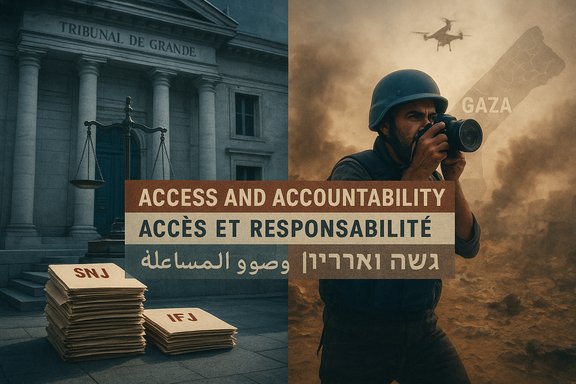
Two French journalist organisations — the Syndicat national des journalistes (SNJ) and the International Federation of Journalists (IFJ) — publicly announced a legal complaint lodged in Paris accusing Israeli authorities of systematically obstructing the work of French reporters trying to cover Gaza and the West Bank. The complaint, filed with the Paris anti‑terror prosecutor’s office, alleges repeated denials of access, harassment and incidents that the complainants argue may amount to crimes under French law when committed against French nationals abroad. The IFJ’s weekly roundup lists a broad set of international media references to that filing and to continuing constraints on reporting from Palestinian territories. The casualty that renewed the focus
During the same week, freelance photojournalist Mahmoud Wadi was killed in Khan Younis in Gaza by an Israeli strike, an incident covered by Reuters, the Committee to Protect Journalists (CPJ), Al Jazeera and other outlets. Gaza authorities and the Government Media Office reported that Wadi’s death brought the local count of journalists and media workers killed since October 2023 to 257 — a number that has been repeated by several regional and international outlets but that different monitoring organisations report using distinct methodologies and totals. Why this week matters
Between the legal escalation in Paris and the renewed frontline fatality, the IFJ’s weekly list crystallises two related dynamics: (1) media organisations are shifting some of their battle for access and safety into legal and institutional channels in Western courts, and (2) the operational environment inside Gaza and the West Bank remains lethal and unpredictable for local and international journalists. Those dynamics shape everything from newsroom risk assessments to the ability of international audiences to receive independent verification of events on the ground.
Source: International Federation of Journalists - IFJ IFJ in the news / IFJ
 Background / Overview
Journalism unions and the IFJ: what was filed and whyTwo French journalist organisations — the Syndicat national des journalistes (SNJ) and the International Federation of Journalists (IFJ) — publicly announced a legal complaint lodged in Paris accusing Israeli authorities of systematically obstructing the work of French reporters trying to cover Gaza and the West Bank. The complaint, filed with the Paris anti‑terror prosecutor’s office, alleges repeated denials of access, harassment and incidents that the complainants argue may amount to crimes under French law when committed against French nationals abroad. The IFJ’s weekly roundup lists a broad set of international media references to that filing and to continuing constraints on reporting from Palestinian territories. The casualty that renewed the focus
During the same week, freelance photojournalist Mahmoud Wadi was killed in Khan Younis in Gaza by an Israeli strike, an incident covered by Reuters, the Committee to Protect Journalists (CPJ), Al Jazeera and other outlets. Gaza authorities and the Government Media Office reported that Wadi’s death brought the local count of journalists and media workers killed since October 2023 to 257 — a number that has been repeated by several regional and international outlets but that different monitoring organisations report using distinct methodologies and totals. Why this week matters
Between the legal escalation in Paris and the renewed frontline fatality, the IFJ’s weekly list crystallises two related dynamics: (1) media organisations are shifting some of their battle for access and safety into legal and institutional channels in Western courts, and (2) the operational environment inside Gaza and the West Bank remains lethal and unpredictable for local and international journalists. Those dynamics shape everything from newsroom risk assessments to the ability of international audiences to receive independent verification of events on the ground.
What the IFJ digest reported — a summary
- The IFJ’s “IFJ in the news” (covering 29 Nov–5 Dec 2025) highlights the joint complaint filed by the IFJ and the SNJ in Paris over alleged obstruction of press coverage in Gaza and the West Bank. The digest lists multiple English‑language reports and carries extensive multilingual coverage across French, Spanish and other outlets.
- The IFJ roundup calls out the death of Palestinian photojournalist Mahmoud Wadi in Khan Younis and reproduces media reports that place the Gaza journalist death toll at 257 since October 2023, reflecting the Government Media Office figure cited by regional sources. The digest also aggregates follow‑on commentary and solidarity actions by unions and press freedom groups.
- Beyond the two headlines above, the IFJ list includes items about press freedom threats in other countries, technology and press ethics (including concerns about new Indian data law and AI in newsrooms), and solidarity actions for threatened journalists — emphasising that press freedom pressures are global and multi‑faceted.
Legal strategy and potential reach: the Paris filing explained
Who filed, where and on what legal basis
The complaint reported by multiple outlets and highlighted by the IFJ was lodged by French journalists’ organisations and invokes French criminal and procedural law to challenge actions that allegedly obstructed French journalists’ ability to report from Gaza and the occupied West Bank. The filing was made to the Paris anti‑terror prosecutor’s office — the division that handles crimes with international connections in France — because some alleged acts were committed against or in relation to French nationals or involved events that French prosecutorial authorities can claim jurisdiction over. Media reporting indicates the complaint runs to hundreds of pages and relies on anonymised witness statements from journalists who say they were prevented, intimidated, or otherwise obstructed.What complainants are asking for
The unions’ filing seeks, among other remedies: urgent investigation, judicial determination about whether the actions observed constitute obstruction of the freedom to inform, and consideration of whether such obstruction crosses into internationally prosecutable offences when committed against nationals abroad. The filing also asks French authorities to preserve evidence and to use criminal investigative powers to press for accountability where appropriate. This is both a legal move and a public‑pressure tactic, designed to create institutional scrutiny beyond standard diplomatic channels.Jurisdictional and practical hurdles
Bringing a Paris‑based complaint against a foreign state or actors raises immediate jurisdictional and evidentiary questions. To secure action, prosecutors need credible, verifiable evidence that ties the alleged obstruction to identifiable actors and shows that the elements of the alleged offences are met under French law. Even when a complaint is lodged, practical enforcement — subpoenas, witness interviews, or securing evidence from another sovereign territory — depends on cooperation from foreign authorities or international legal instruments. That makes prosecutorial follow‑through legally and diplomatically complex. Media reports note that filing with the anti‑terror prosecutor’s office is a tactical choice intended to broaden investigative avenues available to French authorities.The human cost: verifying journalist fatalities and the figure of 257
The immediate incident: Mahmoud Wadi
Multiple independent outlets reported that freelance photojournalist and drone operator Mahmoud Wadi was killed in Khan Younis on 2 December 2025. Reuters described local health authorities’ accounts of the strike and cited Israeli statements that disputed aspects of the event; the Committee to Protect Journalists (CPJ) published an account that includes on‑the‑ground testimony from family members and colleagues. The diversity of reports — international news agencies, press freedom organisations and local health authorities — provides correlated verification of the core fact: a journalist died in Khan Younis on the date reported.The 257 figure — confirmation and caveats
The number “257 journalists killed” in Gaza since October 2023 appeared in statements from the Gaza Government Media Office and was widely reproduced by regional and partisan outlets; the IFJ roundup also references coverage that uses the 257 figure. International monitoring organisations (for example, the Committee to Protect Journalists and UNESCO) and specialist trackers sometimes publish different totals because they use different inclusion criteria (e.g., whether they count only verified journalists, or broader “media workers” such as fixers, drivers and support staff; whether they count only deaths directly attributed to military action; and how they treat cases where attribution of responsibility is contested). Independent trackers such as Airwars and CPJ documented very high numbers in October 2023 and have continued to update their databases; their methodologies differ, and so do their totals. In short: the 257 figure reflects the tally reported by Gaza authorities and echoed in multiple outlets, but other independent monitors report different numbers depending on their definitions and verification thresholds. Readers should treat the 257 number as the Gaza Government Media Office’s figure corroborated by regional reporting, and note that independent trackers may publish conservative or variant totals.Why the discrepancy matters
Counting casualties in active conflict zones is inherently fraught: access is restricted, information is contested, and organisations may prioritise either caution (strict verification) or comprehensive inclusion (broader social and institutional claims). When unions or government offices publish high‑impact tallies, they are making a political and humanitarian case as well as a factual one. Independent journalists and editors must therefore annotate and contextualise casualty data, explaining the source, the definition used, and the margin of uncertainty.What legal and newsroom leaders should take from the IFJ roundup
- Press unions are shifting tactics. Faced with prolonged access restrictions and repeated incidents affecting journalists, unions are using domestic courts in third countries (here, France) to demand accountability and to create investigatory pressure even when diplomatic routes are slow. This is a notable strategic adaptation from protest and advocacy toward legal adjudication.
- Safety remains a persistent, unresolved operational risk. The Wadi incident — confirmed by multiple outlets — demonstrates that even periods described as “low intensity” or “truce” do not remove the frontline threat to journalists. Newsrooms must continue to invest in protective measures, medical and legal evacuation planning, and insurance for staff and freelancers.
- Data and casualty claims require transparent sourcing. When unions or local authorities release totals such as “257 journalists killed,” newsrooms and analysts should explicitly communicate the provenance of those numbers and compare them to independent trackers, so audiences understand the basis and limitations of reporting.
Critical analysis: strengths, implications and risks
Strengths of the unions’ legal approach
- Legal filings bring new tools: subpoenas, forensic orders, and document preservation mechanisms can compel disclosure in ways advocacy letters cannot. That procedural leverage can potentially surface evidence about entry denials, equipment seizures, or documented patterns of harassment.
- Public legal action amplifies political pressure: high‑profile filings attract sustained media attention and may force diplomatic responses or third‑party investigations. The complaint’s existence alone changes the frame from episodic press‑freedom advocacy to a formal judicial matter requiring reasoned response.
Risks and limitations
- Jurisdictional friction: prosecutorial momentum depends on cooperation from foreign authorities and on the ability to obtain admissible evidence. A Paris complaint may generate statements, but its practical reach — especially if evidence or witnesses are inside Gaza and access is controlled — will face significant obstacles.
- Politicisation risk: legal actions embedded in highly polarised geopolitical contexts risk being framed as politically motivated by opponents, potentially reducing neutral observers’ willingness to rely on their findings without independent corroboration. That could undermine the broader legitimacy of valid press‑freedom claims if not handled with stringent documentary standards.
- Safety of witnesses and sources: when court filings depend on anonymous testimonies, there is a trade‑off between protecting individuals from retaliation and presenting robust, verifiable evidence. Unions and lawyers must safeguard contributors while striving to preserve forensic traceability.
Editorial implications
Editors and newsroom leaders must balance public interest reporting with staff safety and legal prudence. This includes:- Verifying casualty claims against multiple independent monitors before publishing aggregated figures.
- Including method notes in high‑impact stories that rely on union or government tallies.
- Ensuring freelancers and local fixers have access to insurance, legal counsel and secure communication channels.
Broader context: press freedom, access and the role of courts
Courts as a pressure valve
As access channels for journalists close, courts become an available — and increasingly used — alternative for seeking remedies. The Paris filing demonstrates how national legal systems can be invoked to address transnational barriers to reporting, especially where claimants are nationals of the forum state. Such legal strategies were relatively rare in previous conflicts but are now an established part of unions’ playbooks.The ecosystem of verification
A healthy verification ecosystem draws on:- Local sources and health authorities (for immediate casualty reporting);
- Independent monitors (CPJ, Airwars, UNESCO) for longitudinal datasets and verified tallies; and
- International news agencies (Reuters, AP) for corroborated eyewitness and institutional statements.
When unions or authorities present data, cross‑checking across these layers is essential to produce defensible reporting.
The reputational dimension for technology and data
The IFJ roundup also lists items about surveillance, technology and threats to press freedom elsewhere (for example, concerns about a new Indian data law and AI’s role in newsrooms). These items underline an interlocking set of risks: restricted physical access, digital surveillance targeting journalists, and algorithmic amplification or suppression of reporting. News organisations must therefore consider both physical protection and digital hygiene as core newsroom responsibilities.Practical guidance for newsrooms and unions (short checklist)
- Prioritise multi‑source verification before publishing casualty totals; include source attribution and methodology notes.
- Maintain a legal playbook that includes emergency contact points in countries where your staff operate, and consider pre‑emptive legal strategies for access denials.
- Ensure freelancers and local fixers have coverage for medical evacuation, trauma counselling and legal defense.
- Adopt rigorous digital OPSEC for sensitive contacts and testimonies, balancing encryption with legal disclosure requirements.
- Use coalition tactics: cross‑union solidarity and coordinated legal filings increase publicity and can mobilise complementary institutional responses.
What to watch next
- Prosecutorial response in Paris: whether the anti‑terror prosecutor’s office opens an investigation, seeks cooperation with foreign authorities, or declines to pursue the complaint. The choice will shape whether legal pressure translates into investigatory action.
- Independent casualty tallies: whether CPJ, UNESCO or other monitoring organisations publish updated figures that converge on a consistent verified total, or whether discrepancies widen, affecting public perception.
- Operational changes by news organisations: further shifts toward legal remedies, new security protocols, or coordinated demands for unfettered access that might trigger diplomatic or multilateral responses.
Conclusion
The IFJ’s weekly roundup for 29 November–5 December 2025 highlighted a decisive moment for press freedom: unions are moving from protest to litigation in pursuit of access and accountability, even as frontline conditions continue to put journalists at mortal risk. The Paris filing by the SNJ and IFJ frames access denials and harassment not only as professional obstacles but as matters that may engage criminal justice when French nationals are affected; the death of Mahmoud Wadi the same week — and the contested tally that followed — demonstrates the continuing human cost that sits behind legal arguments. For editors, legal teams and union leaders, the imperative is clear: protect people, be transparent about sources and methods, and use every appropriate institutional channel — including courts — to preserve the right to report. Those steps will not erase danger, but they can strengthen journalism’s evidentiary base and public standing at a time when independent verification is more necessary than ever.Source: International Federation of Journalists - IFJ IFJ in the news / IFJ
