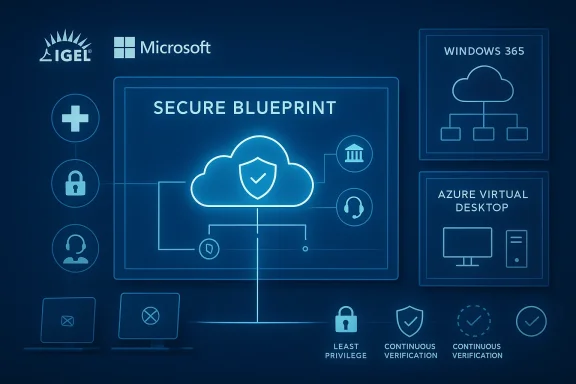
IGEL’s new jointly reviewed reference architectures with Microsoft land at a moment when cloud desktops are moving from experimentation to operational necessity. The blueprints are aimed at Windows 365 and Microsoft Azure Virtual Desktop, but the real story is narrower and more strategic: they are designed to make secure, controlled endpoint access easier in some of the most demanding environments in IT, including healthcare, government, and contact centers. In an era where endpoint compromise can still become a gateway to data loss, the emphasis on prevention-first design is as important as the cloud desktop itself.
The announcement is best understood as part of the continuing maturation of the desktop virtualization market. Microsoft has spent years refining both Windows 365 and Azure Virtual Desktop, while partners such as IGEL have repositioned the endpoint as a policy-enforced security layer rather than a mere access device. That shift matters because the desktop is no longer just where work happens; it is where identity, compliance, telemetry, and user experience increasingly converge.
The new reference architectures are not a product launch in the classic sense. They are blueprints, reviewed by both vendors, intended to reduce ambiguity for organizations that want to deploy cloud desktops without improvising critical design choices. In practice, that means customers get a more opinionated path for combining IGEL’s immutable endpoint model with Microsoft’s cloud desktop stack, rather than stitching together an architecture from scattered best practices.
Microsoft’s own guidance already frames Azure Virtual Desktop around security, governance, and landing-zone discipline, including Microsoft Entra ID, conditional access, Azure RBAC, and network controls. Windows 365 likewise relies on a managed cloud PC model and integrates with Microsoft’s broader identity and security ecosystem. The IGEL collaboration is important because it tries to extend those principles to the endpoint itself, where policy enforcement can reduce local attack surface before a user ever reaches the cloud desktop.
The timing is also telling. Security teams have become far less tolerant of “soft” endpoints, especially in regulated or high-churn settings. Healthcare, public sector, and contact center environments need fast onboarding, repeatable access patterns, and predictable lockdown behavior; the more users, devices, and contractors change, the more valuable a reference architecture becomes. That is exactly the kind of environment where standardization has measurable security value.
Microsoft has also spent years publishing design guidance for Azure Virtual Desktop landing zones and Zero Trust architectures. The company’s architecture guidance emphasizes identity-first access, governance, and secure networking, and it positions Virtual Desktop as a workload that should fit neatly into broader Azure landing-zone design principles. That background matters because IGEL’s announcement is not inventing a new model; it is attempting to make Microsoft’s model easier to adopt from the endpoint outward.
IGEL’s role in this ecosystem has long been tied to secure endpoint access. The company’s value proposition centers on a hardened, policy-driven device layer that can reduce the risks associated with general-purpose endpoints. In this release, IGEL frames its Preventative Security Model and Adaptive Secure Desktop as complementary to Microsoft’s cloud desktop services, which is consistent with the broader industry push to move controls closer to the user session and away from local device trust.
The new blueprints are aimed at organizations that need to move quickly but cannot afford trial-and-error design. They are especially relevant where security, uptime, and governance are not optional extras but baseline requirements. That makes them more useful for public-sector agencies and healthcare systems than for a small business evaluating cloud desktops for the first time.
That is especially attractive in environments where local data storage is a liability. If no meaningful data resides on the endpoint, then the endpoint becomes less valuable to attackers and easier to reset or repurpose operationally. The architecture is therefore as much about containment as it is about access.
The release also frames the architecture as a way to reduce architectural risk and accelerate deployment. That combination is important because cloud desktop projects often fail not because the technology is immature, but because operational teams cannot converge on secure defaults. When two vendors jointly validate a pattern, it lowers the burden on architects who would otherwise spend weeks reconciling implementation details.
At the same time, readers should not over-interpret the phrase. A reference architecture is not a compliance certification, and it does not eliminate the need for local validation. It is a map, not a waiver.
That dual focus is smart from a market standpoint. Many organizations compare the two services side by side, and they want guidance that works across both planning paths. A single endpoint strategy that can support either model reduces complexity and helps organizations avoid dead-end designs.
The company’s immutable endpoint OS is central to that argument. If the endpoint is designed to be difficult to modify, with policy centrally enforced and local data minimized, then the attack surface becomes more predictable. In practical terms, that can simplify remediation, reduce the likelihood of persistence, and make shared-device scenarios easier to manage.
It also changes the economics of recovery. Instead of spending time cleaning a compromised workstation, teams can reapply a known-good state and resume service more quickly. In a contact center or hospital ward, that difference can be operationally decisive.
That design intent aligns well with cloud desktops. If workloads and user state live in the cloud, then the device can become a managed access layer instead of a repository. The endpoint becomes easier to standardize, and the recovery model becomes less about file repair and more about session continuity.
Baptist Health’s quoted endorsement is important because it grounds the marketing language in an operational context. The statement links IGEL and Azure Virtual Desktop to a unified operational fabric, suggesting that the architecture is not just about endpoint hardening but about workflow continuity. In healthcare, that matters because delays, downtime, or session instability can directly affect patient care.
That makes cloud desktops useful, but only if access is simple and the endpoint does not become another source of complexity. A reference architecture can help standardize how clinicians reach their applications without forcing every department to invent its own implementation pattern. That standardization is the hidden benefit here.
Centralized management also helps with evidence collection. If policy enforcement lives in a known control plane, teams can more easily explain how access is granted, monitored, and revoked. That transparency is often as important as technical strength.
The key advantage for government is not simply cloud adoption. It is the ability to combine a hardened endpoint with a governed Microsoft desktop platform, while keeping data and access policy tightly controlled. That reduces the likelihood that every agency or department will invent its own fragile security pattern.
Microsoft’s security guidance for Azure Virtual Desktop emphasizes Microsoft Entra ID, conditional access, and least privilege. IGEL’s role is to make the endpoint behavior more consistent with those controls, especially when access comes from distributed or hybrid workplaces.
A standard pattern can also support interagency portability. If multiple agencies adopt the same basic endpoint and cloud desktop design, they can share operational lessons and accelerate service delivery. In bureaucratic environments, consistency is often a force multiplier.
This makes IGEL’s approach appealing. A controlled endpoint paired with cloud desktops can simplify device lifecycle management while helping supervisors enforce uniform access policies. If the device is locked down and the desktop lives in Microsoft’s cloud, the operating model becomes far easier to replicate across shifts and locations.
This is one of the clearest business cases in the announcement. The endpoint is not just secure; it is operationally disposable in the best sense. That is a powerful property in a workforce with constant movement.
It also improves resiliency planning. If one site needs to be remediated, the others can follow the same deployment and recovery model with fewer surprises. In a distributed environment, architecture uniformity is almost as valuable as raw performance.
IGEL’s announcement fits that strategy by extending it to the edge. Rather than competing with Microsoft’s desktop services, IGEL is trying to make them easier to consume in high-assurance environments. That is a classic partner play, but it is also a sign that Microsoft’s ecosystem still benefits from specialized endpoint vendors.
That governance layer is where IGEL wants to be relevant. If the endpoint is standardized, then the differences between cloud PC and VDI matter less to the frontline user and more to the IT architect. That is exactly where partner value often hides.
This is a useful division of labor. Microsoft handles the cloud platform and its control plane; IGEL helps ensure the device joining that platform is less vulnerable and easier to manage. That separation of concerns is one reason the collaboration can be compelling to enterprise buyers.
It also raises the bar for rivals. Competing cloud desktop vendors and endpoint suppliers will need to explain not just how their systems work, but how they integrate into serious enterprise governance. In the long run, that tends to favor vendors with strong architecture stories, not just feature checklists.
The enablement suite matters because many enterprises struggle in the gap between architecture and implementation. A nice diagram can inspire confidence, but the real work begins when teams need naming conventions, policy baselines, operational roles, and rollback plans. That is where a playbook turns a concept into a deployable standard.
This is especially true for regulated sectors, where changes need to be reviewed and documented. A well-structured enablement suite can reduce the consulting burden and improve internal confidence. The more operationally specific the guidance, the more valuable it becomes.
That said, reducing uncertainty has value in itself. Organizations often delay projects because they fear hidden complexity, and a jointly reviewed blueprint can shrink that fear. In enterprise IT, fewer unknowns often mean faster approval.
Another concern is that endpoint hardening can sometimes trade away flexibility or user convenience if implemented too rigidly. Security controls that are excellent on paper can become support burdens if they slow login, complicate peripherals, or limit exception handling. That tension is especially sensitive in healthcare and contact centers, where users need speed as much as control.
The next phase will likely be about proof, not promise. Buyers will want to see field deployments, measurable operational gains, and evidence that the architecture scales across real-world identity and network conditions. They will also want to know whether the guidance remains stable as Microsoft updates Windows 365 and Azure Virtual Desktop, because cloud platforms evolve quickly and architectural recommendations must keep pace.
The practical test will come in the months ahead, when customers move from reading the blueprints to actually deploying them. If those deployments prove repeatable, supportable, and resilient under real-world pressure, this collaboration could become a quietly influential model for the next phase of secure cloud desktop adoption.
Source: GlobeNewswire IGEL Releases Joint Reference Architectures for Secured Cloud Desktops in Collaboration with Microsoft
 Overview
The announcement is best understood as part of the continuing maturation of the desktop virtualization market. Microsoft has spent years refining both Windows 365 and Azure Virtual Desktop, while partners such as IGEL have repositioned the endpoint as a policy-enforced security layer rather than a mere access device. That shift matters because the desktop is no longer just where work happens; it is where identity, compliance, telemetry, and user experience increasingly converge.The new reference architectures are not a product launch in the classic sense. They are blueprints, reviewed by both vendors, intended to reduce ambiguity for organizations that want to deploy cloud desktops without improvising critical design choices. In practice, that means customers get a more opinionated path for combining IGEL’s immutable endpoint model with Microsoft’s cloud desktop stack, rather than stitching together an architecture from scattered best practices.
Microsoft’s own guidance already frames Azure Virtual Desktop around security, governance, and landing-zone discipline, including Microsoft Entra ID, conditional access, Azure RBAC, and network controls. Windows 365 likewise relies on a managed cloud PC model and integrates with Microsoft’s broader identity and security ecosystem. The IGEL collaboration is important because it tries to extend those principles to the endpoint itself, where policy enforcement can reduce local attack surface before a user ever reaches the cloud desktop.
The timing is also telling. Security teams have become far less tolerant of “soft” endpoints, especially in regulated or high-churn settings. Healthcare, public sector, and contact center environments need fast onboarding, repeatable access patterns, and predictable lockdown behavior; the more users, devices, and contractors change, the more valuable a reference architecture becomes. That is exactly the kind of environment where standardization has measurable security value.
Background
Virtual desktop infrastructure has existed for years, but the cloud desktop market has changed its center of gravity. Traditional VDI often carried heavy infrastructure overhead, while modern services such as Windows 365 and Azure Virtual Desktop offer more cloud-native options with tighter integration into Microsoft 365, identity services, and policy frameworks. The result is a market where the desktop is increasingly delivered as a managed service, not a server farm project.Microsoft has also spent years publishing design guidance for Azure Virtual Desktop landing zones and Zero Trust architectures. The company’s architecture guidance emphasizes identity-first access, governance, and secure networking, and it positions Virtual Desktop as a workload that should fit neatly into broader Azure landing-zone design principles. That background matters because IGEL’s announcement is not inventing a new model; it is attempting to make Microsoft’s model easier to adopt from the endpoint outward.
IGEL’s role in this ecosystem has long been tied to secure endpoint access. The company’s value proposition centers on a hardened, policy-driven device layer that can reduce the risks associated with general-purpose endpoints. In this release, IGEL frames its Preventative Security Model and Adaptive Secure Desktop as complementary to Microsoft’s cloud desktop services, which is consistent with the broader industry push to move controls closer to the user session and away from local device trust.
Why reference architectures matter
A reference architecture is more than marketing polish. It is a way to codify design decisions so organizations do not have to infer them from product documentation, blog posts, and partner slides. For regulated industries, that matters because ambiguity is itself a risk, and the cost of a misconfiguration can exceed the cost of extra planning.The new blueprints are aimed at organizations that need to move quickly but cannot afford trial-and-error design. They are especially relevant where security, uptime, and governance are not optional extras but baseline requirements. That makes them more useful for public-sector agencies and healthcare systems than for a small business evaluating cloud desktops for the first time.
How Microsoft’s architecture guidance sets the stage
Microsoft already advises secure access patterns for Azure Virtual Desktop, including identity controls, policy enforcement, and secure network design. The company’s landing-zone documentation makes clear that cloud desktops are expected to sit within an enterprise governance model, not outside it. That gives IGEL a strong foundation to build on, because the partner can align device-side controls with Microsoft’s established cloud-side patterns.- Identity-first access is central to Microsoft’s model.
- Conditional access and Azure RBAC are standard building blocks.
- Policy-driven governance reduces drift in complex deployments.
- Network segmentation remains essential for enterprise readiness.
The endpoint problem IGEL is trying to solve
Endpoints remain the most exposed part of the digital workspace because users touch them directly, and because they are often the least standardized component in the stack. A browser, a laptop, a kiosk, and a contractor-issued thin client can all end up at the same virtual desktop, but they do not carry the same risk profile. IGEL’s pitch is that an immutable or tightly controlled endpoint can reduce that variability and make cloud desktop delivery more defensible.That is especially attractive in environments where local data storage is a liability. If no meaningful data resides on the endpoint, then the endpoint becomes less valuable to attackers and easier to reset or repurpose operationally. The architecture is therefore as much about containment as it is about access.
What IGEL and Microsoft Actually Announced
The announcement centers on jointly reviewed reference architectures for secure access to Windows 365 and Azure Virtual Desktop from IGEL devices. The emphasis is on secured Cloud PCs and Virtual Machines, with a focus on healthcare, government, and contact center environments. Microsoft’s partner product manager is quoted as saying the collaboration offers customers clearer architectural guidance from cloud to endpoint, which suggests the goal is practical deployment confidence rather than just co-marketing.The release also frames the architecture as a way to reduce architectural risk and accelerate deployment. That combination is important because cloud desktop projects often fail not because the technology is immature, but because operational teams cannot converge on secure defaults. When two vendors jointly validate a pattern, it lowers the burden on architects who would otherwise spend weeks reconciling implementation details.
The significance of “jointly reviewed”
“Jointly reviewed” is a modest phrase, but in enterprise IT it carries real weight. It implies the architecture has been checked against both vendors’ expectations, which can matter to teams that need vendor support or at least vendor-aligned guidance. For organizations operating in regulated sectors, that confidence can shorten procurement cycles and reduce internal governance friction.At the same time, readers should not over-interpret the phrase. A reference architecture is not a compliance certification, and it does not eliminate the need for local validation. It is a map, not a waiver.
Why Windows 365 and Azure Virtual Desktop are both in scope
Windows 365 and Azure Virtual Desktop are often discussed together, but they serve slightly different deployment philosophies. Windows 365 is typically associated with a simpler, per-user cloud PC model, while Azure Virtual Desktop offers more flexible desktop and app virtualization options. Microsoft’s own documentation differentiates their architectures, but both can sit within enterprise identity and security controls.That dual focus is smart from a market standpoint. Many organizations compare the two services side by side, and they want guidance that works across both planning paths. A single endpoint strategy that can support either model reduces complexity and helps organizations avoid dead-end designs.
The industry segment focus is deliberate
Healthcare, government, and contact centers are not random examples. They share a few common traits: high compliance pressure, frequent shared-use or shift-based access, and a low tolerance for endpoint variability. In those settings, secure desktop delivery is not just about convenience; it is about operational continuity and auditability.- Healthcare needs clinical continuity and strong data handling.
- Government needs policy control and identity assurance.
- Contact centers need rapid onboarding and controlled offboarding.
- All three benefit from no local data persistence and simpler endpoint management.
Endpoint Security as the Core Value Proposition
IGEL’s announcement repeatedly returns to the endpoint as the first and best place to reduce risk. That is a notable framing because many cloud desktop conversations still focus mostly on the hosted desktop layer, network posture, or identity provider. IGEL wants the conversation to begin at the edge, where policy and hardware behavior can be constrained before user sessions start.The company’s immutable endpoint OS is central to that argument. If the endpoint is designed to be difficult to modify, with policy centrally enforced and local data minimized, then the attack surface becomes more predictable. In practical terms, that can simplify remediation, reduce the likelihood of persistence, and make shared-device scenarios easier to manage.
Immutable by design
An immutable endpoint is attractive because it reduces configuration drift. If a user, contractor, or malicious script cannot easily alter the base operating environment, then IT has fewer unknowns to chase later. That is especially valuable in settings where devices are deployed at scale and local support is limited.It also changes the economics of recovery. Instead of spending time cleaning a compromised workstation, teams can reapply a known-good state and resume service more quickly. In a contact center or hospital ward, that difference can be operationally decisive.
Local data elimination and its limits
The promise of eliminating local data storage is powerful, but it should not be oversold. Some local caching, certificates, or device metadata may still exist depending on the implementation. What matters is the broader design intent: minimize valuable local data and reduce the window in which an endpoint can become a data-exfiltration target.That design intent aligns well with cloud desktops. If workloads and user state live in the cloud, then the device can become a managed access layer instead of a repository. The endpoint becomes easier to standardize, and the recovery model becomes less about file repair and more about session continuity.
The Zero Trust fit
IGEL explicitly ties the blueprints to Zero Trust outcomes such as continuous verification, least privilege, and the reduction of implicit trust. That is consistent with Microsoft’s own guidance for Azure Virtual Desktop, which recommends identity controls, privileged access restraint, and secure access patterns.- Continuous verification helps limit stale trust.
- Least privilege reduces blast radius.
- No implicit trust is essential for shared or remote environments.
- Policy enforcement at the endpoint complements cloud-side controls.
Healthcare: Security, Compliance, and Clinical Continuity
Healthcare is the most compelling use case in the announcement because it combines strict compliance needs with user experience demands. Clinicians need fast, reliable access to applications and records, but hospital IT teams also need to contain risk, support audit requirements, and manage devices across highly dynamic care settings. The reference architecture appears designed to help with exactly that balance.Baptist Health’s quoted endorsement is important because it grounds the marketing language in an operational context. The statement links IGEL and Azure Virtual Desktop to a unified operational fabric, suggesting that the architecture is not just about endpoint hardening but about workflow continuity. In healthcare, that matters because delays, downtime, or session instability can directly affect patient care.
Why clinical workflows are a special case
Clinical environments are not typical office environments. Users move between stations, devices may be shared, and downtime is more than an inconvenience. Any desktop strategy must preserve speed, security, and resilience while also keeping support overhead manageable.That makes cloud desktops useful, but only if access is simple and the endpoint does not become another source of complexity. A reference architecture can help standardize how clinicians reach their applications without forcing every department to invent its own implementation pattern. That standardization is the hidden benefit here.
Compliance and auditability
Healthcare organizations operate under intense compliance scrutiny, and desktop architecture can influence how well they satisfy internal and external controls. A design that emphasizes centralized policy, reduced local data, and consistent endpoint behavior is easier to document and audit. That does not eliminate compliance work, but it reduces the number of exceptions auditors have to review.Centralized management also helps with evidence collection. If policy enforcement lives in a known control plane, teams can more easily explain how access is granted, monitored, and revoked. That transparency is often as important as technical strength.
Operational resilience in a clinical setting
The announcement repeatedly references resilience, and in healthcare that should be read literally. When a clinician cannot access a charting system or virtual desktop, the impact is immediate. A secure endpoint that is easier to recover, update, or redeploy can materially reduce disruption.- Faster onboarding for new clinicians.
- More predictable access across shared workstations.
- Better containment if a device is lost or compromised.
- Less dependence on locally installed software states.
Government: Policy Control and Reduced Attack Surface
Government IT environments have long been allergic to unnecessary endpoint risk, and for good reason. They often support mixed user populations, contractor access, legacy systems, and diverse security mandates. A jointly reviewed architecture for IGEL and Microsoft is particularly relevant here because it promises a more standardized way to deliver cloud desktops without loosening device controls.The key advantage for government is not simply cloud adoption. It is the ability to combine a hardened endpoint with a governed Microsoft desktop platform, while keeping data and access policy tightly controlled. That reduces the likelihood that every agency or department will invent its own fragile security pattern.
Identity assurance and device trust
Government use cases lean heavily on identity assurance, and that means device posture matters. If a device is difficult to modify and centrally managed, it becomes easier to trust as a gateway to sensitive systems. That is not the same as making the device itself trusted forever; rather, it narrows the conditions under which access is allowed.Microsoft’s security guidance for Azure Virtual Desktop emphasizes Microsoft Entra ID, conditional access, and least privilege. IGEL’s role is to make the endpoint behavior more consistent with those controls, especially when access comes from distributed or hybrid workplaces.
Why government likes standard patterns
Public-sector IT is full of long-lived environments, procurement constraints, and security reviews. The more a deployment resembles a repeatable, reviewed pattern, the easier it is to approve and scale. That is why reference architectures often matter more than feature lists in this segment.A standard pattern can also support interagency portability. If multiple agencies adopt the same basic endpoint and cloud desktop design, they can share operational lessons and accelerate service delivery. In bureaucratic environments, consistency is often a force multiplier.
Shared-use and contractor scenarios
Government agencies frequently need temporary access for contractors, field staff, or seasonal personnel. That is where cloud desktops and immutable endpoints can combine effectively. Instead of provisioning complex local environments, IT can expose controlled access to a virtual desktop with sharply defined policy.- Easier access revocation when contracts end.
- Less risk of data persisting on borrowed hardware.
- Better separation between personal and official use.
- Cleaner support for field and remote operations.
Contact Centers: Scale, Turnover, and Control
Contact centers are one of the most overlooked but practical places to apply this kind of architecture. They are often characterized by high staff turnover, short onboarding cycles, and a need for standardized applications delivered at scale. In that environment, the endpoint is valuable mainly as a reliable access point, not as a rich local computing platform.This makes IGEL’s approach appealing. A controlled endpoint paired with cloud desktops can simplify device lifecycle management while helping supervisors enforce uniform access policies. If the device is locked down and the desktop lives in Microsoft’s cloud, the operating model becomes far easier to replicate across shifts and locations.
Fast onboarding, fast offboarding
High-churn environments require fast access provisioning and equally fast access removal. A cloud desktop strategy can reduce the amount of local setup required, while IGEL’s endpoint model can keep the device baseline stable. That cuts down on the support load and reduces the chance that a departed worker leaves behind local data or config residue.This is one of the clearest business cases in the announcement. The endpoint is not just secure; it is operationally disposable in the best sense. That is a powerful property in a workforce with constant movement.
Consistency across sites
Many contact centers operate across multiple sites, temporary locations, or hybrid arrangements. A reference architecture helps ensure that a desktop deployed in one city behaves the same way in another. That consistency reduces troubleshooting variance and makes training easier for both agents and administrators.It also improves resiliency planning. If one site needs to be remediated, the others can follow the same deployment and recovery model with fewer surprises. In a distributed environment, architecture uniformity is almost as valuable as raw performance.
User experience is still a deciding factor
Security-only arguments rarely win in contact centers unless the user experience is good. Agents need low friction, responsive sessions, and enough stability to keep customer interactions smooth. Cloud desktop architectures can succeed here only if they remain invisible to the workflow.- Low-friction sign-in matters.
- Session continuity affects customer satisfaction.
- Centralized policy should not create constant prompts.
- Hardware simplicity must not become performance weakness.
How This Fits Microsoft’s Broader Desktop Strategy
Microsoft’s desktop strategy now spans multiple delivery models, but the common thread is tighter integration with identity and governance. Windows 365 is presented as a cloud PC model, while Azure Virtual Desktop offers a broader virtual desktop platform for enterprise scenarios. Both are part of a larger push toward managed, cloud-delivered workspaces with security controls woven through the architecture.IGEL’s announcement fits that strategy by extending it to the edge. Rather than competing with Microsoft’s desktop services, IGEL is trying to make them easier to consume in high-assurance environments. That is a classic partner play, but it is also a sign that Microsoft’s ecosystem still benefits from specialized endpoint vendors.
Windows 365 versus AVD: two paths, one governance model
Windows 365 tends to simplify administration by presenting a cloud PC model that is straightforward to consume. Azure Virtual Desktop is more flexible and can support multi-session and more complex deployment patterns. A reference architecture that spans both can help customers think less about the product distinction and more about the governance model they need.That governance layer is where IGEL wants to be relevant. If the endpoint is standardized, then the differences between cloud PC and VDI matter less to the frontline user and more to the IT architect. That is exactly where partner value often hides.
The role of Azure landing zones
Microsoft’s landing-zone guidance for Azure Virtual Desktop emphasizes scalable, secure, and operationally efficient design. It highlights identity, network, and management boundaries, which means cloud desktops are expected to fit into a mature cloud operating model. IGEL’s architecture complements that by focusing on the last mile: device access, policy execution, and endpoint hardening.This is a useful division of labor. Microsoft handles the cloud platform and its control plane; IGEL helps ensure the device joining that platform is less vulnerable and easier to manage. That separation of concerns is one reason the collaboration can be compelling to enterprise buyers.
Competitive implications for the ecosystem
The announcement also signals a broader competitive pattern. As desktop virtualization becomes more mainstream, differentiation shifts from “can you deliver a desktop?” to “can you deliver it securely, repeatably, and with minimal operational burden?” That opens room for endpoint specialists, identity providers, and infrastructure partners to add value above the base platform.It also raises the bar for rivals. Competing cloud desktop vendors and endpoint suppliers will need to explain not just how their systems work, but how they integrate into serious enterprise governance. In the long run, that tends to favor vendors with strong architecture stories, not just feature checklists.
Deployment Readiness and the Enablement Suite
IGEL says it is developing a Unified Reference Architecture Enablement Suite with deployment guides and implementation playbooks. That part of the announcement may sound routine, but it is actually critical. Blueprints are useful only if organizations can translate them into build steps, validation routines, and supportable production configs.The enablement suite matters because many enterprises struggle in the gap between architecture and implementation. A nice diagram can inspire confidence, but the real work begins when teams need naming conventions, policy baselines, operational roles, and rollback plans. That is where a playbook turns a concept into a deployable standard.
Why playbooks matter more than brochures
Playbooks help organizations avoid reinventing simple but dangerous details. They can define who owns the image, who manages policy exceptions, how access is revoked, and what telemetry is reviewed during incidents. In complex environments, these details often determine whether a project becomes maintainable or chaotic.This is especially true for regulated sectors, where changes need to be reviewed and documented. A well-structured enablement suite can reduce the consulting burden and improve internal confidence. The more operationally specific the guidance, the more valuable it becomes.
From design to deployment
A successful reference architecture usually follows a predictable sequence. First comes the design review, then a proof of concept, then pilot deployment, and finally broader rollout. The best blueprints reduce uncertainty at each step rather than leaving teams to guess which controls are optional and which are mandatory.- Validate identity and access assumptions.
- Confirm endpoint hardening and management model.
- Test cloud desktop access paths under realistic load.
- Document operational responsibilities and incident response.
- Expand from pilot to production in controlled phases.
Implementation complexity still exists
It is important not to confuse “better guidance” with “simple deployment.” Cloud desktop environments still require identity integration, network planning, security policy alignment, and user-experience tuning. The reference architecture lowers friction, but it does not remove the need for skilled engineering.That said, reducing uncertainty has value in itself. Organizations often delay projects because they fear hidden complexity, and a jointly reviewed blueprint can shrink that fear. In enterprise IT, fewer unknowns often mean faster approval.
Strengths and Opportunities
The strongest aspect of this announcement is that it addresses a real operational pain point rather than inventing a vague strategic story. Secure cloud desktop delivery becomes much more practical when endpoint behavior, cloud architecture, and deployment guidance all point in the same direction. The opportunity is especially large in sectors that value consistency, compliance, and fast rollout.- Reduced architectural ambiguity for Windows 365 and Azure Virtual Desktop deployments.
- Better alignment between endpoint controls and Microsoft cloud desktop guidance.
- Stronger fit for regulated environments with high security expectations.
- Improved onboarding and offboarding in high-turnover workforces.
- Lower endpoint attack surface through immutable or tightly controlled devices.
- Clearer operational playbooks that can shorten pilot-to-production timelines.
- Potentially stronger vendor supportability through jointly reviewed patterns.
Risks and Concerns
The main risk is that customers may assume a reference architecture is a substitute for local engineering judgment. It is not. Every enterprise has unique identity, networking, compliance, and support requirements, and a blueprinted model still needs careful adaptation. If buyers treat it as turnkey, they may underestimate the work ahead.Another concern is that endpoint hardening can sometimes trade away flexibility or user convenience if implemented too rigidly. Security controls that are excellent on paper can become support burdens if they slow login, complicate peripherals, or limit exception handling. That tension is especially sensitive in healthcare and contact centers, where users need speed as much as control.
- False sense of completeness if organizations rely on the blueprint without local validation.
- Integration complexity with existing identity and network estates.
- User experience tradeoffs if controls become too restrictive.
- Operational overhead if playbooks are not detailed enough.
- Vendor dependency risk if the architecture becomes too tightly tied to one ecosystem.
- Change management challenges in large, decentralized organizations.
- Compliance interpretation gaps where guidance is not the same as certification.
Looking Ahead
The most interesting question is not whether this architecture is technically sound, but whether it will become a repeatable pattern customers actually adopt. If IGEL and Microsoft can show that the blueprints shorten deployment time and improve security outcomes, the partnership could become a template for how endpoint vendors add value in cloud desktop ecosystems. That would be especially relevant as organizations keep pushing more users toward managed, cloud-delivered workspaces.The next phase will likely be about proof, not promise. Buyers will want to see field deployments, measurable operational gains, and evidence that the architecture scales across real-world identity and network conditions. They will also want to know whether the guidance remains stable as Microsoft updates Windows 365 and Azure Virtual Desktop, because cloud platforms evolve quickly and architectural recommendations must keep pace.
What to watch next
- Whether IGEL publishes the deployment guides and implementation playbooks with enough operational detail to support enterprise rollouts.
- Whether Microsoft expands or updates its own Azure Virtual Desktop and Windows 365 architecture guidance in ways that reinforce this pattern.
- Whether healthcare and public-sector customers provide concrete deployment feedback and referenceable outcomes.
- Whether the model extends beyond the named verticals into education, retail, and distributed professional services.
- Whether competing endpoint vendors answer with similarly opinionated cloud desktop blueprints.
The practical test will come in the months ahead, when customers move from reading the blueprints to actually deploying them. If those deployments prove repeatable, supportable, and resilient under real-world pressure, this collaboration could become a quietly influential model for the next phase of secure cloud desktop adoption.
Source: GlobeNewswire IGEL Releases Joint Reference Architectures for Secured Cloud Desktops in Collaboration with Microsoft