

Microsoft’s Ignite stage delivered more than incremental feature updates — it formalized a blueprint for “agentic” work by folding role‑aware intelligence, in‑app agents, and enterprise governance into Microsoft 365 Copilot, with implications that range from daily inbox triage to fully autonomous sales agents operating alongside human teams.
Microsoft framed Ignite 2025 around a new operating model it calls the Frontier Firm — organizations that are human‑led and agent‑operated. At the heart of that vision are three tightly coupled ideas: an intelligence layer that models people and work (Work IQ), discoverable and controllable in‑app agents that perform multi‑step tasks (Agent Mode and Office Agents), and an enterprise control plane to manage agents at scale (Agent 365). These announcements were presented as an architectural pivot: Copilot is not just a sidebar assistant any more, it is becoming the orchestration fabric that sits between people, apps, and enterprise data. Several community and forum captures of the Ignite coverage reflect the same core points — Work IQ as a contextual memory/inference layer, Office Agents and Agent Mode embedded into Word/Excel/PowerPoint, and a governance console for agents — underscoring how Microsoft is repositioning Copilot from helper to platform.
That transition is transformative when done deliberately: productivity gains and faster app/automation delivery are real. But the technical and regulatory tradeoffs are non‑trivial. The good news is Microsoft packaged governance and lifecycle tools into the announcement precisely because these are the gaps enterprises identified first. The pragmatic path forward is simple: pilot with guardrails, instrument for ROI and compliance, and scale when telemetry shows the model and agents behave as intended.
Microsoft’s materials, independent reporting and the community captures we reviewed all point to a consistent direction: agentic workflows are next. The winners will be the organizations that combine rapid experimentation with disciplined governance and clear metrics for success.
Source: SSBCrack News Microsoft Ignite Unveils New AI Capabilities for Transforming Work with Microsoft 365 Copilot - SSBCrack News
 Background
Microsoft framed Ignite 2025 around a new operating model it calls the Frontier Firm — organizations that are human‑led and agent‑operated. At the heart of that vision are three tightly coupled ideas: an intelligence layer that models people and work (Work IQ), discoverable and controllable in‑app agents that perform multi‑step tasks (Agent Mode and Office Agents), and an enterprise control plane to manage agents at scale (Agent 365). These announcements were presented as an architectural pivot: Copilot is not just a sidebar assistant any more, it is becoming the orchestration fabric that sits between people, apps, and enterprise data. Several community and forum captures of the Ignite coverage reflect the same core points — Work IQ as a contextual memory/inference layer, Office Agents and Agent Mode embedded into Word/Excel/PowerPoint, and a governance console for agents — underscoring how Microsoft is repositioning Copilot from helper to platform.What Microsoft actually announced (overview)
- Work IQ — a people‑ and work‑centric intelligence layer that ingests emails, files, meetings, chats and user interaction patterns; it combines data and memory (preferences, writing style, work habits) to infer context, suggest next actions, and route tasks to the right agent.
- Agent Mode and Office Agents — Word, Excel and PowerPoint Agents that can produce near‑final artifacts via multi‑turn conversations or run inside the app canvas to execute multi‑step work like data cleaning, formula generation, and slide creation. Agent Mode emphasizes an auditable plan with visible steps and rollback.
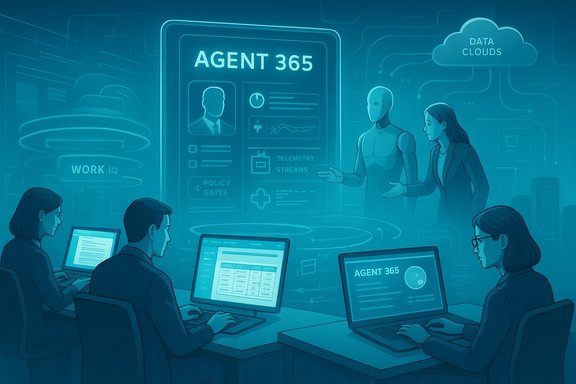
- Agent 365 — a tenant‑level control plane and registry: discovery, identity, permissioning, telemetry, and lifecycle management for agents (including third‑party agents). Agent 365 is Microsoft’s response to the management complexity of fleets of agents.
- Sales Development Agent and vertical agents — prebuilt, domain‑tuned agents (for example, Sales Development Agent) that autonomously research, qualify, and engage leads while handing off to humans as needed. These are available initially via Microsoft’s Frontier preview program.
- Copilot Studio, App Builder, Workflows — low‑code/no‑code tooling to build, train and deploy agents and lightweight apps with natural‑language prompts; App Builder and Workflows permit citizen developers to produce usable apps and automations quickly.
- Model choice and multimodel routing — Microsoft is expanding model choice (OpenAI, Anthropic, Microsoft’s Sora family and other tuned models) and routing decisions to pick the most appropriate reasoning model per task. Public docs reference GPT‑5 (and other work‑tuned models) as part of the stack; some third‑party summaries have used variant model names that are not in Microsoft’s official list and should be treated cautiously.
Work IQ — the new intelligence layer: how it works, what it stores
What Work IQ is designed to do
Work IQ is described as a layered inference engine: it consumes your work signals (email, files, meetings, chats), tracks personal style and habits, and combines this with organizational topology (org chart, relationships, shared workflows) to deliver contextually appropriate suggestions and to select or ground the right agent for a task. The goal is relevance: more accurate drafts, fewer clarifying prompts, and agents that “know the job” before they act.Where Work IQ draws its signals
- Email and calendar contents for meeting and communication context.
- Files and SharePoint content for documents and organizational knowledge.
- Teams chats and meeting notes for conversational context and action items.
- Interaction signals (how and when you edit, your phrasing preferences, patterns of approvals) to build a working memory of style and habits.
Privacy, retention and governance — the hard questions
Work IQ's power stems from concentrating sensitive metadata and inferred relationships in a new place. Microsoft positions Work IQ as tenant‑bound and governed by standard Microsoft 365 controls (sensitivity labels, Purview, Entra identity), but the operational detail — what exactly Work IQ persists, for how long, and what admin knobs exist at GA — is delegated to tenant configuration and forthcoming admin consoles. Independent reporting and Microsoft’s own briefings repeatedly emphasize the need for tenant administrators to treat Work IQ as a managed service with policy guardrails. Treat public claims about privacy and data residency as contingent on the admin policies you configure.Agent Mode and Office Agents — what changes inside Word, Excel, PowerPoint
Agent Mode: in‑canvas, multi‑step automation
Agent Mode is an in‑app runtime that lets an agent propose a plan, execute steps directly inside a document or workbook, and present intermediate artifacts for review. This is not a single “generate and deliver” reply — it’s a sequence of audit‑friendly actions that can be inspected, reordered, or rolled back. That design choice is important because it reduces opacity and gives users a chance to verify steps in data‑sensitive scenarios.App‑by‑app changes
- Excel Agent / Agent Mode in Excel: transforms raw data into summaries, charts, PivotTables and validated formulas. Excel Agents can pull external data and allow users to choose between different reasoning models (Anthropic or OpenAI) for certain flows. This reduces the need for spreadsheet expertise for many common tasks.
- Word Agent / Agent Mode in Word: generates structured documents by selecting relevant sources — emails, meeting notes and files via Work IQ — and iteratively refining drafts. Agent Mode in Word is described as generally available for licensed users.
- PowerPoint Agent / Agent Mode in PowerPoint: constructs decks, applies brand templates, and can auto‑generate speaker notes. Availability is staged through the Frontier program.
Strengths
- Speeds creation of business artifacts (reports, decks, forecasts) with less manual plumbing.
- Makes advanced tasks accessible to non‑specialists (e.g., building PivotTables or crafting a go‑to‑market deck).
- Encourages iterative human‑in‑the‑loop workflows rather than one‑shot generation.
Risks and caveats
- Agents may infer or use incorrect context if data connectors, sensitivity labels, or permissions are misconfigured.
- Model selection affects output style and hallucination risk; relying on a single model choice without validation increases error exposure.
- Auditing is possible but requires IT to enable and monitor telemetry; unchecked agent activity could create security and compliance blind spots.
Agent 365 — governance, identity and observability for agent fleets
Agent 365 is Microsoft’s administration answer to the prospect of billions of agents operating across enterprises. It is a registry and control plane designed to treat agents as first‑class tenant principals: they have identity, short‑lived credentials, scopes, telemetry, and policy bindings. The console offers discovery, permission management, quarantine options, and usage telemetry — analogous to how admins manage apps or service principals today.Why a control plane matters
A proliferation of agents without a governance layer creates cascade risks: data exfiltration, unauthorized access, and difficult‑to‑trace automated workflows. By giving agents identity and attaching policies (access scopes, logging, sensitivity constraints), Agent 365 aims to make agent behavior auditable and controllable. Early reporting emphasizes that Agent 365 supports third‑party agents and open‑source agent runtimes so disparate agents can be managed under a common policy fabric.Operational considerations for IT
- Inventory first — treat agents as part of your asset register before wide deployment.
- Apply least privilege — scope agent permissions narrowly to the data and actions required.
- Enable telemetry and logging — agent activity should feed into SIEM and compliance workflows.
- Define approval gates — require human approval for high‑impact actions (e.g., sending external emails or moving funds).
Vertical agents, Copilot Studio, App Builder and the Sales Development Agent
App Builder, Workflows and Copilot Studio
Microsoft is packaging low‑code authoring experiences into Copilot: App Builder to create shareable mini apps, Workflows agent to map natural‑language process definitions to scheduled/triggered automations, and Copilot Studio to author and iterate agents. The intent is to lower the barrier for citizen developers while connecting agent logic to enterprise telemetry and policies. These capabilities are designed to complement the Power Platform and Azure Foundry tooling so both citizen and professional developers can ship agentic solutions.Sales Development Agent — an early vertical play
The Sales Development Agent is a good example of a prebuilt vertical agent: it autonomously researches prospects, crafts and personalizes outreach, and follows up to build pipeline — handing off to human sellers when further human judgment is required. It integrates with CRM systems (Salesforce, Dynamics 365) and the Microsoft 365 apps used by sellers. Microsoft positions it as available via the Frontier preview in December 2025. Independent coverage and Microsoft’s Dynamics and product blogs corroborate the specifics around functionality and preview timing.Strengths & pitfalls for vertical agents
- Strengths: These agents specifically target repeatable, high‑volume tasks (lead qualification, candidate screening, incident triage) and can yield measurable ROI if instrumented and governed properly.
- Pitfalls: Acting autonomously on customer communications raises legal/privacy/regulatory questions (consent for outreach, data residency). Organizations must validate CRM connectors and audit logs to ensure compliance.
Model choices, naming and an important caveat
Microsoft’s public pages point to a multi‑model strategy: a mix of Microsoft‑tuned models (Sora family), OpenAI models (publicly referenced as GPT‑5 in Microsoft communications), and Anthropic models in certain contexts. These choices let tenants select the model that best balances cost, latency and safety for a given task. A few outlets and syndicated posts have used model variant labels such as “GPT‑5.1.” That precise label is not present in Microsoft’s official Ignite communications or the Microsoft Book of News; the official messaging references GPT‑5 alongside Sora models and Anthropic options. Treat any specific numbered model claims (e.g., “GPT‑5.1”) that are not echoed by Microsoft or the model vendors as unverifiable until confirmed by vendor documentation or formal model release notes. Flagging unverified model names is prudent because product messaging here matters for licensing, capabilities and compliance.Pricing and SME accessibility
Microsoft announced Microsoft 365 Copilot Business, targeted at organizations with fewer than 300 users, at $21 per user per month, with availability starting in December (pricing as published in Microsoft’s Ignite materials). This is a notable move to bring advanced Copilot capabilities to SMBs at a predictable per‑user price point, rather than reserving agentic features for only the largest enterprises. Validate budget impact by modeling per‑user costs and projected time savings before broad rollout.Security, compliance and the regulatory surface area
What the announcements change in practice
- Agents will hold credentials and operate as tenant principals — so authentication and secrets management become first‑order governance issues.
- Agents will access and synthesize enterprise data, which elevates the role of data classification, sensitivity labels and DLP rules.
- Agent telemetry must be integrated with existing audit and SIEM pipelines for real‑time monitoring and retroactive forensics.
Practical security checklist for pilot programs
- Enable Entra Agent ID and short‑lived agent credentials.
- Restrict agent scopes to minimal required datasets.
- Route agent activity to SIEM and set anomaly detection for unusual agent behavior.
- Require human approval for outbound communications and transactional actions.
- Conduct legal review for automated customer outreach (consent, opt‑outs, regional privacy law compliance).
Adoption advice: how to pilot Copilot + agents responsibly
- Start small: pick one high‑value, low‑risk use case (e.g., meeting summaries, internal report drafts).
- Define success metrics: time saved, quality improvement, reduction in task backlog, compliance incidents.
- Build governance into the pilot: least privilege, telemetry, manual kill switches.
- Train users: explicitly teach staff how to validate agent outputs and when to escalate.
- Iterate and expand: instrument ROI, refine policies and scale what demonstrably delivers value.
Strengths, commercial upside and real‑world impact
- Productivity gains: Agents reduce routine drag — triaging email, drafting standard documents, preparing meeting briefs — freeing knowledge workers for higher‑value tasks.
- Democratized application building: App Builder and Copilot Studio shrink the gap between idea and usable tool, accelerating internal automation.
- Vertical acceleration: Prebuilt agents (Sales Development Agent, Security Copilot integrations) can materially improve throughput for revenue and security teams.
- Governed scale: Agent 365 addresses a major enterprise blocker — how to manage many agents safely and transparently.
Risks, open questions and where to be cautious
- Concentration of sensitive inference: Work IQ centralizes personal and organizational signals. Improper configuration could leak relationships and workflows or surface sensitive data via agent outputs.
- Hallucination and model drift: Agents that synthesize or act without robust grounding risk producing inaccurate or misleading artifacts. Grounding layers like Foundry IQ and Fabric IQ are designed to reduce this risk but are as effective as their data hygiene.
- Regulatory and legal exposure: Autonomous outreach by sales agents intersects with privacy and marketing laws. Organizations must validate consent processes and retention policies before using agents in customer‑facing roles.
- Operational complexity: Agents increase the surface area for monitoring and incident response. Without tight telemetry and lifecycle controls, agents could behave unpredictably at scale.
- Vendor naming and claims: Be skeptical of precise model version claims that are not present in vendor documentation; treat such claims as unverifiable until directly confirmed by Microsoft or the model vendor.
Verdict: transformative — but only with governance
Microsoft’s Ignite announcements mark a meaningful step from “Copilot as helper” to Copilot as platform. The combination of Work IQ, in‑canvas Agent Mode, prebuilt vertical agents, Copilot Studio and Agent 365 creates a capable stack for organizations that are ready to adopt agentic workflows.That transition is transformative when done deliberately: productivity gains and faster app/automation delivery are real. But the technical and regulatory tradeoffs are non‑trivial. The good news is Microsoft packaged governance and lifecycle tools into the announcement precisely because these are the gaps enterprises identified first. The pragmatic path forward is simple: pilot with guardrails, instrument for ROI and compliance, and scale when telemetry shows the model and agents behave as intended.
Conclusion
Ignite 2025’s Copilot announcements read like a product roadmap for an AI‑augmented enterprise — not just smarter assistants, but identity‑bound agents, working with an intelligence layer that knows how work actually happens. For organizations, the opportunity is enormous: faster content creation, scalable sales engagement, and low‑code agentization of routine processes. For IT and risk teams, the mandate is equally large: treat agents as production services — inventory them, gate their permissions, log their actions and keep humans firmly in the loop for high‑impact decisions.Microsoft’s materials, independent reporting and the community captures we reviewed all point to a consistent direction: agentic workflows are next. The winners will be the organizations that combine rapid experimentation with disciplined governance and clear metrics for success.
Source: SSBCrack News Microsoft Ignite Unveils New AI Capabilities for Transforming Work with Microsoft 365 Copilot - SSBCrack News
