

Microsoft Ignite 2025 opened as an unmistakable signal: Microsoft is making a full-court press to turn its AI and cloud investments into partner-ready products and enterprise-grade security controls — and that push is reshaping the partner program, licensing, and Windows security posture in ways that will matter to every systems integrator, MSP, and enterprise IT team. The conference’s biggest partner- and security-focused announcements span new skilling investments, partner designations and go-to-market mechanics, a refreshed Copilot offer targeting small and midsize businesses, expanded agent and governance capabilities in Intune and Purview, and meaningful steps from Microsoft to reduce risky kernel-mode dependencies in endpoint security tooling. Many of these items were presented as practical building blocks for partners to deliver governable, revenue-generating AI and security services — but there are important caveats, pricing contradictions, and technical trade-offs that enterprises and partners must evaluate before committing to pilots at scale.
Microsoft framed Ignite 2025 around an “AI-first” operational playbook: platform primitives (Azure, Microsoft 365, Copilot, Entra/Intune, Purview, Sentinel) plus partner-led implementation to turn demos into measurable outcomes. The partner narrative was explicit — Microsoft is investing in partner skilling, streamlined marketplace mechanics, new badges and specializations, and expanded co-sell support to accelerate enterprise adoption of agentic AI and governed automation. Those changes reflect a strategic shift: Microsoft wants partners to be the trusted bridge that turns platform capabilities into audited, compliant customer outcomes.
At the same time, security remained a top priority. Ignite highlighted new guardrails for agentic AI (identity-bound agents, runtime constraints, auditability), expanded Security Copilot integrations, and significant Windows recovery and endpoint hardening features intended to reduce large-scale service interruptions and make endpoint security safer to operate. That dual focus — partner enablement and hardened security — was the dominant theme across keynotes and partner briefings.
Key takeaways for partners:
Benefits and friction points:
What independent verification shows
Practical partner action items
Microsoft’s message at Ignite is straightforward: the era of agentic AI is here, but adoption will favor partners and customers who can demonstrate auditable governance, measurable ROI, and operational resilience.
Source: CRN Magazine Microsoft Ignite 2025: The Biggest Partner Program, Security News
 Background / Overview
Microsoft framed Ignite 2025 around an “AI-first” operational playbook: platform primitives (Azure, Microsoft 365, Copilot, Entra/Intune, Purview, Sentinel) plus partner-led implementation to turn demos into measurable outcomes. The partner narrative was explicit — Microsoft is investing in partner skilling, streamlined marketplace mechanics, new badges and specializations, and expanded co-sell support to accelerate enterprise adoption of agentic AI and governed automation. Those changes reflect a strategic shift: Microsoft wants partners to be the trusted bridge that turns platform capabilities into audited, compliant customer outcomes.At the same time, security remained a top priority. Ignite highlighted new guardrails for agentic AI (identity-bound agents, runtime constraints, auditability), expanded Security Copilot integrations, and significant Windows recovery and endpoint hardening features intended to reduce large-scale service interruptions and make endpoint security safer to operate. That dual focus — partner enablement and hardened security — was the dominant theme across keynotes and partner briefings.
Partner program: skilling, commerce, and new badges
Partner Skilling Hub and investment in skills
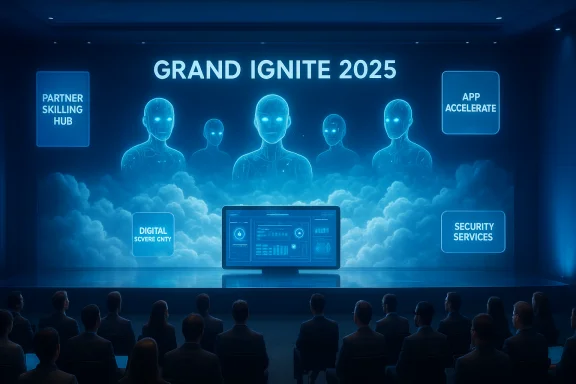
Microsoft made its Partner Skilling Hub generally available as a central resource for partners to train pre-sales, sales, and technical roles with live, virtual, and on‑demand content. The hub is designed to accelerate certification attainment and make partner teams Copilot- and cloud-ready. Microsoft’s bet is clear: skilling is the new currency — partners that invest 10–20% of their time in role-based training should be better positioned to win and operate AI projects. For partners, this converts to a tactical requirement: build a skilling plan, map staff to role exams, and track certified headcounts as procurement-level validation.Key takeaways for partners:
- The Hub consolidates role-mapped learning paths — sell, pre-sales, and technical — into one place.
- Certification attainment becomes a procurement signal; buyers will increasingly ask for dated certification rosters and Partner Center evidence.
- Microsoft is pairing skilling with co-sell incentives and GTM resources, increasing the ROI of certified delivery teams.
App Accelerate and marketplace commerce changes
Microsoft previewed an App Accelerate offering — a combined set of incentives, benefits, and co-sell support across the unified Microsoft Cloud marketplace. App Accelerate promises end-to-end technical guidance, developer tooling, and GTM resources targeted at ISVs and software developer partners; full availability is planned for 2026. Alongside that, Microsoft has made resale-enabled offers globally available in the marketplace to let publishers and channel partners resell software and services directly, streamlining transactions and scaling distribution. This is a structural change: monetization and procurement friction are being reduced for partners who publish hardened, co-sell-ready offers.Benefits and friction points:
- Benefit: Faster route from technical validation to procurement via unified marketplace listing + co-sell.
- Risk: Marketplace listing gates will demand enterprise readiness — security reviews and enterprise SLAs — which increases engineering and compliance effort for smaller ISVs.
New partner designations and specialization badges
Microsoft added a set of partner badges and designations to help customers identify vendors able to deliver on AI+cloud programs:- Frontier partner and frontier distributor badges for solution providers and distributors that combine AI agents and human expertise.
- Support services designation for partners demonstrating rigorous satisfaction and resolution metrics.
- Digital sovereignty specialization for partners that can architect sovereign-cloud solutions across Azure, Microsoft 365, and Security.
Microsoft 365 Copilot for SMBs — offer, pricing, and contradictions
One of Ignite’s marquee commercial announcements was a Copilot offer aimed at small and midsize businesses (SMBs). CRN’s reporting described a Microsoft 365 Copilot Business SKU priced at $21 per user, per month for firms with fewer than 300 users and noted planned bundling and renewal promotions rolling out in December. That statement has been widely echoed in some briefings, but it conflicts with Microsoft’s public pricing at the time of this reporting. Microsoft’s official product pages and blogposts list Microsoft 365 Copilot for small businesses at a different price point — specifically, a per-user commercial Copilot experience at $30 per user per month for eligible business SKUs. This is a critical divergence that buyers and partners must resolve before making procurement decisions. What we verified- Microsoft’s official product page lists Microsoft 365 Copilot pricing for business customers at $30 per user per month (annual commitment pricing shown on the product page). This is the current public list price on Microsoft.com.
- Microsoft’s blog and historical announcements confirm that Copilot for Microsoft 365 has been positioned for small and midsize businesses with seat minimums removed and specific SMB packaging tied to Business Standard/Premium plans, historically at the $30 price point.
- Microsoft has historically used promotional bundles and partner promotions (CSP promotions, renewal-season discounts, and time-limited offers) to trade price concessions for adoption momentum. Microsoft’s partner communications and Partner Center announcements have noted a pattern of temporary promotions and bundled renewal pricing that can alter practical per-seat economics during migration windows. Partners should expect promotional add-ons and CSP-specific discounts — but must verify actual invoiced pricing with their Microsoft partner account team or reseller.
- Don’t assume published MSRP is your effective price — ask for a dated quote showing the exact SKU, billing cadence (monthly vs yearly), and whether a renewal bundle or Purview inclusion applies.
- Validate the allowed seat counts and COPILOT eligibility per tenancy (some promotions have limits and time windows).
- Confirm what’s included (agents, advanced reasoning, Copilot Studio access) versus what triggers additional consumption fees (Copilot Studio compute, Copilot agents).
Security Copilot, SCUs, and the limits of public confirmation
CRN and partner briefings reported Microsoft beginning to bundle Security Copilot capacity into Microsoft 365 E5 licenses — described as an allocation of 400 Security Compute Units (SCUs) per month for every 1,000 paid seats, up to 10,000 SCUs — and an optional pay-as-you-go overage rate (CRN reported $6 per SCU). Those are consequential commercial terms if accurate, because SCUs are the unit that drives Security Copilot compute capacity for investigative and analytic workloads.What independent verification shows
- Microsoft’s pricing and product pages for Purview and Security Copilot document the concept of Security Compute Units (SCUs) as a metered capacity used to run Security Copilot and Purview data security investigations. The Purview pricing pages describe SCUs as provisioned or overage metered capacity and outline that Microsoft applications have a built-in audit standard. Those pages confirm the architectural reality of SCUs but do not, by themselves, confirm the specific E5‑bundled allocation numbers reported in some press accounts.
- The public Purview pages confirm the existence of SCU metering but do not list enterprise bundle allocations or the exact $/SCU overage rate as a universal public MSRP. Until Microsoft publishes a formal licensing bulletin or Partner Center notice stating the E5 allocation, buyers and partners should treat the CRN-sourced numbers as a partner-facing communication that requires confirmation from Microsoft’s licensing team or reseller. If the allocation is implemented, it materially affects runbook design for SOCs planning to integrate Security Copilot into day-to-day investigations.
Windows, kernels, and endpoint security: moving logic out of the kernel
WESP (Windows Endpoint Security Platform) and kernel-mode reduction
Ignite reinforced Microsoft’s multi-year effort to reduce the amount of third-party code running in kernel mode and to give partners safer user-mode APIs for endpoint security tooling. The Windows Endpoint Security Platform (WESP) API was announced as generally available for partners building security agents outside kernel mode — a direct response to the global instability event in 2024 that was precipitated by a defective third-party update and highlighted the systemic risk of heavy kernel-mode hooks. Microsoft’s roadmap includes:- New in‑box drivers and Microsoft-provided APIs to replace custom kernel drivers where possible.
- Compiler-level safeguards and driver isolation to constrain a driver’s blast radius.
- DMA-remapping enforcement to prevent accidental kernel-memory access.
- Kernel-mode crashes can create mass outages; moving logic to user mode or to standardized, audited kernel interfaces reduces the probability of outages and improves recoverability.
- The shift will require significant partner engineering to refactor drivers, re-architect telemetry flows, and revalidate performance-sensitive scenarios (e.g., graphics where kernel access is sometimes still necessary).
- Microsoft’s position: third-party kernel-mode drivers will still be supported where required, but Microsoft will provide safer user-mode alternatives and in-box drivers for common device classes (networking, cameras, USB, audio).
New guardrails and mission-critical support
Microsoft is adding mandatory compiler safeguards, driver isolation, and tooling for partner engineers to validate behavior under the new constraints. For high-impact incidents, Microsoft product team engineers can work directly with customers via the Windows component of Mission Critical Services for Microsoft 365. This combination of new APIs, operational support, and improved recovery tooling is intended to lower the risk of vendor updates that can put fleets offline.Practical partner action items
- Inventory all kernel-mode drivers in partner solutions and identify those that can be replaced with Microsoft in-box drivers or moved to user mode.
- Prioritize re-architecture for driver classes with the most risk (network, storage, audio).
- Engage early with Microsoft’s compatibility testing programs and driver certification tests to avoid last-minute compatibility failures.
Windows recovery, Intune enhancements, and resilience improvements
Ignite showcased an ambitious set of Windows recovery and management features that are squarely aimed at reducing downtime and improving recovery fidelity:- Windows Cloud I/O Protection for advanced input protection against keylogging and keystroke injection attacks.
- Intune management of Windows Recovery Environment (WinRE) — now generally available — that centralizes recovery actions (custom recovery scripts, triggerable recovery flow) and gives IT a single management plane for WinRE operations.
- Point-in-time restore to rollback devices (or device groups) to a prior state without complex, manual troubleshooting — previewed in Windows Insider builds.
- Cloud-rebuild for Windows 11 (in preview) to allow Intune-triggered, MDM-aware cloud rebuilds that preserve Autopilot flows and accelerate reprovisioning.
- Hardware-accelerated BitLocker support on new devices for stronger hardware-based key protection.
- Sysmon functionality in Windows to surface security event telemetry into event logs (GA planned in early 2026).
- Automated and managed recovery reduces mean time to repair (MTTR) — critical for remote and frontline device fleets.
- Centralized WinRE control and point-in-time restore reduce the operational effort and risk associated with manual reimaging workflows.
- Hardware-based encryption and Sysmon telemetry increase both the security posture and the forensic readiness of fleets.
Intune, Purview and Entra: agent-aware governance and AI-driven data protection
Ignite included numerous previews and GA items across Intune, Purview, and Entra with strong emphasis on AI-aware governance:- Intune gained Security Copilot agents for change review, policy configuration, device offboarding, and administrator tasks to centralize high-priority actions. New deployment and maintenance window controls, phased rollouts, and a managed installer capability aim to reduce the attack surface for line-of-business apps.
- Purview previewed an AI-powered Data Security Posture Management (DSPM) capability that unifies DSPM for data and DSPM for AI, offering outcome-based workflows, AI observability, and agent risk posture metrics. Purview’s DLP is being extended into Copilot Mode in Edge for Business and offering on-demand classification for meeting transcripts and non-Microsoft data sources via integrations (Snowflake, Databricks, Salesforce).
- Entra added agent identity controls and agent lifecycle management in preview, expanded conditional access optimization agents, identity risk management agents, and enhanced MFA features (passkey synchronization and self-remediation). Entra SASE-like capabilities and runtime attack blocking were also shown in preview status.
- Organizations that plan to deploy agentic AI must adopt identity-first agent management: short-lived agent identities, provable provenance, and strict policy enforcement are non-negotiable prerequisites for production deployments.
- Purview’s DSPM and agent observability features materially help close the visibility gap where agents interact with sensitive repositories and external data stores.
Strengths, risks, and the partner calculus
Notable strengths
- Platform leverage: Microsoft controls a deep stack — Azure, Microsoft 365, Entra, Intune, Purview, Sentinel — that eases integration of agents and copilot experiences in ways competitors struggle to match. Partners can assemble end-to-end solutions that are easier for enterprise procurement to accept.
- Partner enablement: Skilling Hub, App Accelerate, marketplace co-sell mechanics, and new specializations create clear commercial and operational pathways for partners to monetize AI projects.
- Security-first framing: Embedding Security Copilot across Defender/Sentinel/Purview and adding WESP and kernel guardrails directly addresses the security concerns that block many enterprise AI rollouts.
Key risks and open questions
- Pricing opacity and promotional complexity: Conflicting price reports (e.g., CRN’s $21 claim vs Microsoft’s $30 listing) show Microsoft’s promotional windows and reseller channels can produce ambiguity. Partners must verify actual invoiced pricing.
- Demo-to-production gap: Agents that perform well in curated demos can behave unpredictably in real-world environments. Governance, observability and human-in-the-loop controls must be in place before scaling.
- Engineering lift to move out of kernel: Rewriting drivers or re-architecting performance-sensitive workflows will be costly and time-consuming for many partners. Expect multi-year migration timelines and a phased approach aligned with Microsoft’s in‑box driver roadmap.
- Licensing and SCU clarity: Until Microsoft publishes a formal licensing bulletin confirming E5 allocations or overage pricing, SOC teams should assume SCU consumption will require explicit budgeting and monitoring. Purview pages confirm SCU metering exists, but not the specific E5 allocations reported in partner press briefs.
Practical playbook for partners and customers
- Readiness & Scoping
- Run focused Copilot and Security Copilot readiness workshops to map 3–5 high-value pilot scenarios.
- Inventory kernel-mode drivers and high-risk endpoint components; plan an early refactor list.
- Pilot & Agent Build
- Deploy narrow-scope agents with human-in-the-loop gating; ground outputs on versioned corpora and RAG architectures to reduce hallucination risk.
- Instrument comprehensive telemetry (prompt lineage, agent actions, human override metrics).
- Scale & Operate
- Expand to role-based copilots and automated agent workflows after measurable success.
- Formalize SLAs for monitoring, incident response, and cost controls for SCU/compute consumption.
- Procurement & Compliance
- Require dated Partner Center proof, certified headcount, telemetry extracts, and at least three validated customer references for specialist Copilot badges.
- Insist on explicit pricing quotes with included SCU allocations or overage terms, and include FinOps controls for model inference/agent compute budgets.
Conclusion
Microsoft Ignite 2025 was not about vague promises — it was a tactical program rollout that aligned partner skilling, marketplace mechanics, Copilot commercialization for SMBs, and an aggressive security and kernel‑hardening roadmap. For partners, the event delivers both opportunity and obligation: new specializations, marketplace routes, and Copilot offers create clear pathways to revenue, but they also raise the bar for documented skills, telemetry, and governance artifacts that enterprise buyers will demand. For enterprise IT, the announcements offer powerful capabilities — Security Copilot integrations, Intune-managed recovery, point‑in‑time restore, and safer endpoint APIs — but real value will depend on disciplined pilots, clarity on licensing (especially Copilot and SCU economics), and a pragmatic transition plan for legacy kernel-dependent tooling. Treat the new badges, previews, and claims as working components of an evolving platform: verify pricing and SCU allocations directly with Microsoft or your reseller, demand Partner Center evidence before contracting, and plan multi-phase modernization to move risky code out of the kernel while keeping service-level reliability front and center.Microsoft’s message at Ignite is straightforward: the era of agentic AI is here, but adoption will favor partners and customers who can demonstrate auditable governance, measurable ROI, and operational resilience.
Source: CRN Magazine Microsoft Ignite 2025: The Biggest Partner Program, Security News
