

Microsoft’s Ignite stage this week delivered a sweeping, coordinated push to make Azure the backbone of the “agentic” enterprise — a platform where models, data, and fleets of AI agents are intended to work together under enterprise-grade security, governance, and observability to generate measurable outcomes.
Microsoft framed Ignite 2025 as the moment when AI moves from experiment to operational practice: a unified product story that stitches Azure AI Foundry, Fabric IQ, Foundry IQ, Microsoft Agent Factory, Azure Copilot, new database offerings, and next‑generation infrastructure into a single narrative about trusted, agentic cloud. This is both a technical roadmap and a commercial play — Microsoft is packaging model choice, data unification, and agent orchestration so enterprises can adopt AI at scale with governance baked in. The announcements fall into four clear pillars:
Caveat: Microsoft’s description emphasizes integration with Microsoft 365, SharePoint, and Fabric; organizations with highly fragmented or third‑party systems must still plan integration work and validate mapping quality for their own entity models.
Key control features announced:
That said, the most important advice is pragmatic: validate claims with your workloads, demand clarity about model tenancy and data handling, and put governance and cost controls in place before expanding agent fleets. Vendor benchmarks and marketing language are a starting point, not a substitute for proof‑of‑concepts that measure real business outcomes.
Adopting the agentic cloud is not a product flip — it’s an organizational program. The announcements at Ignite 2025 provide a clearer set of tools to run that program, but success depends on disciplined testing, clear governance, and realistic cost and portability planning. For teams that approach this carefully, the agentic era offers the potential to automate complex workflows and unlock new productivity — but it must be built on verified performance, legal clarity, and human oversight.
Source: Microsoft Azure Azure at Microsoft Ignite 2025: All the intelligent cloud news explained | Microsoft Azure Blog
 Background / Overview
Microsoft framed Ignite 2025 as the moment when AI moves from experiment to operational practice: a unified product story that stitches Azure AI Foundry, Fabric IQ, Foundry IQ, Microsoft Agent Factory, Azure Copilot, new database offerings, and next‑generation infrastructure into a single narrative about trusted, agentic cloud. This is both a technical roadmap and a commercial play — Microsoft is packaging model choice, data unification, and agent orchestration so enterprises can adopt AI at scale with governance baked in. The announcements fall into four clear pillars:- Model and runtime choice: broadened Foundry model catalog and multi‑vendor support.
- Data and knowledge grounding: Fabric IQ and Foundry IQ to provide semantic, business‑centric data context.
- Agent orchestration and governance: Foundry Control Plane, Agent Factory, and Azure Copilot for operations.
- Infrastructure and performance: Azure Boost, Azure Cobalt 200, and new database services like HorizonDB and DocumentDB.
What changed — concrete announcements and verified specs
Model choice: Anthropic, Cohere, and an expanded Foundry ecosystem
Microsoft publicly announced that Anthropic’s Claude family (Sonnet 4.5, Opus 4.1, Haiku 4.5) and Cohere models are available through Microsoft’s Foundry and Copilot surfaces, giving customers additional frontier model options alongside OpenAI and others. This makes Azure one of the few clouds offering a broad multi‑vendor frontier catalog and reflects major commercial commitments between Anthropic, Microsoft and Nvidia. The Reuters and AP coverage confirms the commercial scale of that relationship and Anthropic’s compute commitments. Why this matters: enterprises get choice in model behavior and reasoning profiles (e.g., Anthropic’s safety‑/reasoning‑oriented models vs. alternative model tradeoffs), and Microsoft positions Foundry as the single orchestration layer that exposes those models with enterprise SLAs and governance controls.Fabric IQ and Foundry IQ: contextualizing agents with business semantics
Microsoft introduced Fabric IQ—a semantic layer designed to organize enterprise data around business concepts (entities, relationships, operational context) rather than raw tables—and Foundry IQ, a managed knowledge/agent retrieval system that simplifies RAG (retrieval‑augmented generation) and knowledge grounding for agents. Both are now in preview. Fabric IQ uses OneLake as the underlying storage fabric to provide cross‑source, real‑time semantics; Foundry IQ exposes a single API for agentic retrieval and includes preconfigured knowledge bases and permission‑aware retrieval. These features are aimed at solving a central enterprise problem: giving agents clear, auditable access to the right enterprise data with correct access controls.Caveat: Microsoft’s description emphasizes integration with Microsoft 365, SharePoint, and Fabric; organizations with highly fragmented or third‑party systems must still plan integration work and validate mapping quality for their own entity models.
Microsoft Agent Factory and Foundry Control Plane: agent management at scale
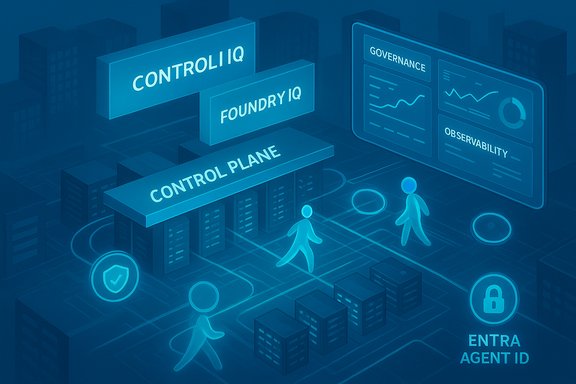
To help organizations build and manage agent fleets confidently, Microsoft launched Microsoft Agent Factory (a program/plan combining Work IQ, Fabric IQ, and Foundry IQ) and the Foundry Control Plane for lifecycle, security, and telemetry across agent platforms. The Control Plane integrates with Microsoft security signals (Defender, Purview), identity (Entra Agent ID) and observability (OpenTelemetry traces, telemetry from Agent 365 and other surfaces). This is Microsoft’s attempt to make agents a first‑class, auditable enterprise workload.Key control features announced:
- Entra Agent ID for identity-bound agents.
- Defender runtime protections for hosted agents.
- Centralized lifecycle and security policies for distributed agents.
Databases built for AI: HorizonDB, DocumentDB, SQL Server 2025, Fabric DBs
Microsoft announced several data services aimed squarely at AI and agent use cases:- Azure HorizonDB — a new managed PostgreSQL service in private preview. Microsoft states it provides transaction and vector search performance up to three times faster than open‑source PostgreSQL, supports scale‑out compute to 15 replicas with 192 vCores each, auto‑scaling storage up to 128 TB, and DiskANN vector indexing. These numbers come from Microsoft’s internal benchmarking and are published in Ignite’s Book of News. Customers should treat the “3x faster” as a vendor benchmark and validate with independent workload tests.
- Azure DocumentDB — now generally available as a managed, open‑source‑based MongoDB‑compatible service that includes vector embeddings, advanced search, autoscaling, and multicloud/hybrid deploy patterns. SLA and enterprise features are highlighted in Microsoft’s Book of News.
- SQL Server 2025 — Microsoft reconfirmed the product’s AI‑ready focus (embedded vector search, REST model management inside T‑SQL workflows, DiskANN index) and continued Fabric integration. SQL Server 2025 had earlier public previews in 2025 and is a core part of Microsoft’s ground‑to‑cloud story for AI.
Infrastructure and silicon: Azure Boost and Cobalt 200
Microsoft detailed infrastructure upgrades labeled as designed for the agentic era:- Azure Boost (preview): a subsystem offloading virtualization‑adjacent tasks to increase throughput — Microsoft claims up to 20 GBps remote storage throughput, up to 1 million remote storage IOPS, and up to 400 Gbps network bandwidth for future VM series. These are aggressive performance targets announced in the Ignite Book of News.
- Azure Cobalt 200: the next‑generation ARM‑based cloud CPU (preview) built on a 3nm process with claims of up to 50% better performance than Cobalt 100, deeper caches, more cores, and improved power efficiency. Microsoft positions Cobalt 200 together with Boost and Azure‑integrated HSMs for performance and security.
Critical analysis — strengths, opportunities, and measurable risks
Strengths: integrated story, enterprise controls, model choice
- Platform coherence: Microsoft’s biggest strength here is integration. Foundry + Fabric + Copilot + Entra + Defender creates a full‑stack claim where data, model, agent runtime, identity, and observability are designed to work together. For enterprises that already run Microsoft stacks, this reduces integration cost and shortens the path from pilot to production.
- Model diversity: adding Anthropic and Cohere to Foundry is strategically important — it reduces single‑vendor reliance and lets organizations pick model behavior (safety‑aware reasoning vs. high‑throughput generation) depending on the task. Public reporting confirms large commercial commitments that make these models cloud‑grade.
- Observability and governance: explicit control plane features (agent identity, runtime protections, Purview integration) address the most pressing enterprise blockers for agent adoption: auditability, least privilege, and compliance. Making these primitives available as first‑class constructs is a positive move for regulated industries.
Risks and limits: vendor lock‑in, cost, and benchmark caution
- Vendor lock and operational coupling: the deeper you go into the “Azure + Fabric + Foundry” stack, the more operational dependency you place on Microsoft control planes and tooling. Organizations must weigh faster time‑to‑value against long‑term portability. The marketplace unification and Agent Factory licensing model will make procurement easier but also consolidate commercial dependency.
- Benchmark skepticism: performance claims such as “HorizonDB up to 3x faster” and Azure Boost’s 20 GBps / 1M IOPS are vendor benchmarks. Independent validation is essential before committing core systems. These numbers are real claims in Microsoft’s Book of News, but customer workloads vary and I/O/network characteristics can differ widely. Treat these as starting points for proof‑of‑concepts, not guarantees.
- Data residency and model boundaries: Anthropic models are being offered through Foundry/Copilot surfaces, but details about hosting, telemetry sharing, and whether model providers can access plaintext data vary by integration and tenancy model. Redmond and other reporting warn that Anthropic models in some surfaces remain hosted outside Microsoft‑managed compute — an important nuance for compliance. Enterprises must confirm tenancy, contractual terms, and data handling for each model provider.
- Operational complexity of fleets: agent fleets create new operational vectors — cost explosions from runaway agent behavior, hidden compute for long‑running agents, and complex debugging scenarios across multi‑agent orchestrations. The Foundry Control Plane is designed to help, but tooling, cost models, and runbook maturity in your org will determine the real outcome.
What IT leaders and architects must test first (practical roadmap)
- Map business outcomes to agent capabilities: define 2–3 high‑value use cases and measurable KPIs (time saved, error reduction, revenue uplift).
- Run a pilot with constrained scope: pick one model provider, instrument Foundry IQ or a single RAG pipeline, and test grounding quality vs. Fabric IQ entity maps.
- Perform load and security tests: validate the Azure Boost and HorizonDB claims with your specific workload patterns and run penetration tests on the agent surfaces.
- Validate data flows and residency: confirm model hosting, telemetry access, and contractual data handling for each external model (Anthropic, OpenAI, Cohere).
- Prepare governance runbooks: define human‑in‑the‑loop thresholds, escalation paths, and cost‑control policies before going wide.
Developer and platform implications
For platform teams
- Consolidate identity and governance: enable Entra standards for agents, map Purview labels to any agent-accessible knowledge store, and centralize telemetry into your SIEM.
- Define RAG standards: maintain canonical chunking, embedding versioning, and freshness windows in your knowledge stores to keep agent outputs reliable.
For application developers
- Leverage Foundry IQ and prebuilt MCP tools for connectors to SAP, Salesforce, and other line‑of‑business systems. This reduces plumbing and accelerates useful agent behaviors.
- Build for observability: instrument agents for traceability and human‑approved audit trails; instrument cost‑tracking into agent actions.
Security, compliance and ethical guardrails
Microsoft emphasized built‑in protections (Defender runtime, Purview governance, Entra Agent ID). These are necessary but not sufficient.- Protect sensitive paths: adopt least privilege for agent credentials and wrap high‑risk actions in human approvals by default.
- Require provenance and explainability when agents affect decisions with legal, financial, or safety consequences.
- Regular independent audits: agent platforms introduce systemic risk; periodic third‑party audits and red‑team exercises should be part of production readiness.
Commercial and market implications
- Microsoft’s multi‑model strategy (OpenAI + Anthropic + Cohere + others) signals a shift to model pluralism: hyperscalers will compete on curated model catalogs and integration, not only raw compute.
- The Anthropic + Microsoft + Nvidia commitments reported in major outlets indicate increasing capital flows and strategic consolidation among a few model vendors, which could reduce long‑term price competition even as choice expands in the short term.
- For cloud buyers, this means bargaining power shifts to vendors that deliver managed model operations and seamless governance. Expect procurement and vendor management teams to engage at a higher technical level than before.
Final verdict — the good, the necessary caution, and next steps
Microsoft’s Ignite 2025 announcements amount to a coherent platform vision: a single stack to build, run, govern, and observe agents that operate against enterprise knowledge while offering broad model choice and new infrastructure performance. For organizations already invested in Microsoft technologies, the path to production is materially smoother.That said, the most important advice is pragmatic: validate claims with your workloads, demand clarity about model tenancy and data handling, and put governance and cost controls in place before expanding agent fleets. Vendor benchmarks and marketing language are a starting point, not a substitute for proof‑of‑concepts that measure real business outcomes.
Quick reference: Verified claims you can act on today
- Anthropic Claude Sonnet 4.5 and Cohere models are now available across Microsoft Foundry and Copilot surfaces (model availability and enterprise terms vary by product).
- Fabric IQ and Foundry IQ are in preview to provide semantic business entity layers and preconfigured agent knowledge retrieval.
- Azure HorizonDB is in private preview, with vendor claims of up to 3x transaction/vector performance vs. upstream PostgreSQL and scale‑out to 15 replicas; validate in your environment.
- Azure DocumentDB is generally available with vector search and multicloud/hybrid support.
- Azure Boost (preview) targets up to 20 GBps remote storage throughput, up to 1M remote IOPS, and up to 400 Gbps network bandwidth for future VM families.
Adopting the agentic cloud is not a product flip — it’s an organizational program. The announcements at Ignite 2025 provide a clearer set of tools to run that program, but success depends on disciplined testing, clear governance, and realistic cost and portability planning. For teams that approach this carefully, the agentic era offers the potential to automate complex workflows and unlock new productivity — but it must be built on verified performance, legal clarity, and human oversight.
Source: Microsoft Azure Azure at Microsoft Ignite 2025: All the intelligent cloud news explained | Microsoft Azure Blog
