

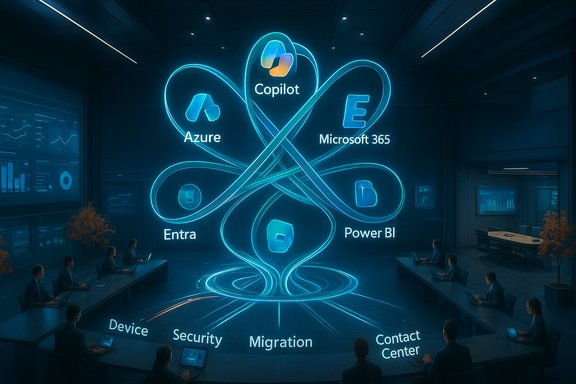
Microsoft Ignite 2025’s partner spotlight in Technology Record foregrounds a familiar but increasingly consequential storyline: Microsoft’s partner ecosystem is the practical engine converting platform-level AI and cloud promises into measurable customer outcomes. The Autumn 2025 partner roundup highlights a mix of device, security, migration, analytics and contact‑centre vendors — and the case studies underline one consistent message: integration with Microsoft platforms (Azure, Microsoft 365, Entra/Intune, Copilot, Power BI) remains the fastest route to scalable, repeatable customer value.
Microsoft Ignite 2025 is scheduled at the Moscone Center in San Francisco with pre‑conference labs on 17 November and the main event running 18–21 November. The conference is positioned as Microsoft’s operational playbook for enterprise AI: platform primitives (Azure AI, Fabric, Azure AI Foundry), co‑sell mechanics, and partner solutions that embed Copilot and governed agentic workflows into real business processes will dominate the program. Local authorities and event partners were preparing for significant on‑site attendance while broad digital reach continues through online channels. Technology Record’s partner spotlight collects a dozen short case studies and vendor summaries that signal practical use cases and frequently recurring themes:
Yet vendors’ headline KPIs often come with caveats. Many of the most eye‑catching numbers appear in partner marketing and magazine roundups; pragmatic buyers must insist on named references, measurement methodologies, and contractual protections before rolling large projects forward. AI and platform integrations magnify both opportunity and risk: better outcomes when partners address governance, portability and observability up front; painful integrations when they do not.
Microsoft Ignite is where those gaps either get closed — through new platform controls, marketplace guardrails, and partner certification — or where the industry’s buying patterns continue to favor speed over auditability. For IT leaders, the path is clear: use partner creativity to speed adoption, but anchor purchases in pilots, measurement and contractual governance that protect data, privacy and future portability.
Source: Technology Record Microsoft Ignite 2025: partner spotlight
 Background / Overview
Microsoft Ignite 2025 is scheduled at the Moscone Center in San Francisco with pre‑conference labs on 17 November and the main event running 18–21 November. The conference is positioned as Microsoft’s operational playbook for enterprise AI: platform primitives (Azure AI, Fabric, Azure AI Foundry), co‑sell mechanics, and partner solutions that embed Copilot and governed agentic workflows into real business processes will dominate the program. Local authorities and event partners were preparing for significant on‑site attendance while broad digital reach continues through online channels. Technology Record’s partner spotlight collects a dozen short case studies and vendor summaries that signal practical use cases and frequently recurring themes:- Endpoint security and automation (Action1 + Intune; Huntress + Intune),
- Industrial and environmental telemetry (AVEVA CONNECT on Azure with ABS‑CBN Foundation / Calibr8),
- Hybrid workplace hardware (Barco ClickShare large‑scale deployment),
- Tenant and workstation migration scale (BitTitan + PowerSyncPro),
- Document automation and e‑invoicing (Formpipe Lasernet and Georg Jensen),
- AI‑powered contact centre and sales enablement (Reply + Dynamics 365 + Copilot Studio),
- Training and enablement for generative AI (Skillable simulations),
- Audio and room‑systems tuning to improve Copilot outcomes (Shure + Forté).
Why the partner ecosystem still matters
Microsoft’s product strategy has converged around a few platform primitives — Azure, Microsoft 365 / Entra, Copilot, and Azure AI Foundry — and each primitive requires integrators, hardware vendors and ISVs to tie them to outcomes. Partners provide three critical functions that platform vendors rarely deliver alone:- Rapid, field‑tested connectors and templates that translate platform APIs into repeatable products.
- Vertical knowledge (manufacturing, energy, public sector) so integrations solve domain‑specific operational problems.
- Delivery and change‑management at scale (migrations, workplace rollouts, contact centre redesigns).
Notable partner stories: summary and validation
Below are succinct summaries of selected partner cases called out in the spotlight, with verification where available and caution where claims are only reported by the magazine.Action1 + Microsoft Intune — Carwow: rapid endpoint management for a remote workforce
- What Technology Record reported: Carwow (400+ remote employees) combined Microsoft Intune and Action1 to scan for deviations from Microsoft’s security baseline, auto‑remediate via PowerShell, and speed Windows 11 upgrades; weekly effort dropped from six hours to 20 minutes.
- Verification status: The case narrative appears in Technology Record’s partner roundup; at the time of publication there was no separate public Action1 or Carwow press release with the exact “six hours to 20 minutes” metric that could be independently located. The broader elements — Intune for baseline management and Action1’s capabilities for visibility and automation — match the vendor product descriptions, but the specific time‑savings claim is reported by the magazine and should be validated in procurement conversations or a vendor‑supplied ROI worksheet. Treat the exact number as an indicative KPI, not a contractually guaranteed outcome.
AVEVA + ABS‑CBN Foundation / Calibr8 — citizen science meets industrial software
- What was reported: AVEVA’s CONNECT on Microsoft Azure aggregates IoT boat‑based water‑quality telemetry, visualised through Power BI, to help protect the Verde Island Passage — a biodiversity hotspot in the Philippines. The setup is cited as a replicable conservation model evolved from industrial use cases.
- Independent corroboration: Industry reporting and regional coverage confirm AVEVA’s work with local partners on telemetry and environmental projects; journalism covering AVEVA’s sustainability narratives mentions ABS‑CBN Foundation’s citizen science programmes that use digital monitoring to help local stewardship. This story aligns with AVEVA’s documented push into cross‑industry use cases for CONNECT and with third‑party reporting of AVEVA deployments in the Philippines. The use of Power BI and Azure for telemetry dashboards is a proven, common architecture.
Barco ClickShare — Flemish Government: scale and UX in a hybrid workplace
- What was reported: The Flemish Government installed over 1,000 ClickShare units across meeting spaces in a major Brussels renovation; one‑click hybrid meetings and BYOD are central to the experience.
- Independent corroboration: Barco’s own customer story on the Flemish Government confirms the scale (1,000+ ClickShare units and 1,000+ meeting spaces) and emphasises sustainability, BYOD support and one‑click meeting starts — exactly as the partner spotlight describes. This is a straightforward hardware + management case where vendor documentation is an acceptable primary source.
Huntress — hospitality group: managed EDR + Intune
- What was reported: A US hospitality group deployed Huntress managed EDR and managed identity threat detection; Huntress rolled out its EDR agent via Microsoft Intune across ~320 endpoints in under 24 hours and cut response times from up to 45 minutes to under 10 minutes.
- Independent corroboration: Huntress’s published case study for a leading hospitality group details these outcomes — 315–320 endpoints, <24‑hour deployment via Intune, and response‑time improvements — matching the magazine’s summary. This is reliably sourced from the vendor’s own case materials.
Formpipe / Lasernet — Georg Jensen: e‑invoicing saves hundreds of thousands
- What was reported: Georg Jensen reduced annual invoice costs from ~€500,000 to ~€200,000 after Lasernet/ Dynamics automation; ~70% of customers now receive emailed PDFs.
- Independent corroboration: Formpipe’s own customer references document Georg Jensen’s e‑invoicing results, citing a ~€300,000 annual saving and transition to digital invoicing. Vendor case studies are consistent with the magazine’s figures; buyers should still confirm baseline costing and assumptions when budgeting for similar projects.
BitTitan + PowerSyncPro — large migration projects and AI readiness
- What was reported: A UK customer consolidated Microsoft 365 tenants and reconfigured over 9,000 workstations in a single weekend using BitTitan MigrationWiz and PowerSyncPro, moving terabytes of data while resetting join states and minimising downtime.
- Verification status: Technology Record presents this as a high‑scale migration vignette; BitTitan’s public materials emphasize MigrationWiz’s scale (millions of users migrated globally) and partnership narratives with third‑party tooling. However, independent corroboration of the specific “9,000 workstations in one weekend” case was not located in public press releases during verification — it may be a valid customer story that has not been separately published. Treat headline throughput claims as vendor‑reported and verify with named references in supplier due diligence.
Reply + Riverty — omnichannel contact centre in 100 days
- What was reported: Reply built an AI‑powered omnichannel contact centre for Riverty on Dynamics 365 Customer Service, Copilot Studio and Azure AI in 100 days, cutting case processing time by 35% and lifting customer satisfaction by 28%.
- Verification status: The magazine’s summary is plausible given Dynamics + Copilot templates and known Reply practice, but public press materials matching these exact numbers were not found during verification. This is a typical partner KPI story; buyers should ask Reply for the detailed measurement methodology and baseline datapoints before assuming identical results will follow.
Shure + Forté — room audio that makes Copilot better
- What was reported: Forté’s Microsoft Experience Center uses Shure’s IntelliMix Room Kit 30 to deliver audio clarity that materially improves Copilot transcription, summarisation and translation outcomes. The quote from a Forté engineer in Technology Record stresses “clean audio equals better AI outcomes.”
- Independent corroboration: Shure publishes similar use cases and product claims about IntelliMix improving transcription and speech recognition performance in hybrid rooms. The technical premise — cleaner mic signals yield better ASR and downstream agent performance — is also broadly accepted by voice‑AI practitioners.
Analysis: where the partner model succeeds — and where it needs caution
Strengths: speed, vertical extension, and measurable KPIs
- Partners accelerate adoption by offering templates and prebuilt connectors that remove months of integration work. The migration, EDR and document automation stories all follow the same pattern: pre‑certified connectors plus vendor delivery processes produce fast time‑to‑value.
- Vertical reuse is powerful. AVEVA reuses industrial telemetry patterns for environmental monitoring; this is a low‑cost example of platform reuse.
- The partner ecosystem translates platform capabilities (Copilot, Fabric, Azure AI) into procurement‑friendly artifacts: SLAs, ROI claims and measurable KPIs that IT and finance teams can evaluate.
- Hardware partners (Barco, Shure) solve a pragmatic problem: platform AI is only as good as the data it gets. Better room audio or consistent meeting UX materially improves Copilot and meeting AI outcomes.
Risks and practical caveats partners must address
- Vendor-reported KPIs need scrutiny. Many of the headline numbers (hours saved, percent reductions, terabytes migrated in a weekend) are vendor or magazine reported. Procurement must demand:
- Named references that will permit verification.
- Baseline measurement methodology (what “case processing time” means, which queues were included, how averages were calculated).
- Contractual SLAs for migration timelines and rollback windows.
- Governance for AI and data custody. When solutions plug Copilot or Azure OpenAI into workflows, customers must determine what data is accessible to models, how prompt logs are retained, and whether non‑training guarantees are in contracts. The partner ecosystem needs to make governance features explicit, not optional.
- Hidden integration costs. Template‑based solutions often assume standard topologies; every real environment has edge cases. Expect configuration and exception engineering to add professional services spend unless these are priced up front.
- Lock‑in and portability. Partners that embed deeply into Microsoft stacking (one tenant, Fabric OneLake assumptions, Entra‑bound identities) can deliver fast outcomes — but customers must negotiate exit and data portability clauses.
- Security posture assumptions. Several stories assume Intune + partner tooling suffices for endpoint security. Enterprises should map these solutions into their broader Zero Trust architecture, Sentinel/SIEM integration, and e‑discovery/compliance requirements.
Practical guidance for IT and procurement teams
If you are evaluating partner offers similar to those in Technology Record, use this checklist to separate headline claims from deliverable value:- Ask for a named customer reference and an onsite (or recorded) walkthrough that shows before/after telemetry for the KPI you care about.
- Require a measurable pilot: three‑to‑six weeks with agreed observability and success metrics. Use the pilot to validate ingestion, telemetry, and remediation workflows.
- Validate governance: obtain a written Non‑Training/Data‑Use policy for any Azure OpenAI or Copilot integration and confirm where logs and embeddings are stored.
- Demand a rollback and contingency plan for migration and tenant consolidations that includes identity sync testing, password handling (never in clear), and an agreed period of coexistence.
- Build cross‑team acceptance: include Security, Legal, and Compliance in vendor validation — not just IT and the business sponsor.
What Microsoft Ignite 2025 should make visible
Microsoft has built a vast partner marketplace and co‑sell model; the value exchange at Ignite should become more transparent and procurement‑friendly. The following are things to watch for during the event:- Standardised partner ROI templates and measurement playbooks that make vendor claims auditable.
- Marketplaces or certifications that highlight partners who provide tenant‑contained AI (non‑training contractual guarantees).
- Deeper integrations between room hardware (audio) and Copilot Studio to quantify how UX improvements raise model accuracy and lower human review costs.
- Migration accelerators that include identity lifecycle management and secure, auditable password migration or federation primitives.
Conclusion
Technology Record’s Microsoft Ignite 2025 partner spotlight offers a useful snapshot: partners are the practical multiplier that turns Microsoft’s platform investments into measurable business outcomes. The stories collected — from Carwow’s endpoint automation to AVEVA’s environmental telemetry and Barco’s thousand‑unit ClickShare rollout — demonstrate repeatable patterns: tie platform primitives to measurable outcomes, use vertical templates to reduce delivery risk, and make governance part of the value proposition.Yet vendors’ headline KPIs often come with caveats. Many of the most eye‑catching numbers appear in partner marketing and magazine roundups; pragmatic buyers must insist on named references, measurement methodologies, and contractual protections before rolling large projects forward. AI and platform integrations magnify both opportunity and risk: better outcomes when partners address governance, portability and observability up front; painful integrations when they do not.
Microsoft Ignite is where those gaps either get closed — through new platform controls, marketplace guardrails, and partner certification — or where the industry’s buying patterns continue to favor speed over auditability. For IT leaders, the path is clear: use partner creativity to speed adoption, but anchor purchases in pilots, measurement and contractual governance that protect data, privacy and future portability.
Source: Technology Record Microsoft Ignite 2025: partner spotlight
