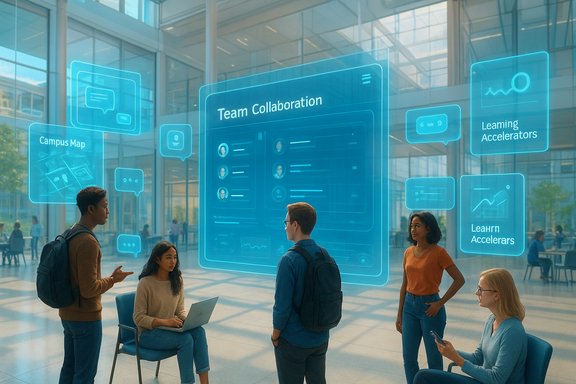
Across campuses, Microsoft Teams for Education is no longer just a place for chat and video calls — when deliberately configured and governed, it can act as the central nervous system for student engagement, academic collaboration, administration, telephony, and AI-driven insights that together form the basis of an intelligent campus.
Hybrid learning and dispersed campus services have left students and staff frustrated by fractured experiences: multiple portals, long response times, and unclear ownership for routine requests. Those problems have political and financial consequences — enrollment and retention hinge on simple things like prompt answers to admissions or financial aid queries. Many institutions already pay for Microsoft 365 licenses and have Teams installed on almost every device, yet most only use a fraction of its capabilities. Turning that latent platform into a campus-wide service platform is both a practical and strategic opportunity.
Microsoft has purpose-built layers — from Teams Phone and contact-center integrations to Copilot and learning-specific accelerators — that can be stitched together to handle voice, messaging, case management, and analytics within a single secured tenant. That convergence is attractive because it reduces app switching, keeps context, and enables data-driven interventions across the student lifecycle.
Key FinOps controls to adopt early:
Source: UC Today The Hidden Power Inside Every Campus - Microsoft Teams
 Background: why Teams matters now
Hybrid learning and dispersed campus services have left students and staff frustrated by fractured experiences: multiple portals, long response times, and unclear ownership for routine requests. Those problems have political and financial consequences — enrollment and retention hinge on simple things like prompt answers to admissions or financial aid queries. Many institutions already pay for Microsoft 365 licenses and have Teams installed on almost every device, yet most only use a fraction of its capabilities. Turning that latent platform into a campus-wide service platform is both a practical and strategic opportunity.Microsoft has purpose-built layers — from Teams Phone and contact-center integrations to Copilot and learning-specific accelerators — that can be stitched together to handle voice, messaging, case management, and analytics within a single secured tenant. That convergence is attractive because it reduces app switching, keeps context, and enables data-driven interventions across the student lifecycle.
What “Teams as a platform” looks like in practice
When Teams is treated as a platform rather than a chat app, three patterns emerge across successful implementations:- Centralized student engagement and contact handling, where advisors, counselors, and service desks use Teams-based queues and dashboards to capture interactions and case notes rather than letting conversations fragment across tools.
- Consolidated telephony and contact-center services (Teams Phone + partner contact-center integrations), which drop hardware costs and let staff answer calls from any device under enterprise security and compliance controls.
- Data and AI-driven insight layers — Power BI / Fabric analytics, Learning Accelerators, and Copilot agents — that turn day-to-day interactions into actionable signals for teachers and student-success teams.
Centralized student engagement: fewer handoffs, faster help
Most students abandon a request if the journey to resolution feels long or confusing. Centralizing service points into Teams reduces friction: chat, voice, meeting history, and case notes live in one location and are discoverable to authorized staff. That makes handoffs visible, reduces duplicated effort, and improves first-contact resolution. Institutional pilots convert anecdotes into measurable metrics — especially around response time and volume management — when they instrument queues and dashboards.Telephony consolidation: operational savings and flexibility
Moving campus telephony into Teams Phone and integrated contact-center partners can materially reduce legacy PBX and hardware overhead. For many institutions, the immediate wins are simpler provisioning, cloud-managed call routing, and unified policies for recording and retention. However, telco migrations require deliberate number-porting plans, phased pilots, and careful partner choice to protect continuity.Embedded analytics and learning accelerators: turning conversations into insight
Every call, chat, and assignment contains signals about student engagement and risk. Teams combined with Power BI/Fabric and purpose-built education tools surfaces those signals into real-time dashboards for advisors and teachers. Learning Accelerators such as reading and search coaching shift formerly manual monitoring into continuous telemetry, enabling targeted interventions rather than quarterly retrospectives.Case studies and real-world signals — potential and caveats
The momentum behind Teams in education is supported by multiple institutional examples. These are useful guides, but they require cautious interpretation: customer-reported numbers are directional unless confirmed by third-party audits or detailed measurement annexes.- Institutions have reported major gains by embedding contact centers and call queues inside Teams, reducing response times and increasing transparency for advisors and service teams. Many playbooks recommend instrumented pilots to validate vendor-provided figures.
- Moving telephony and endpoints into Teams Phone often produces large hardware savings and improved voice quality, but savings vary by campus topology and legacy contracts. The technical ability to answer calls across devices under one security model is a repeatable benefit.
- Early AI pilots — Copilot for productivity, Learning Accelerators for classroom activities, and private tenant-hosted models for sensitive use cases — consistently show productivity gains in pilots, but institutions must implement guardrails to avoid governance gaps and runaway costs.
Why governance and change management are the real blockers
Technology alone does not deliver outcomes. Teams deployments that skip governance, lifecycle management, and role-based training rapidly produce sprawl, orphaned Teams, and security exposure. Strong implementations emphasize:- Standard naming conventions and lifecycle policies for every Team.
- Two owners per Team and an automated owner-certification process.
- A Centre of Excellence or service owner responsible for change management and licensing FinOps.
- Role-based training that targets faculty, advisors, and IT with different modules (e.g., Copilot for faculty; call-queue dashboards for advisors; compliance for IT).
Security, privacy, and compliance: operational realities
Consolidating conversations and documents into Teams centralizes risk as well as value. Institutions must explicitly manage:- Identity and access: Enforce MFA, conditional access, and least-privilege roles via Azure AD/Entra.
- Data governance: Apply sensitivity labels, DLP policies, and retention rules to chats, recordings, and files before enabling broad recording or Copilot access.
- Auditability: Ensure telemetry, prompt histories, and model versioning are logged to a SIEM for regulated workloads and research — tenant containment alone is not sufficient without instrumented logs and contractual guarantees.
- Vendor commitments: For any agent or model handling student data, ensure contracts include non-training clauses, deletion commitments, and audit rights where feasible.
Costs, FinOps, and the risk of “license plus consumption”
A persistent blind spot is conflating seat licensing with total cost. Copilot agents, multi-model inference, and meeting transcript storage add consumption-based costs that can compound quickly if left unmanaged.Key FinOps controls to adopt early:
- Map license tiers and expected usage profiles (student-facing agents vs. staff productivity copilots).
- Pilot with consumption telemetry and set hard usage caps during the test phase.
- Model cost-per-student and include sensitivity ranges for high-adoption scenarios.
Practical playbook: turning Teams into the campus backbone
Implementations that scale follow a disciplined sequence. The following condensed blueprint captures repeatable actions:- Discover & baseline (0–45 days)
- Inventory Teams, SharePoint, phone numbers, and third-party tools.
- Define CFO-grade KPIs (hours reclaimed, license utilization, telephony opex).
- Pilot high-value micro-use cases (30–120 days)
- Examples: an admissions triage bot, an advisor call queue with wallboard, and a Copilot pilot for meeting recaps in an administrative office.
- Run time-boxed pilots (6–12 weeks) with telemetry and manager-verified sampling.
- Build governance & a Centre of Excellence (60–180 days)
- Implement naming conventions, retention rules, two-owner minimums, and periodic recertification.
- Publish role-based training and create champion networks to sustain behavior change.
- Scale with operational measurement and FinOps
- Gate premium features (Copilot, Teams Premium, telephony) based on role and KPI outcomes.
- Integrate usage dashboards into finance reporting and adjust procurement plans accordingly.
AI in Teams: practical promise and clear limits
AI features — Copilot, intelligent recaps, and Learning Accelerators — transform repetitive workflows and surface signals from everyday work. Use cases with strong ROI include:- Meeting recaps and action-item extraction that reduce follow-up emails.
- Draft-first documents for administrative teams, saving review time.
- Learning accelerators that automate formative assessments and reading practice to give teachers immediate, actionable feedback.
- Human-in-the-loop: treat AI outputs as drafts that require human verification for high-stakes decisions.
- Model governance: maintain an approved model inventory and versioning, and define which models are permitted for which classes of data.
- Consumption controls: cap agents and monitor token usage to prevent runaway costs.
Risks to call out (and how to mitigate them)
- Overstated ROI: vendor and media case studies often present optimistic savings. Mitigation: require instrumented pilots and conservative CFO modelling.
- Compliance and privacy: transcription and AI prompts may cross regulatory boundaries. Mitigation: legal sign-off and DLP before broad enablement.
- License and consumption creep: Copilot and premium features scale cost rapidly. Mitigation: staged enablement, license reclamation, and FinOps dashboards.
- Vendor lock-in: consolidating identity, data, telephony, and analytics into a single vendor increases migration cost. Mitigation: insist on exportable APIs, documented data flows, and exit clauses.
Measurable outcomes to track from day one
Dashboards should focus on finance-grade KPIs, not vanity metrics. Track:- License utilization rate for targeted workflows (not simply MAUs).
- Hours reclaimed per role (minutes saved × users × days).
- Telephony Opex reduction from retired PBX and trunks.
- Service metrics for student-facing desks: Average Handle Time, First Contact Resolution, CSAT.
- AI consumption and inference costs per pilot.
The road ahead: an intelligent campus stitched by Teams
The long-term vision is an intelligent campus where conversations become data, data triggers action, and action is measured and improved iteratively. Teams — when combined with Fabric/Power BI analytics, tenant-contained AI, and disciplined governance — can be the connective tissue that makes that vision work. However, the transition is organizational as much as technical: success depends on pilots that measure, governance that constrains, FinOps that measures consumption, and procurement that negotiates clear model- and telemetry-related guarantees.Conclusion
Microsoft Teams for Education is already present on most campus devices; the strategic opportunity is to convert that ubiquity into a platform that improves student experience, reduces administrative friction, and yields measurable operational savings. The blueprint is clear: start with outcomes, pilot conservatively, govern deliberately, and measure with finance-grade KPIs. When those pieces come together — secure identity, governed AI, telemetry-driven pilots, and FinOps discipline — Teams can evolve from a background collaboration tool into the hidden power inside every campus.Source: UC Today The Hidden Power Inside Every Campus - Microsoft Teams