

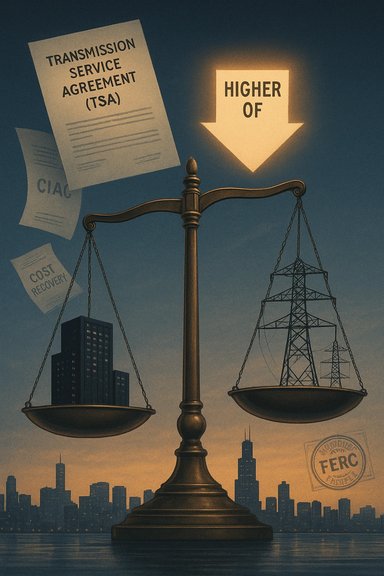
The Illinois attorney general has asked the Federal Energy Regulatory Commission to pause and scrutinize proposed Transmission Service Agreements (TSAs) between Commonwealth Edison (ComEd) and multiple data center developers, arguing the contracts fail to insulate existing ratepayers from potentially massive transmission costs and reliability risks driven by rapidly expanding hyperscale data center demand.
Background
The filings at FERC challenge TSAs tied to large planned facilities in northern Illinois — notably those proposed by Monarch Rock Air and Karis Critical — that could grow to roughly 1,200 MW and 500 MW, respectively. Those agreements use contractual revenue guarantees, minimum payments, and security deposits intended to protect ComEd and customers if projected demand falls short, but Illinois’ Office of the Attorney General (AG) says those safeguards are inadequate to stop cost shifting to existing customers. Utility filings show ComEd also has pending TSAs with several other data center developers, reflecting a broader surge in large-load proposals across Exelon’s utility footprint. This dispute sits at the intersection of two hard-to-reconcile regimes: state-jurisdictional retail utility service (which typically governs distribution and retail tariffs) and FERC-jurisdictional wholesale transmission rules. ComEd has argued TSAs should be accepted by FERC because contract provisions could be construed as affecting rates or practices for FERC-jurisdictional transmission service; the AG argues FERC should defer until Illinois regulators adopt and finalize a large-load interconnection framework. The Illinois Commerce Commission (ICC) is reviewing related tariff proposals and has a regulatory timeline tied to the matter.Why this matters: scale, speed, and stakes
Data center customers are not typical industrial loads. Hyperscale facilities designed to support artificial intelligence and cloud services can require enormous and rapidly-growing power — often occupying multiple substations and triggering broad network upgrades. Exelon executives disclosed that its advanced data center pipeline grew into the multiple-gigawatt range (reported as 18 GW of advanced pipeline and 47 GW of potential future additions in company statements during 2025), underscoring the scale of the new demand pressure on distribution and transmission systems. That scale has direct implications for capital spending and rate design. Transmission upgrades needed to serve concentrated, high-density loads can be expensive and system-wide in effect: upgrades made to support one large load may be rolled into embedded transmission cost pools and recovered from all transmission customers unless explicitly priced or allocated differently. That creates a potential for cross-subsidization: if new large loads do not fully and explicitly pay the incremental costs their interconnection imposes, existing customers could see higher transmission rates. The Illinois AG’s filings argue exactly this point: ComEd’s TSA structure does not guarantee the revenues pledged by data centers will match the actual costs the utility will have to recover through its formula rates.The contracts at issue: what’s in a TSA?
Transmission Service Agreements under discussion share some common features designed by ComEd and the developers:- Defined growth ramps that set expectations about when and how much load will materialize.
- Customer facility readiness obligations requiring milestones before full service obligations apply.
- Credit and security obligations: letters of credit or other financial assurances if committed revenues are missed.
- Committed revenue contributions and shortfall payments if actual usage and resulting transmission revenues fall below contractual commitments.
- Published termination-fee schedules to govern contract exit scenarios.
Federal precedent and where FERC stands
FERC’s recent handling of a similar case — the PECO Energy Company agreement with Amazon Data Services — looms large. In that order, FERC accepted the PECO-Amazon TSA under the Mobile‑Sierra presumption (a doctrinal presumption that freely-negotiated contracts are just and reasonable), but Commissioner Judy Chang wrote a detailed concurrence flagging the increasing number of one-off contracts and the lack of an agency framework to assess whether bilateral safeguards sufficiently protect customers from transmission cost shifts. Chang urged coordination with state regulators and emphasized existing policies (notably the “higher of” pricing policy) that historically protected customers by charging new large loads either the rolled-in rate or an incremental rate, whichever was higher — thereby shielding legacy customers from bearing the costs of major upgrades required solely for the new load. Chang warned FERC may be asked to review such agreements more often, yet currently lacks a uniform approach to evaluate whether they truly prevent subsidization. The Illinois AG’s filings lean heavily on Chang’s point: FERC should not approve ComEd’s TSAs without a rigorous determination of whether those agreements will shift costs onto other customers, and the agency should coordinate with the ICC and other state actors before issuing a decision. The AG asked FERC to defer rulings until the ICC resolves its pending large-load interconnection rulemaking. The ICC is positioned to issue an order tied to ComEd’s proposed large-load rules (the AG noted a May 14 deadline in filings).Technical primer: transmission cost allocation, “higher of,” and formula rates
Understanding the contention requires a quick technical detour.- Embedded cost (rolled‑in) pricing spreads the costs of network upgrades across the entire customer base. It’s the traditional approach to recovery through average rates.
- Incremental cost pricing charges a new customer for the particular upgrades needed to serve it, preventing the cost from raising the average embedded rate.
- The “higher of” policy: historically used by FERC to prevent new interconnection customers from raising costs for existing customers. Under this policy, a new transmission customer is charged the higher of the incremental cost rate or the rolled‑in rate (including the expansion costs). If rolling costs into embedded rates would raise what existing customers pay, the transmission provider can charge an incremental rate — effectively insulating legacy customers.
- Formula rates (like ComEd’s) automatically pass through certain capital and operating recovery mechanisms into wholesale or distribution rates; if a TSA’s guaranteed revenues don’t track the actual costs of upgrades, formula-driven cost recovery could leave a shortfall absorbed by other ratepayers.
Broader context: many states, shifting tariffs, and regulatory uncertainty
This conflict is not isolated. States nationwide are wrestling with large-load tariff design. As Commissioner Chang noted, more than half of U.S. states have approved or are actively considering “large-load” tariffs or special interconnection charges intended to ensure large customers (often data centers) pay their own way. Examples include model tariff frameworks, policies to require upfront contributions in aid of construction (CIAC), and demand-specific incremental pricing regimes. Illinois’ review of ComEd’s proposed large-load rules is part of that trend, and other state-level battles — such as Michigan’s contested process over DTE’s approval of special contracts for a planned 1.4‑GW data center — show how contentious and high-stakes these decisions are. The Michigan Attorney General has actively pushed for contested hearings and transparency, citing heavily-redacted contracts and uncertain consumer protections. Two regulatory tensions dominate:- Speed vs. scrutiny: developers and utilities push for rapid approvals and certainty to secure financing; regulators and consumer advocates seek full record-building to avoid long-term rate-shifts.
- Wholesale-retail jurisdictional overlap: FERC regulates wholesale transmission; states regulate retail distribution and service terms. When contracts purport to protect wholesale rates but are tethered to retail tariffs or commitments, jurisdictional frictions and regulatory gaps emerge.
Strengths of ComEd’s approach — and where it may fall short
ComEd’s argument is straightforward: rapid economic development opportunities (jobs, tax base, construction activity) hinge on enabling data center builds. The company has folded together contractual devices intended to reduce abandonment risk and to secure committed revenue — shortfall payments, termination fees, and credit obligations aim to materially reduce the risk that ComEd and its customers get left on the hook for stranded assets built to serve projects that never materialize.Strengths:
- Practical risk-reduction: revenue guarantees and security requirements provide a first line of defense against project non-performance and abandonment.
- Flexibility for developer-driven projects: TSAs can accelerate project timelines by creating negotiated certainty that helps developers and utilities coordinate build-out.
- Alignment with retail service: because these facilities will be served under ComEd’s retail tariff (not via PJM’s wholesale NITS), integrating protections into a single set of agreements can be administratively simpler.
- Mismatch between revenues and system upgrade costs: contractual payments tied to expected usage may not equal the incremental or regional transmission upgrade costs imposed by the load.
- Formula rate exposure: if ComEd’s formula rate recovers transmission investments and the TSA payments are not cost‑linked, residual costs can be rolled into embedded rates that all customers pay.
- Precedent risk: approving TSAs lacking explicit cost‑recovery linkages could encourage more bilateral deals that shift the burden of constitutionally or statutorily mandated public protection onto future customers.
- Limited transparency: as seen in Michigan and elsewhere, heavily-redacted contracts and rapid ex parte routes to approval erode public trust and reduce the regulator’s ability to create a full evidentiary record.
Risks to reliability and affordability
Two risk vectors merit emphasis.- Reliability pressure: large concentrated loads can change power flows, create new thermal constraints, and require network reinforcements beyond local distribution. If projects accelerate faster than generation or transmission upgrades can be built — and if the contracts don’t force simultaneous investment timing — the system may strain during peak events or contingency outages, risking curtailments or worse. Commissioner Chang stressed that one-off TSAs do not address generation capacity needed to serve the load and that wholesale capacity implications often lie outside the immediate TSA scope.
- Affordability and rate shock: if embedded cost recovery mechanisms include significant new transmission buildout costs triggered by a handful of large customers, absent explicit incremental cost allocation, the average rate paid by households and small businesses can rise. That dynamic is politically charged and has prompted executive-level concern and intervention in other cases, as well as state-level defense measures like large-load tariffs. Michigan’s AG and Illinois’ AG protests illustrate growing consumer advocate pushback.
Policy options for regulators — pragmatic pathways
Several policy levers are available to state and federal regulators to manage these conflicts and protect consumers while preserving economic development opportunities from data center investment.- Require clear, cost-linked recovery mechanisms in TSAs. Contractual payments should be explicitly tied to the actual incremental costs of required transmission upgrades (regional and local) or otherwise structured as contributions in aid of construction (CIAC) that reduce the utility’s rate-base exposure.
- Apply or adapt the “higher of” pricing policy to large retail-served loads where practical. Ensuring the new customer pays either the embedded rate (including upgrades) or the incremental upgrade cost — whichever is higher — prevents a scenario where rolling upgrade costs into embedded rates increases others’ bills.
- Use staged approvals and interconnection milestones. Approve incremental investment only after discrete, verifiable project milestones are met (e.g., final site control, financing commitments, power usage milestones), and tie in-service timing to demonstrated load to avoid stranded assets.
- Require full transparency and contested evidentiary processes for large special contracts. Redactions and ex parte routes should be strictly limited for deals that could materially affect millions of ratepayers.
- Coordinate state and FERC review. Create a formal mechanism for synchronous review where FERC action tied to wholesale transmission implications is deferred until state regulators provide assurance that retail protections and tariff conditions will prevent cost shifting.
- Require independent technical and economic impact studies. Before major approvals, require third-party modeling to quantify transmission, distribution, capacity, and energy market impacts; these should be filed in the public record.
- Consider a targeted large-load tariff. A statewide or utility-specific large-load tariff can set minimum contributions, CIAC rules, and standardized cost-recovery terms so that bilateral agreements don’t become loopholes or set uncoordinated precedents.
What must FERC and states reconcile?
At the heart of the issue is a jurisdictional and policy reconciliation: FERC must ensure wholesale transmission rates and practices remain just and reasonable, while state regulators must guard retail consumers from cost shifts embedded in retail tariffs and distribution investments. Both levels have legitimate tools to protect customers; the test is coordination.FERC’s Mobile‑Sierra acceptance of bilateral contracts does not absolve the Commission of its broader obligation to ensure that acceptance does not create wholesale-retail gaps that leave retail customers exposed. Commissioner Chang’s concurrence explicitly invited FERC to think proactively — perhaps by defining a more rigorous framework for adjudicating TSAs that could affect transmission rates and by coordinating meaningfully with states negotiating large-load tariffs and interconnection rules. The Illinois AG’s filings echo that call for coordinated review.
Case studies and comparable precedents
Recent events provide instructive comparisons:- PECO–Amazon TSA — FERC accepted the TSA under Mobile‑Sierra but Commissioner Chang’s concurrence asked for a careful review of customer protections and raised the “higher of” pricing policy question. That order is a bellwether showing how FERC might approach future TSAs, but it also highlights an absence of a formal, consistent framework for assessing one-off bilateral safeguards.
- DTE and Michigan 1.4-GW data center — Michigan’s Attorney General has pursued contested processes and public scrutiny, citing heavily-redacted contracts and the scale of the project that would add load similar to a million homes. The MPSC conditional approval and ensuing AG petitions illustrate the political and procedural friction that follows secretive or rushed approvals.
- Exelon’s multi‑GW pipeline — corporate disclosures that Exelon’s utilities face gigawatts of potential large-load additions show why rapid regulatory clarity is essential: cumulative impacts are massive and have real-dollar price tags for transmission spending. Regulators without a standardized approach risk a patchwork outcome with uneven protections.
Practical recommendations for stakeholders
For state regulators:- Finalize standardized large-load tariffs that define CIAC, credit, timing, and cost-allocation rules.
- Require public, contested hearings for special contracts with systemic impact.
- Coordinate with neighboring states and RTO/ISO operators to capture cross-border effects.
- Develop a clear evaluative framework for TSAs that may affect transmission rates, with explicit guidance on when the “higher of” policy or CIAC should apply.
- Require TSAs filed under FERC jurisdiction to include models tying contractual payments to cost causation metrics.
- Design TSAs that tie revenue guarantees to demonstrable, itemized, and time-bound transmission upgrade costs.
- Increase transparency for ratepayers by publishing unredacted (or minimally redacted) contract terms where possible and offering more robust stakeholder engagement.
- Push for evidentiary hearings and insist on independent economic and reliability impact studies.
- Monitor formula-rate recoveries and advocate for clawbacks or explicit CIAC mechanisms where warranted.
Areas of uncertainty and claims that need verification
A number of assertions central to public debate require careful verification before regulators finalize policy:- The exact dollar impact of each proposed upgrade and how those costs would be incorporated into ComEd’s formula rate needs transparent line-item modeling (current TSA language does not publicly show a cost-matching mechanism).
- The long-term demand trajectories for individual data centers are projections; minimum payments mitigate, but do not eliminate, the risk that actual use will materially underperform commitments.
- Cross‑jurisdictional effects — such as whether PJM regional upgrades triggered by ComEd’s local projects will be socialized across a broader footprint — must be quantified with independent studies.
Conclusion: balancing growth and protection
The ComEd/FERC filings and the Illinois AG’s protests are a microcosm of a national regulatory tension: how to enable transformative economic projects — hyperscale data centers that promise jobs and investment — without creating asymmetric costs or reliability risks for the broader public. ComEd’s TSAs embed practical tools — minimum payments, security, and termination fees — that are reasonable first-line protections. But contractual revenue guarantees alone do not necessarily equate to true cost causation alignment or complete protection for existing customers when large, system-wide transmission upgrades are required.Policymakers at both the state and federal level have tools to mitigate these risks: adapt the “higher of” pricing approach to large retail-served loads, require CIAC or cost-linked TSAs, insist on staging and milestone-based investment triggers, and demand full transparency through contested evidentiary processes. FERC’s recent orders and Commissioner commentary suggest the agency recognizes the problem but lacks a uniform framework; states like Illinois and Michigan are increasingly asserting their consumer-protection prerogatives.
The immediate path forward should be cautious and coordinated: defer final wholesale approvals where state-level tariff or rulemakings remain unresolved, require concrete cost‑alignment clauses in TSAs, and mandate independent reliability and cost impact studies before embedding multi‑hundred-million-dollar investments into formula rates. Without those measures, the promise of data center-driven growth risks being overshadowed by the political, financial, and reliability costs borne by the customers who had no part in the investment decisions.
Source: Utility Dive Illinois AG files objections to ComEd data center agreements at FERC
