

Microsoft’s plan to let Microsoft 365 Copilot interaction data be processed inside national borders — with India, the United Kingdom, Japan and Australia slated for an in‑country option by the end of calendar year 2025 and a broader rollout to eleven additional countries in 2026 — is a major step toward making generative AI acceptable to regulated organisations, while also raising practical questions procurement teams must answer before they declare compliance achieved.
Microsoft 365 Copilot has been integrated into Microsoft’s enterprise productivity stack as an assistive, generative‑AI layer across Outlook, Word, Excel, Teams and Power Platform. Historically the company offered data residency assurances — commitments about where stored content (mailboxes, SharePoint, Teams artifacts) lives. The new in‑country processing option goes further: it promises that the live processing of Copilot interactions (prompt ingestion, model inference, responses, and associated telemetry) can be routed and executed inside a customer’s national borders during normal operations. That operational routing promise is the difference that matters for organisations with strict data‑sovereignty or procurement requirements.
Microsoft’s public timeline — which appears in regional announcements and industry reporting — lists Australia, India, Japan and the United Kingdom as countries where customers will have the option to keep Copilot interactions in‑country by the end of 2025. A second wave of availability is reported for 2026 and includes Canada, Germany, Italy, Malaysia, Poland, South Africa, Spain, Sweden, Switzerland, the United Arab Emirates, and the United States. While several regional Microsoft releases corroborate the general strategy, some country‑by‑country timetables are circulating via local briefings and third‑party reporting rather than a single consolidated global release; procurement teams should treat these timetables as vendor commitments to validate in writing.
Recommended next steps for organisations considering onshore Copilot:
Source: Argus English https://argusenglish.in/national/mi...copilot-data-processing-in-india-by-2025-end/
 Background / Overview
Microsoft 365 Copilot has been integrated into Microsoft’s enterprise productivity stack as an assistive, generative‑AI layer across Outlook, Word, Excel, Teams and Power Platform. Historically the company offered data residency assurances — commitments about where stored content (mailboxes, SharePoint, Teams artifacts) lives. The new in‑country processing option goes further: it promises that the live processing of Copilot interactions (prompt ingestion, model inference, responses, and associated telemetry) can be routed and executed inside a customer’s national borders during normal operations. That operational routing promise is the difference that matters for organisations with strict data‑sovereignty or procurement requirements.Microsoft’s public timeline — which appears in regional announcements and industry reporting — lists Australia, India, Japan and the United Kingdom as countries where customers will have the option to keep Copilot interactions in‑country by the end of 2025. A second wave of availability is reported for 2026 and includes Canada, Germany, Italy, Malaysia, Poland, South Africa, Spain, Sweden, Switzerland, the United Arab Emirates, and the United States. While several regional Microsoft releases corroborate the general strategy, some country‑by‑country timetables are circulating via local briefings and third‑party reporting rather than a single consolidated global release; procurement teams should treat these timetables as vendor commitments to validate in writing.
What Microsoft is actually offering
The functional promise
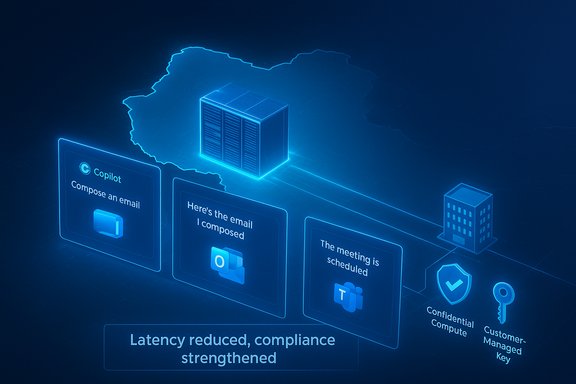
- In‑country processing for Copilot interactions: Prompts, model inferences and responses, and the telemetry generated by interactive Copilot sessions can be routed to compute inside a specified country, rather than being processed in a remote region by default.
- Day‑one option model: Microsoft positions this as an option customers can choose — not a forced change — intended primarily to support government agencies and highly regulated industries that require tighter jurisdictional control.
- Performance benefit: Local processing reduces round‑trip latency and can materially improve responsiveness for interactive features such as meeting summarisation and in‑app assistance. Microsoft explicitly calls out improved responsiveness as a key advantage.
Countries and timeline (as publicly reported)
- By end of 2025: Australia, India, Japan, United Kingdom.
- Expansion in 2026 reported to include: Canada, Germany, Italy, Malaysia, Poland, South Africa, Spain, Sweden, Switzerland, United Arab Emirates, United States.
Why this matters: compliance, latency and procurement
Compliance and procurement
For public‑sector bodies and regulated enterprises (banking, healthcare, critical infrastructure), the location of processing is often a gating factor in procurement. In‑country processing addresses a large portion of the jurisdictional objection: if inference and telemetry remain inside national borders under routine conditions, the scope for foreign legal process to compel access is narrowed compared with cross‑border processing models. That change alone can accelerate approvals and unblock pilots that were previously stalled on residency grounds.Performance and user experience
Generative‑AI interactions are latency‑sensitive. Local routing typically reduces round‑trip times by tens to low hundreds of milliseconds in many scenarios, which can be the difference between a smooth, adoptable Copilot experience and one that users find slow or frustrating. Faster, more responsive Copilot features will likely increase adoption inside knowledge workflows and collaborative meetings.Ecosystem effects
An onshore processing option creates market opportunity for local systems integrators, managed service providers and resellers who can package compliance‑focused landing zones, connectivity, attestation services and operational support for regulated deployments. It also creates extensions for Microsoft’s partner ecosystem to deliver independent verification and assist procurement teams with day‑one testing and attestation requests.Technical and contractual contours every buyer must verify
Providing an “in‑country” option is a headline promise; the implementation details decide risk transfer. IT leaders and legal teams must secure written, enforceable answers to the following points before routing regulated workloads to Copilot.1. Day‑one service inventory and feature parity
Insist on a written day‑one inventory that itemises which Microsoft 365 Copilot features will be processed locally at launch, and which features — if any — will be phased in later. Not all Copilot capabilities or supporting Azure services may be available on day one, and missing features can force selective off‑ramping or cross‑border fallback.2. GPU families, VM SKUs and hardware availability
Generative‑AI inference is hardware‑sensitive. If a local Azure region lacks the GPU families or VM SKUs required for certain Copilot inference workloads, Microsoft may route those specific inference operations to other regions — which defeats the in‑country promise for those workloads. Demand a GPU SKU inventory and a roadmap for capacity expansion.3. Networking and predictable routing
For interactive Copilot use cases, predictable latency matters. Get details on ExpressRoute or private peering options, PoP locations, and routing SLAs. Public internet paths are often insufficiently consistent for production SLAs on interactive AI.4. Key management and confidential compute
Negotiate access to confidential compute and the ability to use customer‑managed keys (CMKs) if policy requires cryptographic control. The ability to hold keys and control decryption materially reduces the risk of extraterritorial disclosure. Define key custody, key escrow policies and how Microsoft will respond to lawful requests for keys.5. Definition, retention and redaction of interaction data
Ask for an explicit definition of what constitutes “Copilot interaction data” (prompts, responses, embeddings, telemetry, logs), default retention windows, redaction options and how these integrate with Microsoft Purview for eDiscovery and legal hold. Without fine‑grained retention and redaction controls, regulatory benefits are attenuated.6. Exception handling and fallback behaviour
Contracts must specify the exact conditions under which processing may be routed outside the country (security incidents, disaster recovery, capacity constraints), plus notification triggers and remediation steps. A public statement without contractual exception definitions is insufficient for high‑risk deployments.Market context and why India was on the early priority list
India has become a strategic market for hyperscalers, driven by rapid digital adoption, a huge developer base and strong public and private demand for cloud and AI services. Microsoft has publicly committed major capital and skilling investments in India and is expanding Azure region capacity to serve the market’s AI needs. Independent industry estimates point to very rapid growth in India’s data‑centre capacity (widely quoted projections move from roughly 1.2 GW today toward multi‑gigawatt footprints by 2030), which makes in‑country AI processing technically feasible and commercially sensible. These investments in local compute, networking and partner programs are the physical bedrock that enables a credible in‑country Copilot processing option. Treat GW and capacity forecasts as market context and projections rather than contractual guarantees.Risks and limits: what in‑country processing does not solve
- Domestic lawful access remains real. In‑country processing reduces exposure to foreign jurisdictions but increases exposure to the country’s own legal process. Customers seeking absolute immunity from third‑party access must negotiate cryptographic controls or alternative architectures.
- False assurance about model risk. Localisation does not remove generative‑AI hazards — hallucination, IP derivation, and inadvertent leakage remain risks that require governance: human‑in‑the‑loop checks, DLP, Purview classification and operational gating for high‑impact outputs.
- Feature parity and phased rollouts. Some Copilot features or dependent Azure services may be phased, creating a mismatch between expectation and capability on day one. Verify the roadmap.
- Vendor concentration and lock‑in. Moving a whole productivity and AI stack onshore with a single hyperscaler simplifies operations but increases exit friction. Negotiate data export mechanics, verifiable exit playbooks and migration SLAs.
A practical procurement and IT checklist
Below is a prescriptive checklist IT, procurement and legal teams should use when evaluating an in‑country Copilot processing offer.- Request a written day‑one service inventory and a feature parity roadmap.
- Obtain a GPU/VM SKU matrix for the local Azure region and a capacity expansion roadmap.
- Require CMK support and confidential compute options; define key custody and access procedures under lawful requests.
- Secure private connectivity (ExpressRoute) designs and latency SLAs for interactive workflows.
- Insist on sample contractual schedules that define exceptions, notification obligations and remediation steps.
- Demand third‑party attestations and day‑one audit packages (SOC 2, ISO 27001) for the local datacenter.
- Pilot with non‑mission‑critical data for 4–8 weeks to validate latency, feature behaviour and governance integrations.
- Negotiate exit mechanics and SLAs for data export and independent verification of migrated archives.
- Establish a Copilot Centre of Excellence (legal, security, procurement, business) to govern prompt engineering, connectors, DLP and continuous auditing.
What this means for Windows‑focused IT teams and enterprise adopters
For organisations that build on Windows endpoints, Microsoft 365 apps and Microsoft identity controls, in‑country Copilot processing can be integrated into existing governance frameworks built around Microsoft Entra, Purview and endpoint management. That integration path reduces operational friction: existing DLP and compliance tooling can be extended to manage what Copilot is allowed to see and output. However, teams must still test end‑to‑end scenarios: meeting summarisation inside Teams, in‑app Copilot prompts in Word and Excel, and agentic flows in Power Platform to ensure the user experience and audit trails behave as expected under local processing conditions.Strategic assessment — strengths, opportunities and hazards
Strengths
- Tangible governance improvement that materially addresses procurement and regulatory objections in many markets.
- Performance uplift for latency‑sensitive interactions, improving perceived responsiveness and adoption.
- Unified vendor stack that simplifies integration when identity, compliance and AI are managed within a single platform.
Opportunities
- Faster Copilot adoption in government, financial services and healthcare where residency concerns blocked earlier pilots.
- Local partner growth: managed services and attestation offerings will become valuable intermediaries for regulated buyers.
Hazards
- Headline promises vs. binding language: public announcements without contractual schedules leave customers exposed to exceptions and fallbacks.
- Domestic legal exposure: onshore processing does not eliminate lawful domestic access.
- Operational surprises: missing GPUs, phased features or undocumented fallback routing can erode the expected control.
Final verdict and recommended next actions
Microsoft’s move to offer in‑country Copilot processing is a strategically necessary evolution that aligns a flagship generative‑AI product with real procurement realities in regulated markets. The promise is meaningful: improved governance posture for many buyers and better user experience thanks to lower latency. Equally clear is that the announcement is the start of a procurement journey rather than the end of one.Recommended next steps for organisations considering onshore Copilot:
- Treat public timetables as invitations to validate, not as automatic contractual guarantees. Obtain day‑one inventories and sample contract schedules that define exceptions and notification procedures.
- Pilot deliberately: measure UX improvements, validate audit trails, and stress‑test fallback handling with non‑sensitive data.
- Lock down cryptographic controls where policy needs them: CMKs and confidential compute are the strongest technical protections against unwanted disclosure.
- Require ongoing attestation and transparent notification if Microsoft invokes any routing exception that moves data outside the country.
Source: Argus English https://argusenglish.in/national/mi...copilot-data-processing-in-india-by-2025-end/
