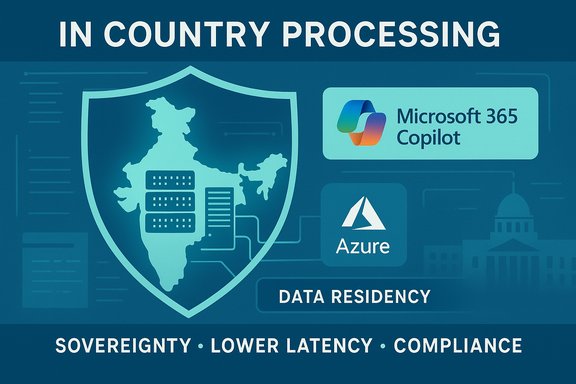
Microsoft’s latest push to give customers more control over where AI work happens marks a pragmatic — and politically sensitive — step toward making generative AI acceptable to highly regulated organisations, but the announcement leaves important technical, contractual, and governance questions unresolved.
Microsoft has been steadily folding generative AI into the Microsoft 365 ecosystem under the Microsoft 365 Copilot brand while simultaneously extending its data residency commitments for core Microsoft 365 workloads. Microsoft publicly added Copilot interaction data to its Product Terms commitments in 2024 and has documented routing and residency behaviours for Copilot, the EU Data Boundary, and Advanced Data Residency options for customers with stringent localization needs. In late 2025 Microsoft and local partners began announcing in‑country processing options for Copilot interactions in select markets. Public materials make two consistent claims: (1) processing Copilot interaction data locally can strengthen governance and regulatory compliance for government and regulated industries, and (2) local processing often reduces latency and improves performance for interactive features. Microsoft’s regional press materials and independent reporting confirm an October 2025 UAE deployment plan and describe similar country-focused initiatives in Asia-Pacific and Europe. The recent media item the industry is citing reports that Microsoft will offer in‑country processing for Microsoft 365 Copilot interactions in India (and a small set of other countries) by the end of calendar year 2025, with a broader expansion to eleven additional countries in 2026. That media report is the starting point for this analysis; where company statements or primary Microsoft documentation are available they are used to verify the claims and highlight gaps.
For organisations in regulated industries, the pragmatic next step is disciplined validation: demand day‑one inventories, independent attestations, and explicit contractual language on key management and lawful access before moving production workloads to any in‑country Copilot offering. The promise is real; the implementation details will decide whether the promise delivers the compliance and trust organisations require.
Source: LatestLY Microsoft To Offer In-Country Copilot Data Processing in India by End of 2025 To Enhance Customer Control Over AI Data | LatestLY
 Background
Microsoft has been steadily folding generative AI into the Microsoft 365 ecosystem under the Microsoft 365 Copilot brand while simultaneously extending its data residency commitments for core Microsoft 365 workloads. Microsoft publicly added Copilot interaction data to its Product Terms commitments in 2024 and has documented routing and residency behaviours for Copilot, the EU Data Boundary, and Advanced Data Residency options for customers with stringent localization needs. In late 2025 Microsoft and local partners began announcing in‑country processing options for Copilot interactions in select markets. Public materials make two consistent claims: (1) processing Copilot interaction data locally can strengthen governance and regulatory compliance for government and regulated industries, and (2) local processing often reduces latency and improves performance for interactive features. Microsoft’s regional press materials and independent reporting confirm an October 2025 UAE deployment plan and describe similar country-focused initiatives in Asia-Pacific and Europe. The recent media item the industry is citing reports that Microsoft will offer in‑country processing for Microsoft 365 Copilot interactions in India (and a small set of other countries) by the end of calendar year 2025, with a broader expansion to eleven additional countries in 2026. That media report is the starting point for this analysis; where company statements or primary Microsoft documentation are available they are used to verify the claims and highlight gaps.What Microsoft is promising — the headline offer
- Microsoft is positioning an option for customers to have Copilot interaction data (prompts and responses) processed and stored inside a customer’s national borders under “normal operations.” This is distinct from mere storage-at-rest guarantees; it’s an operational routing promise for processing of Copilot interactions.
- The announced UAE program confirms a model where qualified organisations can route Copilot interactions to local Azure regions (Dubai and Abu Dhabi) beginning in early 2026; Microsoft has published regional announcements and local partner messaging about eligibility and timetables for that market.
- Media reports claim that Microsoft will make in‑country processing available in Australia, the United Kingdom, India, and Japan by the end of 2025, and then expand the option in 2026 to Canada, Germany, Italy, Malaysia, Poland, South Africa, Spain, Sweden, Switzerland, the United Arab Emirates and the United States. The list and timeline have been widely circulated in news feeds but are not uniformly documented in a single Microsoft global press release at the time of writing; the UAE announcement is the clearest primary confirmation so far. Where the vendor’s public documentation exists it shows Copilot has been incorporated into M365 data‑residency commitments that Microsoft has been expanding since 2024. Treat the country-by-country timetable reported by third-party outlets as plausible and consistent with Microsoft’s regional rollouts, but verify with Microsoft account teams before procurement.
Why this matters: compliance, performance, procurement
Data residency vs in‑country processing — subtle but important distinction
- Data residency typically means customer data at rest (e.g., mailbox, files) is stored in a datacenter located in a specified country or region. Microsoft has long offered product‑level residency commitments for Exchange, SharePoint, Teams and — since March 2024 — Copilot interaction contents are included in those data residency commitments for many countries.
- In‑country processing goes further: it means that not only is the stored content in‑country, but the live processing of Copilot interactions (model inference, prompt handling, response generation, telemetry processing) occurs inside the nation’s borders under normal operations. That reduces cross‑border flows and narrows the set of jurisdictions that could lawfully access those interaction records, which is critical for regulated public sector and financial workloads. However, in most listable exceptions (security incidents, capacity constraints) some outside‑region routing may still occur under documented exceptions — these are contract terms CIOs must confirm.
Latency and UX
Local processing can materially reduce round‑trip latency for interactive Copilot experiences (e.g., Teams meeting notes, real‑time summarisation, Office agent prompts). For users in interactive workflows a 50–200ms reduction can change perceived responsiveness and adoption rates. Microsoft explicitly frames improved responsiveness as an advantage of in‑country processing.Procurement friction removed — but not eliminated
Local processing options lower legal friction for procurement in jurisdictions with data sovereignty rules. They can also shorten procurement negotiation cycles for government and regulated industries. That said, procurement must still secure written definitions of eligibility, detailed service inventories, and explicit contractual language about exception handling and lawful requests. Independent attestations and audit rights remain crucial.Verification: what’s confirmed and what remains unverified
Confirmed (primary sources)
- Microsoft added Copilot interaction data to Microsoft 365 data residency commitments in 2024 and documents residency and routing behaviour in Microsoft 365 product documentation. This is a firm product‑term change and forms the legal foundation for any in‑country processing option.
- Microsoft announced a UAE‑specific in‑country Copilot processing offering with availability planned for early 2026 and hosting within Dubai and Abu Dhabi regions; Microsoft and UAE authorities publicly commented on that program. This announcement is a primary, verifiable Microsoft regional press release.
- Microsoft is investing heavily in India and other global regions (including a multibillion‑dollar India investment announced earlier in 2025) and continues to expand Azure region availability and AI‑ready data center capacity. These investments underpin the feasibility of regional Copilot processing.
Reported but not independently confirmed by a single Microsoft global release
- The specific claim that “by the end of calendar year 2025 customers in Australia, the United Kingdom, India, and Japan will have the option for Copilot interactions to be processed within their national borders” originates in third‑party media coverage. Independent Microsoft documentation confirming that exact 2025 timetable for those four countries (and the 2026 expansion list that includes the United States) was not located in a single official Microsoft global announcement at the time of reporting. The UAE 2026 date is confirmed; the broader list appears consistent with Microsoft’s regional rollouts but should be validated directly with Microsoft account teams and contract language before assuming day‑one availability in any jurisdiction. This is an important procurement caveat.
Technical contours: what organisations must verify before buying
In‑country Copilot processing at production grade requires multiple on‑day‑one conditions. Organisations should demand a day‑one checklist from Microsoft and include it in procurement schedules.- Region & service inventory
- Verify which Azure regions and Availability Zones will host the Copilot processing plane on day one and which Microsoft 365 Copilot features are available locally. Some Copilot features may be phased.
- GPU and instance SKUs
- Confirm which GPU families and VM SKUs are available locally. AI workloads are hardware‑sensitive; missing GPU SKUs could push inference outside the country.
- Private connectivity and predictable networking
- Ensure ExpressRoute / private peering options, latency guarantees, PoP locations, and network SLAs to support interactive workloads.
- Confidential compute and key management
- Request confidential compute options and the ability to use customer‑managed keys (CMKs) if required by policy. Define who holds the keys and how access is controlled under lawful request scenarios.
- Logging, auditability and retention controls
- Get a precise definition of “Copilot interaction data” (prompts, responses, telemetry, logs) and verify retention policies, redaction options, and Purview integration for legal hold / eDiscovery.
- Day‑one attestations and audits
- Insist on SOC/ISO reports, third‑party attestation of the local datacenter security posture, and sample contractual schedules that commit to in‑country processing with defined exceptions.
Governance and legal risks — what winning in‑country processing does not solve
- Local processing reduces exposure to foreign jurisdictions but does not eliminate domestic lawful access. Local hosting makes data accessible to that nation’s legal process; that is a feature not a bug for procurement in many countries. Contracts should explicitly address how Microsoft will handle domestic lawful requests and whether customers retain cryptographic control.
- “In‑country processing” may be implemented with exceptions for security incidents, high‑utilisation routing, or disaster recovery. These exceptions must be spelled out in the contract. A headline residency promise without binding exceptions is insufficient for regulated workloads.
- Vendor concentration: bringing Copilot and the rest of the productivity stack onshore with a single hyperscaler improves operational simplicity but increases lock‑in risk. Procurement teams should negotiate data export, portability and exit mechanics.
- Model governance and hallucinations: even in‑country deployments do not remove inherent generative AI risks — hallucination, IP leakage, and derivation risks remain and must be mitigated through human‑in‑the‑loop controls, DLP, Purview classification, and operational gating for high‑impact outputs.
Practical checklist for IT leaders and procurement teams
- Request a day‑one service inventory listing:
- Which Copilot features are processed locally on day one?
- Which GPU families and Azure services are present?
- Get written eligibility criteria:
- Define “qualified organisation” precisely and demand a sample contract schedule that shows residency and processing guarantees.
- Secure cryptographic and key management commitments:
- Can customers use CMKs? Where are keys stored? What is Microsoft’s process for key escrow and lawful requests?
- Obtain audit and attestation packages:
- SOC 2, ISO 27001, penetration test reports, and third‑party attestations for local datacenter controls.
- Define exception handling and fallbacks:
- Under what exact conditions will data or processing leave the country? How will customers be notified?
- Pilot with non‑mission‑critical data:
- Validate latency, throughput and compliance controls before scaled rollout.
- Negotiate exit and portability mechanics:
- Include data export playbooks, SLAs for export time, and independent verification of exported archives.
- Instrument governance:
- Create a Copilot Centre of Excellence for prompt engineering, access control, DLP, and continuous auditing.
Market context and capacity — why India was singled out
India’s cloud and data‑centre market has been among the fastest growing globally and has seen major hyperscaler commitments in 2025. Microsoft announced a multibillion‑dollar investment in India for Azure and AI capacity, and independent market commentary estimates India’s installed data centre power capacity rising steeply toward 2030 — estimates range from roughly 1.2 GW today toward multi‑gigawatt footprints by decade’s end, with annual growth rates often quoted in the high single digits to double figures. These capacity expansions are the physical backbone enabling in‑country AI processing scenarios. That market context explains why India appears on Microsoft’s early priority list for regional Copilot processing options. Caveat: capacity forecasts vary by source and methodology; references to specific GW numbers (for example “1.2 GW to 8 GW by 2030”) reflect independent industry estimates and should be treated as projections rather than precise contractual guarantees.Strategic assessment: strengths, opportunities, and hazards
Strengths
- Tangible governance improvement: routing Copilot processing in‑country addresses one of the most common procurement objections for regulated public sector customers.
- Performance boost: local processing lowers latency for highly interactive Copilot experiences, improving end‑user adoption.
- Vendor coherency: Microsoft can present a unified stack (Entra identity, Purview, Copilot, Azure) with consistent governance primitives, which reduces integration complexity for in‑country deployments.
Opportunities
- Faster adoption in regulated sectors: ministries, banks and healthcare systems that previously paused pilots due to residency concerns may now accelerate Copilot rollouts.
- Local partner ecosystem: in‑country processing will create business opportunities for system integrators, sovereign cloud partners, and managed security providers who can supply validated solutions and attestations.
Hazards and unknowns
- Contract gap risk: headline residency claims without binding contractual provisions on exceptions, lawful requests, and key management create legal risk.
- Feature parity risk: regional rollouts frequently arrive in phases; missing GPU SKUs or absent Copilot features on day one may force fallback to cross‑border processing for specific workloads.
- False assurance risk: in‑country processing reduces but does not eliminate data access risk — domestic legal access remains and must be explicitly addressed.
Recommendations for Windows‑focused IT teams and WindowsForum readers
- Treat the vendor messaging as an option, not an automatic change to your tenant. Confirm day‑one service inventories before switching regulated workloads to Copilot.
- For Windows‑centric deployments (Windows endpoints, Microsoft 365 apps), test the full end‑to‑end user experience: Copilot responses inside Office apps, meeting summarisation in Teams, and agent‑driven workflows in Power Platform.
- Use the Microsoft Purview and DLP toolchain to classify and block sensitive connectors and sources from feeding Copilot without explicit approval.
- Run red‑team tests against agent workflows (Copilot Actions) and validate audit trails are complete and tamper‑evident.
- Negotiate explicit exit and export mechanics so tenant data can be migrated on demand in a verifiable and timely way.
Conclusion
Microsoft’s move to offer in‑country Copilot processing is a strategically necessary evolution: it aligns product design with the procurement and regulatory realities organisations face when adopting generative AI. The UAE announcement in October 2025 provides a clear prescriptive precedent; broader claims about expanded availability in late 2025 and 2026 are consistent with Microsoft’s regional expansion strategy but require confirmation with account teams and contract schedules. Technical readiness — region SKUs, GPU availability, confidential compute and private connectivity — and legally binding contractual exceptions will determine whether in‑country Copilot processing meaningfully reduces risk for a given organisation.For organisations in regulated industries, the pragmatic next step is disciplined validation: demand day‑one inventories, independent attestations, and explicit contractual language on key management and lawful access before moving production workloads to any in‑country Copilot offering. The promise is real; the implementation details will decide whether the promise delivers the compliance and trust organisations require.
Source: LatestLY Microsoft To Offer In-Country Copilot Data Processing in India by End of 2025 To Enhance Customer Control Over AI Data |
LatestLY