

India’s choice of a Republic Day Chief Guest is one of the most visible instruments of diplomatic signalling New Delhi deploys each year: the invitation, acceptance and the pageantry that follows are shorthand for priorities in trade, security, regional influence, and international alliance-building. This year’s decision — to invite Ursula von der Leyen, President of the European Commission, and António Costa, President of the European Council, to serve jointly as Republic Day 2026 chief guests — crystallises that approach. It is both an unprecedented protocol move and a carefully managed exercise in foreign policy messaging.
The Chief Guest at India’s Republic Day is accorded the highest protocol honours extended to foreign dignitaries during the national celebrations. The guest (traditionally a head of state, head of government, or — in recent, exceptional cases — leaders of international organisations) receives a Guard of Honour, participates in the parade review alongside the President of India, attends official state functions, and engages in scripted bilateral meetings and cultural events. The visit always has two faces: ceremonial theatre for domestic and global audiences, and a compact, high-value diplomatic mission where specific policy priorities are advanced.
Historically, the practice began in 1950 when President Sukarno of Indonesia attended India’s first Republic Day — an early signal of Nehru-era outreach and the nascent Non-Aligned Movement. Since then, invitees have ranged from neighbours to global powers, each pick reflecting India’s strategic emphasis at that moment. The 2026 decision to invite the leadership of the European Union together is the first time India has named two leaders from an international organisation jointly as chief guests — a break with the usual model in both symbolism and logistics.
A related point: the ET Now explanation the user provided follows the same conventional outline on selection mechanics — MEA coordination, PMO and President sign-off, ambassadorial checks and ceremonial roles — and aligns with independent reporting on the subject. Readers should treat media explanations as accurate summaries of public protocol, while recognising that classified background deliberations will remain out of public view.
At the same time, the novelty carries practical and political challenges. Protocol adjustments, legal distinctions between institutional and state-level agreements, and the expectation-management necessary to avoid overpromising are real concerns. Measured diplomacy in the months after the visit will determine whether the Republic Day platform translates into durable policy outcomes or remains primarily a high-profile symbolic success.
Source: ET Now Republic Day 2026: How is the chief guest selected? EXPLAINED
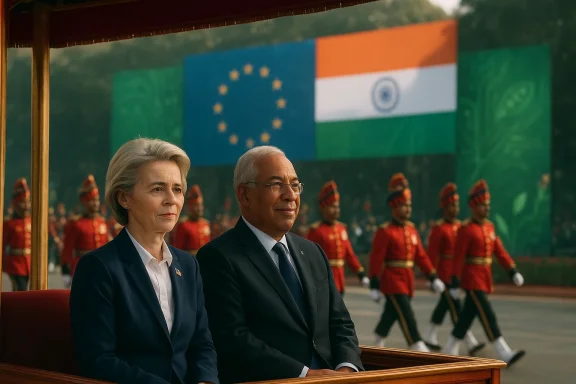 Background: what the Republic Day chief guest role means
The Chief Guest at India’s Republic Day is accorded the highest protocol honours extended to foreign dignitaries during the national celebrations. The guest (traditionally a head of state, head of government, or — in recent, exceptional cases — leaders of international organisations) receives a Guard of Honour, participates in the parade review alongside the President of India, attends official state functions, and engages in scripted bilateral meetings and cultural events. The visit always has two faces: ceremonial theatre for domestic and global audiences, and a compact, high-value diplomatic mission where specific policy priorities are advanced. Historically, the practice began in 1950 when President Sukarno of Indonesia attended India’s first Republic Day — an early signal of Nehru-era outreach and the nascent Non-Aligned Movement. Since then, invitees have ranged from neighbours to global powers, each pick reflecting India’s strategic emphasis at that moment. The 2026 decision to invite the leadership of the European Union together is the first time India has named two leaders from an international organisation jointly as chief guests — a break with the usual model in both symbolism and logistics.
Overview: who decides, and when the decision is taken
The lead role: Ministry of External Affairs (MEA)
The MEA coordinates the entire selection process. In practice, the MEA prepares options and options analyses for the Prime Minister’s Office (PMO), seeking political sign-off and concurrence from the President’s office for the formal invitation to be issued in the President’s name. The MEA’s work includes internal inter-agency consultations, risk assessments, and practical checks through India’s diplomatic missions abroad. These are not casual exchanges; the process is planned months in advance. Multiple explanatory accounts and reporting peg the typical lead time at roughly six months before January 26.Who signs off
The selection is effectively multilayered:- MEA drafts and prioritises candidate names and rationales.
- The PMO reviews, adds political and tactical filters, and often sets the guiding objectives (trade, defence, technology, regional balance).
- The President’s office signs the formal invitation when the invitee is finalised and available.
This trilateral flow — MEA → PMO → President — is the long-established architecture for ceremonial and diplomatic protocol.
Key considerations in selecting a Chief Guest
The MEA and the political leadership balance numerous factors when deciding who to invite. These include, but are not limited to:- Diplomatic importance and bilateral ties: Countries with substantial or emerging strategic partnerships with India (defence ties, trade partners, technology cooperation) are prioritised. Invitations can accelerate negotiations or symbolically consolidate agreements already in progress.
- Regional and global context: India frequently uses the platform to reinforce ties with neighbours, the Global South, and global governance partners — depending on what message New Delhi wants to send that year.
- Anniversaries and diplomatic milestones: Key anniversaries of diplomatic relations or recent landmark agreements may tip the scale toward a particular partner. An invitation becomes a way to underline or commemorate those milestones.
- Practical availability: Indian ambassadors discreetly check whether prospective invitees are free on January 26. Heads of state and government have packed calendars, and scheduling constraints can be decisive. This practical step often narrows a shortlist to one final nominee.
- Domestic political considerations: While the decision is primarily diplomatic, domestic political optics — how a choice will be perceived by Parliament, stakeholders, and the public — also factor into the calculus. This is especially true if the pick could trigger contentious debates about foreign policy direction or economic competition.
The 2026 selection: what’s new and why it matters
India’s invitation to the European Union’s leadership — Ursula von der Leyen (Commission President) and António Costa (European Council President) — is notable on several counts.- It is the first time India has jointly invited leaders of an international organisation to stand as Chief Guests, rather than a single head of state or government from a specific country. That choice signals a strategic tilt toward institution-level engagement with the EU as a bloc, rather than to a single EU member state.
- The move underscores India’s prioritisation of deeper engagement on trade, technology rules, regulatory cooperation (notably on data and AI), and climate. The EU is a regulatory heavyweight and a major trade and investment partner; the joint invitation amplifies India’s intent to treat the EU as a consolidated strategic interlocutor.
- Protocol innovation: the EU leadership does not represent a single sovereign state, so protocol required (banquets, state meetings, bilateral instruments) needs custom handling — a nuanced blend of state-level reception and institutional-level engagement that will require diplomacy and meticulous scheduling.
What happens after the selection: logistics, protocol and agenda-setting
Once the MEA, PMO and the President agree on an invitee and secure availability, a predictable sequence follows:- The formal invitation is extended in the President’s name; acceptance is confirmed through diplomatic channels.
- Detailed protocol planning begins: security, motorcade routes, residency at official guest houses, and ceremonial choreography (Guard of Honour, parade review, wreath-laying). The President’s secretariat, MEA, and Home Ministry coordinate closely with local authorities in Delhi.
- A bilateral agenda is developed: senior ministers and officials from both sides map out priorities for meetings, including a leaders’ summit, ministerial-level discussions on trade, defence, technology, and side events aimed at business and civil society. For the EU visit, that included scheduling the India–EU leaders’ summit around the Republic Day dates.
- Public communications and media management plan the narrative: state receptions, cultural programmes, and bilateral briefings present the visit as both ceremonial celebration and substantive diplomacy.
Ceremonial roles and expectations during the visit
The Chief Guest’s public itinerary follows a standard protocol pattern that merges ceremony and statecraft:- Review the Republic Day parade with the President of India and receive the Guard of Honour.
- Attend a state banquet hosted by the President and a lunch hosted by the Prime Minister.
- Lay a wreath at Raj Ghat (in memory of Mahatma Gandhi).
- Participate in bilateral meetings and a leaders’ summit where heads discuss shared priorities — trade, security cooperation, technology, climate, and people-to-people ties.
Strengths and strategic upside of the India–EU chief guest arrangement
Inviting the EU leadership as chief guests carries several immediate diplomatic advantages:- Signals institutional commitment: India positions the EU not just as a collection of states but as a strategic regulatory and economic partner. This is an important reframing for trade talks, standards diplomacy (data, AI, semiconductors), and joint global governance.
- Leverage for trade and investment: The Republic Day platform creates an auspicious context to accelerate trade negotiations, deepen investment flows, and showcase India as an EU-investment destination. State-level receptions and business roundtables make this a high-visibility economic push.
- Multilateral signalling: With tensions in multiple geopolitical theatres, a consolidated India–EU message can amplify cooperation in climate action, digital governance, and rules-based trade. The joint visit lets both sides emphasise shared values and policy alignment.
Risks, caveats and diplomatic complexity
The same novelty of the joint EU invitation introduces a set of risks and complications that merit close scrutiny.- Protocol ambiguity and representational clarity: The EU leadership does not speak for a single sovereign polity in the way a president or prime minister does. That raises questions about the legal and political instruments India and the EU can sign during the visit. Treaties and defence pacts are state-to-state instruments; institutional agreements have a different legal standing. Managing expectations from businesses and domestic constituencies requires careful messaging.
- Domestic political optics: Critics may ask why India did not invite a head of state from an individual country, especially if a bilateral issue with a single state needed emphasis. Political commentators and opposition parties could interpret this as a departure from a country-first diplomacy model.
- Operational complexity: Security and logistics are more complicated when two high-profile international leaders with overlapping but distinct mandates arrive together. The MEA, Home Ministry and Delhi security apparatus must coordinate an unusually dense sequence of ceremonial and functional events.
- Expectation-management on deliverables: The Republic Day stage creates pressure to produce headline outcomes. But the depth of regulatory alignment and trade talks with the EU can take months or years; promising more than what can be delivered in a 48–72 hour visit risks reputational disappointment. Readers should onial optics are immediate, substantive policy changes require follow-up work.
What the 2026 guests concretely bring to the table
Ursula von der Leyen and António Costa sit at the intersection of Europe’s executive and political leadership. Their presence enables New Delhi to:- Push on regulatory cooperation in digital and AI governance where the EU has been influential, potentially creating space for interoperability or mutual recognition frameworks.
- Heighten trade and investment conversations with a unified EU interlocutor rather than negotiating member-by-member.
- Create political momentum ahead of larger multilateral meetings (G20, UN forums) by projecting a more coherent India–EU front on economic and security issues.
How to read this choice: a short diplomatic primer
- Short-term message: India wishes to elevate its relationship with the EU as a unified economic and regulatory partner rather than transact purely with individual member states. This supports India’s broader ambitions to secure investment, high-tech collaboration, and regulatory space for its digital economy.
- Medium-term work: Exchanging ceremonial goodwill for real policy outcomes will require follow-up work in trade liberalisation talks, mutual recognition on standards, and aligned regulatory approaches on emerging tech. Expect months of negotiations and inter-agency working groups after the visit.
- Watchpoints: Monitor the communiqués and joint statements issued during the visit for concrete commitments — not just ceremonial language. These will show whether the visit was symbolic or the start of binding cooperation.
Transparency and verification: what is and isn’t public
Many procedural details of chief-guest selection are not visible in the public record because they are handled through diplomatic channels and internal deliberations. The broad contours — MEA leadership, PMO approval, President’s formal invitation, ambassadorial availability checks — are consistently reported across independent outlets and MEA practice. The specific private deliberations, security assessments, and strategic briefings are typically classified or internal until and unless officials choose to disclose them. Where media reports attribute specifics (timelines, internal priorities), cross-checking against more than one reputable source is the prudent journalistic standard.A related point: the ET Now explanation the user provided follows the same conventional outline on selection mechanics — MEA coordination, PMO and President sign-off, ambassadorial checks and ceremonial roles — and aligns with independent reporting on the subject. Readers should treat media explanations as accurate summaries of public protocol, while recognising that classified background deliberations will remain out of public view.
What to expect in Delhi around Republic Day 2026 (practical notes)
- Dates and timing: The Republic Day main parade happens on January 26; chief-guest arrivals typically span January 24–27, allowing for leaders’ summits and state events in that window. For 2026 the EU leaders’ visit was scheduled around January 25–27.
- Public programming: Expect a leaders’ summit, business roundtables with CEOs from India and Europe, cultural programmes showcasing people-to-people ties, and side-events aimed at deepening parliamentary and civil-society linkages.
- Media and messaging: Both governments will use joint statements and photo-ops to foreground sectors where fast progress is possible — green technologies, trade facilitation, mobility of professionals, and research collaboration. Keep an eye on any specific MoUs announced; they are the closest thing to immediate deliverables on such fast visits.
Final assessment — strategic and journalistic takeaways
Inviting the EU leadership as Republic Day chief guests is an elegant piece of diplomatic choreography. It performs several functions simultaneously: it elevates India–Europe ties, it brands India as open to institution-level engagement, and it hands New Delhi an amplified negotiating table for trade and regulation. Symbolically, it repositions India from bilateral partner to a peer-level interlocutor for a deeply interconnected political-economic bloc.At the same time, the novelty carries practical and political challenges. Protocol adjustments, legal distinctions between institutional and state-level agreements, and the expectation-management necessary to avoid overpromising are real concerns. Measured diplomacy in the months after the visit will determine whether the Republic Day platform translates into durable policy outcomes or remains primarily a high-profile symbolic success.
Conclusion
The Republic Day chief-guest selection process is a modest mirror of India’s foreign-policy priorities: it is bureaucratically led by the MEA, politically ratified by the PMO and finalised through the President’s office, and constrained by practical availability and strategic aims. The 2026 decision to host Ursula von der Leyen and António Costa together marks a deliberate shift toward institution-led engagement with the EU and illustrates how ceremonial occasions serve as instruments of high-stakes diplomacy. Whether that signal converts into swift policy change will depend on follow-through in trade negotiations, regulatory cooperation and bilateral mechanisms — the substantive work that begins after the Guard of Honour is dismissed.Source: ET Now Republic Day 2026: How is the chief guest selected? EXPLAINED