

The Indian government has issued a sweeping directive that will force popular messaging platforms to remain continuously bound to the physical SIM card used at registration and to force web/desktop sessions to re‑authenticate at short intervals — a change that promises stronger traceability against cross‑border fraud but will also reshape daily workflows for millions of users and create sizable technical, privacy and business headaches for app vendors.
On November 28 the Department of Telecommunications (DoT) issued directions under the Telecommunication Cybersecurity rule‑set that classify app‑based messaging services which use mobile numbers as Telecommunication Identifier User Entities (TIUEs) and require immediate technical controls to keep those services linked to the device’s active SIM. Affected platforms named in the DoT notice include WhatsApp, Telegram, Signal, Snapchat, ShareChat, JioChat, Josh and several regional players. The core operational requirements are blunt and concrete:
The Department of Telecommunications’ instruction is consequential, deliberate and immediate: the technical and policy choices made during the compliance window will shape how citizens, startups and global platforms interact in India for years to come.
Source: The Indian Witness WhatsApp Web to Log You Out Every 6 Hours: New DoT Rules Force SIM Binding on Telegram, Signal Too
 Background / Overview
On November 28 the Department of Telecommunications (DoT) issued directions under the Telecommunication Cybersecurity rule‑set that classify app‑based messaging services which use mobile numbers as Telecommunication Identifier User Entities (TIUEs) and require immediate technical controls to keep those services linked to the device’s active SIM. Affected platforms named in the DoT notice include WhatsApp, Telegram, Signal, Snapchat, ShareChat, JioChat, Josh and several regional players. The core operational requirements are blunt and concrete:- Within 90 days platforms must ensure the app cannot be used on a device unless the same, active SIM used for identification is present in that device.
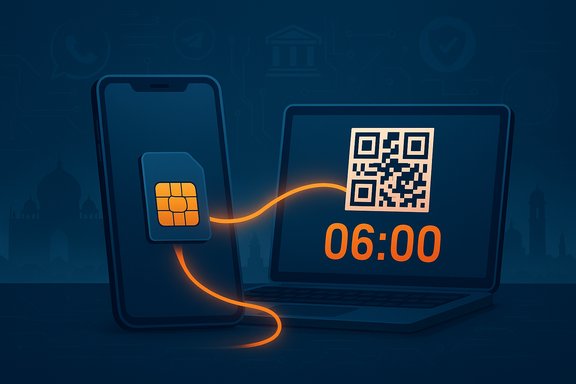
- Web and desktop instances of the service must be configured to auto‑logout periodically — not later than every six hours — and permit re‑linking only by scanning a QR code from the device that has the active SIM.
- All TIUEs must file compliance reports within 120 days, with non‑compliance opening the door to action under the Telecommunications Act, 2023 and the Telecommunication Cybersecurity Rules (as amended).
Why the DoT moved — the stated rationale
The DoT frames this as a targeted response to traceability gaps created by the way many OTT messaging services currently operate. In the prevalent verification model, a phone number is linked to an account via a one‑time OTP or voice verification and thereafter a token grants continued access even if the original SIM is removed, swapped, or becomes inactive. The DoT says that behaviour has been exploited by remote actors and cross‑border fraud rings, where persistent sessions without a tied SIM create difficulties for investigation and enable fraudulent activity. Tying a session’s lifecycle to a physical SIM is intended to restore a direct mapping from telephone identifier → device → person during incident response. That same rationale echoes long‑standing industry concerns: mobile numbers are often the weakest link in transaction authentication, and SIM swap or cloning attacks are a known vector for fraud. By demanding continuous SIM‑to‑device linkage and frequent web revalidation, regulators hope to reduce the window for impersonation and improve the evidentiary chain in cybercrime investigations.The legal and regulatory frame: TIUEs, Telecom Cybersecurity Rules and the Telecommunications Act
The DoT’s directions invoke the Telecommunication Cyber Security / Telecom Cybersecurity amendments and the new Telecommunications Act, 2023 as the enforcement basis. The TIUE concept is central: by defining certain app providers as users of telecommunication identifiers (mobile numbers) the DoT gives itself authority to issue directions that resemble those it would give licensed telecom operators. Media reporting shows the regulatory text was updated across 2024–2025 and the DoT reaffirmed the amended rules recently, complicating the timeline of notifications. Readers should note that some coverage refers to the Telecom Cyber Security Rules, 2024 (as amended), while other accounts describe October 2025 amendments and a November 27 clarification about duplicate notifications — the legal chronology is therefore nuanced and evolving. This regulatory reframing — treating OTT apps that rely on mobile identifiers as entities subject to telecom‑grade directions — is consequential because it moves large, global app providers into a regulatory regime historically applied only to network operators and licensed equipment providers. That shift, even if limited to specific technical obligations, raises compliance, procedural and constitutional questions that will be litigated and negotiated in the weeks ahead.What the rules require in practical terms (technical breakdown)
The DoT's prescriptions are functional rather than prescriptive about exactly how to implement them. But the operational implications are clear and technically exacting:- Continuous SIM checks on mobile clients. Apps will need to verify — likely periodically and not only at install time — that the SIM currently present in the device corresponds to the registered mobile number. If not, the app must refuse to operate. Implementing this reliably across Android, iOS and other platforms requires careful use of device APIs and fallbacks for platform limitations.
- Short‑lived companion tokens for web/desktop. Web and desktop sessions will likely be reduced to short‑lived tokens that expire no later than six hours; resuming a session must require the SIM‑bearing phone to perform QR re‑linking. This in effect ends the “always‑on” desktop model many power users and enterprises depend on.
- Server‑side session revalidation. Platform backends must bind session validity to recent SIM presence attestations from the mobile client and drop or require revalidation of any session where the SIM check fails or times out.
- Mobile Number Validation (MNV) integration. The DoT’s rules contemplate using an MNV platform to validate whether a number is active and assigned to an operator at a point in time; platforms may be required to integrate with operator‑level validation services if mandated. The mechanics and cadence of MNV queries (privacy, rate limits, false positives) are open questions.
Immediate impact on users and workflows
For everyday consumers the change will be visible and sometimes painful:- Multi‑device users — people who switch SIMs, use a number on a secondary device, or rely on WhatsApp Web on a work PC — will see sessions drop more frequently and will need their phone with the registered SIM present to re‑link. Remote, long‑running desktop workflows and automation scripts that rely on persistent sessions will break.
- International travellers and dual‑SIM users — someone who travels internationally and temporarily uses a local SIM or removes their India SIM will lose access to apps that require the original SIM to be present. The DoT gives a 90‑day compliance window, but the transition will be bumpy.
- Enterprises and contact centres — businesses that run automated or unattended chatbots through conversational sessions may need to migrate to authenticated APIs or narrow usage models that are explicitly permitted. Long‑running business sessions that use phone‑number binding without authenticated accounts will be at risk.
- Accessibility and device edge‑cases — tablets, IoT devices, devices with eSIMs or special OS constraints may not expose a reliable SIM presence API; platform vendors will need exemptions, alternate attestations or fallbacks.
Security gains — what the measure fixes
There are measurable security benefits to binding session state to a physical SIM and shortening web sessions:- Reduces SIM‑swap exploitation windows. If session tokens are short‑lived and revalidation requires the SIM’s presence, attackers who gain control of a number via SIM swap have less time to abuse sessions.
- Improves traceability for investigations. Authorities can more reliably map a telephone identifier to the device that generated a session, which aids attribution in cross‑border fraud investigations.
- Aligns OTT services with telecom security expectations. The DoT argues this closes a regulatory asymmetry between operators and over‑the‑top providers that leverage mobile numbering without equivalent obligations.
Risks, trade‑offs and unintended harms
Security improvements come with concrete costs and hazards that must be acknowledged and mitigated:- Severe user friction. Frequent QR re‑linking and device‑bound sessions erode convenience and could reduce usage of legitimate services — especially for groups that depend on multi‑device access (small businesses, journalists, power users).
- Privacy and surveillance concerns. Continuous device binding increases the granularity of device‑level identifiers held by platforms and potentially by regulators if logs are requested, raising risks of function creep and surveillance. Privacy advocates will challenge the need for persistent device ties absent judicial oversight or narrow, transparent logging rules.
- Operational and engineering burden. Implementing robust SIM‑presence checks and a compliant MNV integration within 90 days at scale (hundreds of millions of devices) is a major engineering lift. Small vendors and startups may be disproportionately affected due to cost and testing overhead.
- Platform fragmentation and competition effects. The change advantages large, resource‑rich platforms that can fund rapid engineering and legal responses. Smaller players may exit or be forced to rearchitect toward account‑based models, raising competitive concerns.
- False positives and service loss. Network issues, operator reporting lags or eSIM edge cases could trigger wrongful session terminations, disrupting legitimate users. The DoT and operators must design robust mitigation and appeals processes.
How major platforms are likely to respond
Engineering, legal and policy responses will run in parallel:- Short term: Push client updates that implement periodic SIM checks and reduce web session lifetimes; use server‑side forced expirations and require QR re‑linking at the six‑hour boundary. Expect staged rollouts and region‑gated behaviours.
- Medium term: Move toward an account‑backed model — where the phone number is a recovery/verification factor but device authorization and session sync are driven by a cloud account (reducing dependence on SIM presence while meeting audit requirements).
- Regulatory engagement and pushback: Platforms and industry bodies (for example IAMAI and other trade groups) will press for clarifications, carve‑outs (travelers, enterprise deployments), and detailed technical guidance on acceptable implementations. Expect industry‑DoT dialogues within the 90‑day window.
Global context — is this common elsewhere?
At present, mandatory, continuous SIM‑binding for general messaging apps is not a widely adopted global standard; most jurisdictions regulate content, data retention and lawful access rather than forcing device‑level SIM presence for consumer messaging sessions. Indian telco operators and some national authorities have previously pushed for tighter coupling between numbers and identity — and DoT’s measure should be seen in that regulatory lineage — but the specific combination of continuous SIM linkage plus a six‑hour web logout is notable for its immediacy and strictness. Industry executives have already noted that such stringent SIM linkage remains uncommon globally, and that India’s approach may set a precedent.Questions the DoT and platforms must answer (open policy issues)
- What exactly qualifies as proof of compliance? Will the DoT require instrumented telemetry, test matrices, or attestation logs? The DoT’s notice sets objectives but does not prescribe a single technical approach.
- How will exceptions be handled for enterprise devices, tablets, eSIMs, and roaming users? Technical exemptions or alternate attestations (hardware‑backed keys) may be necessary.
- What privacy safeguards and retention limits will apply to SIM‑presence logs that platforms must keep for compliance? Without safeguards, these logs can become a surveillance vector.
- How will the MNV platform be governed (if used), and what are the cost, latency, and privacy implications of live operator checks?
Practical guidance — what users, enterprises and developers should do now
- Individual users: Expect more frequent QR re‑link prompts for web clients; keep your registered phone and SIM accessible when you use desktop sessions. Back up important chat history securely and consider account recovery options if you travel.
- Enterprises: Audit all workflows that depend on long‑running sessions or phone‑number only authentication. Migrate critical automations to authenticated APIs, implement fallbacks, and plan employee communications about new login expectations.
- Developers and startups: Implement short‑lived tokens, robust revalidation flows, and cross‑device recovery paths. Build test matrices across device types, OS versions and eSIM scenarios to document fallback behaviour for compliance reports.
- Privacy officers and civil‑society groups: Request clarity on data retention, audit access controls and oversight. Seek transparent compliance reporting templates and a public explanation of how logs will be protected from misuse.
What to watch next
- Platform responses: Watch how Meta/WhatsApp, Telegram and Signal publish technical changes, product notices and timing for region‑specific rollouts. Expect staged client updates and coordinated press statements.
- DoT follow‑up guidance: The DoT may issue technical clarifications, an MNV governance note, or compliance checklists that materially change implementation expectations; those clarifications will be decisive for operators and platforms.
- Litigation and policy pushback: Industry groups and privacy advocates may seek legal review or ask for carve‑outs for international travel, enterprise use, and accessibility scenarios.
- Real‑world disruption: Expect anecdotal reports of broken desktop sessions, travel‑related lockouts and enterprise integration failures during the rollout period; those reports will pressure both regulators and vendors to refine implementation details.
Final analysis — balancing security, convenience and rights
The DoT’s directive targets a real security gap: the decoupling of phone numbers from the devices that use them has been abused in high‑impact fraud and criminal schemes. By requiring continuous SIM binding and regular web revalidation, regulators aim to restore a more direct, auditable chain of responsibility. Those are legitimate public‑safety objectives and, if narrowly framed, can substantially improve the traceability of malicious actors. But the measure is a blunt instrument with significant collateral effects. Forcing short‑lived companion sessions and device‑SIM coupling will degrade usability for millions, raise costs for smaller firms, and increase the risk that device‑bound logs can be repurposed for surveillance absent strict safeguards. The most constructive path forward requires three parallel commitments:- Clear technical guidance from DoT on acceptable implementations and exceptions (especially for eSIMs, tablets, enterprise hardware).
- Robust privacy safeguards, retention limits and independent oversight on any logs or validation exchanges that are collected for compliance.
- A practical, phased approach from platforms that minimizes disruption while documenting compliance (for example, graduated token expiry policies, grace periods for travellers, and prominent user education).
The Department of Telecommunications’ instruction is consequential, deliberate and immediate: the technical and policy choices made during the compliance window will shape how citizens, startups and global platforms interact in India for years to come.
Source: The Indian Witness WhatsApp Web to Log You Out Every 6 Hours: New DoT Rules Force SIM Binding on Telegram, Signal Too
