

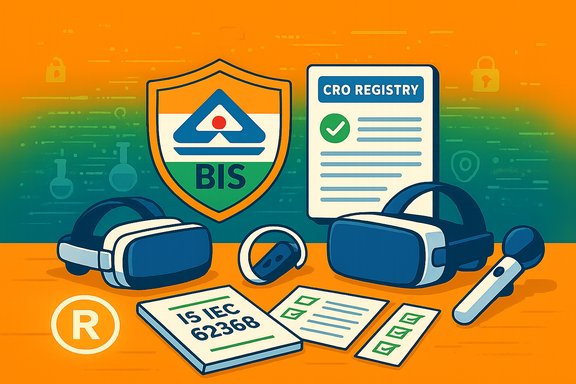
India’s Ministry of Electronics and Information Technology (MeitY) has moved to bring Augmented Reality (AR), Virtual Reality (VR) and Mixed Reality (MR) devices — collectively marketed as Extended Reality (XR) products — into the scope of the country’s compulsory safety certification regime, a regulatory step that will force manufacturers, importers and retailers to certify XR headsets and related immersive hardware under Bureau of Indian Standards (BIS) rules.
India’s Electronics and Information Technology Goods (Requirement of Compulsory Registration) Order — commonly referred to as the CRO — is the legal instrument that identifies categories of electronic and IT goods that must comply with specified Indian Standards before they can be manufactured, imported, sold or otherwise placed on the market. BIS administers the registration scheme and maintains the catalogue of product standards and the timelines for implementation. Over the last two years MeitY and BIS have been consolidating legacy safety standards into the hazard‑based IS/IEC 62368 series (Edition 4 / 2023), which merges earlier TV/audio and IT equipment safety rules (IS 616 and IS 13252) into a single modern framework. The migration is intended to align India with international practice and to reduce classification ambiguities across overlapping product families. Stakeholder discussions and ministry briefings dating up to mid‑2025 described a migration covering some 42 product categories and emphasized faster timelines for emerging categories such as XR.
Until the final Gazette notification and BIS implementation guidelines are published, stakeholders should assume that a legal change is imminent but not irreversible, and take a pragmatic course of readiness planning rather than immediate panic. Early engagement with accredited labs, careful SKU mapping, and documented justifications for any requested transition extensions will be the most effective ways for manufacturers and importers to navigate the next phase.
Note on sources and verification: this article synthesises recent media coverage and public regulatory material available as of late October–early November 2025, including industry analyses of the IS/IEC 62368 migration and the BIS Compulsory Registration Scheme. Where press reports state specific calendar dates for CRO amendments and transition windows, those claims were cross‑checked against BIS and WTO registry updates; some secondary sources vary on precise dates and thus any date quoted from media reports should be confirmed against the final Gazette notification before being treated as legally binding.
Source: Storyboard18 Govt brings AR, VR, and XR devices under mandatory safety certification regime
 Background
India’s Electronics and Information Technology Goods (Requirement of Compulsory Registration) Order — commonly referred to as the CRO — is the legal instrument that identifies categories of electronic and IT goods that must comply with specified Indian Standards before they can be manufactured, imported, sold or otherwise placed on the market. BIS administers the registration scheme and maintains the catalogue of product standards and the timelines for implementation. Over the last two years MeitY and BIS have been consolidating legacy safety standards into the hazard‑based IS/IEC 62368 series (Edition 4 / 2023), which merges earlier TV/audio and IT equipment safety rules (IS 616 and IS 13252) into a single modern framework. The migration is intended to align India with international practice and to reduce classification ambiguities across overlapping product families. Stakeholder discussions and ministry briefings dating up to mid‑2025 described a migration covering some 42 product categories and emphasized faster timelines for emerging categories such as XR. What changed: XR devices added to the CRO
The recent change reported by industry press brings XR devices explicitly within the CRO schedule. According to the published coverage, an amendment to the CRO was notified in late October 2025 to list XR products under the safety standard cluster described as “Audio/Video, Information and Communication Technology Equipment – Part 1: Safety Requirements,” effectively making BIS registration compulsory for those devices. This is the first time AR/VR/MR hardware has been named as a distinct category in the CRO’s compulsory certification list. Two practical outcomes flow from that listing:- XR devices will need conformity assessment and a BIS registration number (R‑number) to be legally imported or sold once the transition deadlines lapse.
- The safety baseline for XR hardware is being consolidated under IS/IEC 62368, rather than the older IS 13252 or IS 616 standards that previously covered many audio‑visual and IT equipment types by default.
Timelines, transition windows and what they mean
Published reports outline a two‑tier transition timeline for legacy standards and XR devices:- The story widely reported cites a notification dated 29 October 2025 and states that XR products will be allowed to run concurrently under legacy certifications and the new IS/IEC 62368 standard until 1 May 2026, after which the new standard becomes the exclusive safety requirement for XR.
- For the broader set of product categories migrating from IS 13252 and IS 616 to IS/IEC 62368, the reported transition period extends until 1 November 2028, giving those manufacturers a longer runway to re‑certify.
Why MeitY is doing this: safety, alignment, and policy aims
The migration to IS/IEC 62368 and the inclusion of XR devices under CRO serve a cluster of policy objectives:- Modern safety alignment: IS/IEC 62368 is a hazard‑based standard that reflects contemporary componentry (including lithium batteries, wireless radios and complex mixed‑signal electronics) better than legacy rules, and it is the global norm for modern A/V and IT hardware. Bringing XR into that framework reduces ambiguity about which safety tests apply to headsets and tethered displays.
- Consumer protection and uniformity: Naming XR explicitly limits the regulatory gray area where headsets were sometimes tested as “VDUs” (visual display units) or under broader audio‑video categories. A clear rule reduces inconsistent test outcomes & helps enforcement.
- Trade and import control: BIS registration is already tied to import controls; non‑registered models cannot be lawfully imported. Adding XR makes it harder for uncertified or potentially non‑compliant XR hardware to enter the market unchecked, aligning safety with national trade policy. Past notices and commentary on import restrictions reiterate that imports of CRO‑notified products are prohibited unless registered with BIS.
- Security and supply‑chain oversight: MeitY has used the CRO framework previously to add essential security requirements for categories like CCTV; the extension to XR sits within a broader strategic concern about networked devices and potential security vectors, especially as headsets increasingly integrate cameras, sensors and always‑on connectivity. That context makes the CRO an attractive vehicle for adding both safety and baseline security expectations.
Practical impact on makers, importers, retailers and startups
The regulatory shift has practical, immediate consequences across the XR ecosystem.Testing and certification workload
- BIS‑recognised test labs will need to absorb a fresh wave of XR test requests, including electrical safety, battery safety, electromagnetic compatibility and possibly accessory testing (power adapters, controllers, batteries). MeitY/BIS consultations acknowledged pressure on accreditation capacity and signalled plans to fast‑track lab recognition for IS/IEC 62368 testing.
- Series‑testing proposals (testing a representative model for a family of products) were under active discussion in stakeholder meetings; where accepted, series testing can materially reduce cost and time for manufacturers that ship many SKUs with small hardware variants. However, the final series‑testing rules and their scope will determine how much relief this actually provides.
Cost for small and medium manufacturers
- Re‑testing, lab booking fees, and documentation updates will impose non‑trivial costs. For established consumer device manufacturers these costs are manageable within product roadmaps; for small XR startups — which often iterate hardware quickly and run short production runs — the fixed cost of obtaining BIS registration and the administrative overhead can be a meaningful barrier.
Import delays and inventory risk
- Retailers and importers who keep stock of global XR headset SKUs will need to ensure every model has an R‑number once the transition ends. Failure to do so may lead to shipments held at ports or retail delistings. Previously BIS‑registration requirements have been used at customs to block non‑compliant imports.
After‑sales, warranty and spares
- MeitY and BIS have contemplated limited exemptions for end‑of‑life and warranty replacement parts in prior CRO discussions. Nonetheless, the practical need to support field‑replacements and AMCs will push OEMs to retain legacy R‑numbers or seek explicit transitional carve‑outs to avoid service disruptions. ��Independent advisories encouraged manufacturers to prepare justification materials where this is necessary.
Security, privacy and non‑safety risks — a special note for XR
XR headsets are not just screens on the head: modern devices integrate cameras, multiple sensors (IMUs, depth sensors), microphones, wireless radios and increasingly powerful local compute. That combination raises privacy and security issues that go beyond electrical safety.- The CRO mechanism has previously been used to impose essential security requirements (e.g., for CCTV) — a precedent that suggests future XR conformity requirements could include baseline cybersecurity expectations for device firmware, secure boot, telemetry controls and documented data‑handling practices.
- For consumer trust and regulatory compliance, XR makers should treat security specifications — such as authenticated firmware updates, encrypted storage of sensor logs and minimised telemetry — as part of their compliance planning, even if those requirements are not yet hard‑coded into the IS/IEC 62368 safety testing matrix. This is particularly important for enterprise and government procurement, where security considerations often govern purchase decisions.
- Additionally, since BIS registration ties into customs controls, devices that fail to meet both safety and declared labelling requirements can be refused entry — which combines physical safety concerns with national security and trade enforcement.
How manufacturers and importers should prepare — a practical checklist
- Identify applicable CRO classification
- Map each product SKU to the CRO list: is it listed under IS 616, IS 13252 or explicitly under the new XR category? Keep records for each SKU.
- Inventory current R‑numbers and expiry timelines
- Extract all existing BIS R‑numbers tied to legacy standards and confirm the permitted overlap period with IS/IEC 62368. Prepare for renewal or re‑registration if necessary.
- Plan testing and lab bookings early
- Contact BIS‑recognised labs for IS/IEC 62368 testing slots. Consider accredited labs outside India if permitted, but factor in lead times for reports that BIS accepts. Explore series‑testing allowances with your regulatory counsel.
- Audit batteries, power systems and accessories
- XR headsets frequently use lithium cells and external power adapters. Ensure battery test reports, thermal run‑away assessments and charger compliance are current and align with the IS/IEC 62368 requirements.
- Labeling, documentation and user manuals
- Update labels, user manuals and safety instructions to reflect IS/IEC 62368 compliance and the BIS standard mark rules. Prepare device pictures, firmware hashes and BOM documentation if series guidelines require them.
- Plan firmware and security controls
- Document secure‑update mechanisms, explain telemetry minimisation steps and implement secure boot/firmware integrity where possible; these measures lower downstream risk from potential regulatory security scrutiny.
- Engage with BIS and MeitY where necessary
- If product roadmaps or supply constraints make short transition windows impractical, prepare justifications and evidence (manufacturing ramp plans, lab unavailability) and submit formal requests for transition extensions or case‑by‑case exemptions. MeitY has signalled an openness to consider such inputs in stakeholder consultations.
Strengths and likely benefits of the move
- Harmonised safety baseline: Consolidation under IS/IEC 62368 brings India into step with global hazard‑based testing, reducing cross‑jurisdictional compliance friction for global OEMs and limiting dangerous legacy test interpretations.
- Consumer protection: Explicit CRO listing makes it easier to enforce basic safety for a product class that contains batteries and head‑mounted electronics — items that can cause fires, shocks or other safety incidents in the absence of proper controls.
- Market clarity: Retailers and enterprise buyers will have clearer expectations for required documentation at purchase or import time, reducing disputes and the risk of unsafe products proliferating.
Risks, unintended consequences and what to watch for
- Certification bottlenecks: If BIS‑recognised labs cannot scale accreditation and testing capacity fast enough, manufacturers could face long backlogs that slow product launches or reduce imports — an especially acute risk for fast‑moving XR startups. Industry commentaries have flagged this as a major implementation risk.
- Compliance cost for small players: Fixed testing and documentation costs can disproportionately hurt small developers, potentially concentrating the market among larger incumbents unless series‑testing and reasonable exemptions are applied.
- Label and supply‑chain disruption: Discrepancies between legacy R‑numbers and new IS/IEC labels may cause temporary stockouts or customs detentions unless carefully managed. Historical BIS deadlines in other product categories have led to pending application cancellations where timelines were missed.
- Regulatory uncertainty where dates diverge: Multiple secondary sources reported slightly different effective dates and migration windows. Where the press cites precise dates, but the Gazette or BIS page is yet to be clear, firms risk mistaking soft guidance for definitive law. This legal uncertainty itself is a risk for supply planning. Where exact dates matter for compliance, rely on the Gazetted text.
Editorial analysis: policy logic vs. commercial realities
MeitY’s move is, from a policy standpoint, sensible: XR devices are increasingly capable, widely distributed and contain multiple hazard vectors (batteries, displays, radios). Applying a modern hazard‑based standard and bringing devices into CRO closes an enforcement gap and gives regulators tools to keep unsafe or insecure devices out of the market. The technical adoption of IS/IEC 62368 reduces the complexity of deciding which legacy test applies to a given headset and brings India closer to international norms — an advantage for exporters and global OEMs. However, the commercial reality is more fraught. XR hardware is an innovation‑heavy, rapid‑iteration sector where firms launch minor revisions frequently. A certification process designed for stationary appliances or slow‑cycle consumer electronics can impose friction if it does not accommodate series testing, firmware‑driven feature updates, and small‑batch production runs. For the regulation to be an enabler rather than a brake, the practicalities of lab capacity, series allowances and realistic transition windows must be clearly spelled out in the Gazette and the accompanying BIS implementation guidelines. Industry submissions from 2025 showed that these procedural details were still under discussion — a sign that a successful rollout depends on administrative follow‑through as much as the headline policy.What’s next and recommended actions
- Treat press reports as high‑value alerts but not the final word: confirm dates and legal obligations from the BIS Scheme‑II registry and the Gazette notification before halting sales, imports or committing capital to re‑tooling.
- For product teams: begin internal classification and testing planning now. Book tentative lab slots and gather BOM/firmware evidence required under anticipated series guidelines. Prioritise battery, adapter and charger compliance.
- For startups and MSMEs: explore consortium testing or shared lab capacity, and consider early conversations with BIS to seek clarity on series testing rules or transitional relief that could reduce the certification burden.
- For retailers and importers: audit existing inventory for R‑number coverage and prepare contingency plans for delayed shipments or temporary delistings. Factor certification timelines into Q1 and Q2 procurement planning if deadlines fall in the next six months.
Final assessment
The extension of India’s compulsory certification regime to include XR hardware is a structurally important development: it clarifies safety obligations for head‑mounted displays and aligns India to global hazard‑based standards. That alignment should ultimately benefit consumers and enterprises by improving safety, harmonising tests and reducing ambiguity. However, the devil is in the process: lab readiness, series testing rules, the exact Gazetted deadlines and clear operational guidance from BIS will determine whether the policy protects consumers without throttling innovation.Until the final Gazette notification and BIS implementation guidelines are published, stakeholders should assume that a legal change is imminent but not irreversible, and take a pragmatic course of readiness planning rather than immediate panic. Early engagement with accredited labs, careful SKU mapping, and documented justifications for any requested transition extensions will be the most effective ways for manufacturers and importers to navigate the next phase.
Note on sources and verification: this article synthesises recent media coverage and public regulatory material available as of late October–early November 2025, including industry analyses of the IS/IEC 62368 migration and the BIS Compulsory Registration Scheme. Where press reports state specific calendar dates for CRO amendments and transition windows, those claims were cross‑checked against BIS and WTO registry updates; some secondary sources vary on precise dates and thus any date quoted from media reports should be confirmed against the final Gazette notification before being treated as legally binding.
Source: Storyboard18 Govt brings AR, VR, and XR devices under mandatory safety certification regime
