

Informatica’s announcement at Microsoft Ignite 2025 — tying its Intelligent Data Management Cloud (IDMC) and CLAIRE metadata engine directly into Microsoft Foundry — marks a deliberate push to make enterprise GenAI more deployable, auditable and enterprise-ready by anchoring agentic systems to governed, high‑quality data.
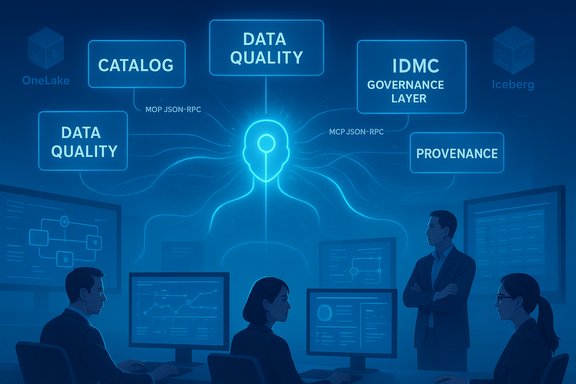
Enterprises are moving quickly from experiments with large language models to building agentic AI — systems of models that can call tools, orchestrate multi‑step workflows and act on behalf of users. That shift exposes a familiar set of enterprise problems: data quality, identity resolution, lineage, compliance and secure access. Informatica’s IDMC specializes in those areas; Microsoft’s Foundry provides an enterprise‑grade agent runtime and governance plane. The joint announcement creates an integration surface intended to let Foundry agents access IDMC services — catalog, governance, data quality and Master Data Management (MDM) — using the industry’s emerging connector standard, the Model Context Protocol (MCP). At its core the news is practical: Informatica revealed an MCP Server for Foundry Agent Service, a library of GenAI recipes and blueprints built for Foundry, and the expansion of its CLAIRE intelligence to run natively in Azure regions in the U.S. and Europe. The company also highlighted read/write support for Microsoft OneLake tables backed by the Apache Iceberg table format to improve analytics interoperability.
The adoption of MCP as a standard is a positive for interoperability but also creates centralization points that vendors and customers must secure. The larger vendor ecosystem — model providers, observability platforms, identity and secrets managers — must coordinate to make these agent systems robust at scale. Independent third‑party vetting, professional services and systems integrators will remain critical in early production deployments.
Source: HPCwire Informatica Deepens Collaboration with Microsoft to Accelerate Enterprise GenAI with Trusted Data - BigDATAwire
 Background / Overview
Enterprises are moving quickly from experiments with large language models to building agentic AI — systems of models that can call tools, orchestrate multi‑step workflows and act on behalf of users. That shift exposes a familiar set of enterprise problems: data quality, identity resolution, lineage, compliance and secure access. Informatica’s IDMC specializes in those areas; Microsoft’s Foundry provides an enterprise‑grade agent runtime and governance plane. The joint announcement creates an integration surface intended to let Foundry agents access IDMC services — catalog, governance, data quality and Master Data Management (MDM) — using the industry’s emerging connector standard, the Model Context Protocol (MCP). At its core the news is practical: Informatica revealed an MCP Server for Foundry Agent Service, a library of GenAI recipes and blueprints built for Foundry, and the expansion of its CLAIRE intelligence to run natively in Azure regions in the U.S. and Europe. The company also highlighted read/write support for Microsoft OneLake tables backed by the Apache Iceberg table format to improve analytics interoperability. What was announced — the product details
Informatica MCP Server for Foundry Agent Service
- A connector layer that exposes selected IDMC services to Foundry agents over MCP, enabling agents to query catalog metadata, verify data quality, resolve MDM records and fetch governed datasets in near real‑time.
- The architecture leverages MCP — a JSON‑RPC style open protocol for model-to-tool communication — so agents and tools can interoperate without bespoke integrations. Microsoft’s Foundry supports MCP as a first‑class integration mechanism.
New GenAI recipes and blueprints for Foundry
- A library of pre‑built templates that stitch together Foundry agent runtimes, Azure OpenAI model endpoints (where used) and IDMC data‑management primitives.
- Delivered examples include a Simple React Agent, an Agent with Multifunction Calling, and vertical templates for loan processing and automobile insurance claims, intended to accelerate proofs of value into production.
CLAIRE expansion with Foundry
- CLAIRE, Informatica’s metadata‑driven AI/automation engine, is integrated with Foundry to provide reasoning and automated metadata‑led actions across data integration, data quality, governance and MDM.
- Informatica reports CLAIRE is now natively available in Microsoft Azure regions in the U.S. and Europe, a claim aimed at reducing data‑residency friction for regulated customers.
OneLake + Apache Iceberg interoperability
- Informatica announced support for reading and writing OneLake tables using the Apache Iceberg table format so customers can unify analytics and avoid duplicative ETL work between platforms.
- Microsoft Fabric / OneLake already supports Iceberg virtualization and shortcuts, enabling Fabric workloads to consume Iceberg‑formatted tables without copying data. That technical foundation amplifies Informatica’s interoperability claim.
Why this matters: enterprise GenAI, but grounded in data ops
Enterprises say they want faster GenAI adoption and stronger governance. This partnership attempts to address both simultaneously:- Speed to production: Pre‑built Foundry recipes reduce boilerplate for retrieval‑augmented generation (RAG), tool chaining and agent orchestration, shortening the path from prototype to production.
- Data trust and provenance: Connecting agents to IDMC services gives models access to cataloged, lineage‑tracked and quality‑scored data rather than ad‑hoc document dumps — a control that reduces hallucinations and improves auditability.
- Operational governance: Using MCP with Foundry allows the agent runtime to enforce tool‑approval flows and tokenized, per‑run authentication, strengthening runtime controls when agents invoke external tools. Microsoft’s Foundry documentation lays out those guardrails.
Technical analysis: how the integration actually works
MCP as the plumbing
MCP provides a standardized contract between model clients and tool servers. In this pattern:- An agent running in Foundry issues structured tool invocation requests via MCP.
- The MCP Server — in this case, Informatica’s MCP Server for Foundry — receives those requests, executes the governed IDMC operations (catalog lookup, MDM resolution, data quality checks) and returns structured responses with provenance metadata.
- Foundry can then incorporate the structured outputs directly into agent reasoning, logging, and audit trails.
CLAIRE + Foundry: metadata‑driven reasoning
CLAIRE operates over metadata to recommend mappings, resolve identities, score data quality and automate data‑ops tasks. By integrating CLAIRE with Foundry, Informatica is positioning metadata not just as passive catalog entries but as active context the agent uses to reason — for example, rejecting a dataset for use if a quality gate fails or annotating responses with lineage references. The practical benefit is explainability and a stronger audit trail for agent decisions.OneLake / Iceberg mechanics
OneLake’s virtualization layer enables Iceberg tables to appear as Delta Lake tables to Fabric workloads through metadata translation. That means agents and analytics jobs can query Iceberg data in place, avoiding heavy ETL or copies — an efficiency that improves both cost and compliance posture for large analytic datasets. Microsoft’s documentation explains how OneLake creates virtual metadata to expose Iceberg tables to Fabric engines.Strengths — what this partnership gets right
- Standards-first approach: Using MCP as the connector standard reduces bespoke integration costs and improves portability. It’s a pragmatic choice while the agent‑tool ecosystem stabilizes.
- Enterprise-grade controls: Foundry’s built‑in policy, approval workflows and Entra identity integration combined with IDMC’s governance fill real enterprise needs around access control, auditing and data lineage.
- Reduced data movement: Support for OneLake + Iceberg and virtualized metadata reduces duplication, a recurring operational headache in large enterprises. This lowers storage cost and simplifies compliance scopes.
- Faster time-to-value: Pre‑built GenAI recipes and industry blueprints are practical accelerators for use cases that are high value but tightly regulated, such as claims processing and loan adjudication.
Risks and limitations — what IT leaders must evaluate
- MCP increases the attack surface: Standardizing agent‑to‑tool traffic via MCP concentrates risk — a compromised MCP server or a misconfigured tool chain can enable unauthorized data access or prompt injection attacks. Security teams must treat MCP endpoints as high‑risk assets and apply hardened authentication, least privilege, and runtime approvals. Independent analyses have already flagged prompt injection and tool‑permission risks in MCP implementations.
- Operational complexity: Integrating IDMC with Foundry will require platform engineering work: enabling MCP endpoints, mapping enterprise schemas into GenAI recipes, instrumenting lineage and SLOs, and building on‑call and incident response for agent misbehavior. The tooling reduces integration boilerplate, but does not eliminate systems engineering needs.
- Latency and consistency tradeoffs: Informatica claims “near real‑time” access. Architectures that call external MCP servers introduce network hops and potential bottlenecks that must be stress‑tested for low‑latency agent use cases. Agents that rely on synchronous external lookups can amplify latency into user‑facing slowdowns.
- Governance vs. agility tension: Recipes and blueprints accelerate deployment but can embed risky defaults. Organizations must enforce pre‑deployment red‑teaming, define guardrails, and tie business owners to outcome metrics before wide rollout.
- Region and compliance caveats: While CLAIRE is announced as available in U.S. and European Azure regions, customers with narrower residency or certification needs must validate the exact region availability, data at‑rest and transit policies, and the handling of derived artifacts. Informatica’s press materials should be verified against contractual and operational SLAs.
Practical guidance: how to evaluate or pilot this stack
- Inventory and classify sensitive datasets and tag them in IDMC before enabling MCP access. Ensure MDM records are complete for identity resolution.
- Run a narrow pilot with a low‑risk recipe (for example, internal document retrieval or a claims‑triage assistant) and instrument: hallucination rate, provenance inclusion, response latency and cost per request.
- Configure per‑run auth tokens and runtime approvals for MCP calls; validate that credentials are ephemeral and logs are immutable. Microsoft Foundry docs describe tool approval flows and Entra integration.
- Test OneLake/Iceberg virtualization and measure query performance and metadata sync behavior in a sandbox before migrating production workloads. Microsoft Learn covers limitations and preview caveats for Iceberg virtualization.
- Define SLOs and on‑call runbooks for agent misbehavior and data exfiltration scenarios, and require pre‑deployment threat models for agents that will access regulated data.
Competitive and ecosystem implications
This integration is a visible example of a broader market pattern: hyperscalers and leading data‑management vendors are trying to make GenAI safe, auditable and operational by design. Microsoft’s Foundry is positioning itself as the enterprise agent runtime, while data fabric players like Informatica aim to supply the governed data layer that agents must trust. Both sides benefit: Foundry gets deeper enterprise data connectivity; Informatica gains a clear path into agentic application stacks.The adoption of MCP as a standard is a positive for interoperability but also creates centralization points that vendors and customers must secure. The larger vendor ecosystem — model providers, observability platforms, identity and secrets managers — must coordinate to make these agent systems robust at scale. Independent third‑party vetting, professional services and systems integrators will remain critical in early production deployments.
Verdict: realistic progress with necessary caveats
Informatica and Microsoft’s joint work is an important, pragmatic step toward operationalizing enterprise GenAI. The value proposition is straightforward: give agents access to trusted, governed data and you reduce hallucinations, improve audit trails and make productionization more tractable. The packaged ingredients — MCP connectivity, CLAIRE in Azure regions, recipe libraries and OneLake/Iceberg interoperability — are sensible and align with the needs of regulated enterprises. That said, this is not a turnkey safety solution. MCP standardization brings efficiency and portability — but also concentrates security risk and operational responsibility. The announcements accelerate the technology stack, but realizing durable business outcomes will require disciplined pilots, strong security engineering, and governance investments. Early adopters should budget for systems integration work, red‑teaming and thorough validation of performance, region availability and compliance claims.Conclusion
The Informatica–Microsoft expansion announced at Ignite 2025 is a meaningful next step in the evolution of enterprise GenAI. By marrying IDMC’s governance, MDM and data‑quality services to Microsoft Foundry’s agent orchestration and MCP‑based tool model, the integration offers a plausible path to faster, more auditable agent deployments that operate on trusted data. Organizations that treat this stack as a platform — not a point solution — and invest in security, testing and governance will find real upside. Those that view recipes and standards as shortcuts to production without compensating controls will face the familiar perils of early GenAI adoption: hallucinations, compliance drift and operational surprises.Source: HPCwire Informatica Deepens Collaboration with Microsoft to Accelerate Enterprise GenAI with Trusted Data - BigDATAwire
