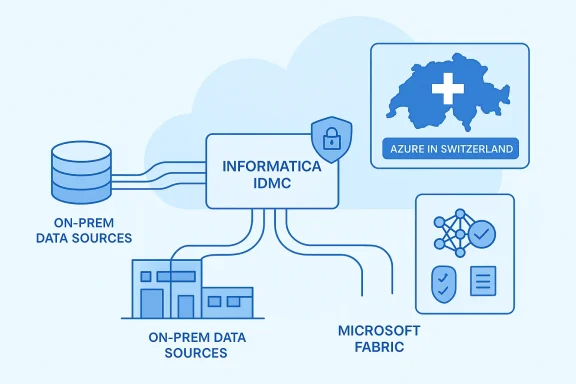
Informatica Brings Fabric Open Mirroring and Swiss Azure Control to IDMC

  • Thread Author
Informatica is sharpening its Microsoft strategy again, and this time the message is as much about control as it is about connectivity. The company’s newly announced Microsoft Fabric Open Mirroring support and a Switzerland-based Azure point of delivery for IDMC show a vendor trying to solve two of enterprise IT’s hardest problems at once: getting data into AI-ready form without creating more plumbing, and keeping that data inside the regulatory boundaries customers actually have to honor. The move lands in a market where Fabric is becoming a gravity well for Microsoft-centric analytics teams, but where trust, residency, and governance still decide whether those projects survive contact with production.

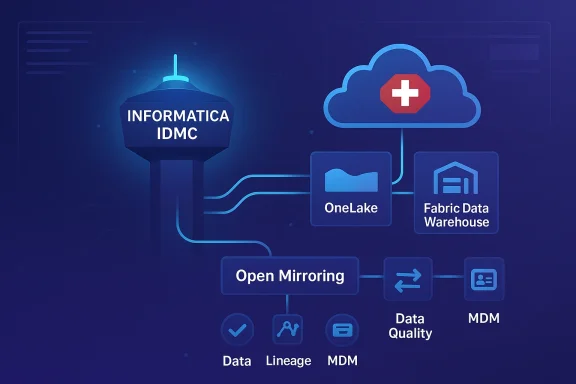
Blue data-integration diagram linking Informatica IDMC with OneLake, Fabric Data Warehouse, and Open Mirroring.Background​

Informatica’s relationship with Microsoft has been evolving for years, but 2024 and 2025 marked the point where the partnership started to look less like a simple integration story and more like a coordinated go-to-market framework. Microsoft and Informatica first laid out deeper Fabric and Azure integrations in 2023, including native application work in Fabric and connectors designed to move trusted data into Microsoft’s analytics stack. Informatica later expanded those plans in 2024 with Azure Native ISV Service support and additional Fabric-oriented data quality and open table format capabilities.
That backdrop matters because today’s announcement is not happening in a vacuum. It builds on a pattern in which Informatica has repeatedly pushed the same core idea: trusted data is the prerequisite for AI. Microsoft, for its part, has been turning Fabric into an increasingly broad analytics and data integration platform, adding mirroring, shortcuts, and cross-workload access so customers can keep more of their estate in one semantic and operational plane.
The new Fabric Open Mirroring support fits that trajectory neatly. Informatica’s 2025 Fabric-related release already described the ability to ingest from 300-plus enterprise sources into Fabric endpoints and apply data quality capabilities inside the Fabric environment. The latest development appears to extend that same philosophy into the mirroring workflow, so the platform can feed Fabric OneLake and the Fabric Data Warehouse without forcing customers to stitch together entirely separate pipelines. That is a big deal for organizations that have learned the hard way that a data platform is only as useful as its least governed ingestion path.
The Switzerland pod is equally strategic, though in a different way. Informatica has long used regional Azure-based pods to satisfy local data residency and sovereignty requirements, including prior regional footprints in Germany, the UAE, Canada, and other markets. The Swiss deployment is therefore not a surprise so much as an acknowledgment that regulated European buyers still want cloud-native capabilities without accepting a one-size-fits-all global tenancy model.
In short, this is less about flashy feature count and more about market reality. Enterprise AI projects do not stall only because models are weak; they stall because the data is fragmented, governed inconsistently, or trapped in the wrong jurisdiction. Informatica is trying to be the vendor that removes those obstacles before customers turn to alternative tooling, custom code, or shadow pipelines.

What the New Fabric Support Actually Changes​

The headline feature here is Microsoft Fabric Open Mirroring support inside Informatica’s Intelligent Data Management Cloud (IDMC). The practical promise is simple: data can be synchronized into Fabric’s OneLake and warehouse layers through existing Informatica ingestion pipelines rather than by constructing new one-off routes for every source system. That means a team already invested in Informatica can extend its existing data movement and governance model into Fabric instead of starting from scratch.

Why mirroring matters​

Mirroring is important because it narrows the gap between source systems and analytics surfaces. Microsoft has been positioning Fabric mirroring as a way to make near-real-time copies of external databases available inside OneLake so teams can use downstream Fabric experiences without constantly rebuilding ETL. Informatica’s role is to widen the source ecosystem dramatically, since its platform already connects to hundreds of enterprise systems.
That source reach matters more than marketing departments usually admit. AI programs often begin with a narrow set of modern SaaS data and then quickly run into the older, messier reality of ERP, CRM, mainframe, finance, and custom operational systems. By anchoring mirroring to IDMC, Informatica is saying that AI-readiness is not just about where data lands; it is about whether the data can be trusted, profiled, and corrected on the way in.
The company has also emphasized that governance is not a post-processing step in this model. Data quality, lineage, and master data management are applied as part of ingestion, which reduces the common temptation to “fix it later” after data has already spread across a warehouse, lakehouse, or AI workflow. That “later” is often where the most expensive mistakes happen. Governance after replication is usually governance too late.

The enterprise logic behind 300-plus sources​

The source-count claim is not merely a vanity metric. In enterprise integration, the hard part is not connecting one system; it is maintaining a coherent policy, security model, lineage graph, and data quality regime across many systems at once. Informatica’s pitch is that customers can keep using IDMC’s broader control plane while benefiting from Fabric’s analytics environment.
A useful way to think about the change is as a reduction in integration sprawl. Instead of building a bespoke connector or transformation layer for every new Fabric workload, enterprises can pull from a common ingestion foundation and then decide which elements of the data estate need stricter curation. That will appeal most strongly to teams that already treat data management as a central platform capability rather than a departmental utility.
  • Fewer custom pipelines to maintain
  • More consistent quality and lineage enforcement
  • Better alignment between ingestion and governance
  • Faster onboarding of new Fabric workloads
  • Lower risk of duplicate, inconsistent copies of key data
The limitation, of course, is that no mirroring model can fully erase data complexity. If the source system is poor, if the metadata is wrong, or if governance rules are inconsistent across business units, the mirror simply moves the problem faster. The difference is that Informatica is trying to make the mirror operationally safer than a do-it-yourself pipeline.

Why Switzerland Is More Than a Geographic Footnote​

The new Swiss Azure-based IDMC point of delivery is best understood as a sovereignty product, not just a regional expansion. Swiss enterprises, especially in finance, life sciences, and public-sector-adjacent industries, often operate under constraints that go beyond standard multinational cloud policy. For them, the question is not whether cloud is acceptable in theory; it is whether the provider can demonstrate precise locality, governance, and jurisdictional control.

Data residency as a buying criterion​

This is where Informatica’s regional pod strategy becomes commercially meaningful. Earlier regional launches in the UAE, Germany, and Canada showed that the company is willing to place its data management stack directly into local cloud regions to address regulatory and procurement demands. The Swiss rollout extends that playbook to one of Europe’s most compliance-conscious markets.
The significance is not just legal. Data residency affects architecture, procurement, latency, and internal politics. A regional pod makes it easier for legal, security, and compliance teams to sign off on a deployment, but it also simplifies the conversation with operational teams that do not want sensitive datasets bouncing across continents to satisfy an abstract cloud design. For many buyers, that is the difference between “interesting” and “approved.”
Informatica’s own documentation and prior announcements have repeatedly stressed that regional pods exist so customers can keep data secure, well-governed, and in-region when required. That is now a recognizable part of the company’s cloud strategy rather than an emergency workaround.

Azure Marketplace and MACC alignment​

The Swiss pod is also available through Azure Marketplace and eligible for Microsoft Azure Consumption Commitments (MACC), which is a subtle but important procurement advantage. Microsoft Learn describes MACC as a contractual spend commitment that organizations use to satisfy agreed Azure consumption targets, and marketplace purchases can count toward that commitment under the right conditions.
For enterprise buyers, this matters because cloud modernization is not purchased feature by feature; it is often budgeted through precommitted consumption structures. If a data management product can be bought in a way that counts toward existing Azure spending frameworks, it becomes much easier to deploy without creating a separate financial exception path. That is often enough to accelerate buying decisions by months.
The broader implication is that Informatica is trying to become financing-compatible as well as technically compatible with Azure-centric customers. In enterprise software, that is a real competitive edge. A platform that aligns with existing cloud commitments can be easier to approve than a functionally similar tool that requires fresh budget, fresh billing logic, and fresh governance paperwork.

The Fabric Angle: Why Microsoft Benefits Too​

Microsoft is clearly not just a passive host in this story. Fabric is designed to centralize analytics, data movement, and operational insights, and the more workloads it can absorb from the broader Microsoft and partner ecosystem, the stronger its strategic position becomes. Informatica’s support for Fabric Open Mirroring effectively gives Microsoft another credible enterprise data-management partner feeding its lake-centric model.

Fabric’s expanding gravitational pull​

Microsoft has been steadily turning Fabric into a platform that can ingest, mirror, query, and operationalize data across a broad set of systems. The platform’s mirroring and OneLake story is especially attractive to organizations that want near-real-time access without stitching together separate warehouse, lake, and BI stacks. Informatica’s IDMC integration reinforces that vision by making enterprise data sourcing less of a custom engineering exercise.
That helps Microsoft because it reduces friction for customers already contemplating Fabric adoption. If Informatica can carry the burden of source integration, data quality, and governance while Fabric provides the common analytical runtime, Microsoft gets to present a more complete ecosystem story. It is a classic platform move: let partners specialize in the messy parts while the core platform becomes the destination.
The result is also a stronger defense against rival data platforms. Competing ecosystems want to be seen as the best place to centralize governed enterprise data, but Microsoft has a compelling combination of identity, productivity, analytics, and cloud infrastructure. Every credible ISV that validates Fabric makes it easier for Microsoft to argue that Fabric is not merely a product bundle; it is an enterprise operating layer.

Why this is different from a simple connector story​

A basic connector says “we can move data.” This announcement says something closer to “we can move, govern, and operationalize data in a way that fits your Microsoft estate.” That distinction matters because buyers increasingly care about the lifecycle of data, not just the transport. They want lineage, policy enforcement, and AI readiness from the start.
  • Fabric gains richer enterprise source access
  • Informatica gains a larger installed base and a more central role
  • Customers get a less fragmented path into AI workloads
  • Microsoft deepens its partner-led analytics ecosystem
  • Both companies reinforce the narrative of governed, trusted data
This is also a signal that the Microsoft ecosystem is maturing. Early platform adoption often hinges on breadth of features. Later-stage adoption hinges on whether trusted partners can fill the gaps around compliance, source integration, and operational resilience. Informatica is filling exactly those gaps.

Governance, Quality, and MDM as AI Infrastructure​

One of the most important parts of the announcement is the insistence that data quality, lineage, and master data management (MDM) should not be bolt-ons. Informatica is effectively positioning these capabilities as foundational infrastructure for AI and analytics, not auxiliary services that sit beside the pipeline. That framing is increasingly aligned with the way enterprises now talk about AI risk.

The real AI bottleneck is trust​

Most AI projects do not fail because the model cannot predict something. They fail because the organization cannot agree on which data is authoritative, which definitions are current, or which records are safe to use. Informatica’s pitch is that its IDMC stack can enforce the data discipline needed before those problems surface in production.
That is particularly relevant in Microsoft-heavy environments, where teams may be tempted to treat Fabric as the endpoint for everything. In reality, a lakehouse or warehouse can still inherit all the contradictions of the upstream world. If customer records, product hierarchies, or regional compliance tags are inconsistent, then analytics dashboards and AI copilots will simply automate confusion at scale.
The addition of MDM into the story is especially important. MDM is not glamorous, but it is often the difference between a trustworthy enterprise AI program and a beautiful demo. By tying MDM to the same ingestion and mirroring motion, Informatica is saying that harmonization is not optional if customers want AI outputs they can defend to auditors and executives.

Why this changes enterprise architecture​

For architects, the implication is that governance no longer belongs only in a post-ingestion catalog or stewardship workflow. It needs to travel with the data. That changes how teams think about platform design, because ingestion, cleansing, stewardship, and analytics are no longer discrete phases in the process; they are layered aspects of one pipeline.
  • Data quality rules can be enforced earlier
  • Lineage becomes easier to preserve across systems
  • MDM can standardize critical business entities
  • Governance becomes part of platform architecture
  • AI risk is reduced before model training or inference
This architecture is attractive because it lowers the number of places where trust can be lost. But it also raises the bar for implementation, since a “trusted” pipeline is only as effective as the rules and metadata behind it. Organizations that lack mature stewardship will not magically gain it through software alone.

Competitive Implications Across the Data Stack​

The market impact here extends well beyond Informatica and Microsoft. Any vendor that sells data ingestion, quality, governance, cataloging, lakehouse integration, or AI data preparation now has to contend with a Microsoft ecosystem that is increasingly making first-party and partner-first options feel interchangeable to end users. That is not good news for standalone point tools whose only advantage is convenience.

Pressure on integration and ETL rivals​

The competitive pressure will be strongest on firms that depend on building and maintaining custom pipelines for cloud analytics environments. If Informatica can offer broad source coverage, governance, and Azure-native procurement convenience, customers may ask harder questions about why they should maintain separate tooling for the Microsoft side of the house. The answer will increasingly need to be specialization, not just connectivity.
That said, competitors are not standing still. Many are pursuing their own zero-copy, lakehouse, or AI-readiness narratives. The difference is that Informatica has the advantage of a long-standing brand in data management and a deep Microsoft relationship that gives its feature announcements immediate credibility. It can speak both the language of governance and the language of cloud consumption.
There is also a subtle lock-in risk for the market. When a partner ecosystem becomes tightly aligned with one cloud provider’s data and AI strategy, it can be harder for enterprises to preserve architectural neutrality. Some customers will welcome that simplicity; others will worry that the path of least resistance is also the path of greatest dependency. That tension is not going away.

How rivals might respond​

The most likely response from competitors will be to emphasize cross-cloud flexibility, faster time-to-value, or easier data sharing without heavy governance overhead. Some will argue that customers should not need a heavyweight integration layer to use Fabric effectively. Others will focus on specialized areas such as streaming, reverse ETL, or domain-specific data quality where Informatica may be less nimble.
A second response will likely be pricing. Enterprise buyers under budget pressure may compare the cost of a full governed-stack approach with lighter-weight alternatives. If the Microsoft ecosystem becomes too expensive to operationalize through premium governance tooling, some customers will still prefer to assemble a more modular stack.
A third response will be to lean harder into open standards. Because the Fabric story is increasingly tied to OneLake, mirroring, and open table formats, competitors will likely keep highlighting interoperability as a defensive moat. In other words, the fight is not just over features; it is over who controls the architectural defaults.

Enterprise vs. Consumer Impact​

This announcement is squarely enterprise-focused, but its effects may still ripple into broader productivity and AI experiences over time. For consumers, the change is mostly invisible. For enterprise users, it can shape whether the data behind dashboards, copilots, and automated workflows is reliable enough to use without constant caveats. That difference is crucial.

What enterprises gain​

Enterprises using Microsoft Fabric stand to benefit the most because they can potentially reduce pipeline sprawl and bring more data movement under a common governance model. The Swiss pod is especially valuable for multinational firms that need regional data processing without splitting their architecture into separate local and global estates. That reduces friction for compliance, analytics, and procurement.
The more interesting benefit is organizational. When integration is simpler and governance is embedded, data teams can spend less time fighting fragmentation and more time on data products, domain modeling, and AI enablement. That is the kind of efficiency that rarely shows up in a launch slide but matters enormously in production.
  • Faster onboarding for Fabric workloads
  • Better compliance alignment in Switzerland
  • Improved data trust for AI projects
  • Simpler procurement through Azure channels
  • Less custom plumbing for enterprise sources

What consumers do not directly see​

Consumers, by contrast, will not notice much immediately. They do not buy IDMC pods or manage OneLake mirroring policies. But they may eventually experience better corporate services if enterprises use this stack to build smarter internal copilots, more accurate customer analytics, or cleaner data-driven applications. The consumer benefit is downstream and indirect.
That said, the consumer impact is not trivial. Better enterprise data hygiene can improve everything from recommendations and support workflows to fraud detection and personalization. The public rarely sees the plumbing, but the quality of the plumbing shapes the services they use every day.

Strengths and Opportunities​

The announcement has several obvious strengths: it aligns with Microsoft’s platform direction, it reinforces Informatica’s governance-first identity, and it meets a real enterprise need for regional sovereignty. Just as importantly, it ties technical value to procurement and compliance realities, which is where many otherwise promising cloud projects get stuck.
  • Deepens Informatica’s role inside the Microsoft ecosystem
  • Extends governed data movement into Fabric workflows
  • Makes enterprise source onboarding less fragmented
  • Addresses Swiss and European residency needs directly
  • Improves procurement via Azure Marketplace and MACC alignment
  • Supports AI-readiness with quality, lineage, and MDM controls
  • Reduces the need for custom integration sprawl
The opportunity is broader than any single customer segment. Informatica can use these updates to strengthen its positioning among regulated industries, global enterprises, and Microsoft-first organizations that want to modernize without sacrificing control. If executed well, this could become a template for how enterprise data vendors remain relevant in a Fabric-centered world.

Risks and Concerns​

The biggest risk is that the pitch sounds cleaner than the operational reality. Enterprise data integration is messy, and adding more governance layers can also add more complexity if organizations lack the maturity to implement them well. There is also the perennial cloud concern: better integration can look suspiciously like deeper dependency on a single platform.
  • Implementation complexity may still be high for underprepared teams
  • Governance features require strong metadata discipline to work well
  • Cloud concentration could increase Microsoft dependency
  • Regional pods solve residency, not every compliance concern
  • Competing tools may still win on price or simplicity
  • Source quality problems will still propagate if upstream systems are poor
  • Customers may overestimate what mirroring can do without stewardship
There is also a strategic concern for buyers: if all the “easy” paths into governed data flow through a single cloud ecosystem, portability may suffer later. Convenience today can become constraint tomorrow. That does not make the approach wrong, but it does mean enterprises should think carefully about abstraction boundaries, exit options, and data portability from the start.

Looking Ahead​

The next phase to watch is whether Informatica turns these announcements into measurable adoption, especially among regulated European enterprises and large Microsoft Fabric customers with complex source estates. The Switzerland pod could be the kind of practical regional offering that wins deals quietly, while the Fabric support may become the more visible headline in Microsoft-centric accounts. The key question is whether customers see this as a truly simpler operating model or just a better-branded one.
Another important variable is how Microsoft continues to evolve Fabric itself. If Fabric keeps expanding its own mirroring, governance, and data preparation capabilities, Informatica will need to prove that its depth adds enough value to justify the stack. If, on the other hand, enterprise buyers keep demanding stronger source coverage and pre-ingestion governance, Informatica’s role may actually become more central.
What to watch next:
  • Adoption of the April 2026 IDMC release
  • Customer uptake of the Swiss Azure pod
  • Whether additional European regions follow
  • New Fabric-specific governance and AI features
  • Broader marketplace and MACC-driven procurement wins
In the end, this announcement is less about a single feature than about the architecture of trust in the Microsoft cloud era. Informatica is betting that the winners in enterprise AI will not be the teams that move data fastest, but the teams that move it safely, locally, and intelligently. If that proves true, the company has just positioned itself squarely in the middle of one of the most valuable layers in modern enterprise software.

Source: ChannelE2E Informatica Adds Microsoft Fabric Support and Opens Swiss Data Center
 

Informatica’s latest move with Microsoft Fabric and Azure in Switzerland is more than another cloud partnership press release. It is a signal that enterprise data platforms are being reshaped around two pressures at once: AI-ready data movement and data sovereignty. By deepening its Fabric integration while also localizing IDMC on Azure in Switzerland, Informatica is trying to satisfy both the modernization teams that want simpler pipelines and the compliance teams that want firmer control. The result is a product story that looks technical on the surface but strategic underneath, especially for regulated European buyers.

A digital visualization related to the article topic.Overview​

The announcement lands in the middle of a broader industry shift toward integrated data and AI stacks. Microsoft has spent the last year pushing Fabric as a unified analytics and governance layer, while partners like Informatica have worked to position themselves as the operational glue that moves, cleanses, and governs data before it reaches that layer. The thread title itself captures the two halves of the story: “Informatica Brings Fabric Open Mirroring and Swiss Azure Control to IDMC.”
That phrasing matters because it points to two distinct customer needs. One is architectural: enterprises want data to land in analytics and AI platforms faster, with less custom code and fewer brittle connectors. The other is jurisdictional: organizations in regulated industries increasingly want assurances that sensitive workloads can remain inside a specific country or sovereignty boundary. The Swiss Azure deployment speaks directly to that second concern, while the Fabric integration speaks to the first.
Informatica is not alone in chasing this convergence. Microsoft has been turning Fabric into a control plane for analytics, while also expanding its Azure footprint to address national and industry-specific compliance expectations. The broader direction across the market is clear: cloud vendors no longer sell only scale and speed; they also sell location, policy, and trust. That is especially true in Europe, where data residency and regulatory scrutiny can determine whether a platform is deployable at all.
The fact that this story is surfacing now also reflects how quickly enterprise AI conversations have moved from experimentation to production plumbing. Companies are no longer asking whether they can access data for AI. They are asking whether they can do it without multiplying ETL complexity, breaking governance, or violating national and sectoral controls. Informatica’s message is that it can help with all three, or at least reduce the friction between them.

Why Fabric Integration Matters​

Microsoft Fabric has become attractive because it promises a more unified data experience across ingestion, transformation, analytics, and AI. For customers, that means fewer handoffs between tools and fewer places where data lineage gets murky. For partners like Informatica, that also means an opportunity: if Fabric becomes the destination, Informatica can become the trusted on-ramp.
The open mirroring angle is especially important because it suggests a lower-friction synchronization model. Instead of moving data through a maze of custom pipelines, organizations can mirror operational data into Fabric in a way that is more native to the platform. That reduces latency, shortens the path from transaction systems to analytics, and makes it easier to support near-real-time use cases.

What This Means for Data Teams​

For data engineers, the immediate upside is simpler integration work. A cleaner mirroring path can reduce the need to maintain multiple point-to-point connectors, patch failing jobs, or rebuild transformations for every downstream consumer. In practice, that is the kind of operational relief that matters more than flashy feature lists.
For analytics teams, the value is time. When data is mirrored more directly into Fabric, reporting and modeling teams can work with fresher information and spend less time waiting for nightly batch jobs. That is not just a convenience; in fast-moving businesses, it can change how often decisions are made and how confidently they are made.
  • Less custom plumbing between source systems and Fabric
  • Faster time to insight for analytics and AI projects
  • Better alignment with Microsoft’s own data platform direction
  • Reduced maintenance burden for data engineering teams
  • More predictable governance when data flows are standardized
The strategic significance is that Informatica is not merely adding compatibility. It is trying to make itself indispensable in a world where the destination platform is increasingly Microsoft-controlled. That is a smart move, but it also means Informatica must constantly justify its relevance as Microsoft continues to absorb more of the data stack into Fabric.

Why Switzerland Matters​

The Swiss Azure deployment for IDMC is the other half of the announcement, and arguably the more consequential one for certain customers. Switzerland is a natural landing zone for sovereignty-sensitive cloud services because it sits outside the European Union while still being closely tied to European business and regulatory expectations. For multinational firms, a Swiss deployment can function as a compromise between cloud modernization and jurisdictional caution.
This is not just a checkbox for legal teams. A regional deployment can influence procurement decisions in banking, insurance, public sector, healthcare, and critical infrastructure. In those segments, the question is rarely whether a cloud service exists; it is whether the service can be used without triggering compliance concerns. Switzerland gives Informatica a stronger answer to that question.

Sovereignty as a Product Feature​

The market has moved beyond generic “cloud trust” messaging. Enterprises now expect cloud providers to articulate where data is stored, who can access it, and what legal framework governs it. A Swiss Azure deployment turns sovereignty from an abstract promise into a deployable architecture choice.
That matters because sovereignty is increasingly becoming a competitive differentiator, not just a regulatory necessity. Vendors that can pair cloud scale with local control have a better shot at winning regulated workloads. Vendors that cannot tend to be relegated to less sensitive use cases, no matter how strong their core feature set may be.
  • Country-specific hosting can reduce regulatory friction
  • Regional control can ease public-sector and financial-services adoption
  • Local deployment options help with data residency concerns
  • Sovereignty-ready architecture is now a sales differentiator
  • Compliance messaging is becoming as important as technical performance
The Swiss angle also shows how much enterprise buyers now care about operational geography. Global cloud strategies used to assume that data could be centralized anywhere the economics were favorable. That assumption is fading. The new reality is that data gravity, legal gravity, and geopolitical gravity all matter at once.

The Microsoft Partnership Dynamic​

Informatica’s relationship with Microsoft has clearly matured from simple ecosystem alignment into deeper strategic co-dependency. Microsoft wants Fabric to be the place where customers govern and analyze data; Informatica wants to stay relevant by powering the ingestion, quality, and movement layer that feeds Fabric. Each company benefits from the other, but each also has to avoid being commoditized by the other.
That balancing act is familiar in enterprise software. Platform vendors want to own more of the stack, while specialized vendors want to remain the best at a narrow but critical layer. Informatica’s challenge is to prove that integration with Microsoft is additive rather than substitutive. If it succeeds, it becomes a preferred partner. If it fails, it risks becoming just another compatibility badge.

A Partnership Built on Mutual Need​

Microsoft needs partners because enterprise data estates are messy and heterogeneous. Informatica helps bridge the gap between legacy systems, hybrid environments, and Microsoft’s newer data services. That is particularly valuable for large organizations that cannot simply move everything into a greenfield cloud architecture overnight.
Informatica needs Microsoft because customer gravity is pulling toward Fabric and Azure. Rather than fight that trend, it is choosing to ride it. That is sensible, but it also means Informatica’s product roadmap will increasingly be judged by how well it complements Microsoft’s priorities.
  • Microsoft gains ecosystem depth
  • Informatica gains distribution relevance
  • Customers gain smoother interoperability
  • The partnership reduces integration friction
  • Both firms benefit from enterprise modernization cycles
The deeper implication is that the partnership is no longer just about data integration; it is about the future of enterprise AI plumbing. Whoever controls the cleanest path from source data to AI-ready surface will have leverage in the next wave of platform buying.

Enterprise Impact​

For enterprises, this announcement is best understood as a reduction in decision friction. IT leaders are being asked to move faster on analytics and AI while preserving auditability, access control, and sovereignty guarantees. Informatica and Microsoft are trying to make that tradeoff look less painful by narrowing the gap between modern cloud capabilities and regulated deployment requirements.
That matters differently depending on the buyer. A digitally native company may care most about speed and automation, while a bank or public agency may care most about residency and compliance. The appeal of this combination is that it speaks to both groups without forcing one to abandon the other.

Consumer vs Enterprise: A Clear Divide​

Consumer users will barely notice this kind of announcement, and that is the point. The real value lives in the backend systems that power reporting, compliance, and AI enablement. This is the kind of infrastructure that determines whether a business can safely scale a data product, not whether a consumer app feels a little faster.
Enterprise buyers, by contrast, will see immediate implications for architecture planning. A better mirror into Fabric can reduce the workload on internal teams, while a Swiss Azure option can unblock contracts that might otherwise stall in legal review. In procurement terms, that combination can shorten sales cycles and broaden the set of eligible workloads.
  • Faster modernization for hybrid and legacy environments
  • Improved compliance posture for regulated sectors
  • Simpler AI readiness through cleaner data pipelines
  • Potentially shorter procurement cycles
  • Better alignment with Microsoft-centric roadmaps
The enterprise impact is also psychological. Vendors that can talk credibly about both AI and sovereignty are tapping into the current mood of the market: excitement about automation, but caution about control. That is a powerful combination because it reduces fear without reducing ambition.

Competitive Implications​

Informatica’s move puts pressure on rivals in two markets at once: data integration and cloud data governance. Traditional integration vendors will need to match the operational simplicity of tighter Fabric support, while cloud-native competitors will need to match the credibility of a regional sovereignty story. That makes the announcement look modest in wording but significant in competitive scope.
The most obvious competitive threat comes from platforms that try to bundle too much functionality into one layer. If Fabric continues to absorb more native capabilities, specialized vendors will have to defend their existence by offering better governance, better cross-cloud support, or better regulatory options. Informatica appears to be choosing all three, which is a sensible hedge.

Who Gains, Who Loses​

Microsoft gains because Fabric becomes more useful to a wider range of enterprises, especially those already standardized on Azure. Informatica gains because it remains embedded in the data lifecycle even as Microsoft expands its footprint. Rivals that rely on generic cloud integration narratives may struggle if they cannot match either the technical depth or the sovereignty story.
The competitive risk for Informatica is obvious, though. Closer integration with Microsoft can be a strength today and a dependency tomorrow. If Microsoft later decides to internalize more of the workflow, Informatica could find itself squeezed between platform extension and customer expectation.
  • Specialist vendors may need stronger differentiation
  • Platform vendors may accelerate native feature expansion
  • European sovereignty features become more commercially important
  • Integration depth becomes a purchasing criterion
  • Microsoft ecosystem gravity intensifies
The larger market implication is that “data platform” is no longer a single category. It is becoming a layered stack of control, movement, governance, residency, and AI activation. Informatica’s announcement is a reminder that the winning vendors will likely be the ones that can connect those layers without making customers rebuild them from scratch.

Technology and Architecture​

On the technical side, the appeal of open mirroring is that it reduces the impedance mismatch between operational data and analytical platforms. Enterprises have spent years trying to build pipelines that are robust, timely, and policy-aware. A better mirroring model can shrink that complexity, especially where near-real-time visibility is important.
Azure deployment localization in Switzerland complements that by addressing the infrastructure layer beneath the data flow. It is one thing to move data efficiently; it is another to prove where that data lives and under what legal conditions it is processed. The architecture story only works if both layers are credible.

The Architecture Stack in Practice​

At a practical level, enterprises are trying to assemble systems that can ingest from multiple sources, apply governance consistently, and feed both analytics and AI models without duplication. That is why integration announcements have become so important: they are less about one feature than about reducing the number of moving parts.
If Informatica can make IDMC act as a trusted orchestration layer for Microsoft Fabric, it may help organizations avoid building bespoke middleware for every source. That saves time, lowers operational risk, and gives IT teams a cleaner control point. It also makes support and auditing easier, which is crucial in regulated environments.
  • Fewer bespoke integration layers
  • Cleaner data lineage
  • Better operational observability
  • Reduced maintenance overhead
  • More consistent policy enforcement
This is also where the AI conversation becomes concrete. AI models are only as good as the data they can reach and trust. By simplifying data movement into Fabric and keeping that movement regionally controlled, Informatica is helping turn “AI-ready” from a slogan into an architecture pattern.

Market Context​

The market context is straightforward: enterprise software buyers want fewer tools that do more, but they also want more assurances that those tools respect governance and geography. That contradiction is driving the shape of modern platform strategy. Microsoft has responded by building Fabric; Informatica has responded by leaning into integration depth and deployability.
This is the same pattern showing up across the industry. Vendors are packaging AI with controls, automation with observability, and cloud scale with residency guarantees. The companies that can do this credibly are the ones likely to win the next budget cycle. The ones that cannot will be forced into niche roles or price competition.

Why the Timing Is Strategic​

The timing is especially important because enterprises are in a planning window where many data platform decisions are being revisited. Organizations that once saw analytics modernization as optional now see it as tied to competitiveness and AI adoption. That makes partnership announcements like this disproportionately influential.
Switzerland also offers a useful signal of where demand is heading. If vendors are investing in country-specific Azure delivery for data platforms, they are acknowledging that sovereignty is no longer a fringe requirement. It is part of the mainstream buying process for an increasing number of enterprises.
  • AI adoption is pulling data platforms forward
  • Sovereignty is becoming a baseline expectation
  • Integration quality now affects vendor selection
  • Regional deployment options are strategic assets
  • Platform ecosystems are consolidating influence
The market is moving toward a world where platform breadth matters, but only if it can be paired with trust. Informatica’s announcement is a useful example of that new equation. It is not simply “more cloud,” and it is not merely “better integration.” It is an attempt to make cloud modernization acceptable to the people who still have to sign off on it.

Strengths and Opportunities​

The strongest aspect of the announcement is that it solves a real enterprise problem rather than inventing a new one. Customers need both easier data movement and more precise deployment control, and this combination addresses those needs without asking them to choose. That makes the story commercially attractive and strategically coherent.
  • Tighter Microsoft Fabric integration
  • Improved AI data readiness
  • Swiss deployment for regulated workloads
  • Stronger appeal to European enterprises
  • Potentially simpler governance workflows
  • Better fit for hybrid cloud estates
  • Clearer positioning against generic integration tools
The opportunity is not just incremental adoption. If Informatica can become the preferred control plane feeding Microsoft’s analytics stack, it could deepen its role in large enterprise accounts and strengthen renewal dynamics. The Swiss deployment could also open doors in sectors where data residency is a gating factor rather than a preference.

Risks and Concerns​

The biggest risk is dependency. The closer Informatica ties itself to Microsoft’s ecosystem, the more its fortunes may track Microsoft’s product roadmap and pricing strategy. That is fine when partnerships are stable, but it becomes dangerous if platform priorities shift or if Microsoft adds more native capabilities that reduce the need for third-party intermediaries.
Another concern is execution. A partnership announcement is not the same as frictionless real-world deployment. Enterprises will still need to validate data quality, test compliance assumptions, and verify whether mirroring behavior matches operational expectations in production. Promises are easy; migration is hard.
  • Vendor dependency on Microsoft’s roadmap
  • Risk of feature overlap over time
  • Complexity in compliance validation
  • Potential adoption friction in legacy estates
  • Regional deployment does not solve all legal questions
  • Competitive response from rival platforms
  • Overpromising on “AI-ready” simplicity
There is also the perennial risk of overreading sovereignty features as a cure-all. A local deployment helps, but compliance is still broader than geography. Access controls, logging, retention, operational policy, and contractual structure still matter, so buyers should treat the Swiss announcement as an enabler, not a finish line.

Looking Ahead​

The next phase to watch is whether this integration translates into visible customer wins. If Informatica can point to successful deployments in finance, healthcare, government, or other regulated industries, the announcement will look like a genuine market shift rather than a simple product update. If not, it may remain an elegant but limited ecosystem enhancement.
The other thing to watch is how Microsoft continues to evolve Fabric. Every time Microsoft expands native capabilities, it redraws the value map for partners. Informatica’s ability to stay relevant will depend on whether it remains the best bridge between messy enterprise reality and Microsoft’s increasingly integrated cloud stack.
  • Customer references in regulated sectors
  • Expansion of regional Azure deployment options
  • Further Fabric governance enhancements
  • Possible partner ecosystem announcements
  • Competitive responses from integration vendors
The most likely outcome is not a dramatic market reset, but a gradual tightening of the Microsoft data ecosystem around partners that can provide real operational value. Informatica appears to understand that the battle is no longer just about moving data; it is about making the movement trustworthy, auditable, and jurisdictionally acceptable. That is where the enterprise data market is heading, and this announcement is a clear signpost along the way.

Source: HPCwire Informatica Deepens Microsoft Fabric Integration, Brings IDMC Azure Deployment to Switzerland - BigDATAwire
Source: IT Brief UK https://itbrief.co.uk/story/informatica-deepens-microsoft-fabric-tie-up-in-switzerland/
 

Informatica’s latest Microsoft collaboration is more than a routine partner update: it is a signal that the data-management layer around Microsoft Fabric is becoming increasingly important to enterprise AI strategy. The company says support for Fabric Open Mirroring in Informatica Intelligent Data Management Cloud (IDMC) is now generally available, while a new Azure point-of-delivery in Switzerland is set to broaden regional choice for customers with sovereignty and residency requirements. Taken together, the two moves show how the Microsoft-Informatica alliance is shifting from broad integration talk toward concrete operational tooling for governed, near-real-time data delivery.

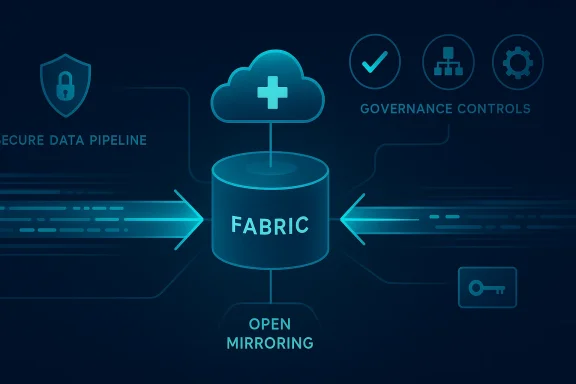
Neon cloud-to-container data flow diagram labeled “FABRIC,” with secure pipeline and governance controls.Background​

The Informatica-Microsoft relationship has been building for years, and the latest announcement fits into a longer pattern of deepening technical alignment. Informatica has repeatedly positioned its IDMC platform as a way for Azure customers to combine integration, quality, governance, and MDM with Microsoft’s analytics stack, while Microsoft has increasingly treated partners as essential to filling out Fabric’s ecosystem. Earlier Informatica announcements in 2023 and 2024 emphasized Azure-native service delivery, Fabric integration, and AI-ready data pipelines, showing that this is not a one-off partnership flourish but a sustained product strategy.
Fabric itself matters because it is Microsoft’s effort to collapse multiple data workloads into one integrated analytics fabric. Microsoft’s own Fabric materials make clear that Mirroring and Open Mirroring are intended to reduce friction when moving operational data into OneLake and related analytical surfaces, and Microsoft has been steadily expanding the partner ecosystem around that architecture. That matters to Informatica because a platform like IDMC does not need to replace Fabric; it needs to sit in front of it, feed it, govern it, and make it enterprise-ready.
The timing also matters. Microsoft’s Fabric Community Conference in Atlanta, held March 16–20, 2026, has become a key venue for partner announcements, and Microsoft has continued to frame Fabric as central to its data and AI story. Informatica’s announcement at that event therefore lands in a moment when the market is actively reassessing what “trusted data” means in the age of AI, especially as organizations move from experimentation to production deployments.
There is also a sovereignty angle that has become more important in Europe and Switzerland. Microsoft has publicly expanded digital sovereignty capabilities in the region, and its Swiss cloud footprint is clearly part of a broader regional compliance narrative. Informatica’s new Swiss pod aligns neatly with that trend, giving customers a way to keep data closer to home without giving up mainstream cloud tooling.

What Informatica Actually Announced​

At the center of the announcement is general availability of IDMC support for Microsoft Fabric Open Mirroring. Informatica says the capability is embedded into its Cloud Data Integration and Replication services and can be enabled with a single click, which is a subtle but important claim: the goal is not just compatibility, but operational simplification for mass ingestion pipelines.
The company also announced a new Microsoft Azure-based IDMC pod in Switzerland, available beginning March 2026. According to the announcement, this pod offers the full suite of cloud data management features on Azure, including serverless integration, governance, data quality, and MDM, with a focus on local processing and residency requirements. That combination makes the announcement both a product update and a regional infrastructure play.

Why “single-click” matters​

“Single-click” may sound like marketing shorthand, but in enterprise data engineering it usually translates into fewer moving parts, fewer manual setup steps, and less room for configuration drift. If the promised flow really does reduce the complexity of standing up mirrored database pipelines, then the operational value is real, especially for large teams juggling many source systems.
In practice, the significance lies in consistency. Enterprises do not usually struggle with one pipeline; they struggle with hundreds of pipelines, each with slightly different assumptions, governance controls, and failure modes. Embedding Open Mirroring into IDMC therefore has the potential to standardize how Fabric becomes a downstream analytics target.

What’s new versus older integrations​

This is not Informatica’s first Fabric story. Earlier integrations focused on general connectivity, AI-powered analytics experiences, and Fabric-native data management services, including data quality and profiling capabilities. The new announcement moves the company closer to the operational heart of Fabric by emphasizing mirrored data movement rather than just adjacent tooling.
That distinction matters. A connector is useful; a synchronized operational path is strategically sticky. Once an enterprise builds its trusted data flow around a partner’s replication and governance stack, switching costs rise quickly.

Open Mirroring and the Fabric Architecture​

Open Mirroring is one of the more interesting pieces of Fabric because it reflects Microsoft’s broader attempt to support a more open, partner-driven data estate. Microsoft Learn describes Open Mirroring as a way for applications to write change data directly into a mirrored database in Fabric, and Microsoft has already assembled a partner ecosystem around it. Informatica’s entry into that ecosystem gives the feature real enterprise weight.
The technical implication is straightforward: instead of forcing every source system through custom ETL logic, customers can feed Fabric with mirrored operational data that is available for analytics and downstream AI use cases. That is a practical answer to a longstanding problem in data platforms, namely the gap between transactional systems and analytical consumption layers.

Why mirrored data is attractive​

Mirroring reduces the latency between source and analytics, which is valuable for dashboards, operational intelligence, and AI retrieval workflows. Microsoft’s own documentation and partner examples show that Fabric is being positioned as a place where operational data can become analysis-ready without excessive copying or transformation.
For enterprises, the appeal is not only speed but governance. Informatica is explicitly tying mirroring to data quality, master data management, and policy enforcement, which suggests it wants to prevent the familiar scenario where “real-time” means “real-time chaos.” That’s the real differentiator: not just faster ingestion, but faster ingestion with controls.

The ecosystem angle​

Microsoft has been cultivating a partner ecosystem around Open Mirroring, and that is important because no single vendor can cover every source, every compliance regime, or every enterprise data pattern. Microsoft’s official partner ecosystem pages show this is intended to be a modular, partner-friendly framework rather than a closed, single-vendor stack.
Informatica’s participation effectively broadens that ecosystem’s enterprise credibility. It brings a known data-management brand into Fabric’s mirroring story, which can reassure customers who want open architecture but still expect strong governance.

Why IDMC Matters in the AI Era​

The real story here is not mirroring itself; it is the idea of trusted data for AI. Informatica is leaning hard into the proposition that AI initiatives fail when data quality, lineage, and stewardship are weak. Microsoft has made a similar argument across Fabric, Azure AI, and its broader data platform messaging.
This is where IDMC matters. Informatica is not selling merely a pipe from source to sink. It is selling a control plane for data: integration, governance, quality, cataloging, and MDM. In AI terms, that means less hallucination risk, better grounding, and more confidence that training or inference workflows are using fit-for-purpose data.

Enterprise AI needs more than speed​

Many organizations are discovering that low-latency ingestion is necessary but insufficient. If the underlying data is inconsistent, duplicated, or poorly governed, then a fast pipeline just speeds up bad decisions. Informatica’s pitch is that AI success depends on a cleaner upstream data foundation, and this announcement reinforces that message.
That stance should resonate in regulated industries such as finance, healthcare, and manufacturing. Those sectors often need both rapid analytics and auditable data stewardship, which makes a governed mirroring solution more attractive than a raw replication tool.

Governance as a product feature​

By tying Open Mirroring to governance, data quality, and MDM, Informatica is framing governance as an enabler rather than a brake. That is a smart positioning move because buyers increasingly want AI acceleration without creating a compliance blind spot. The message is that governance can be embedded into the data flow instead of bolted on later.
  • Better lineage across source-to-analytics workflows
  • Stronger trust in AI training and retrieval data
  • Reduced manual cleanup in downstream Fabric datasets
  • More consistent stewardship across teams and regions
  • Less reliance on ad hoc replication scripts

The Switzerland Pod and the Sovereignty Shift​

The Switzerland pod may be the less flashy part of the announcement, but it could be the more commercially important one in Europe. Data residency, processing locality, and regulatory certainty are no longer niche procurement requirements; they are central buying criteria for many European enterprises.
By offering a Swiss IDMC pod on Azure, Informatica is signaling that it understands how regional cloud strategy is changing. Customers want modern analytics and AI features, but they also want assurance that sensitive data is not being moved unnecessarily across borders or jurisdictions. For some buyers, that alone can determine vendor shortlists.

Why Switzerland is strategically relevant​

Switzerland is not just another European market. It has a long-standing reputation for privacy-conscious business practices, a sophisticated financial sector, and strong expectations around data handling. A Swiss deployment option therefore serves not only domestic customers but also multinational firms using Switzerland as a regional operating hub.
Microsoft has been investing in sovereign cloud capabilities in Switzerland, and Informatica’s pod expands that ecosystem story. The move also fits a broader European pattern where cloud vendors are localizing infrastructure to keep pace with regulatory and political demands.

Practical compliance implications​

The announcement says the pod is designed to support data residency, sovereignty, and regulatory requirements that call for local processing. That matters because many organizations can technically comply with policy only by deploying services in-region rather than just asserting logical controls.
  • Local data processing can simplify compliance reviews
  • Regional deployment can reduce legal ambiguity
  • Sovereignty features can accelerate procurement cycles
  • In-region cloud services can improve latency for local workloads
  • Localized infrastructure can help customers align with internal risk policies
The broader implication is that cloud strategy is becoming geopolitical as well as technical. Vendors that can offer both innovation and locality will likely have an advantage.

Microsoft Fabric, Azure, and the Partner Strategy​

Microsoft’s strategy with Fabric has been to make the platform broad enough to be useful, but open enough to attract partners that fill in real enterprise gaps. The Open Mirroring ecosystem is one of the clearest examples of that strategy in action, and Informatica’s deeper integration strengthens the case that Microsoft wants partners to do more than resell capacity.
The Azure pod announcement also reinforces the commercial mechanics of the partnership. Customers can buy IDMC via Microsoft Marketplace, and qualifying purchases can count toward Azure Consumption Commitments under Microsoft’s terms, which creates an incentive for procurement teams to stay within the Microsoft commercial envelope.

The procurement advantage​

This is a classic platform play. Microsoft benefits when third-party services are bought through its marketplace because it increases customer lock-in and makes spend management easier. Informatica benefits because it enters more deeply into enterprise Azure budgets and buying motions.
That commercial alignment is often underappreciated. The technical integration may be what gets the demo, but the marketplace and commitment mechanics often determine whether the deal actually closes.

Why rivals should pay attention​

For competitors in the data integration space, the message is unmistakable: Fabric is becoming a battleground for data-management ecosystems, not just a reporting surface. If Microsoft can make Fabric the default analytics destination while partners like Informatica provide governance and ingestion, then rival data platforms must answer not only on features but on ecosystem fit.
That could pressure other data-management vendors to tighten their own cloud-native integrations, especially where sovereignty and real-time replication are concerned.

Competitive Implications for the Data Market​

The announcement also highlights how the competitive map is shifting. The big battle is no longer simply ETL versus ELT, or warehouse versus lakehouse. It is now about which platform can support a governed, interoperable, low-friction AI data estate across multiple clouds and jurisdictions.
Informatica’s strategy is to remain the trusted data layer above infrastructure choices. Microsoft’s strategy is to make Fabric and Azure the attractive center of gravity. Those strategies complement each other nicely, but they also squeeze competitors from both ends.

Snowflake, Databricks, and the ecosystem pressure​

Vendors like Snowflake and Databricks have been strong on analytics and data engineering respectively, but Microsoft is increasingly tying together platform, AI, and partner governance in a way that can be hard to match. Informatica’s deep Microsoft alignment raises the bar for any rival trying to win enterprise data modernization deals.
This is especially true where customers want one vendor for analytics, another for governance, and a third for replication. If the Microsoft-Fabric-Informatica stack feels sufficiently integrated, the argument for that three-part architecture becomes much stronger.

The enterprise differentiation​

Enterprise buyers do not evaluate these announcements in isolation. They ask whether the stack can reduce complexity, support compliance, and accelerate AI. Informatica’s move suggests that Microsoft’s ecosystem is maturing toward that answer, which is why the partnership matters beyond a single product release.
  • Stronger Microsoft ecosystem credibility for Informatica
  • More pressure on alternative data-integration vendors
  • Greater visibility for Fabric as an enterprise hub
  • Better story for regulated industries
  • Higher switching costs for customers already on Azure

Strengths and Opportunities​

The announcement has several clear strengths, especially for organizations that want to combine modern analytics with controls that satisfy security, compliance, and governance teams. It also opens a few commercial doors that could matter a great deal if Informatica and Microsoft continue to execute well.

Key opportunities​

  • Simplified ingestion from more than 300 enterprise sources into Fabric mirrored databases
  • Near-real-time analytics with fewer hand-built replication pipelines
  • Stronger governance through integrated quality and MDM controls
  • Better regional compliance via the Swiss Azure pod
  • Marketplace-friendly procurement through Azure Consumption Commitments
  • Improved AI readiness because trusted data can be delivered closer to the point of use
  • Lower operational overhead for teams that want standardized data movement patterns
The biggest opportunity is probably customer trust. If Informatica can prove that mirrored data can stay governed, local, and operationally sane, it will own a premium niche in the Fabric ecosystem. That niche could expand quickly if AI deployments keep demanding cleaner and faster access to enterprise data.

Risks and Concerns​

The announcement is promising, but there are still reasons to be cautious. Enterprise data platforms often look elegant in the keynote and then become complex in production, especially when they span multiple clouds, compliance regimes, and source systems.

Key risks​

  • Implementation complexity may remain high despite “single-click” setup claims
  • Governance overhead could still be significant in large, heterogeneous estates
  • Regional availability limits may leave some customers waiting for local options
  • Vendor coupling to Microsoft and Informatica could intensify lock-in concerns
  • Operational reliability will matter more than demo-time simplicity
  • Cost predictability may be difficult if mirrored workloads scale rapidly
  • Jurisdictional questions can still arise even with in-region deployment
There is also a practical risk that customers expect mirroring to solve deeper data-modeling problems it was never designed to fix. Mirroring can move data faster, but it cannot by itself reconcile bad source data, inconsistent master records, or weak data ownership. That is why the governance layer is essential, and also why buyers should be wary of treating this as a silver bullet.

What to Watch Next​

The most important thing to watch is execution. If Informatica and Microsoft can turn this announcement into repeatable customer outcomes, then the partnership becomes a serious blueprint for AI-era data architecture. If not, it risks becoming another attractive but narrow integration story.
Over the next few months, three signals will matter most: adoption, regional expansion, and evidence of production-grade reliability. Enterprises will want to know not just whether the feature exists, but whether it reduces cost and complexity in real deployments.

Watch list​

  • Customer references for Fabric Open Mirroring with IDMC
  • Expansion of the Swiss pod model to other European markets
  • Additional Fabric-native services that deepen governance and quality integration
  • Marketplace traction and Azure consumption usage patterns
  • Performance benchmarks for near-real-time mirrored pipelines
  • New partner ecosystem additions around Open Mirroring
  • Evidence of regulatory wins in finance, healthcare, and public sector deals
The most revealing next step would be a set of published customer stories showing how organizations use IDMC plus Fabric to shorten time to insight without compromising control. That kind of proof would be more persuasive than another architecture diagram.

The Bigger Picture for AI Data Architecture​

This announcement sits at the intersection of three broader trends: the rise of data governance as AI infrastructure, the growing importance of regional cloud sovereignty, and the continuing push toward open yet managed data ecosystems. Informatica and Microsoft are trying to own all three.
The combination is powerful because it addresses a common enterprise anxiety: businesses want AI speed, but they do not want to sacrifice control. By linking Open Mirroring, IDMC, Azure, and Fabric, the two companies are proposing that those goals no longer have to be in conflict.
At the same time, buyers should treat the promise with healthy discipline. The market is full of platforms that promise seamlessness and deliver another layer of complexity. The test for Informatica will be whether this deeper Microsoft integration genuinely simplifies the path from source systems to governed analytics, or merely relocates the complexity to a different layer of the stack.
What makes this announcement noteworthy is that it is directionally consistent with where enterprise data is heading. Organizations are increasingly standardizing around a smaller number of strategic cloud platforms, but they still need specialized control planes for integration and governance. If Informatica can be that control plane for Microsoft’s expanding data universe, it may become even more embedded in the architecture of modern AI.

Looking Ahead​

In the near term, the collaboration should help Informatica sharpen its position as the governance and integration layer for Microsoft-centric enterprises. For Microsoft, it strengthens the argument that Fabric is not just an analytics workspace, but a platform around which an ecosystem can form. That is the real strategic significance of this update.
The next phase will be about proof: proof that mirrored data is reliable, proof that sovereignty claims hold up under audit, and proof that enterprise buyers can adopt these tools without creating new operational sprawl. If those proofs emerge, the Informatica-Microsoft partnership will look less like a product announcement and more like a durable blueprint for AI-ready data architecture.

Source: iTWire iTWire - Informatica Expands Microsoft Collaboration with Open Mirroring Support for Microsoft Fabric and Geographic Expansion for Microsoft Azure Point-of-Delivery
 

Informatica’s latest expansion of its Microsoft partnership is more than another routine cloud announcement. It signals a maturing alliance aimed at solving one of the hardest problems in enterprise AI: getting governed, trustworthy, near-real-time data into the places where analytics and copilots actually run. By adding support for Microsoft Fabric Open Mirroring and launching a new Azure point-of-delivery in Switzerland, Informatica is tightening the loop between data ingestion, governance, residency, and AI readiness. For Microsoft customers, especially in regulated markets, the practical result is simpler architecture with fewer moving parts and more control.

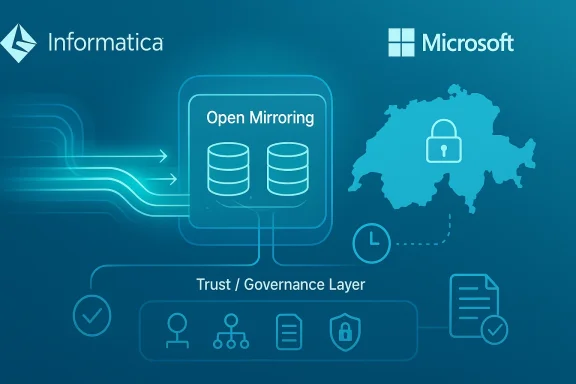
Blue tech graphic showing Informatica and Microsoft branding with an Open Mirroring trust/governance layer.Overview​

The timing matters. Microsoft Fabric has become a core part of Microsoft’s data-and-AI story, and Informatica has been one of the earliest and most persistent partners building around it. Microsoft said at FabCon 2026 in Atlanta that the community conference runs March 16-20, 2026, underscoring how central Fabric has become to the company’s broader data platform push. Against that backdrop, Informatica’s announcement fits a pattern that has been developing since the Fabric launch era: deeper integration, more native experiences, and tighter alignment between enterprise data management and Microsoft’s analytics stack (informatica.com).
Informatica’s relationship with Microsoft has clearly evolved in stages. In 2023, Informatica positioned itself as an early Fabric design partner and framed IDMC as a way to bring trusted data management into OneLake and Microsoft’s newer analytics workflows (informatica.com). In 2024, that collaboration moved further into the platform itself, with Azure Native ISV Service positioning and a Fabric-native application story that aimed to reduce the friction of deploying governance and quality capabilities close to the data estate (informatica.com). In May 2025, the companies formalized a strategic agreement to accelerate joint adoption and co-innovation across Azure, Fabric, and Informatica’s cloud data management platform (informatica.com).
The new announcement is therefore not a reset but an acceleration. Support for Fabric Open Mirroring inside IDMC’s Cloud Data Integration and Replication services means customers can connect large-scale ingestion and mirroring workflows more directly to the fabric of Microsoft’s own analytics architecture. At the same time, the Swiss Azure pod extends Informatica’s regional footprint into a geography where sovereignty, residency, and compliance are not just checkboxes but buying criteria. Taken together, these are strategic plumbing upgrades with very real enterprise consequences.

Why this matters now​

AI programs are increasingly constrained by data quality rather than model quality. Enterprises have learned that even the most advanced foundation models become brittle when fed inconsistent, stale, or poorly governed data. Informatica’s pitch is that its IDMC platform can help make Fabric not just fast, but trustworthy, by combining ingestion, governance, quality, and master data management in one operational layer (informatica.com).
Microsoft’s own Fabric messaging has been consistent on this point. Fabric is designed as a unified analytics environment, and open mirroring is part of the broader OneLake strategy for making data more accessible across workloads. By aligning with that model, Informatica is effectively betting that customers want fewer hand-built ETL and replication pipelines and more managed, policy-aware data movement that works inside the platform they are already adopting.
  • The announcement strengthens a long-running Microsoft-Informatica partnership.
  • It puts governance and data quality closer to mirrored data flows.
  • It helps regulated buyers address residency and sovereignty constraints.
  • It makes Fabric more attractive to enterprises with diverse source systems.
  • It signals continued investment in multicloud-friendly enterprise architecture.

The broader market signal​

This is also a competitive move. The data integration market is crowded, and vendors are fighting to own the trusted-data layer that sits between operational systems, cloud warehouses, and AI applications. Informatica is leaning into its differentiation: broad source connectivity, enterprise governance, and a mature metadata and MDM stack. Microsoft, meanwhile, benefits by showing that Fabric is not just a standalone analytics product, but an ecosystem that can absorb high-value third-party capabilities.
The message to rivals is clear. If you want to compete for enterprise AI data pipelines, you need more than speed and scale. You need compliance, lineage, governance, and regional deployment choices. That is where Informatica is trying to anchor itself.

Open Mirroring and the Fabric Data Plane​

Open Mirroring is the headline feature here because it moves the partnership from “integration exists” to “integration is operationally embedded.” Informatica says its April 2026 IDMC release will support Microsoft Fabric Open Mirroring directly within Cloud Data Integration and Replication services, letting customers enable it with a single click while building and maintaining mass ingestion pipelines from more than 300 enterprise data sources. That matters because enterprise data teams increasingly want mirroring workflows that feel native rather than stitched together.
The practical appeal is obvious. Mirroring can reduce latency between source systems and analytic destinations, while preserving a consistent data copy for downstream use in BI, reporting, and AI workflows. If done well, it reduces the maintenance burden of custom pipelines and gives teams more deterministic behavior around synchronization. If done poorly, it merely adds another layer of abstraction, but Informatica’s strategy is to make the process operationally safer through its own orchestration and governance capabilities.

What Open Mirroring changes​

Microsoft Fabric’s mirrored databases and OneLake-oriented architecture are designed to simplify how data lands in the analytics environment. Informatica’s contribution is to make that landing zone more enterprise-friendly by inserting IDMC’s integration and replication layer directly into the workflow. That gives teams a place to apply policies, standardize quality checks, and track lineage before mirrored data starts feeding dashboards or AI agents.
This is where the announcement becomes more than a connector story. A simple mirror can move bytes. A governed mirror can move trust. The distinction matters because AI systems are only as reliable as the data they consume, and enterprises now judge platforms not merely on whether data arrives, but on whether it arrives in a usable, auditable, policy-compliant form.

Why the one-click promise is important​

“Single click” sounds like marketing language, but in enterprise software it often points to something concrete: fewer configuration steps, fewer prerequisite services, and fewer opportunities for operator error. Informatica is effectively saying that customers will not need to assemble a custom replication stack every time they want to mirror sources into Fabric. Instead, the flow is built into existing CDIR tooling.
That may sound incremental, but incremental improvements are often the ones enterprises adopt first. Teams are typically conservative about replacing brittle but familiar pipelines. A lower-friction migration path can therefore become a wedge for broader platform adoption.
  • Fewer bespoke replication jobs to maintain.
  • Lower operational overhead for data engineers.
  • More standardized onboarding for source systems.
  • Better alignment with Fabric-native analytics patterns.
  • A cleaner path to near-real-time analytics.

The governance angle​

Informatica is also emphasizing that mirrored data can still be subject to enterprise-grade governance, data quality, and master data management services. That is important because mirroring without control can create faster chaos. The value proposition is not just speed, but disciplined speed.
For enterprises, this may be the strongest part of the announcement. Many organizations already have enough tools to copy data. What they lack is confidence in the data once it is copied. Informatica is trying to solve that confidence gap by making mirroring part of a broader managed data lifecycle rather than a standalone technical trick.

Azure Pod Expansion in Switzerland​

The Switzerland-based Azure pod is the less flashy but potentially more consequential part of the announcement. Informatica says the new IDMC Azure pod will be available beginning March 2026 and will deliver the full suite of IDMC cloud data management capabilities on Azure, including serverless integration, governance, data quality, and master data management. For European buyers, especially those with stringent data residency requirements, that is not a footnote; it is often the deciding factor.
Regional pods matter because cloud adoption in Europe is increasingly shaped by sovereignty, regulatory clarity, and operational locality. Switzerland has long been an attractive jurisdiction for sensitive workloads precisely because customers want strong privacy expectations and local processing options. By placing an IDMC pod there, Informatica is making it easier for buyers to deploy closer to data subjects, reduce cross-border transfer friction, and satisfy internal governance rules.

Data residency as a product feature​

What used to be a legal and procurement concern is now a platform design requirement. Enterprise buyers increasingly ask whether a provider can keep data in-region, support local processing, and document how workloads align with regulatory obligations. Informatica’s Swiss pod turns that question into an architectural choice rather than an exception workflow.
That is especially relevant for financial services, healthcare, manufacturing, and public sector organizations operating in or across Europe. These sectors often need data management tools that can support analytics without forcing data out of approved jurisdictions. The announcement suggests Informatica recognizes that regional trust is becoming as important as cloud scale.

Why Switzerland is strategically smart​

Switzerland is not just another EU-adjacent market. It is a high-trust location that resonates with enterprises looking for a neutral, compliance-forward deployment posture. Launching there gives Informatica a way to speak to European buyers who may be wary of overly centralized cloud architectures.
It also broadens the company’s competitive narrative. Rather than being seen as a global SaaS vendor with one-size-fits-all hosting, Informatica can present itself as a placement-aware platform, one that adapts to local regulatory environments. That nuance matters when selling into multinational organizations with inconsistent data rules across regions.
  • Supports data residency and sovereignty needs.
  • Enables local processing for sensitive workloads.
  • Improves alignment with European compliance demands.
  • Expands deployment flexibility for multinational customers.
  • Strengthens Informatica’s regional Azure footprint.

Marketplace and commitment alignment​

The company also notes that customers can purchase IDMC services via Microsoft Marketplace and have qualifying purchases count toward Microsoft Azure Consumption Commitments under applicable terms. This is a meaningful commercial detail. Enterprise cloud buying is increasingly shaped by commitment accounting, and if a service can be consumed in a way that fits existing Azure commitments, that lowers procurement friction.
In practice, that means the Swiss pod is not just a technical deployment location. It is a sales enabler. It gives account teams a cleaner story for enterprise customers who want regional hosting without losing commercial alignment with the broader Azure estate.

The Long Arc of the Microsoft-Informatica Partnership​

This announcement makes more sense when viewed as the latest step in a multi-year integration strategy. Informatica first announced Fabric integration in May 2023, saying it was one of the first ISV design partners for Microsoft Fabric and that customers would gain access to IDMC capabilities as a first-party service (informatica.com). The 2024 follow-up added Azure Native ISV Service positioning and deeper Fabric-native delivery, making the platform feel less like a partner add-on and more like an extension of the Microsoft experience (informatica.com).
By May 2025, the companies were talking in explicitly strategic terms, with a formal agreement to accelerate customer adoption and joint innovation across Azure and Fabric (informatica.com). That language matters because it signals the relationship is no longer just about integration engineering; it is about coordinated go-to-market and shared platform positioning.

From design partner to embedded capability​

The progression is important. Design-partner status can sometimes be symbolic. Azure-native service integration is more substantive. Open Mirroring support and a regional pod go one step further by embedding Informatica deeper into day-to-day customer operations.
This creates a stronger switching-cost story for both companies. Microsoft benefits when Fabric becomes the default place where enterprise data lands. Informatica benefits when its governance, quality, and integration logic becomes part of that default path. The result is a partnership that is increasingly self-reinforcing.

The AI context changes everything​

The partnership has also evolved because the market has changed. In 2023, the story was largely about modern analytics and cloud data management. In 2025 and 2026, the narrative is dominated by AI readiness, responsible AI, and enterprise trust. That shift gives Informatica a larger strategic opening because its historical strengths—cataloging, quality, lineage, MDM, and policy enforcement—map well to AI governance needs.
In that sense, the company is not just selling data plumbing. It is selling the trust layer for AI. That is a stronger and more durable positioning than pure connectivity alone.

Key milestones in the partnership​

  • 2023: Informatica announced Fabric integration as an early design partner.
  • 2024: The company added Azure Native ISV Service and Fabric-native data quality capabilities.
  • 2025: A strategic agreement formalized joint innovation and adoption efforts.
  • 2026: Open Mirroring support and a Swiss Azure pod extend the partnership into operational and regional deployment territory.
This evolution suggests deliberate, staged deepening rather than opportunistic co-marketing. That is usually a good sign for enterprise buyers who need platform roadmaps they can trust.

Enterprise Impact: Governance, Quality, and Operational Simplicity​

For enterprise customers, the biggest value in this announcement is simplification without surrendering control. Most large organizations do not struggle because they cannot move data. They struggle because they move data through too many brittle paths, with too little lineage, and too many manual controls. Informatica’s pitch is that its IDMC layer can reduce that complexity while preserving the governance discipline that enterprises need.
That is particularly compelling for firms running multi-cloud estates. Many companies live in a world where operational systems, warehouse tools, BI tools, and AI services sit across Azure, other clouds, and on-prem environments. A platform that can normalize data movement and governance across those domains has obvious appeal.

Why enterprises care about “trusted data”​

The phrase “trusted data” can sound abstract, but it becomes concrete fast in enterprise operations. It means that finance can reconcile reports, compliance can trace transformations, and AI teams can explain what data a model consumed. Without that trust, analytics teams spend huge amounts of time validating outputs rather than generating insight.
Informatica’s integration story addresses this by combining ingestion, replication, quality, governance, and MDM around Fabric. That helps enterprises avoid the common trap of using a modern analytics front end with a fragmented back end.

Operationally, the value is labor reduction​

There is also a hidden labor story here. Every hand-built pipeline is a future maintenance task. Every custom quality script is a future incident. Every inconsistent schema mapping is a future outage. If Informatica can reduce the number of bespoke objects teams need to maintain, the savings accumulate quickly.
This is why seemingly modest features can matter so much in enterprise software. They do not just improve user experience; they compress operational drag. In large organizations, that drag is often the real cost center.
  • Less hand coding for mirroring and replication.
  • Better consistency across source systems.
  • Easier compliance documentation.
  • Reduced pipeline fragility.
  • More predictable AI data inputs.

The Microsoft buyer advantage​

There is also a procurement benefit for Azure-first organizations. Because Informatica can be consumed through Microsoft Marketplace and aligned with Azure commitments, it becomes easier to justify adoption in budget cycles that are already centered on Azure spend. This is a subtle but powerful advantage, especially in enterprises where platform decisions are tied to cloud consumption commitments.
That means the announcement is not merely about technology compatibility. It is about fitting into how enterprises already buy software.

Consumer and SMB Relevance: Smaller Teams, Same Pressure​

Although the announcement is primarily enterprise-focused, smaller teams and midsize businesses will feel some of the downstream effects too. As more companies adopt Fabric and Azure as standardized data environments, the same simplicity and governance benefits that appeal to global enterprises will trickle down to teams with fewer engineers and tighter budgets. They may not need every advanced feature, but they still need secure, reliable data movement.
For SMBs, the appeal lies in reducing platform sprawl. A smaller IT team often cannot afford multiple point solutions for replication, cataloging, quality, and governance. If Informatica can package those capabilities in a way that fits Fabric and Azure workflows, it may help smaller organizations avoid assembling an overly complex stack.

What smaller organizations gain​

The value proposition for smaller teams is mostly about reducing the need for specialized data engineering resources. A one-click or more fully managed mirroring setup can save time that would otherwise be spent on schema alignment, connector maintenance, and manual policy enforcement.
There is also a trust benefit. Smaller organizations often need to move fast, but they are rarely immune from regulatory scrutiny. A platform that bakes in governance can help them move faster without taking on disproportionate risk.

The catch for smaller buyers​

The challenge is cost and complexity. Informatica is a powerful enterprise platform, and some SMBs may find it more than they need. The value will depend on whether the company can make the new capabilities feel accessible rather than heavyweight.
That tension is common in enterprise software. If the platform becomes too rich, smaller teams may still choose lighter tools. If it becomes too simple, it may lose the enterprise depth that made it compelling in the first place.
  • Easier adoption for small data teams.
  • Less need for custom pipeline engineering.
  • Better governance by default.
  • Potentially faster time to insight.
  • But still a premium enterprise orientation.

Competitive Implications for Databricks, Snowflake, and Others​

This announcement also lands in a fiercely competitive market. Microsoft, Informatica, Databricks, Snowflake, and other data platform vendors are all trying to control the path from raw data to AI-ready insight. The battleground is no longer just storage or compute. It is the trust layer, the governance layer, and the workflow layer that determine where data lands and how it gets consumed.
Informatica’s move strengthens Microsoft’s position in that contest by making Fabric more adaptable to enterprise realities. It also helps Informatica defend against being reduced to a generic integration vendor. Instead, it can position itself as the enterprise control plane that complements whichever analytics environment the customer chooses.

Why this pressures rivals​

For competitors, the problem is that Microsoft plus Informatica offers a compelling combination: platform scale, enterprise connectivity, governance, and regional deployment options. A rival would need to match not just one piece of that stack, but the combination. That is much harder.
It also raises the bar for “native” claims across the market. If data management tools can be embedded directly into major cloud ecosystems while still retaining cross-cloud flexibility, standalone tools must work harder to prove they offer unique value.

The Fabric angle specifically​

Fabric is still in its growth phase relative to more established analytics ecosystems, and partnerships like this help de-risk adoption for large buyers. If a customer knows they can bring Informatica’s governance and integration capabilities into Fabric, the platform feels more enterprise-ready. That can tilt evaluations away from rival warehouses or analytics suites that lack equivalent governance depth.
At a minimum, this keeps Microsoft in the conversation when enterprises are comparing analytics platforms for AI programs.

Market differentiation in one sentence​

Informatica is not trying to out-warehouse warehouse vendors. It is trying to own the reliability layer that sits above them.
  • Stronger Fabric credibility for Microsoft.
  • Better enterprise posture for Informatica.
  • More pressure on standalone integration vendors.
  • Increased importance of governance and MDM in platform sales.
  • More competition on sovereignty and regional deployment.

Strengths and Opportunities​

The announcement has several clear strengths. It connects platform strategy with operational utility, and it does so in a way that aligns with where the market is headed: governed AI, regional compliance, and simplified enterprise data motion. More importantly, it builds on years of partnership rather than introducing a one-off feature that might disappear in the next roadmap shuffle.
  • Deepens an already credible Microsoft partnership.
  • Reduces pipeline complexity for Fabric customers.
  • Improves governance around mirrored data.
  • Expands regional deployment options in a high-trust geography.
  • Supports AI and analytics with more reliable data foundations.
  • Fits Azure consumption and Marketplace procurement patterns.
  • Strengthens Informatica’s differentiation as a trusted-data platform.
  • Creates a smoother path from source systems to AI workloads.

Strategic upside​

The biggest opportunity is that Informatica can become the default enterprise data-management complement to Fabric. If that happens, Microsoft gets stronger enterprise credibility and Informatica gets a more durable place in the AI stack. That kind of mutual reinforcement is hard for competitors to disrupt once customers standardize on it.
The Swiss pod also gives Informatica a better story in Europe, where cloud sovereignty is increasingly a strategic requirement rather than an edge case. In that sense, the company is not only growing coverage; it is growing relevance.

Risks and Concerns​

There are, however, meaningful risks. The first is execution risk. Enterprise customers will judge these capabilities not by the press release but by stability, supportability, and how well the integrations behave under real workloads. If mirroring becomes fragile or the regional pod introduces operational friction, the narrative weakens fast.
The second concern is complexity creep. The promise of simplification only holds if customers can actually use the new features without needing specialist expertise. A platform can easily become more capable while becoming less approachable, and that is a common trap in enterprise data software.
  • Execution risk if early deployments are unstable.
  • Complexity risk if setup still requires expert intervention.
  • Cost concerns for smaller organizations.
  • Vendor dependence concerns if Microsoft alignment narrows flexibility.
  • Compliance expectations may rise faster than operational maturity.
  • Competitive pressure could force faster roadmap commitments.
  • Regional rollout differences may create support inconsistencies.

The AI trust problem remains unsolved​

It is also worth remembering that governance tools do not automatically guarantee trustworthy AI. They help, but they are not magic. Enterprises still need clean source systems, disciplined metadata management, and governance processes that are actually enforced. Informatica can lower the barrier, but it cannot eliminate the organizational work required to make AI reliable.
That is the real risk behind every trusted-data promise: the technology may be ready before the operating model is.

Looking Ahead​

The next phase of this story will be about adoption, not announcement. If customers start using Open Mirroring support to move data into Fabric with less friction, and if the Switzerland pod becomes a credible option for regulated European workloads, this collaboration will look like a meaningful platform shift rather than a marketing milestone. The proof will be visible in deployment patterns, customer references, and how quickly enterprise teams turn these features into production habits.
Microsoft and Informatica will also need to show that the experience is genuinely seamless across the full lifecycle: onboarding, replication, governance, observability, and compliance reporting. That is the standard enterprise buyers now expect. They do not want isolated features; they want operational coherence.

What to watch next​

  • Adoption of Open Mirroring support in real customer environments.
  • Whether the Swiss Azure pod attracts regulated industries in Europe.
  • New references showing governed Fabric analytics at scale.
  • Further native integrations between IDMC and Microsoft’s data stack.
  • Signs that Microsoft and Informatica are aligning on AI governance workflows.
  • Competitive responses from Databricks, Snowflake, and other integration vendors.
  • Additional regional expansions if the Switzerland launch performs well.
The bigger picture is straightforward. Enterprise AI is becoming a data governance story, and data governance is becoming a platform strategy story. Informatica’s latest move with Microsoft acknowledges that shift and tries to turn it into a commercial advantage. If the execution matches the ambition, this partnership could become one of the more important enterprise data alliances in the Azure era.
What makes the announcement notable is not just that it adds another feature or another region. It is that it reflects how the market is changing: away from fragmented data tooling and toward integrated, policy-aware, geographically flexible data foundations. In that world, the winners will not simply be the fastest systems, but the ones enterprises trust enough to build their next generation of analytics and AI on top of them.

Source: iTWire iTWire - Informatica Expands Microsoft Collaboration with Open Mirroring Support for Microsoft Fabric and Geographic Expansion for Microsoft Azure Point-of-Delivery
 

Back
Top