

On May 20, 2026, Informatica from Salesforce announced expanded Microsoft integrations that put its Headless Intelligent Data Management Cloud into Microsoft Foundry via MCP servers and extend Microsoft Fabric support with mass ingestion and Change Data Capture for Fabric Data Warehouse. The move is not just another partner badge on a marketplace page. It is a sign that the real contest in enterprise AI is shifting from model selection to data access, governance, lineage, and operational plumbing. For Microsoft customers, the pitch is simple: agents and analytics are only useful when they can reach the right data without turning compliance into an afterthought.
Microsoft has spent the last several years turning Azure, Fabric, Copilot, and now Foundry into the scaffolding for enterprise AI. The company’s argument is that customers should not have to assemble every model, connector, governance layer, and analytics service from scratch. Foundry sits in that story as the place where developers and organizations build, test, and operate AI agents.
But agents are not magic simply because they can call tools. A business agent that cannot find trusted customer records, reconcile duplicate identities, understand metadata, or respect governance boundaries is little more than a chatbot with ambition. That is where Informatica wants to insert itself.
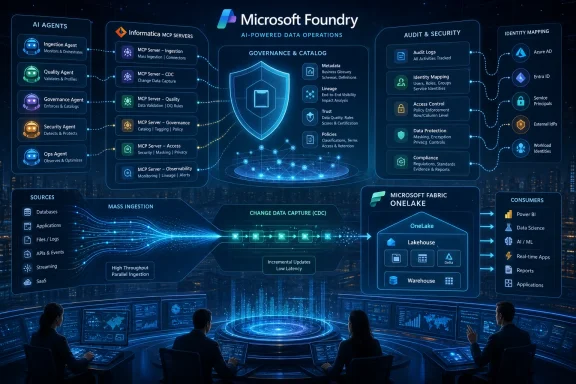
The new integration makes Informatica’s Model Context Protocol servers available through Microsoft Foundry’s tools ecosystem. In practical terms, developers building agents in Foundry can discover and connect Informatica capabilities without stepping outside the Microsoft environment. The available services include data governance and catalog metadata search, address verification, customer identification, job management, and data provisioning.
That list matters because it is not a collection of flashy generative AI features. It is the kind of unglamorous enterprise infrastructure that determines whether an AI project survives contact with production. The agent era is making metadata, lineage, and data quality newly fashionable, but only because companies are discovering that AI systems amplify bad data faster than dashboards ever did.
For Informatica, that model is a natural fit. Its business has long revolved around moving, cataloguing, governing, and cleaning enterprise data. MCP gives those functions a new surface area: not just pipelines triggered by engineers, but callable services inside agent workflows.
That could change how data management is consumed. An agent might need to verify an address before generating a customer communication, check catalog metadata before answering a business analyst’s question, or provision governed data before triggering a downstream process. In each case, the data management function becomes part of the reasoning-and-action loop rather than a separate pre-processing chore.
The risk is that MCP also makes integration look deceptively simple. A tool listed in a catalog is not the same thing as a governed enterprise deployment. Authentication, permissions, logging, policy enforcement, and failure handling still have to be designed carefully. The catalog makes discovery easier; it does not absolve IT teams from architecture.
Informatica benefits because it meets customers where new AI projects are being built. The company does not have to persuade every team to begin in its own console. Instead, its capabilities appear inside the platform where Azure customers are already experimenting with agents.
That is a subtle but significant change in enterprise software power. The old integration play was to sell a platform and ask customers to connect it to everything else. The new one is to appear as a trusted tool inside someone else’s agent workbench. Vendors that win in this environment may not be the ones with the loudest AI demos, but the ones whose services become default building blocks in agent workflows.
There is a defensive angle too. Microsoft’s platform ambitions are broad enough that partners have to decide whether they are complements, competitors, or both. By integrating deeper with Foundry, Informatica is choosing to become part of Microsoft’s AI fabric rather than forcing customers into a parallel universe.
This is the part of the story that will matter to data engineers and administrators who have to make AI and analytics systems run on Monday morning. Moving a few clean demo tables into a warehouse is easy. Moving enterprise-scale data from hundreds of sources, keeping it current, and doing so without burning compute on wasteful full reloads is the hard part.
Change Data Capture exists because reality changes incrementally. Orders are updated, customer records are corrected, subscriptions are cancelled, and inventory shifts. Rather than re-copying entire datasets, CDC tracks changes and moves only what is needed. At scale, that can reduce compute consumption, improve freshness, and make analytics environments less brittle.
Informatica says the service can ingest data from more than 300 enterprise sources and support very large monthly row volumes. That is the kind of claim IT teams will test against their own constraints: source system load, schema drift, latency needs, licensing costs, and governance requirements. Still, the direction is obvious. Fabric wants to be Microsoft’s unified analytics estate, and Informatica wants to be one of the trusted ramps into it.
Most enterprises do not have a single clean data estate waiting to be moved. They have operational databases, SaaS platforms, legacy warehouses, departmental spreadsheets, data lakes, governance tools, and years of undocumented business logic. The harder Microsoft pushes Fabric as the destination, the more it needs credible ways to get messy data into that destination.
That is where Informatica’s integration has practical appeal. A customer already invested in Informatica may see Fabric adoption as less risky if existing ingestion, replication, governance, and metadata practices can carry forward. Conversely, a Microsoft-first customer may view Informatica as a way to avoid hand-building every connector and pipeline.
The trade-off is dependency. Deep integration can reduce friction, but it can also tighten the bond between vendor roadmaps. If Fabric becomes the centre of a company’s analytics strategy and Informatica becomes the preferred ingestion and governance layer, switching costs rise on both sides. That may be acceptable for enterprises that value standardisation, but it should not be mistaken for neutrality.
Salesforce and Microsoft compete fiercely across CRM, productivity, AI assistants, data platforms, and developer mindshare. Yet enterprise customers routinely run both stacks. A global company might use Microsoft 365, Azure, Fabric, Power BI, and Foundry while also depending on Salesforce for customer engagement and revenue operations.
Informatica sits across that divide. Its value increases if it can operate as a data management layer that is useful beyond Salesforce’s own clouds. A strong Microsoft integration reassures customers that Informatica will not become trapped inside Salesforce’s ecosystem.
For Salesforce, that matters strategically. The Informatica acquisition was partly about strengthening the data foundation for AI. But if Informatica is to retain its broader enterprise relevance, it has to remain credible in heterogeneous environments. The Microsoft tie-up is a public signal that Salesforce understands that data infrastructure cannot be treated as a single-vendor island.
Those incentives overlap just enough to produce collaboration. Microsoft gains a mature data management provider inside Foundry and stronger ingestion options for Fabric. Informatica gains distribution and relevance inside Microsoft’s AI stack. Salesforce gains proof that its newly acquired data asset can serve multicloud, multi-platform enterprises.
But the overlap does not erase competition. Every vendor in this chain wants to own the customer relationship, the orchestration layer, and the governance narrative. Today’s integration can become tomorrow’s platform boundary dispute if customers start asking which system is the source of truth for policy, identity, metadata, or lineage.
That is why IT leaders should read this announcement less as a final architecture and more as a signpost. The market is converging on a model where agents call tools, tools enforce policy, and data platforms compete to become the trusted context layer. The details of who controls which layer will matter enormously.
An agent that answers a finance question needs governed data. An agent that updates a customer record needs identity resolution and auditability. An agent that triggers a workflow needs access controls and operational monitoring. If those foundations are missing, the impressive demo becomes a liability.
The announcement leans heavily on the phrase “trusted data,” and for once the cliché is doing real work. Trust in this context does not mean a vague feeling that the system is probably right. It means the organization can understand where data came from, whether it is current, who is allowed to use it, how it has changed, and what happened when an automated process acted on it.
That is why the integration spans both Foundry and Fabric. Foundry is about agents and tool use. Fabric is about analytics, storage, ingestion, and data movement. Informatica is trying to bridge the two so that the data foundation and the agent experience are not designed in isolation.
A sales agent that uses an outdated customer hierarchy may recommend the wrong contract action. A support agent that cannot distinguish between two similar customer identities may expose information to the wrong account. A procurement agent using incomplete supplier data may route approvals incorrectly. None of these failures require science fiction; they require ordinary enterprise data problems.
That is the market opening for Informatica. Its pitch is that AI adoption will drag old data management disciplines into the centre of executive attention. Governance, cataloguing, master data, address validation, and data provisioning may not sound like the future, but they are exactly the things that determine whether agentic systems can be trusted.
Microsoft has the same incentive. Foundry needs enterprise customers to believe agents can be built and scaled with confidence. The more Microsoft can surround Foundry with governed tool ecosystems and data integrations, the easier it becomes to argue that agent development belongs in Azure rather than in scattered experiments.
Enterprise teams will still need to map permissions, configure connections, decide which agents can call which tools, monitor usage, and define escalation paths. They will need to understand how Informatica’s services interact with Microsoft identity, logging, governance, and security controls. They will need to test how agents behave when a tool fails, returns ambiguous results, or exposes data that requires additional approval.
The same applies to Fabric ingestion. Mass ingestion and CDC can reduce manual work, but they do not eliminate data modelling, quality checks, capacity planning, or cost management. Keeping a Fabric Data Warehouse current is valuable only if downstream consumers understand the freshness, meaning, and limitations of the data.
In other words, this is not a shortcut around enterprise architecture. It is a potentially useful consolidation of surfaces. The best outcome is fewer brittle hand-built integrations and more reusable governed services. The worst outcome is a new layer of agent-accessible tools that organizations enable faster than they can control.
That means the tool layer has to be treated with the same seriousness as APIs, service accounts, and automation scripts. Least privilege matters. Logging matters. Separation between development and production matters. So does understanding whether an agent is acting on behalf of a user, a service principal, or some delegated identity model.
MCP does not remove these concerns. It standardises a way for agents to interact with tools, which can make governance easier if implemented well. But standardisation also accelerates adoption, and acceleration is where security gaps tend to appear.
The right question for administrators is not whether MCP is good or bad. The right question is whether the organization has a policy for agent-accessible tools before those tools begin proliferating. If Foundry becomes the place where business teams discover new capabilities, IT needs visibility before experimentation becomes shadow infrastructure.
Media companies are useful examples because they tend to have fragmented data problems: subscriptions, advertising, content analytics, customer engagement, finance, and operational systems all generating information at different speeds and in different formats. Bringing that data to business users is not simply an analytics challenge. It is an integration and governance challenge.
Informatica’s role in that story is to make Microsoft’s stack more plausible for the messy middle of the enterprise. Fabric may be the destination, and Foundry may be the agent-building layer, but customers still need a way to connect real systems with real histories. The more complex the estate, the more valuable mature data management becomes.
That does not mean every Microsoft customer needs Informatica. Smaller organizations or teams already standardised on Microsoft-native tooling may find enough in Fabric, Data Factory, Power BI, Purview, and related services. But for enterprises with deeply heterogeneous environments, third-party data management remains a practical necessity rather than a luxury.
Foundry needs agents that can do real work. Real work requires tools. Tools require data, permissions, governance, and observability. Microsoft can build much of this itself, but it cannot credibly replicate every specialised enterprise system and data management capability. Partner integrations fill the gap.
The Tools Catalog is therefore more than a convenience feature. It is Microsoft’s answer to the question of how organizations will safely expand what agents can do. If the catalog becomes the default place to discover trusted tools, Microsoft gains leverage over the agent ecosystem even when the underlying capability comes from another vendor.
Informatica is betting that being present there is better than being adjacent. That is probably right. In the current market, the point of integration is no longer just data movement between applications. It is placement inside the workflow where AI systems are being designed.
AI changes the economics. When an agent can make recommendations, trigger workflows, draft communications, or initiate operational steps, the cost of bad data becomes more immediate. A flawed dashboard may mislead a meeting. A flawed agent may act.
That distinction is why vendors are rushing to reposition data management as AI infrastructure. Informatica is not alone. Every company with a catalog, data quality engine, integration platform, lakehouse, warehouse, vector store, or governance tool is now arguing that it is essential to agentic AI. Some of that is marketing inflation. Some of it is true.
The useful way to separate the two is to look for operational specificity. Informatica’s announcement has enough specificity to be meaningful: named services in Foundry, MCP servers, Fabric Data Warehouse support, mass ingestion, CDC, OneLake targets, and hundreds of enterprise sources. The value will still depend on implementation, but this is more concrete than generic “AI-ready data” branding.
They should also test latency and freshness assumptions. CDC can keep data more current, but “near real time” means different things across industries and workloads. Some use cases need seconds. Others tolerate hours. The architecture should match the business risk rather than the marketing phrase.
Finally, buyers should be wary of duplicating governance systems. Many Microsoft customers already use Microsoft Purview or other catalog and governance tools. Informatica may complement those investments, but overlap can create confusion if ownership is unclear. The worst governance architecture is one in which every system claims to be authoritative and none actually is.
The best deployments will define roles explicitly. Foundry may be the agent environment, Fabric the analytics and storage foundation, Informatica the integration and data management layer, and existing security tools the enforcement backbone. But those boundaries have to be designed, not assumed.
 Microsoft’s AI Stack Needs More Than Models
Microsoft has spent the last several years turning Azure, Fabric, Copilot, and now Foundry into the scaffolding for enterprise AI. The company’s argument is that customers should not have to assemble every model, connector, governance layer, and analytics service from scratch. Foundry sits in that story as the place where developers and organizations build, test, and operate AI agents.But agents are not magic simply because they can call tools. A business agent that cannot find trusted customer records, reconcile duplicate identities, understand metadata, or respect governance boundaries is little more than a chatbot with ambition. That is where Informatica wants to insert itself.
The new integration makes Informatica’s Model Context Protocol servers available through Microsoft Foundry’s tools ecosystem. In practical terms, developers building agents in Foundry can discover and connect Informatica capabilities without stepping outside the Microsoft environment. The available services include data governance and catalog metadata search, address verification, customer identification, job management, and data provisioning.
That list matters because it is not a collection of flashy generative AI features. It is the kind of unglamorous enterprise infrastructure that determines whether an AI project survives contact with production. The agent era is making metadata, lineage, and data quality newly fashionable, but only because companies are discovering that AI systems amplify bad data faster than dashboards ever did.
MCP Turns Data Management Into Something Agents Can Call
The most important phrase in the announcement is not “AI” or “analytics.” It is Model Context Protocol. MCP has quickly become one of the preferred ways to expose tools, services, and data sources to AI agents in a standardised fashion. The idea is straightforward: instead of hard-wiring every agent to every system through bespoke integrations, vendors expose capabilities through MCP servers that agents can discover and invoke.For Informatica, that model is a natural fit. Its business has long revolved around moving, cataloguing, governing, and cleaning enterprise data. MCP gives those functions a new surface area: not just pipelines triggered by engineers, but callable services inside agent workflows.
That could change how data management is consumed. An agent might need to verify an address before generating a customer communication, check catalog metadata before answering a business analyst’s question, or provision governed data before triggering a downstream process. In each case, the data management function becomes part of the reasoning-and-action loop rather than a separate pre-processing chore.
The risk is that MCP also makes integration look deceptively simple. A tool listed in a catalog is not the same thing as a governed enterprise deployment. Authentication, permissions, logging, policy enforcement, and failure handling still have to be designed carefully. The catalog makes discovery easier; it does not absolve IT teams from architecture.
Foundry Becomes a Distribution Channel for Enterprise Controls
Microsoft benefits from this arrangement because Foundry becomes more than an AI development environment. It becomes a distribution channel for the enterprise controls that customers already need. If agents are going to perform work across CRM, ERP, data warehouses, SaaS applications, and internal repositories, Microsoft needs the surrounding ecosystem to make those connections credible.Informatica benefits because it meets customers where new AI projects are being built. The company does not have to persuade every team to begin in its own console. Instead, its capabilities appear inside the platform where Azure customers are already experimenting with agents.
That is a subtle but significant change in enterprise software power. The old integration play was to sell a platform and ask customers to connect it to everything else. The new one is to appear as a trusted tool inside someone else’s agent workbench. Vendors that win in this environment may not be the ones with the loudest AI demos, but the ones whose services become default building blocks in agent workflows.
There is a defensive angle too. Microsoft’s platform ambitions are broad enough that partners have to decide whether they are complements, competitors, or both. By integrating deeper with Foundry, Informatica is choosing to become part of Microsoft’s AI fabric rather than forcing customers into a parallel universe.
Fabric Is Where the Plumbing Gets Real
The second part of the announcement is less glamorous but arguably more important for day-to-day IT operations. Informatica is expanding Cloud Data Integration support for Microsoft Fabric with mass ingestion and Change Data Capture for Fabric Data Warehouse. That means customers can move large volumes of data into Fabric OneLake or Fabric Data Warehouse and keep it synchronized through incremental updates.This is the part of the story that will matter to data engineers and administrators who have to make AI and analytics systems run on Monday morning. Moving a few clean demo tables into a warehouse is easy. Moving enterprise-scale data from hundreds of sources, keeping it current, and doing so without burning compute on wasteful full reloads is the hard part.
Change Data Capture exists because reality changes incrementally. Orders are updated, customer records are corrected, subscriptions are cancelled, and inventory shifts. Rather than re-copying entire datasets, CDC tracks changes and moves only what is needed. At scale, that can reduce compute consumption, improve freshness, and make analytics environments less brittle.
Informatica says the service can ingest data from more than 300 enterprise sources and support very large monthly row volumes. That is the kind of claim IT teams will test against their own constraints: source system load, schema drift, latency needs, licensing costs, and governance requirements. Still, the direction is obvious. Fabric wants to be Microsoft’s unified analytics estate, and Informatica wants to be one of the trusted ramps into it.
OneLake Wants Gravity, But Gravity Requires Migration Paths
Microsoft’s Fabric strategy depends heavily on OneLake becoming a central data layer for analytics and AI. The company’s pitch is that organizations should be able to unify data engineering, warehousing, real-time analytics, business intelligence, and AI workloads around a common foundation. The aspiration is elegant; the migration work is not.Most enterprises do not have a single clean data estate waiting to be moved. They have operational databases, SaaS platforms, legacy warehouses, departmental spreadsheets, data lakes, governance tools, and years of undocumented business logic. The harder Microsoft pushes Fabric as the destination, the more it needs credible ways to get messy data into that destination.
That is where Informatica’s integration has practical appeal. A customer already invested in Informatica may see Fabric adoption as less risky if existing ingestion, replication, governance, and metadata practices can carry forward. Conversely, a Microsoft-first customer may view Informatica as a way to avoid hand-building every connector and pipeline.
The trade-off is dependency. Deep integration can reduce friction, but it can also tighten the bond between vendor roadmaps. If Fabric becomes the centre of a company’s analytics strategy and Informatica becomes the preferred ingestion and governance layer, switching costs rise on both sides. That may be acceptable for enterprises that value standardisation, but it should not be mistaken for neutrality.
Salesforce’s Ownership Gives the Partnership a Sharper Edge
There is another layer here: Informatica is now part of Salesforce. Salesforce completed its acquisition of Informatica in November 2025, positioning the company’s data management technology as a foundation for its own AI and customer data ambitions. That makes this Microsoft collaboration more interesting than a routine Azure partner update.Salesforce and Microsoft compete fiercely across CRM, productivity, AI assistants, data platforms, and developer mindshare. Yet enterprise customers routinely run both stacks. A global company might use Microsoft 365, Azure, Fabric, Power BI, and Foundry while also depending on Salesforce for customer engagement and revenue operations.
Informatica sits across that divide. Its value increases if it can operate as a data management layer that is useful beyond Salesforce’s own clouds. A strong Microsoft integration reassures customers that Informatica will not become trapped inside Salesforce’s ecosystem.
For Salesforce, that matters strategically. The Informatica acquisition was partly about strengthening the data foundation for AI. But if Informatica is to retain its broader enterprise relevance, it has to remain credible in heterogeneous environments. The Microsoft tie-up is a public signal that Salesforce understands that data infrastructure cannot be treated as a single-vendor island.
Coopetition Is the Default State of Enterprise AI
The partnership also shows how strange the enterprise AI market has become. Microsoft wants as much AI development as possible to happen in its cloud. Salesforce wants its own agentic AI and data platforms to become indispensable. Informatica wants to be the trusted connective tissue. Customers want results without rebuilding their data estates from scratch.Those incentives overlap just enough to produce collaboration. Microsoft gains a mature data management provider inside Foundry and stronger ingestion options for Fabric. Informatica gains distribution and relevance inside Microsoft’s AI stack. Salesforce gains proof that its newly acquired data asset can serve multicloud, multi-platform enterprises.
But the overlap does not erase competition. Every vendor in this chain wants to own the customer relationship, the orchestration layer, and the governance narrative. Today’s integration can become tomorrow’s platform boundary dispute if customers start asking which system is the source of truth for policy, identity, metadata, or lineage.
That is why IT leaders should read this announcement less as a final architecture and more as a signpost. The market is converging on a model where agents call tools, tools enforce policy, and data platforms compete to become the trusted context layer. The details of who controls which layer will matter enormously.
The Agent Hype Cycle Finally Meets the Data Warehouse
The strongest argument for the Informatica-Microsoft expansion is that it connects two conversations that are too often separated. The AI team talks about agents, prompts, tools, and copilots. The data team talks about ingestion, governance, schemas, lineage, and cost. In production, those are the same conversation.An agent that answers a finance question needs governed data. An agent that updates a customer record needs identity resolution and auditability. An agent that triggers a workflow needs access controls and operational monitoring. If those foundations are missing, the impressive demo becomes a liability.
The announcement leans heavily on the phrase “trusted data,” and for once the cliché is doing real work. Trust in this context does not mean a vague feeling that the system is probably right. It means the organization can understand where data came from, whether it is current, who is allowed to use it, how it has changed, and what happened when an automated process acted on it.
That is why the integration spans both Foundry and Fabric. Foundry is about agents and tool use. Fabric is about analytics, storage, ingestion, and data movement. Informatica is trying to bridge the two so that the data foundation and the agent experience are not designed in isolation.
The Hidden Cost of Bad Context Is Operational Risk
The industry has spent plenty of time discussing hallucinations, but less time discussing mundane bad context. In enterprise systems, an AI agent does not need to invent a fact to cause trouble. It can simply rely on stale, duplicated, incomplete, or unauthorised data.A sales agent that uses an outdated customer hierarchy may recommend the wrong contract action. A support agent that cannot distinguish between two similar customer identities may expose information to the wrong account. A procurement agent using incomplete supplier data may route approvals incorrectly. None of these failures require science fiction; they require ordinary enterprise data problems.
That is the market opening for Informatica. Its pitch is that AI adoption will drag old data management disciplines into the centre of executive attention. Governance, cataloguing, master data, address validation, and data provisioning may not sound like the future, but they are exactly the things that determine whether agentic systems can be trusted.
Microsoft has the same incentive. Foundry needs enterprise customers to believe agents can be built and scaled with confidence. The more Microsoft can surround Foundry with governed tool ecosystems and data integrations, the easier it becomes to argue that agent development belongs in Azure rather than in scattered experiments.
The Practical Test Is Not Discovery, But Deployment
The announcement’s language emphasizes discoverability: Informatica’s MCP servers are available in Foundry’s tools catalog, and customers can connect services from within the Microsoft environment. That is useful. But discoverability is only the first inch of the deployment mile.Enterprise teams will still need to map permissions, configure connections, decide which agents can call which tools, monitor usage, and define escalation paths. They will need to understand how Informatica’s services interact with Microsoft identity, logging, governance, and security controls. They will need to test how agents behave when a tool fails, returns ambiguous results, or exposes data that requires additional approval.
The same applies to Fabric ingestion. Mass ingestion and CDC can reduce manual work, but they do not eliminate data modelling, quality checks, capacity planning, or cost management. Keeping a Fabric Data Warehouse current is valuable only if downstream consumers understand the freshness, meaning, and limitations of the data.
In other words, this is not a shortcut around enterprise architecture. It is a potentially useful consolidation of surfaces. The best outcome is fewer brittle hand-built integrations and more reusable governed services. The worst outcome is a new layer of agent-accessible tools that organizations enable faster than they can control.
Security Teams Will Care About the Tool Layer
For WindowsForum.com’s sysadmin and IT pro audience, the security implications deserve special attention. AI agents create a new operational surface because they do not merely retrieve information; they can call tools. Once an agent can provision data, query metadata, identify customers, or trigger jobs, its permissions become part of the security model.That means the tool layer has to be treated with the same seriousness as APIs, service accounts, and automation scripts. Least privilege matters. Logging matters. Separation between development and production matters. So does understanding whether an agent is acting on behalf of a user, a service principal, or some delegated identity model.
MCP does not remove these concerns. It standardises a way for agents to interact with tools, which can make governance easier if implemented well. But standardisation also accelerates adoption, and acceleration is where security gaps tend to appear.
The right question for administrators is not whether MCP is good or bad. The right question is whether the organization has a policy for agent-accessible tools before those tools begin proliferating. If Foundry becomes the place where business teams discover new capabilities, IT needs visibility before experimentation becomes shadow infrastructure.
Hearst Shows the Buyer Microsoft Wants to Win
The customer quote in the announcement comes from Hearst, which says it is using Microsoft Fabric and Microsoft Foundry as part of an enterprise data platform effort. That example is carefully chosen. Microsoft wants large, complex organizations to see Fabric and Foundry not as isolated products, but as parts of a strategic data and AI estate.Media companies are useful examples because they tend to have fragmented data problems: subscriptions, advertising, content analytics, customer engagement, finance, and operational systems all generating information at different speeds and in different formats. Bringing that data to business users is not simply an analytics challenge. It is an integration and governance challenge.
Informatica’s role in that story is to make Microsoft’s stack more plausible for the messy middle of the enterprise. Fabric may be the destination, and Foundry may be the agent-building layer, but customers still need a way to connect real systems with real histories. The more complex the estate, the more valuable mature data management becomes.
That does not mean every Microsoft customer needs Informatica. Smaller organizations or teams already standardised on Microsoft-native tooling may find enough in Fabric, Data Factory, Power BI, Purview, and related services. But for enterprises with deeply heterogeneous environments, third-party data management remains a practical necessity rather than a luxury.
Microsoft’s Ecosystem Strategy Is Becoming the Product
The broader pattern is familiar from earlier platform eras. A platform becomes more valuable as more partners build around it. But in the AI agent market, the ecosystem is not just a set of add-ons; it is part of the product’s claim to enterprise readiness.Foundry needs agents that can do real work. Real work requires tools. Tools require data, permissions, governance, and observability. Microsoft can build much of this itself, but it cannot credibly replicate every specialised enterprise system and data management capability. Partner integrations fill the gap.
The Tools Catalog is therefore more than a convenience feature. It is Microsoft’s answer to the question of how organizations will safely expand what agents can do. If the catalog becomes the default place to discover trusted tools, Microsoft gains leverage over the agent ecosystem even when the underlying capability comes from another vendor.
Informatica is betting that being present there is better than being adjacent. That is probably right. In the current market, the point of integration is no longer just data movement between applications. It is placement inside the workflow where AI systems are being designed.
The Old Data Stack Is Being Repriced by AI
For years, data governance was easy to underfund because the consequences of weak governance were often indirect. Reports disagreed, dashboards proliferated, and analysts spent time reconciling definitions. Painful, yes, but usually survivable.AI changes the economics. When an agent can make recommendations, trigger workflows, draft communications, or initiate operational steps, the cost of bad data becomes more immediate. A flawed dashboard may mislead a meeting. A flawed agent may act.
That distinction is why vendors are rushing to reposition data management as AI infrastructure. Informatica is not alone. Every company with a catalog, data quality engine, integration platform, lakehouse, warehouse, vector store, or governance tool is now arguing that it is essential to agentic AI. Some of that is marketing inflation. Some of it is true.
The useful way to separate the two is to look for operational specificity. Informatica’s announcement has enough specificity to be meaningful: named services in Foundry, MCP servers, Fabric Data Warehouse support, mass ingestion, CDC, OneLake targets, and hundreds of enterprise sources. The value will still depend on implementation, but this is more concrete than generic “AI-ready data” branding.
Buyers Should Demand Proof Beyond the Demo
Enterprise buyers should push past the press-release framing and ask practical questions. How are identities mapped between Foundry, Informatica, Azure, and source systems? How are tool calls logged and audited? What data leaves which boundary when an agent invokes an Informatica service? How are failures surfaced? How does pricing behave when ingestion volumes or agent calls scale?They should also test latency and freshness assumptions. CDC can keep data more current, but “near real time” means different things across industries and workloads. Some use cases need seconds. Others tolerate hours. The architecture should match the business risk rather than the marketing phrase.
Finally, buyers should be wary of duplicating governance systems. Many Microsoft customers already use Microsoft Purview or other catalog and governance tools. Informatica may complement those investments, but overlap can create confusion if ownership is unclear. The worst governance architecture is one in which every system claims to be authoritative and none actually is.
The best deployments will define roles explicitly. Foundry may be the agent environment, Fabric the analytics and storage foundation, Informatica the integration and data management layer, and existing security tools the enforcement backbone. But those boundaries have to be designed, not assumed.
The Fine Print Behind the Foundry-Fabric Pitch
The concrete lesson from this announcement is that Microsoft’s AI stack is becoming more dependent on partner-grade data infrastructure, not less. Informatica’s deeper integration may help customers move faster, but it also raises the bar for architecture, security, and cost discipline.- Informatica’s MCP servers in Microsoft Foundry make governance, catalog search, address verification, customer identification, job management, and data provisioning available as agent-callable tools.
- Expanded Microsoft Fabric support adds mass ingestion and Change Data Capture for Fabric Data Warehouse, giving joint customers a more direct route for keeping Fabric environments current.
- The integration is most relevant for enterprises with hybrid and multicloud data estates that cannot rely solely on Microsoft-native sources or simple batch pipelines.
- MCP improves tool discovery and interoperability, but it does not automatically solve identity, audit, permission, or lifecycle management problems.
- Salesforce’s ownership of Informatica makes the Microsoft collaboration strategically important because it keeps Informatica positioned as cross-platform enterprise infrastructure.
- The real measure of success will be whether customers can reduce integration work without creating a new layer of poorly governed agent-accessible automation.
References
- Primary source: IT Brief UK
Published: Mon, 25 May 2026 14:40:52 GMT

Informatica deepens Microsoft ties with Foundry boost
Enterprise AI teams could gain easier access to governed data as Informatica plugs its tools into Microsoft Foundry and Fabric.
itbrief.co.uk
- Related coverage: informatica.com
Informatica Deepens Collaboration with Microsoft to Deliver Trusted Data for Agentic AI and Analytics at Scale | Informatica
Headless Informatica’s Intelligent Data Management Cloud is Now Available in Microsoft Foundry; Expanded Microsoft Fabric Integration Enhances Analytics Capabilities www.informatica.com
- Official source: learn.microsoft.com
Agent tools overview for Microsoft Foundry Agent Service - Microsoft Foundry
Explore the tools available for agents in Foundry Agent Service, including built-in tools, web search, custom options, and the Foundry tool catalog. Get started today.learn.microsoft.com - Official source: techcommunity.microsoft.com
Announcing Elastic MCP Server in Microsoft Foundry Tool Catalog | Microsoft Community Hub
Introduction The future of enterprise AI is agentic - driven by intelligent, context-aware agents that deliver real business value. Microsoft Foundry is... techcommunity.microsoft.com
- Official source: devblogs.microsoft.com
Announcing Foundry MCP Server (preview) in the cloud, speeding up AI development with Microsoft Foundry | Microsoft Foundry Blog
Foundry MCP Server is available on Visual Studio Code, Visual Studio, and Foundry Tools on Microsoft Foundry today!devblogs.microsoft.com - Related coverage: visualstudiomagazine.com
Microsoft Previews Cloud-Hosted Foundry MCP Server for AI Agent Development -- Visual Studio Magazine
Microsoft Foundry has introduced a preview cloud-hosted Foundry MCP Server that lets AI agents securely access Foundry tools for model, agent, deployment, and evaluation workflows from VS Code, Visual Studio, or Foundry itselfvisualstudiomagazine.com
- Related coverage: itpro.com
Microsoft unveils Foundry overhaul for managing, optimizing AI agents | IT Pro
The hyperscaler is aiming to simplify AI agent oversight, as organizations grapple with the increasingly complicated business of processing and paying for outputswww.itpro.com - Official source: microsoft.com
FabCon 2025: Fueling tomorrow’s AI with new agentic capabilities and security innovations in Fabric | Microsoft Fabric Blog
The Microsoft Fabric Community Conference returns to Las Vegas this week—bigger and better than ever. Learn more.www.microsoft.com - Related coverage: informaticaworld.com
change data capture for real time data ingestion and streaming analytics white paper 3914en
PDF documentwww.informaticaworld.com
- Related coverage: docs.informatica.com
- Official source: cdn-dynmedia-1.microsoft.com
- Related coverage: salesforce.com
Salesforce Completes Acquisition of Informatica - Salesforce
SAN FRANCISCO, CA — November 18, 2025 — Salesforce (NYSE: CRM), the world’s #1 AI CRM, today announced it has completed its acquisition of Informatica, awww.salesforce.com - Related coverage: investor.salesforce.com
Salesforce.com, Inc. - Salesforce Signs Definitive Agreement to Acquire Informatica
Salesforce (NYSE: CRM), the world’s #1 AI CRM, and Informatica (NYSE: INFA), a leader in enterprise AI-powered cloud data management, have entered into an agreement for Salesforce to acquire Informatica for approximately $8 billion in equity value, net of Salesforce’s current investment in...investor.salesforce.com
- Related coverage: sst-www.informatica.com.edgekey.net
- Related coverage: techcrunch.com
Salesforce acquires Informatica for $8 billion | TechCrunch
Salesforce plans to utilize Informatica's data management infrastructure as architecture for its AI agents.techcrunch.com - Related coverage: cnbc.com
Salesforce to acquire data management company Informatica in $8 billion deal
Salesforce is buying cloud data management firm Informatica to bolster the enterprise software giant's push into artificial intelligence.www.cnbc.com
