Microsoft Turns a Dangerous Capability Into a Platform Story
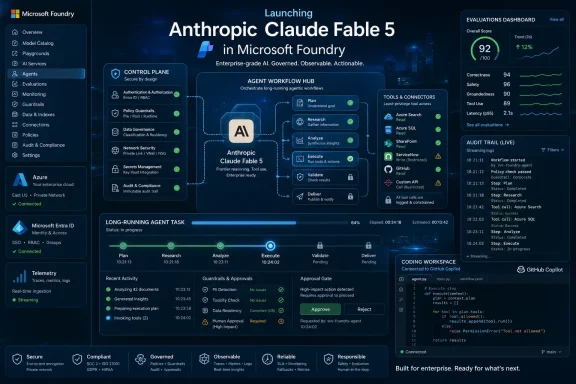
Claude Fable 5 arrives with a name that sounds almost whimsical, but the strategic posture around it is anything but. Anthropic is positioning the model as its latest frontier system for long-running knowledge work, complex coding tasks, deep research synthesis, and document-heavy workflows. Microsoft is positioning the same model as proof that Foundry is not merely a catalog of large language models, but the place where those models become manageable enterprise systems.
That distinction matters because the market has moved beyond the first wave of AI demos. It is no longer enough to show a chatbot summarizing a PDF or writing a unit test. The enterprise pitch is now about agents that can run multi-stage processes, call tools, operate asynchronously, and hold enough context to complete work that previously required a human project owner to keep nudging the system forward.
Fable 5 is framed as a model that can plan, check its own progress, refine outputs, and sustain work across longer arcs. In practical terms, that means Microsoft wants customers to imagine assigning an AI agent to refactor a legacy codebase, digest a set of financial filings, review a contract corpus, or assemble research across internal repositories and the web. That is a bigger promise than “copilot” as autocomplete. It is closer to delegation.
But delegation is where the risk changes shape. A model that can answer a question badly is one class of problem. A model that can operate tools, reason over sensitive data, and continue working after the user has stepped away is a different class of problem entirely. Microsoft’s answer is not to downplay that shift, but to absorb it into Foundry’s governance narrative.
The Model Is the Headline, but the Control Plane Is the Product
The most revealing part of Microsoft’s announcement is not the model’s claimed intelligence. It is the repeated insistence that intelligence alone is insufficient. Foundry is presented as the necessary wrapper around frontier autonomy: evaluation, grounding, guardrails, deployment, monitoring, identity, access control, and operational oversight.
That is classic Microsoft enterprise strategy. The company rarely wins infrastructure markets by insisting it has the only engine worth using. It wins by making the engine fit procurement, security review, compliance reporting, developer workflow, and administrator muscle memory. Azure is the stage; Entra, Purview, Defender, GitHub, Microsoft 365, and Foundry are the supporting cast.
This is why Claude Fable 5 matters even for organizations that are not Anthropic partisans. Microsoft is trying to make model choice less disruptive by turning models into interchangeable components inside a governed agent platform. If a customer wants OpenAI for one workload, Anthropic for another, and a smaller model for routine automation, Microsoft wants that choice to happen without rebuilding the surrounding controls.
The pitch also reflects a subtle acknowledgment of enterprise skepticism. Many organizations have run AI pilots that never became production systems because the operational questions were harder than the prompt engineering. Who owns the agent? What data can it see? Which tools can it call? How are outputs reviewed? How are failures logged? How does a security team prove that policy was enforced?
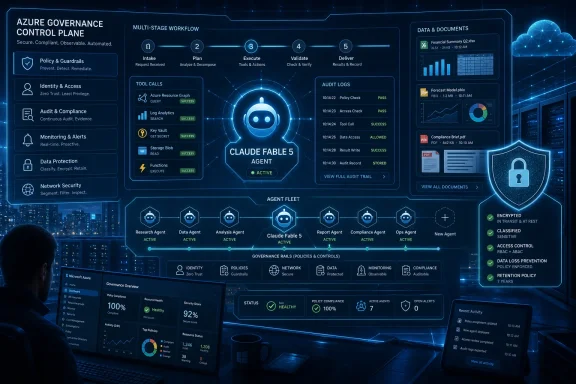
Foundry’s Control Plane is meant to be Microsoft’s answer to those questions. It centralizes inventory, observability, compliance, and security for agents and models. In Microsoft’s framing, that turns agent deployments from one-off experiments into managed assets. Whether customers experience it that way will depend on the maturity of the tooling, but the direction is clear.
Autonomy Is Becoming an IT Governance Problem
The word autonomous has been abused badly in AI marketing, but Fable 5’s arrival shows why the term still matters. The point is not that an agent becomes magically independent. The point is that the loop between human instruction and machine execution stretches out.
A first-generation assistant often needed a user to approve each turn: summarize this, rewrite that, generate this function, explain that error. A more autonomous agent can take a larger goal and decompose it into steps. It can inspect intermediate results, revise a plan, and keep going through tool calls and document reviews without waiting for every micro-instruction.
That makes the user experience more powerful, but it also shifts the burden onto policy. If an agent can act across systems, then its permissions, memory, data access, and escalation rules become as important as the model weights underneath. In a Windows and Microsoft 365 environment, that means the old identity and access management conversation comes roaring back into the center of AI deployment.
For administrators, this is familiar territory wearing unfamiliar clothes. The same organization that would never give a random script broad tenant permissions should not give an agent broad access just because it can speak in polished paragraphs. The fact that a model can reason over Power BI dashboards, application data, internal documents, and web content makes it useful. It also makes it a new kind of insider risk if deployed carelessly.
Microsoft’s emphasis on guardrails, monitoring, and governed agent fleets is therefore not just corporate reassurance. It is an admission that enterprise AI is becoming a live operations discipline. The agent has to be configured, observed, patched, evaluated, and sometimes restrained. That is sysadmin work, even when the interface is conversational.
GitHub Copilot Becomes the First Mass-Market Test Bed
Fable 5 powering agents in GitHub Copilot gives the announcement its most immediate developer impact. Copilot has already trained millions of developers to accept AI assistance inside the coding loop. The next phase is asking those developers to trust AI with larger spans of engineering work: not just completing a function, but understanding a repository, planning a change, editing multiple files, running tests, and explaining the result.
That is where the model’s claimed strengths line up neatly with developer pain. Large refactors are tedious because they require sustained context. Dependency updates are annoying because the work is distributed across build files, tests, runtime assumptions, and documentation. Migration projects are slow because every change seems to expose another hidden coupling.
A stronger long-running agent could help with all of that. It could be especially valuable in enterprise Windows environments where old .NET Framework services, PowerShell scripts, internal line-of-business applications, SQL Server dependencies, and cloud migration plans coexist in uneasy layers. The hard work in those environments is rarely writing greenfield code. It is understanding what is already there without breaking it.
But this is also where developers will be least forgiving. A model that produces a clever answer in a chat window can be impressive even when imperfect. A coding agent that touches a dozen files and introduces a subtle regression will be judged by a harsher standard. In software engineering, autonomy is only valuable if it is paired with reviewability.
That means the practical test for Fable 5 in Copilot will not be whether it can generate more code. The test will be whether it can produce coherent plans, small enough diffs, useful explanations, and testable outputs. Developers do not need an agent that behaves like an overconfident junior engineer with root access. They need one that behaves like a careful collaborator whose work can be inspected.
The Mythos Shadow Gives Fable 5 Its Tension
The announcement’s most interesting tension is Anthropic’s split between Claude Fable 5 and Claude Mythos 5. Microsoft’s Azure post says Fable 5 makes Mythos-level capabilities broadly available with safeguards designed for general use, while Mythos 5 is reserved for a small set of select users, including Project Glasswing participants, for internal defensive use with certain domain restrictions removed.
That framing is important because it suggests the underlying capability frontier has crossed into territory that vendors no longer feel comfortable releasing uniformly. Instead of one public model and one private research model, we now get stratified access: a broadly available version with safety limits, and a more capable or less restricted version held inside a trusted program.
For security professionals, this is both comforting and unsettling. It is comforting because Anthropic and Microsoft are at least acknowledging that advanced cyber, biology, and chemistry capabilities require special handling. It is unsettling because it confirms that model capability is moving into domains where release policy becomes a security control in itself.
Project Glasswing adds another layer to the story. Anthropic has described it as an effort to help major technology companies and infrastructure stakeholders use Mythos-class capabilities for defensive security work. The idea is that trusted defenders should find and fix vulnerabilities before adversaries can use similar AI systems to discover and exploit them.
That sounds sensible. It also raises a difficult question for the broader ecosystem: if the best AI-assisted vulnerability discovery tools are available only to a privileged set of organizations, what happens to everyone else? Smaller software vendors, open-source maintainers, municipal IT departments, and underfunded hospitals may face the downstream effects of AI-accelerated vulnerability discovery without equal access to the strongest defensive tools.
Safety Limits Are Now Part of the Product SKU
Fable 5’s safeguards are not a footnote. They are part of the product definition. According to Microsoft’s summary of Anthropic’s approach, the broadly available model has limits in sensitive domains such as cybersecurity, biology, and chemistry. Mythos 5, by contrast, is intended for internal defensive use by select users with those restrictions removed.
This is a significant shift in how enterprise buyers should think about models. A model is no longer just a set of benchmark scores, token prices, context windows, and latency numbers. It is also a bundle of policy decisions. What the model refuses to do, what it is allowed to help with, and which categories of knowledge are constrained become procurement facts.
That complicates evaluation. A bank assessing Fable 5 for investment research may care most about reasoning over filings, tables, and market commentary. A software company assessing it for code remediation may care about whether the safeguards block legitimate vulnerability analysis. A pharmaceutical company may need to know how the model behaves around chemistry workflows without drifting into prohibited assistance.
The trade-off is unavoidable. If safeguards are too loose, the public release becomes harder to defend. If safeguards are too strict, the model becomes frustrating for professionals doing legitimate work. Microsoft’s job, through Foundry, is to make those trade-offs configurable and observable enough that enterprises can choose risk postures deliberately rather than discovering them through failures.
This is why guided guardrail setup matters. Microsoft says Foundry can ask developers about an agent’s users, data, tools, and actions, then recommend controls at relevant intervention points. That sounds prosaic compared with frontier model drama, but it may be the more important feature for real deployments. Safety that exists only as a model behavior is hard for IT teams to govern. Safety expressed as policy, scope, and logs is at least something they can manage.
Multimodal Reasoning Moves the Battle to the Document Stack
Fable 5’s improved vision capabilities are framed as useful for documents, PDFs, diagrams, charts, and dense tables. That may sound like a secondary feature, but it points directly at one of the richest veins of enterprise work. Businesses do not merely store knowledge as text. They bury it in slide decks, scanned exhibits, architecture diagrams, invoices, filings, spreadsheets, contracts, screenshots, and dashboards.
Traditional automation struggles with this mess because the meaning is often visual and contextual. A table in a regulatory filing may matter because of a footnote. A system diagram may reveal a dependency that is not named in the prose. A chart may carry the argument while the surrounding text says little. A contract exhibit may be more operationally important than the main body.
If Fable 5 can reason more effectively over those mixed formats, it could make agent workflows more useful in finance, legal, analytics, architecture, and compliance teams. The opportunity is not just faster summarization. It is connecting evidence across documents that were never designed for machine reading.
For Microsoft, this is also where the company’s ecosystem advantage becomes clearer. Microsoft 365, SharePoint, Teams, OneDrive, Power BI, Fabric, Dynamics, and Azure repositories already hold enormous amounts of enterprise context. If agents can safely reason over that material, Microsoft can turn existing customer data gravity into an AI platform advantage.
But the privacy and permissions challenge scales with the opportunity. A model that can interpret charts and tables from sensitive documents can also expose sensitive inferences if access boundaries are wrong. The old problem of overshared SharePoint folders becomes more serious when an agent can synthesize hidden meaning across them. Permission hygiene becomes AI hygiene.
Microsoft IQ Is the Ambitious but Murky Middle Layer
The Azure announcement also invokes Microsoft IQ, described as a way to connect agents to enterprise context across Microsoft 365, business systems, knowledge bases, applications, Power BI, and the web. The idea is straightforward: models are more useful when they understand the organization they are working inside. A general model becomes a company-specific agent when grounded in the right data.
That is the dream behind most enterprise AI architecture right now. The model supplies reasoning and language capability. The platform supplies retrieval, permissions, tools, and workflow context. The organization supplies proprietary data. The agent becomes valuable because it can combine all three.
The hard part is that enterprise context is not a clean database. It is contradictory, stale, duplicated, politically sensitive, and full of access mistakes. The average company’s knowledge estate contains retired policies, half-finished planning documents, old pricing sheets, abandoned wiki pages, and Teams threads that were never meant to become durable corporate memory.
If Microsoft IQ is to become the substrate for agents like Fable 5, Microsoft will need to make provenance and freshness visible. Users need to know not just what an agent concluded, but which internal sources shaped that conclusion and whether those sources were authoritative. Otherwise, the agent’s fluency may conceal the same organizational confusion it is supposed to solve.
This is where WindowsForum’s sysadmin readership should pay attention. AI grounding projects will not succeed only because a model is clever. They will succeed when information architecture, identity governance, retention policy, sensitivity labels, and data lifecycle management are treated as prerequisites. The agent era rewards boring discipline.
Pricing Reveals the Intended Workload Class
Microsoft lists Claude Fable 5 pricing at $10 per million input tokens and $50 per million output tokens. That is not bargain-bin inference. It tells customers that this model is meant for difficult work where the value of the task justifies a premium.
The economics matter because autonomous agents can consume tokens in less visible ways than chat sessions. A user sees a single task request, but the agent may perform planning steps, tool calls, intermediate reasoning, file inspections, evaluations, retries, and output revisions. Long-running workflows can turn a simple instruction into a large bill if not monitored.
That does not make Fable 5 expensive in every context. If it saves a legal team hours on diligence, helps a developer complete a risky migration, or accelerates financial analysis, the token bill may be trivial compared with labor costs. But if teams use it casually for work a smaller model could handle, the economics degrade quickly.
Foundry’s role here is again operational. Cost visibility, quotas, model routing, and evaluation should become part of agent deployment design. Enterprises will need to decide which tasks deserve Fable 5, which tasks can run on cheaper models, and when to escalate from one to the other.
This is a familiar cloud pattern. The expensive resource is justified when it is reserved for the right workload and disastrous when treated as unlimited ambient capacity. AI agents will need the same kind of cost engineering that cloud compute eventually required.
Windows Shops Should Read This as an Azure Governance Play
For Windows administrators and Microsoft-centric IT teams, the most practical reading of the announcement is not that Anthropic has a new model. It is that Microsoft is folding third-party frontier intelligence into the Microsoft management story. The agent may be Claude, but the surrounding enterprise experience is Azure.
That has obvious advantages for organizations already standardized on Microsoft identity and security tooling. If agents can be inventoried, monitored, governed, and integrated through familiar Azure and Microsoft 365 patterns, adoption becomes less alien. Procurement can treat the model as part of an existing cloud relationship. Security teams can demand controls in terms they already use.
It also creates lock-in pressure. The more agent workflows depend on Foundry, Microsoft IQ, GitHub Copilot, Microsoft 365 context, Entra permissions, Defender alerts, and Purview policies, the harder it becomes to move those workflows elsewhere. Microsoft’s multi-model pitch gives customers choice among models, but not necessarily choice among platforms.
That is not automatically bad. Many enterprises prefer an integrated stack over a best-of-breed pile of unmanaged services. But IT leaders should be clear-eyed about the trade. Foundry may reduce operational risk by centralizing controls, while also making Azure the default home for agentic work.
This is exactly the kind of strategic bargain Microsoft has offered before. Windows Server, Active Directory, Exchange, System Center, Azure, and Microsoft 365 all made similar promises in their eras: standardize here, and management becomes easier. Fable 5 in Foundry is the AI-era version of that argument.
The Agent Fleet Is the New Endpoint Fleet
Microsoft’s language around agent fleets is worth pausing on. It implies that agents will not remain isolated assistants owned by individual users. They will become numerous, specialized, monitored entities spread across departments and workflows.
That is a profound shift for IT operations. An organization may have agents for invoice review, customer support triage, security alert enrichment, code migration, policy drafting, procurement analysis, and executive reporting. Each agent may have different data access, tool permissions, risk levels, owners, and monitoring requirements.
At that point, agent management begins to resemble endpoint management or service account governance. You need inventory. You need ownership metadata. You need health signals. You need logs. You need compliance posture. You need a process for retirement when an agent is no longer used.
The security implications are obvious. Stale agents with excessive permissions could become the new forgotten service accounts. Poorly monitored tool access could become the new shadow automation. Prompt injection could become the new phishing, except the victim is not a person but a model operating with delegated authority.
Foundry Control Plane is Microsoft’s attempt to get ahead of that future. The fact that the company is already talking about observability, guardrails, compliance, and fleet visibility suggests it understands the shape of the problem. The remaining question is whether customers will impose the same discipline on agents that they often failed to impose on scripts, macros, and shared credentials.
The Competitive Message Is Aimed at Amazon and Google as Much as OpenAI
Microsoft’s Anthropic partnership has always carried a competitive undertone. Anthropic has major relationships across the cloud market, and model availability has become a strategic battleground. By making Claude models available in Foundry, Microsoft can tell customers that Azure is not only the OpenAI cloud. It is a place to access multiple frontier families under one enterprise umbrella.
That matters because enterprises do not want to bet every AI workload on one vendor’s model roadmap. The last two years have taught buyers that model leadership shifts quickly. A model that is best for coding in one quarter may be overtaken in the next. A model that is strong at reasoning may lag in latency or cost. A model that is safe for one regulated workflow may be frustrating in another.
Microsoft benefits if model competition happens above Azure rather than outside it. In other words, the company does not need every customer to choose a Microsoft-made or OpenAI-made model. It needs customers to choose Microsoft as the control surface where those choices are made.
That is the deeper significance of Fable 5 in Foundry. It demonstrates that Microsoft is willing to import outside frontier capability when that strengthens Azure’s platform position. The model marketplace becomes a funnel into Microsoft’s governance stack.
For Anthropic, the arrangement expands enterprise distribution without requiring every customer to adopt Anthropic’s own direct platform as the center of operations. For Microsoft, it neutralizes the objection that Azure customers must leave the Microsoft ecosystem to use Claude at scale. Both sides get something, but Microsoft gets the longer platform story.
The Real Test Will Be Failure Handling
The industry’s AI announcements tend to describe best-case workflows. A model reasons over the right documents, calls the right tools, applies the right guardrails, and produces decision-ready output. The real world will be messier.
Agents will misunderstand goals. They will retrieve stale documents. They will overfit to noisy context. They will call tools in the wrong order. They will generate outputs that look polished but rest on shaky assumptions. They will be blocked by safeguards during legitimate work and miss risky behavior in edge cases. They will cost too much when tasks sprawl.
The key question is not whether Fable 5 can avoid all of that. It cannot. The question is whether Foundry gives organizations enough visibility and control to detect, debug, and improve agent behavior over time. That is where evaluation, tracing, monitoring, and policy enforcement become more than compliance theater.
Microsoft’s announcement leans heavily on the idea of continuously improving systems. That is the right framing. Agents should not be treated as static deployments. They should be evaluated against changing data, changing tools, changing threats, and changing business requirements.
This is especially important for regulated industries. A financial services firm using Fable 5 for research support needs defensible processes around source grounding and review. A legal team using it for contract analysis needs privilege and confidentiality controls. A software team using it for refactoring needs test gates and human review. A security team using it for vulnerability work needs strict boundaries around what is defensive, what is logged, and who can access the results.
The Practical Read for Admins, Developers, and Security Teams
Fable 5 is not a model most organizations should casually sprinkle across every workflow. It is a high-capability, premium-priced system aimed at complex work, and Microsoft is wrapping it in Foundry because that work is risky enough to require real governance. The following points are the practical center of gravity for WindowsForum readers:
- Claude Fable 5 is available through Microsoft Foundry, Foundry Agent Service, and GitHub Copilot as of June 9, 2026.
- The model is being positioned for long-running, multi-stage work such as code refactoring, research synthesis, legal review, financial analysis, and document-heavy enterprise workflows.
- Microsoft’s central pitch is that Foundry can provide the governance layer needed to evaluate, ground, monitor, secure, and operate autonomous agents in production.
- Anthropic is separating broadly available Fable 5 from the more restricted Mythos 5, reflecting a new era in which model access levels and safety limits are part of the product itself.
- IT teams should treat agents as managed enterprise assets with owners, permissions, logs, cost controls, compliance policies, and retirement plans.
- The strongest early deployments will likely be narrow, high-value workflows where the model’s premium cost and autonomy are justified by measurable productivity or risk-reduction gains.
The arrival of Claude Fable 5 in Microsoft Foundry is a marker of where enterprise AI is heading: away from novelty chatbots and toward governed systems that can perform real work inside real organizations. Microsoft is betting that the winners will not be the companies with the flashiest autonomous demos, but the ones that make autonomy legible to administrators, acceptable to security teams, and useful enough for developers and business users to trust. That is a much harder problem than adding another model to a menu, and it is exactly why this announcement matters.