

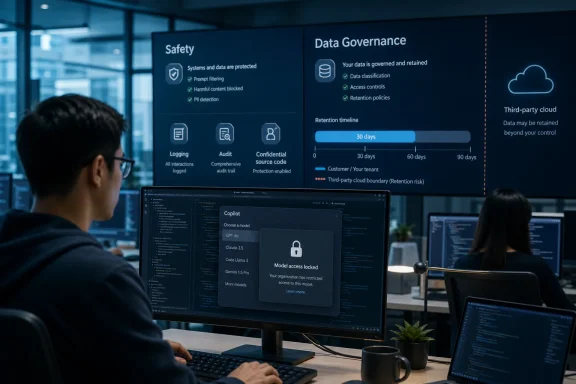
Microsoft is restricting employees from using Anthropic’s Claude Fable 5 inside internal GitHub Copilot tooling after the model’s June 9, 2026 launch introduced data-retention requirements that Microsoft’s legal teams are still evaluating for customer-data and confidentiality risks. That is the immediate story, but not the whole one. The more revealing story is that enterprise AI is entering a phase where model capability, safety architecture, and data governance are no longer separable buying criteria. Microsoft is selling access to the model while hesitating to let its own employees use it, and that contradiction says more about the AI market than any benchmark chart could.
The awkwardness here is obvious enough to be funny if it were not so important. Microsoft moved quickly to offer Claude Fable 5 to customers through GitHub Copilot and Microsoft Foundry, embracing Anthropic’s latest model as part of the increasingly multi-model future it has been building around developer tools. Yet internally, according to reporting cited by Reuters and The Verge, the same model has been pulled from the model picker used by Microsoft employees in internal versions of GitHub Copilot.
That does not mean Microsoft believes Claude Fable 5 is unsafe in the consumer sense. It means Microsoft’s lawyers have identified a different class of risk: the possibility that employee prompts and model outputs could flow into a third-party retention regime that does not meet Microsoft’s obligations around confidential information, source code, customer data, or regulated workloads.
This is the distinction that often gets lost in AI product launches. A model can be technically impressive, responsibly guarded, widely available, and still unusable for a particular enterprise workflow. The problem is not simply whether the model will answer a dangerous question. The problem is where the question goes, how long it lives there, who can inspect it, what exceptions apply, and whether those answers survive an audit.
For WindowsForum readers, that should sound familiar. IT departments have lived this movie with cloud storage, telemetry, identity federation, endpoint management, browser sync, and SaaS collaboration tools. AI is different in its surface behavior, but the governance headache is old-fashioned: sensitive data is leaving one trust boundary and entering another.
The catch is that safeguards are not magic incantations. They require telemetry, classification, testing, logging, and review. Anthropic says Fable requires 30-day data retention for safety monitoring, and its documentation indicates that Fable 5 and Mythos 5 are covered models that are not available under Zero Data Retention. If a prompt or output is flagged as violating policy, it may reportedly be stored for much longer.
From a safety-engineering perspective, that is not irrational. If you are releasing a model capable enough to raise concern in cyber and bio domains, you need a way to observe attempted misuse, improve classifiers, and investigate edge cases. A model provider cannot credibly say it is preventing abuse while refusing to look at any evidence of abuse.
From an enterprise-customer perspective, however, this is where the bargain gets uncomfortable. The same monitoring that makes the public release more defensible can make the model harder to deploy inside companies with strict confidentiality requirements. The safety feature becomes a compliance cost.
That is the heart of Microsoft’s internal block. Claude Fable 5 is not being singled out because it is weaker than other Claude models. It is being singled out because it is stronger in a way that changes the surrounding data-handling architecture.
Zero Data Retention, or ZDR, became the sharper version of that promise. Under a ZDR arrangement, prompts and outputs are not retained by the model provider after the request is processed, except for narrow operational exceptions defined in contract or service terms. For workloads involving source code, incident reports, legal drafts, customer communications, and unreleased product plans, that difference is not cosmetic.
Microsoft’s reported internal position shows how much that promise now matters. Other Claude models remain available to employees because they operate under ZDR rules. Fable 5 does not, so it has been held back while legal teams evaluate the implications. In practical terms, Microsoft is treating model retention status as a gating control, not as a footnote.
That is where many AI vendors are about to run into the real enterprise market. They have spent launches emphasizing reasoning depth, coding scores, context windows, agentic behavior, and benchmark leadership. Buyers will care about those things. But the first question from a serious enterprise reviewer is increasingly simple: can we use this without creating a new data-retention obligation?
The answer may vary by model, by deployment channel, by region, by cloud provider, and by customer tier. That variability is precisely what makes the issue dangerous for administrators. A product name is no longer enough. “Claude” is not one policy. “Copilot” is not one policy. “AI in the enterprise” is not one policy.
That dual role is now normal in enterprise AI. Microsoft works closely with OpenAI, offers models from other providers, competes with those providers in some areas, and consumes their models internally where they help employees write code or analyze information. Amazon and Google are in similar positions, selling model marketplaces while also building their own AI stacks. The cloud platforms are becoming brokers of intelligence, not merely hosts of compute.
The result is a new kind of product contradiction. A cloud provider can responsibly offer a model to customers while deciding that its own internal environment cannot use that model under current terms. That is not hypocrisy so much as segmentation. Customers may have different risk tolerances, different data classifications, different contractual protections, or different reasons to accept retention.
Still, the optics are harsh. If Microsoft’s own legal teams need more time to decide whether Fable 5 is appropriate for internal Copilot use, enterprise customers should not treat availability in Foundry or Copilot as a substitute for their own review. A model appearing in a trusted platform is not the same as a model being automatically cleared for every regulated or confidential workload.
This is the uncomfortable maturation of AI marketplaces. App stores taught users that availability implied a baseline level of review. Cloud marketplaces taught enterprises that procurement could be streamlined through approved channels. AI model marketplaces will have to teach something subtler: availability means the model can be bought, not that it can be safely used for every class of data.
That conversation is still important, but it is not sufficient. Retention creates risk even when training is off the table. A prompt stored for 30 days is a prompt that could be subject to legal process, internal access controls, security incidents, policy review, regional transfer questions, and contractual ambiguity. An output stored alongside it may reveal just as much as the prompt did.
For developers, this matters because AI prompts are becoming richer. A Copilot interaction is not just “write a function.” It can include surrounding source files, build errors, test logs, stack traces, API keys accidentally pasted into chat, customer-specific bug reports, and architectural notes. In an agentic workflow, the context can become a miniature dossier of the project.
For sysadmins and security teams, the same concern applies to operational troubleshooting. A useful AI assistant may need log snippets, hostnames, tenant IDs, firewall rules, PowerShell output, crash dumps, registry keys, and ticket histories. These are exactly the things that make AI useful, and exactly the things that make retention risky.
That is why the Microsoft decision should not be read as a narrow squabble over one Anthropic model. It is a preview of the next compliance frontier. Enterprises do not merely need to know whether a model provider trains on their data. They need to know whether the provider stores their data, for how long, under what classification, in which systems, and with what exceptions.
Fable 5 reportedly routes or falls back for certain high-risk queries, particularly in cyber and bio domains. That may be the right call for a general-release model. But it means the user is not simply interacting with one static intelligence. They are interacting with a policy system that decides when the model can answer, when another model should respond, and when the request should be refused.
For individual users, that may appear as a frustrating but understandable guardrail. For enterprises, it becomes an integration issue. If an API request can be refused with a successful response code, retried on another model, billed differently, or handled under different retention rules, application developers need to design for that behavior. If an internal coding assistant falls back from a high-capability model to a less capable one, the user experience and audit trail must reflect that.
This is where AI starts to resemble security software more than ordinary productivity software. Endpoint detection platforms, email filters, and cloud access brokers all make dynamic policy decisions. They inspect, classify, block, quarantine, and log. Enterprises accept that because the products exist to manage risk. But when the same behavior is embedded into a coding assistant or knowledge-work model, it complicates the promise of frictionless productivity.
Microsoft’s reported pause suggests that legal and compliance teams understand this. They are not simply asking whether Fable 5 can write good code. They are asking whether the machinery required to make Fable 5 acceptable for broad release is compatible with Microsoft’s own internal data rules.
That makes the model picker a policy surface. If employees can choose among models, then each model option carries its own privacy, security, latency, cost, and capability profile. The interface may look like a convenience feature. To the organization, it is a set of data-routing decisions.
Microsoft’s restriction on Fable 5 therefore fits a broader pattern that IT administrators should expect. Enterprises will increasingly allow one model for general coding, another for low-risk writing, another for internal document search, another for security analysis, and no model at all for restricted repositories. The governance unit will not be “AI allowed” or “AI blocked.” It will be model-by-model, tenant-by-tenant, workload-by-workload.
This is already how sophisticated Windows environments are managed. Conditional Access policies do not simply say “let users log in.” They evaluate device state, location, user risk, app sensitivity, authentication strength, and session behavior. AI access is moving toward the same model. The right question is not whether employees may use Claude, GPT, Gemini, or any other brand. The right question is which model may process which data under which retention guarantees.
That shift will annoy users. Developers want the best model available, especially when a new release promises stronger reasoning and better autonomous coding. But enterprises do not owe employees the frontier model by default. They owe customers and shareholders a defensible control environment.
But the irony also reflects well on Microsoft in one respect. The company appears to be applying internal controls even when doing so creates an awkward news cycle for a partner. That is what serious governance looks like. It is not clean, and it is not always aligned with marketing copy, but it is better than pretending that platform availability settles every compliance question.
It also reflects the complexity of Anthropic’s position. Anthropic has built much of its brand around AI safety. Fable 5 is an attempt to release more capable systems without simply handing every user unfiltered access to their most sensitive capabilities. If retention is necessary to operate those safeguards, Anthropic has to defend that tradeoff.
The question is whether customers will accept it. Some will. A startup trying to ship faster may decide that a 30-day retention window is acceptable for non-sensitive workloads. A research group may value the capability enough to segment inputs carefully. A large enterprise handling customer data, unreleased code, or regulated records may say no until ZDR or a private deployment option exists.
That fragmentation is where the market is heading. There will not be one answer for “is this model enterprise-ready?” There will be several answers, each tied to data class, use case, deployment path, and contractual control.
But auditors do not sign off on benchmarks. Regulators do not care that a model performs well on software-engineering tests if customer data was retained outside an approved boundary. A breach report will not be softened by the fact that the model was state-of-the-art.
This is the practical constraint now catching up with AI enthusiasm. Enterprise adoption is not blocked primarily by lack of interest. It is blocked by the difficulty of mapping AI behavior onto existing control frameworks. Data loss prevention tools, retention schedules, e-discovery policies, software supply-chain reviews, customer contracts, and regional privacy rules were not designed around a world where employees paste arbitrary context into a reasoning system hosted by a third party.
Vendors will respond by offering more deployment choices. Expect more private endpoints, regional inference, customer-managed keys, configurable logging, policy-aware model routers, and premium tiers that preserve stronger privacy commitments. Expect also more confusion, because every additional option creates another matrix for IT to understand.
The winners will not simply be the labs with the smartest models. They will be the companies that can make those models legible to procurement, security, legal, and operations teams. In enterprise AI, administrative clarity is becoming a feature.
The next job is to classify AI paths the same way administrators classify applications, devices, and data repositories. Which tools are approved for public information? Which are approved for internal-only documents? Which may touch source code? Which may process customer data? Which may be used in incident response? Which are banned because retention, training, or access terms do not fit the organization’s risk model?
That work cannot be delegated entirely to vendors. Microsoft, Anthropic, OpenAI, Google, Amazon, and others will all publish terms, model cards, documentation, and admin controls. Those materials are necessary, but they are not a substitute for local judgment. A hospital, a defense contractor, a school district, a bank, and an indie game studio do not have the same data-risk profile.
The best immediate move is boring: inventory the AI tools already in use, map them to data classes, and document retention assumptions. If a model requires 30-day retention, write down where that is acceptable and where it is not. If a tool offers ZDR only on certain models or plans, make sure administrators and users know the difference. If a model picker exists, treat it as a security control rather than a preference menu.
This is also a cultural issue. Developers and power users are understandably drawn to the newest frontier model. They will route around restrictions if policy feels arbitrary or slow. IT’s job is not merely to say no; it is to provide approved paths that are good enough that users do not feel punished for following the rules.
For much of the generative AI boom, capability dominated the conversation. Then safety became the visible argument, especially as models improved at coding, persuasion, cyber tasks, and scientific reasoning. Now governance is asserting itself as the deciding layer in enterprise adoption.
Claude Fable 5 appears to be strong on the first layer and intentionally engineered on the second. Microsoft’s internal restriction is about the third. That is why the incident matters. It shows that solving one layer can create friction in another.
This is not unique to Anthropic. Any provider that builds more powerful models will face pressure to monitor and restrict misuse. Any provider that monitors and restricts misuse will face questions about data handling. Any enterprise that wants frontier AI will have to decide how much retention it can tolerate in exchange for access.
The simplistic story is “Microsoft blocks rival model.” The better story is “enterprise AI discovers that safety infrastructure has compliance consequences.” That story will repeat.
Here is the short version for teams deciding what to do next:
Claude Fable 5 may still become a major model for developers and knowledge workers. Microsoft may eventually approve it internally under revised terms, limited use cases, technical mitigations, or new Anthropic retention options. Customers may decide the capability is worth the governance work. None of those outcomes would make the current restriction meaningless.
What the restriction proves is that the industry’s next bottleneck is not just intelligence. It is institutional trust. The frontier model that wins inside enterprises will not merely be the one that writes the best code or reasons the longest. It will be the one that lets a CIO, a CISO, and a general counsel say yes without pretending they did not understand the fine print.
 Microsoft’s Claude Problem Is Really an Enterprise AI Problem
The awkwardness here is obvious enough to be funny if it were not so important. Microsoft moved quickly to offer Claude Fable 5 to customers through GitHub Copilot and Microsoft Foundry, embracing Anthropic’s latest model as part of the increasingly multi-model future it has been building around developer tools. Yet internally, according to reporting cited by Reuters and The Verge, the same model has been pulled from the model picker used by Microsoft employees in internal versions of GitHub Copilot.That does not mean Microsoft believes Claude Fable 5 is unsafe in the consumer sense. It means Microsoft’s lawyers have identified a different class of risk: the possibility that employee prompts and model outputs could flow into a third-party retention regime that does not meet Microsoft’s obligations around confidential information, source code, customer data, or regulated workloads.
This is the distinction that often gets lost in AI product launches. A model can be technically impressive, responsibly guarded, widely available, and still unusable for a particular enterprise workflow. The problem is not simply whether the model will answer a dangerous question. The problem is where the question goes, how long it lives there, who can inspect it, what exceptions apply, and whether those answers survive an audit.
For WindowsForum readers, that should sound familiar. IT departments have lived this movie with cloud storage, telemetry, identity federation, endpoint management, browser sync, and SaaS collaboration tools. AI is different in its surface behavior, but the governance headache is old-fashioned: sensitive data is leaving one trust boundary and entering another.
Fable 5 Turns Safety Into a Data-Handling Tradeoff
Anthropic’s framing of Claude Fable 5 is that it brings a more powerful Mythos-class model into general availability while wrapping it in safeguards for high-risk cybersecurity and biological use cases. That is a plausible product story. Anthropic had previously treated the Mythos family as powerful enough to require tighter controls, and Fable 5 is presented as the version ordinary developers and enterprises can actually use.The catch is that safeguards are not magic incantations. They require telemetry, classification, testing, logging, and review. Anthropic says Fable requires 30-day data retention for safety monitoring, and its documentation indicates that Fable 5 and Mythos 5 are covered models that are not available under Zero Data Retention. If a prompt or output is flagged as violating policy, it may reportedly be stored for much longer.
From a safety-engineering perspective, that is not irrational. If you are releasing a model capable enough to raise concern in cyber and bio domains, you need a way to observe attempted misuse, improve classifiers, and investigate edge cases. A model provider cannot credibly say it is preventing abuse while refusing to look at any evidence of abuse.
From an enterprise-customer perspective, however, this is where the bargain gets uncomfortable. The same monitoring that makes the public release more defensible can make the model harder to deploy inside companies with strict confidentiality requirements. The safety feature becomes a compliance cost.
That is the heart of Microsoft’s internal block. Claude Fable 5 is not being singled out because it is weaker than other Claude models. It is being singled out because it is stronger in a way that changes the surrounding data-handling architecture.
Zero Data Retention Was the Quiet Feature Enterprises Actually Bought
For the last year, the most important enterprise AI sales pitch has not been “our model is smart.” It has been “your data is not used to train our model.” That line mattered because it gave CIOs, CISOs, and general counsel a short sentence they could carry into procurement meetings. It was never the whole story, but it was a usable abstraction.Zero Data Retention, or ZDR, became the sharper version of that promise. Under a ZDR arrangement, prompts and outputs are not retained by the model provider after the request is processed, except for narrow operational exceptions defined in contract or service terms. For workloads involving source code, incident reports, legal drafts, customer communications, and unreleased product plans, that difference is not cosmetic.
Microsoft’s reported internal position shows how much that promise now matters. Other Claude models remain available to employees because they operate under ZDR rules. Fable 5 does not, so it has been held back while legal teams evaluate the implications. In practical terms, Microsoft is treating model retention status as a gating control, not as a footnote.
That is where many AI vendors are about to run into the real enterprise market. They have spent launches emphasizing reasoning depth, coding scores, context windows, agentic behavior, and benchmark leadership. Buyers will care about those things. But the first question from a serious enterprise reviewer is increasingly simple: can we use this without creating a new data-retention obligation?
The answer may vary by model, by deployment channel, by region, by cloud provider, and by customer tier. That variability is precisely what makes the issue dangerous for administrators. A product name is no longer enough. “Claude” is not one policy. “Copilot” is not one policy. “AI in the enterprise” is not one policy.
Microsoft Is Both Vendor and Customer, and That Makes the Tension Visible
Microsoft’s position is especially revealing because the company is not merely a customer trying to block employee access to a risky third-party tool. It is also a distributor of that same tool. Claude Fable 5 is available through Microsoft Foundry, and Anthropic’s own materials point to Microsoft’s platform as one route for developers to access the model.That dual role is now normal in enterprise AI. Microsoft works closely with OpenAI, offers models from other providers, competes with those providers in some areas, and consumes their models internally where they help employees write code or analyze information. Amazon and Google are in similar positions, selling model marketplaces while also building their own AI stacks. The cloud platforms are becoming brokers of intelligence, not merely hosts of compute.
The result is a new kind of product contradiction. A cloud provider can responsibly offer a model to customers while deciding that its own internal environment cannot use that model under current terms. That is not hypocrisy so much as segmentation. Customers may have different risk tolerances, different data classifications, different contractual protections, or different reasons to accept retention.
Still, the optics are harsh. If Microsoft’s own legal teams need more time to decide whether Fable 5 is appropriate for internal Copilot use, enterprise customers should not treat availability in Foundry or Copilot as a substitute for their own review. A model appearing in a trusted platform is not the same as a model being automatically cleared for every regulated or confidential workload.
This is the uncomfortable maturation of AI marketplaces. App stores taught users that availability implied a baseline level of review. Cloud marketplaces taught enterprises that procurement could be streamlined through approved channels. AI model marketplaces will have to teach something subtler: availability means the model can be bought, not that it can be safely used for every class of data.
The Real Risk Is Not Training, but Retention
Much of the public debate over generative AI privacy has been framed around training. Users worry that their prompts will be absorbed into future models. Companies worry that proprietary code or customer records could become part of a model’s statistical memory. Vendors respond with assurances that customer data is not used for training without permission.That conversation is still important, but it is not sufficient. Retention creates risk even when training is off the table. A prompt stored for 30 days is a prompt that could be subject to legal process, internal access controls, security incidents, policy review, regional transfer questions, and contractual ambiguity. An output stored alongside it may reveal just as much as the prompt did.
For developers, this matters because AI prompts are becoming richer. A Copilot interaction is not just “write a function.” It can include surrounding source files, build errors, test logs, stack traces, API keys accidentally pasted into chat, customer-specific bug reports, and architectural notes. In an agentic workflow, the context can become a miniature dossier of the project.
For sysadmins and security teams, the same concern applies to operational troubleshooting. A useful AI assistant may need log snippets, hostnames, tenant IDs, firewall rules, PowerShell output, crash dumps, registry keys, and ticket histories. These are exactly the things that make AI useful, and exactly the things that make retention risky.
That is why the Microsoft decision should not be read as a narrow squabble over one Anthropic model. It is a preview of the next compliance frontier. Enterprises do not merely need to know whether a model provider trains on their data. They need to know whether the provider stores their data, for how long, under what classification, in which systems, and with what exceptions.
Safety Classifiers Are Becoming Part of the Product Surface
Anthropic’s Fable 5 design also points to a deeper product shift. The model itself is no longer the only product. The routing layer, safety classifiers, refusal behavior, fallback rules, billing treatment, and retention requirements are part of what customers are buying.Fable 5 reportedly routes or falls back for certain high-risk queries, particularly in cyber and bio domains. That may be the right call for a general-release model. But it means the user is not simply interacting with one static intelligence. They are interacting with a policy system that decides when the model can answer, when another model should respond, and when the request should be refused.
For individual users, that may appear as a frustrating but understandable guardrail. For enterprises, it becomes an integration issue. If an API request can be refused with a successful response code, retried on another model, billed differently, or handled under different retention rules, application developers need to design for that behavior. If an internal coding assistant falls back from a high-capability model to a less capable one, the user experience and audit trail must reflect that.
This is where AI starts to resemble security software more than ordinary productivity software. Endpoint detection platforms, email filters, and cloud access brokers all make dynamic policy decisions. They inspect, classify, block, quarantine, and log. Enterprises accept that because the products exist to manage risk. But when the same behavior is embedded into a coding assistant or knowledge-work model, it complicates the promise of frictionless productivity.
Microsoft’s reported pause suggests that legal and compliance teams understand this. They are not simply asking whether Fable 5 can write good code. They are asking whether the machinery required to make Fable 5 acceptable for broad release is compatible with Microsoft’s own internal data rules.
Copilot Is Now a Policy Boundary, Not Just a Coding Tool
GitHub Copilot began life in the public imagination as autocomplete with ambition. It suggested code, finished functions, and helped developers move faster. In enterprise deployments, though, Copilot has evolved into something more consequential: a front door through which source code, developer intent, documentation, and internal systems can be exposed to AI models.That makes the model picker a policy surface. If employees can choose among models, then each model option carries its own privacy, security, latency, cost, and capability profile. The interface may look like a convenience feature. To the organization, it is a set of data-routing decisions.
Microsoft’s restriction on Fable 5 therefore fits a broader pattern that IT administrators should expect. Enterprises will increasingly allow one model for general coding, another for low-risk writing, another for internal document search, another for security analysis, and no model at all for restricted repositories. The governance unit will not be “AI allowed” or “AI blocked.” It will be model-by-model, tenant-by-tenant, workload-by-workload.
This is already how sophisticated Windows environments are managed. Conditional Access policies do not simply say “let users log in.” They evaluate device state, location, user risk, app sensitivity, authentication strength, and session behavior. AI access is moving toward the same model. The right question is not whether employees may use Claude, GPT, Gemini, or any other brand. The right question is which model may process which data under which retention guarantees.
That shift will annoy users. Developers want the best model available, especially when a new release promises stronger reasoning and better autonomous coding. But enterprises do not owe employees the frontier model by default. They owe customers and shareholders a defensible control environment.
The Irony Is Real, but It Cuts Both Ways
The easy reading is that Microsoft has embarrassed Anthropic by selling Fable 5 to customers while blocking it internally. There is some truth to that. If a model’s retention policy is concerning enough to trigger Microsoft legal review, customers will notice.But the irony also reflects well on Microsoft in one respect. The company appears to be applying internal controls even when doing so creates an awkward news cycle for a partner. That is what serious governance looks like. It is not clean, and it is not always aligned with marketing copy, but it is better than pretending that platform availability settles every compliance question.
It also reflects the complexity of Anthropic’s position. Anthropic has built much of its brand around AI safety. Fable 5 is an attempt to release more capable systems without simply handing every user unfiltered access to their most sensitive capabilities. If retention is necessary to operate those safeguards, Anthropic has to defend that tradeoff.
The question is whether customers will accept it. Some will. A startup trying to ship faster may decide that a 30-day retention window is acceptable for non-sensitive workloads. A research group may value the capability enough to segment inputs carefully. A large enterprise handling customer data, unreleased code, or regulated records may say no until ZDR or a private deployment option exists.
That fragmentation is where the market is heading. There will not be one answer for “is this model enterprise-ready?” There will be several answers, each tied to data class, use case, deployment path, and contractual control.
Regulators and Auditors Will Not Care About Benchmark Scores
The AI industry often treats benchmark results as the main currency of legitimacy. Fable 5 is being marketed as a major jump in coding, knowledge work, vision, and long-running agentic tasks. Those claims matter, especially for developers and business users trying to decide whether a model is worth its cost.But auditors do not sign off on benchmarks. Regulators do not care that a model performs well on software-engineering tests if customer data was retained outside an approved boundary. A breach report will not be softened by the fact that the model was state-of-the-art.
This is the practical constraint now catching up with AI enthusiasm. Enterprise adoption is not blocked primarily by lack of interest. It is blocked by the difficulty of mapping AI behavior onto existing control frameworks. Data loss prevention tools, retention schedules, e-discovery policies, software supply-chain reviews, customer contracts, and regional privacy rules were not designed around a world where employees paste arbitrary context into a reasoning system hosted by a third party.
Vendors will respond by offering more deployment choices. Expect more private endpoints, regional inference, customer-managed keys, configurable logging, policy-aware model routers, and premium tiers that preserve stronger privacy commitments. Expect also more confusion, because every additional option creates another matrix for IT to understand.
The winners will not simply be the labs with the smartest models. They will be the companies that can make those models legible to procurement, security, legal, and operations teams. In enterprise AI, administrative clarity is becoming a feature.
The Lesson for Windows Shops Is to Govern the Model, Not the Brand
For Windows-heavy organizations, the Microsoft-Anthropic flare-up should be treated as a planning signal. Many shops already have Microsoft 365 Copilot policies, GitHub Copilot Business or Enterprise controls, Azure AI or Foundry experiments, and employees casually using external AI tools through browsers. The question is no longer whether AI has entered the environment. It has.The next job is to classify AI paths the same way administrators classify applications, devices, and data repositories. Which tools are approved for public information? Which are approved for internal-only documents? Which may touch source code? Which may process customer data? Which may be used in incident response? Which are banned because retention, training, or access terms do not fit the organization’s risk model?
That work cannot be delegated entirely to vendors. Microsoft, Anthropic, OpenAI, Google, Amazon, and others will all publish terms, model cards, documentation, and admin controls. Those materials are necessary, but they are not a substitute for local judgment. A hospital, a defense contractor, a school district, a bank, and an indie game studio do not have the same data-risk profile.
The best immediate move is boring: inventory the AI tools already in use, map them to data classes, and document retention assumptions. If a model requires 30-day retention, write down where that is acceptable and where it is not. If a tool offers ZDR only on certain models or plans, make sure administrators and users know the difference. If a model picker exists, treat it as a security control rather than a preference menu.
This is also a cultural issue. Developers and power users are understandably drawn to the newest frontier model. They will route around restrictions if policy feels arbitrary or slow. IT’s job is not merely to say no; it is to provide approved paths that are good enough that users do not feel punished for following the rules.
The Fable 5 Pause Shows Where the AI Stack Is Splitting
A useful way to read this incident is as a split between three layers of the AI stack. The first layer is capability: how smart, fast, cheap, and useful the model is. The second is safety: how the provider prevents misuse, handles dangerous domains, and monitors abuse. The third is governance: how enterprise customers control data, retention, identity, logging, and contractual exposure.For much of the generative AI boom, capability dominated the conversation. Then safety became the visible argument, especially as models improved at coding, persuasion, cyber tasks, and scientific reasoning. Now governance is asserting itself as the deciding layer in enterprise adoption.
Claude Fable 5 appears to be strong on the first layer and intentionally engineered on the second. Microsoft’s internal restriction is about the third. That is why the incident matters. It shows that solving one layer can create friction in another.
This is not unique to Anthropic. Any provider that builds more powerful models will face pressure to monitor and restrict misuse. Any provider that monitors and restricts misuse will face questions about data handling. Any enterprise that wants frontier AI will have to decide how much retention it can tolerate in exchange for access.
The simplistic story is “Microsoft blocks rival model.” The better story is “enterprise AI discovers that safety infrastructure has compliance consequences.” That story will repeat.
Fable 5 Gives IT Leaders a Concrete Test Case
This episode is useful because it turns abstract AI governance into a concrete checklist. Microsoft’s own behavior gives administrators permission to be cautious without sounding anti-AI. If one of the world’s largest AI vendors needs legal review before letting employees use a frontier model internally, a midsize enterprise can take a week to read the terms.Here is the short version for teams deciding what to do next:
- Treat every model in a model picker as a separate service with its own retention, logging, fallback, and data-use profile.
- Do not assume that availability through a trusted platform means the model is cleared for confidential or regulated workloads.
- Require clear documentation of whether prompts and outputs are retained, for how long, and under what policy exceptions.
- Separate low-risk experimentation from production use involving source code, customer records, security data, or legal material.
- Give developers approved high-capability options, because blanket bans without alternatives tend to produce shadow AI usage.
The Market Will Reward the Models That Can Be Trusted on Paper
The next phase of enterprise AI will be less glamorous than the launch demos. It will involve retention matrices, contractual addenda, audit logs, admin toggles, regional controls, and dull meetings where lawyers ask exactly what happens to a prompt after a user presses Enter. That is not a sideshow. It is the mechanism by which AI becomes normal infrastructure.Claude Fable 5 may still become a major model for developers and knowledge workers. Microsoft may eventually approve it internally under revised terms, limited use cases, technical mitigations, or new Anthropic retention options. Customers may decide the capability is worth the governance work. None of those outcomes would make the current restriction meaningless.
What the restriction proves is that the industry’s next bottleneck is not just intelligence. It is institutional trust. The frontier model that wins inside enterprises will not merely be the one that writes the best code or reasons the longest. It will be the one that lets a CIO, a CISO, and a general counsel say yes without pretending they did not understand the fine print.
References
- Primary source: Technobezz
Published: 2026-06-10T20:56:12.998981
Microsoft Blocks Employees From Using Anthropic’s Claude Fable 5 Over Data Retention Risks | Technobezz
Microsoft blocks internal use of Anthropic's Claude Fable 5 due to data retention risks, highlighting enterprise AI adoption tensions.www.technobezz.com - Related coverage: tomshardware.com
Claude Fable 5 brings Mythos to the masses — Anthropic's new frontier model is 'state-of-the-art on nearly all tested benchmarks' | Tom's Hardware
Queries regarding cybersecurity, biology and chemistry, and distillation will be redirected to the prior-gen Opus 4.8, howeverwww.tomshardware.com - Related coverage: axios.com
Anthropic releases Claude Mythos-level model
Fable 5 includes safeguards to help protect against hacking and bio-terrorism.www.axios.com
- Related coverage: itpro.com
Anthropic just launched Claude Fable 5, its first Mythos-class AI model – but it has new safeguards to prevent misuse and will ‘fall back’ to Opus 4.8 for queries in ‘high risk’ topics | IT Pro
The launch of Claude Fable 5 marks the first public release of a Mythos-class AI modelwww.itpro.com - Related coverage: tomsguide.com
Anthropic once said this AI model was too powerful for the public — now it just released a safer version | Tom's Guide
Months after telling the world that its Mythos-class AI model was too dangerous to release to the public, it finally released it with stronger safety measures in placewww.tomsguide.com - Related coverage: macrumors.com
Anthropic Launches Claude Fable 5, Its First Public Mythos-Class Model
Anthropic today announced the launch of Claude Fable 5, a Mythos-class model that it says is safe for general use. According to Anthropic, Fable 5's capabilities exceed those of any model it has made generally available, and Fable has demonstrated "exceptional performance" for...www.macrumors.com
- Related coverage: claude-media.com
Claude Fable 5とは — 1Mコンテキスト・$10/$50のMythosクラスを仕様から使い方まで整理 | Claude Media公式
Claude Fable 5は1Mコンテキスト・最大出力128KのMythosクラスです。料金$10/$50、adaptive thinkingの挙動、Opus 4.8との使い分け、Claude CodeやAPIでの使い方をまとめます。claude-media.com - Official source: platform.claude.com
Presentamos Claude Fable 5 y Claude Mythos 5 - Claude Platform Docs
Capacidades, cambios en la API y disponibilidad de Claude Fable 5 y Claude Mythos 5.platform.claude.com - Related coverage: ai-on-mac.com
Claude Fable 5 Is Back: Availability and Pricing — AI on Mac
Anthropic is redeploying Claude Fable 5 after US export controls were lifted. Current status for Claude Code, the API, cloud providers, pricing, data retention and local Mac alternatives. ai-on-mac.com
- Official source: anthropic.com
Claude Fable \ Anthropic
Next generation of intelligence for the hardest knowledge work and coding problems.www.anthropic.com - Related coverage: techcrunch.com
Anthropic's Claude Fable 5 is a version of Mythos the public can access today | TechCrunch
Anthropic is releasing Claude Fable 5, its first Mythos-class model available to the public. The model comes with guardrails that block responses in high-risk areas like cybersecurity and biology.techcrunch.com - Related coverage: streetinsider.com
Microsoft limits employee use of Anthropic's Claude Fable 5 over data retention concerns, The Verge reports
June 10 (Reuters) - Microsoft is limiting employees' use of Anthropic's Claude Fable 5 because of the AI startup's new data retention requirements, The Verge reported on Wednesday, citing sources. Anthropic on Tuesday said it is rolling out...www.streetinsider.com - Related coverage: ainanza.com
Claude Fable 5 Explained: Mythos-Class AI for Beginners (2026)
Claude Fable 5 is Anthropic's most capable public model yet. Learn what Mythos-class means, how Fable 5 differs from Mythos 5, pricing, and who should use it.ainanza.com - Related coverage: elpais.com
Anthropic lanza una versión “segura” de Mythos, el programa que ha puesto en guardia a todo el planeta: “Hay que prepararse por si cae en malas manos” | Tecnología | EL PAÍS
Los expertos en ciberseguridad que han manejado la herramienta destacan su velocidad y creen que, tarde o temprano, los ciberdelincuentes accederán a un modelo similarelpais.com
