

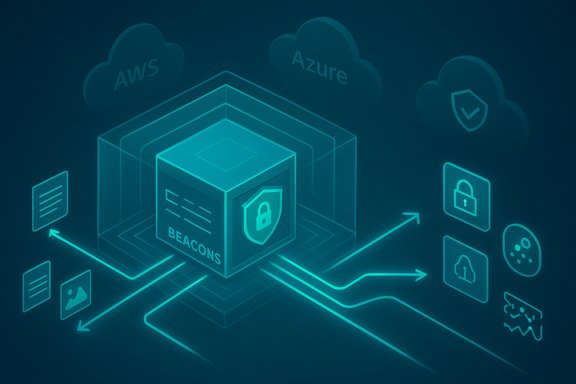
InfoSum’s new Beacons product marks one of the clearest attempts yet to move enterprise data collaboration from identity stitching toward an AI-first, privacy-first architecture that runs where the data already lives — across AWS, Google Cloud, and Microsoft Azure. The announcement frames Beacons as a turnkey way for marketers and data owners to run cross-cloud collaborations that use vector-based matching, support vector databases for multimodal data, and run inside trusted execution environments such as AWS Nitro Enclaves, all while preserving the company’s long-stated principle of non-movement of data.
InfoSum, now part of WPP after an acquisition announced in April 2025, has spent the last half-decade positioning itself as an alternative to centralized “clean rooms” by promoting a patent-backed approach that avoids copying or centralizing raw data. That acquisition brought InfoSum’s cross-cloud data network into WPP’s media ecosystem and set the stage for products — like Beacons — that promise to feed AI workflows with first-party signals at scale. InfoSum’s core thesis has always been privacy-first collaboration: instead of moving PII or raw datasets, InfoSum creates isolated computing environments (often called “bunkers” historically) that transform datasets into irreversible mathematical representations and only share aggregated or modeled outputs. The company explicitly calls this the non-movement of data approach and layers multiple Privacy-Enhancing Technologies (PETs) — hashing, differential privacy, private set intersection, synthetic IDs and strict query controls — to reduce reidentification risk. Beacons is presented as the next-generation infrastructure built on that philosophy, with a focus on AI readiness.
Academic and regulatory literature is explicit: PETs lower certain risks but can introduce new limitations (noise vs. utility trade-offs in differential privacy; coordination and heterogeneity issues with decentralized computations; and potential inference risks from repeated queries). Any enterprise product promising PET-based collaboration must document the exact therapeutic trade-offs: what PET layer is applied to which use-case, how privacy budgets and query limits are enforced, and how the product prevents leakage via model outputs or side channels. InfoSum has argued for layering PETs as a practical approach, but users should expect to validate the parameters and limitations for their specific use cases.
Source: Business Wire https://www.businesswire.com/news/h...echnology-for-cross-cloud-data-collaboration/
 Background
InfoSum, now part of WPP after an acquisition announced in April 2025, has spent the last half-decade positioning itself as an alternative to centralized “clean rooms” by promoting a patent-backed approach that avoids copying or centralizing raw data. That acquisition brought InfoSum’s cross-cloud data network into WPP’s media ecosystem and set the stage for products — like Beacons — that promise to feed AI workflows with first-party signals at scale. InfoSum’s core thesis has always been privacy-first collaboration: instead of moving PII or raw datasets, InfoSum creates isolated computing environments (often called “bunkers” historically) that transform datasets into irreversible mathematical representations and only share aggregated or modeled outputs. The company explicitly calls this the non-movement of data approach and layers multiple Privacy-Enhancing Technologies (PETs) — hashing, differential privacy, private set intersection, synthetic IDs and strict query controls — to reduce reidentification risk. Beacons is presented as the next-generation infrastructure built on that philosophy, with a focus on AI readiness. What Beacons promises: four capability pillars
InfoSum’s announcement lays out four headline capabilities for Beacons. Each is worth unpacking in operational and technical terms.Collaboration without compromise
- Beacons are designed to be deployed inside the data owner’s cloud environment so that raw records do not need to leave their original home. That preserves data sovereignty and short-circuits many commercial and regulatory roadblocks that come with centralized data pooling.
- The product is framed as interoperable across AWS, Google Cloud, and Microsoft Azure, removing “platform fragmentation” by operating as local, permissioned compute that communicates aggregated results, not raw rows. This is consistent with InfoSum’s stated mission since its early product iterations.
AI-ready intelligence (vector-based matching)
- A headline claim is that Beacons “move beyond identity” by using vector-based matching instead of (or alongside) deterministic identifiers. That means datasets are embedded into vector spaces where similarity — behavioral, contextual, or multimodal — can be measured without exposing user-level identifiers. InfoSum says this yields richer insights and higher match rates for modern AI use cases.
- The decision to support vector databases aligns with industry practice: vector stores (Pinecone, Weaviate, Milvus, Qdrant, and others) have become the default way to serve embeddings for retrieval-augmented generation, semantic search, and multimodal similarity tasks. These stores are specifically optimized to index and search high-dimensional embeddings at low latency, which is what Beacons is positioning itself to use. The vector database market is growing rapidly, and the technology is increasingly used in enterprise ML stacks for tasks ranging from image and video retrieval to text and audio similarity.
Real-time collaboration at scale
- InfoSum says Beacons will provide continuous, real-time insights instead of batch reporting. In practice, that requires efficient local embedding pipelines, low-latency vector search, and a federated orchestration layer that reconciles aggregated metrics across participants. If true, it would lower the time-to-insight for marketing analytics and model retraining loops. The claim should be read against the reality that real-time cross-party collaboration introduces both technical complexity and governance challenges (see Risks below).
Built for every cloud, every format
- Beacons emphasize API-driven integration and support for any data format — structured tables, images, video, audio, and free text — by enabling embedding and matching in vector spaces. That capability is what enables “behavioral and contextual matching beyond traditional identifier limitations,” according to InfoSum. Supporting multimodal inputs at enterprise scale is technically feasible today but operationally demanding; it requires standardized ingestion, embedding pipelines, GPU or accelerated inference, and careful metadata governance.
Technical anchoring: Nitro Enclaves, vector DBs, and PETs
AWS Nitro Enclaves — trusted execution and the confidentiality stack
Beacons are explicitly described as “built on AWS Nitro Enclaves” in InfoSum’s announcement and include a quoted endorsement from an AWS executive. Nitro Enclaves provide isolated compute environments for highly sensitive processing inside an EC2 instance: they cannot be reached over the network directly, and they can be paired with AWS KMS for sealed key handling. Nitro Enclaves is a practical choice when you want to reduce the attack surface and implement a hardware-backed confidential compute architecture without moving data outside a client’s cloud account. Nitro Enclaves are broadly available across AWS regions and integrate with EC2 and KMS. Using Nitro Enclaves in a cross-cloud product requires either repeatedly deploying enclave-capable instances in each cloud (or the cloud’s equivalent) or combining Nitro Enclaves for AWS-hosted participants with equivalent TEEs on other clouds. InfoSum’s messaging suggests they will run enclave-equivalent compute within customers’ chosen cloud accounts, which is the safest privacy posture from a data sovereignty perspective — but it also raises engineering and support complexity for a cross-cloud product.Vector databases and embeddings: what’s different now
Vector databases have moved from niche to mainstream in enterprise AI stacks because they let teams index embeddings and run similarity queries across massive, high-dimensional datasets with millisecond latencies. Vendors and open-source projects — Pinecone, Milvus (Zilliz), Weaviate, Qdrant, and others — power a broad set of real-world applications: semantic search, recommender systems, image/video retrieval, and session memory for conversational agents. InfoSum’s move to plug into that ecosystem is a sensible technical evolution if the goal is to let marketers and data scientists run multimodal, context-aware queries without exposing raw PII. That said, turning raw media into robust embeddings at enterprise scale requires standardized preprocessing, model selection for embeddings (e.g., CLIP/CLIP-like models for images and text, audio encoders for sound, or text encoders for free text), and careful versioning of both models and vectors. Without strong MLOps and governance, embedding drift and model inconsistency can erode the claimed “higher match rates.” This point is both a technical and operational caveat.Privacy-Enhancing Technologies (PETs) — layered, not magic
InfoSum emphasizes that Beacons is built on a stack of PETs and on the company’s historic non-movement architecture. Industry best practice treats PETs as complementary controls — not substitutes for governance. PETs like secure multi-party computation (MPC), differential privacy, private set intersection (PSI), and confined execution (TEEs) can reduce risks but bring trade-offs in accuracy, latency, and cost.Academic and regulatory literature is explicit: PETs lower certain risks but can introduce new limitations (noise vs. utility trade-offs in differential privacy; coordination and heterogeneity issues with decentralized computations; and potential inference risks from repeated queries). Any enterprise product promising PET-based collaboration must document the exact therapeutic trade-offs: what PET layer is applied to which use-case, how privacy budgets and query limits are enforced, and how the product prevents leakage via model outputs or side channels. InfoSum has argued for layering PETs as a practical approach, but users should expect to validate the parameters and limitations for their specific use cases.
Who’s on board — customers and partners
InfoSum’s announcement names Disney as one of the early organizations set to use Beacons, building on a history of Disney Advertising working with clean-room-style providers and InfoSum-led initiatives for audience modeling and measurement. Disney Advertising has publicly discussed data collaborations and proprietary clean-room tools in recent years; this appears to be an expansion of that relationship. The WPP integration is central to the narrative: InfoSum is now part of WPP’s AI and media strategy, and WPP has explicitly positioned InfoSum’s platform inside its WPP Open operating system to accelerate AI-driven marketing products. The acquisition, announced in April 2025, helps explain InfoSum’s push to embed its infrastructure into enterprise clouds with WPP’s clients in mind. Independent reporting and WPP materials confirm the acquisition and the intention to integrate InfoSum across WPP’s media stack. AWS and Google Cloud executives are quoted in the release, indicating vendor-level endorsements for secure enclave-based compute and cross-cloud deployments — a strong signal that Beacons aims to be broadly compatible across major cloud ecosystems. However, vendor quotes in press releases are marketing-typical and do not substitute for technical audits or independent performance benchmarks.Strengths: where Beacons could genuinely move the needle
- Data sovereignty and compliance-first architecture. Deploying compute inside the data owner’s cloud account and using TEEs reduces the legal and operational friction of cross-border or partner collaborations. This is a pragmatic model for enterprise customers who cannot move or share raw PII.
- AI-native feature set. Supporting vector databases and multimodal embeddings aligns the product with real-world enterprise AI demands — from semantic matching to context-aware activation and model training. The vector DB market’s momentum underpins the commercial rationale.
- Operational fit with agency stacks. InfoSum’s place inside WPP gives it a clear go-to-market path to agencies and advertisers that need privacy-first data fabric to train models and measure media. Integration with WPP Open could speed adoption for existing WPP clients.
- Layered PETs approach. Combining multiple PETs (PSI, differential privacy, synthetic IDs, enclave execution) is a robust architectural stance — when the controls are explicit and configurable by customers. InfoSum has publicly documented how it layers PETs in prior materials.
Risks and where buyers should insist on proof
The marketing description is compelling; the reality of deploying cross-cloud, real-time, PET-backed vector collaboration is complex. Buyers and technical architects should insist on concrete proofs and independent validation in several areas:- Proof of privacy guarantees and threat model
- Ask for documented threat models, details about which PETs are applied to which data flows, and third-party security audits. Differential privacy parameters, privacy budgets, and reidentification testing must be explicit, not nebulous. Academic literature shows differential privacy and aggregation techniques trade accuracy for privacy; real-world guarantees depend on parameter choices.
- Operational reproducibility and model leakage controls
- When models train over federated or enclave-executed datasets, there is a documented risk of model inversion or membership inference attacks. Buyers should demand controls for query throttling, privacy budgeting, and testing against inference attacks. PETs reduce, but do not eliminate, these risks.
- Latency and scalability trade-offs
- Real-time, cross-party vector queries are resource-intensive. Confirmation is needed for latency, throughput, and the hardware footprint (CPU vs GPU), especially for image/video/audio workloads. Independent benchmarks or pilot-based SLAs are essential.
- Interoperability details
- “Built for every cloud” is a commercial promise that must be validated. Practical deployments will require different TEEs, identity and key management strategies, and provisioning scripts per cloud. Ensure the vendor can show repeatable deployment templates in AWS, GCP, and Azure accounts under customer control.
- Governance and auditability
- Enterprises need full audit trails, explainability of matching logic, and documentation of how synthetic IDs or obfuscation were created. Without transparent governance, legal teams will be hesitant to greenlight sensitive collaborations. Regulatory guidance already warns about the risk of reidentification when datasets contain outliers or when multiple reports are combined.
Practical buying checklist for CTOs and CMOs
When evaluating Beacons (or any similar cross-cloud PET product), organizations should validate the following in a proof-of-concept:- Deployment and governance
- Confirm deployment occurs within your cloud account and that keys/roles remain under customer control.
- Verify audit logs and query lineage are available to your security team.
- Privacy engineering controls
- Request details on which PETs are applied, the default privacy budgets, and whether settings are tunable per collaboration.
- Require independent privacy and security assessments.
- Vector pipeline and MLOps
- Inspect the embedding model choices and versioning policies, and validate a reproducible pipeline for multimodal data (images, audio, video, text).
- Test vector retrieval latency for target workloads.
- Measurement and activation workflows
- Validate downstream activation connectors and how aggregated insights are converted into activation signals without leaking identifiers.
- Cost and operational model
- Understand the cloud cost model when running enclaves, vector indices, GPU inference, and the orchestration layer. Compare to centralized or hybrid alternatives.
Where Beacons fits in the broader adtech and enterprise AI landscape
Beacons arrives in a market where the adtech ecosystem is moving away from third-party identifiers and toward first-party signals, privacy-first collaboration, and AI-driven capabilities. Data clean rooms, federated learning, and vector databases are converging into hybrid architectures that let models consume signals across partners without direct data exchange. Markets and analyst firms project strong growth for vector databases and confidential computing in the coming years; enterprises and cloud providers are racing to provide the foundational building blocks. InfoSum’s productization of its long-standing non-movement approach into an AI-focused, enclave-backed deployment model is a natural next step. However, the industry is still maturing. Standards, operational tooling, and governance frameworks are evolving — IAB working groups, regulator guidance, and academic literature all point to unresolved technical trade-offs and policy questions around privacy budgets, TEEs, and reidentification risks. Buyers should therefore treat Beacons as a platform that needs to be integrated into a rigorous corporate privacy program — not a plug-and-play privacy panacea.Verdict: an important step — with due diligence required
Beacons is a credible technical step for InfoSum to translate its non-movement, PET-centric approach into an AI-ready product that targets the real needs of modern marketers: cross-cloud access to rich, multimodal signals while keeping first-party data under the owner’s control. The integration with WPP’s media stack and endorsements from cloud partners signal strong commercial momentum and a fast go-to-market runway. At the same time, the promises in the announcement — higher match rates via vector matching, real-time scaled collaborations, and frictionless cross-cloud deployment — are complex to deliver in production and should be validated with hard benchmarks, security audits, and clear privacy SLAs. Enterprises should insist on pilot deployments with measurable KPIs around latency, match quality, privacy budget parameters, and governance before committing mission-critical workloads. Academic and regulator guidance shows PETs are powerful but nuanced tools; layered deployment and transparent governance are non-negotiable.Final takeaways for WindowsForum readers and enterprise buyers
- What’s new: InfoSum’s Beacons packages privacy-first, vector-enabled collaboration into enclave-backed deployments that run inside customer cloud accounts and are designed for AI model training and activation.
- Why it matters: It formalizes a path for marketers and data owners to use multimodal, embedding-based intelligence without centralizing raw PII — a real operational advantage in a post-third-party-cookie world.
- What to verify: Ask for independent security and privacy audits, real-world latency/match benchmarks, and explicit privacy parameters (noise levels, query limits, synthetic ID policy). Validate deployments on the specific cloud(s) and data formats you intend to use.
- Where the market is headed: Expect more products to stitch PETs, vector DBs, and TEEs together. The competitive field includes both specialist vector-store vendors and large cloud providers moving to enable confidential compute and managed vector services; comparisons will focus on latency, cost, governance, and open standards.
Source: Business Wire https://www.businesswire.com/news/h...echnology-for-cross-cloud-data-collaboration/
