

Infosys today unveiled an industry-tailored AI Agent for the energy sector that promises to convert mountains of operational telemetry, well logs, images and reports into conversational, real‑time guidance—automating routine paperwork, surfacing predictive early‑warnings and supporting field and control‑room decisions with evidence‑grounded summaries.
The energy industry produces heterogeneous, high‑velocity data—from SCADA streams and time‑series sensors to downhole logs, inspection imagery and regulatory documents. That combination of volume, variety and safety sensitivity makes energy operations a natural fit for multimodal, retrieval‑grounded assistants that can reduce cognitive load and shorten decision cycles. Infosys positions its new Agent as a verticalized, production‑grade solution built on three pillars: Infosys Topaz (an agent fabric / agentic AI platform), Infosys Cobalt (cloud accelerators and compliance blueprints) and Microsoft’s cloud and model stack—most notably Microsoft Copilot Studio, Azure AI Foundry / Azure OpenAI and GPT‑family multimodal models. This announcement landed as Infosys also rolled out Topaz Fabric and a broader Agentic AI Foundry—moves meant to standardize and accelerate repeatable agent deployments across verticals. Those product launches are documented in Infosys’ recent press materials.
Operators evaluating this offering should proceed with guarded optimism: the packaged platform and Microsoft partnership significantly lower engineering lift, but they do not eliminate the essential governance, OT security and measurement work required to make high‑stakes AI safe and reliable in the field. Treat vendor claims as directional until validated by transparent, third‑party audited pilots and require contractual guarantees around auditability, explainability, data residency and model management.
Infosys’ announcement positions agentic AI as a pragmatic productivity lever for the energy industry—but turning a promising blueprint into safer, measurable operations will require disciplined pilots, cross‑functional governance, and continual validation against the sector’s highest standards for safety and reliability.
Source: Techcircle Infosys introduces AI agent to improve data-driven operations in the Energy Sector
 Background
The energy industry produces heterogeneous, high‑velocity data—from SCADA streams and time‑series sensors to downhole logs, inspection imagery and regulatory documents. That combination of volume, variety and safety sensitivity makes energy operations a natural fit for multimodal, retrieval‑grounded assistants that can reduce cognitive load and shorten decision cycles. Infosys positions its new Agent as a verticalized, production‑grade solution built on three pillars: Infosys Topaz (an agent fabric / agentic AI platform), Infosys Cobalt (cloud accelerators and compliance blueprints) and Microsoft’s cloud and model stack—most notably Microsoft Copilot Studio, Azure AI Foundry / Azure OpenAI and GPT‑family multimodal models. This announcement landed as Infosys also rolled out Topaz Fabric and a broader Agentic AI Foundry—moves meant to standardize and accelerate repeatable agent deployments across verticals. Those product launches are documented in Infosys’ recent press materials. Overview: what Infosys is selling
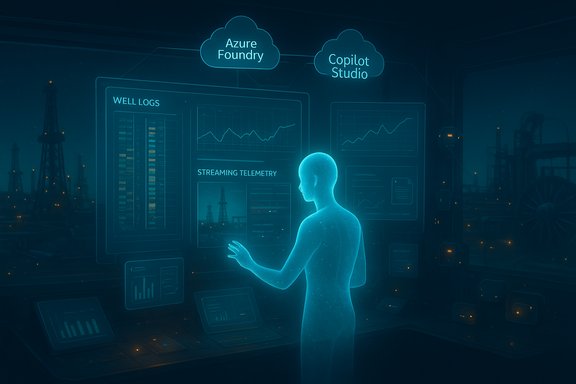
The Agent is described as a conversational, multimodal assistant that:- Ingests and grounds diverse operational artifacts—well logs, streaming telemetry, images, charts, tables and PDF reports—into a governed knowledge layer.
- Applies multimodal models to extract, summarize and explain key findings in natural language.
- Produces predictive insights and early warnings by ranking anomaly signals and surfacing probable failure modes.
- Automates report generation (shift reports, regulatory summaries, NPT logs), reducing administrative overhead.
- Runs as a hybrid architecture with heavy inference and orchestration hosted on Azure Foundry and deterministic safety loops or low‑latency checks localized at the edge.
Technical anatomy: how the stack fits together
Data & ingestion layer
At the base is a governed storage layer (lakehouse or knowledge graph) that captures telemetry, historical incidents, engineering documents and media. Data contracts, schema alignment and access controls are explicit prerequisites in vendor materials—necessary to maintain provenance, reduce hallucination risk and satisfy audit requirements. The Agent’s retrieval layer uses vector search and document retrieval to ground outputs against specific evidence.Agent fabric & orchestration (Infosys Topaz)
Infosys Topaz is presented as the orchestration and lifecycle layer: prompt engineering, agent flows, tool invocation, observability, model routing and human‑in‑the‑loop gates. Topaz and the Agentic AI Foundry are intended to package reusable agent patterns and domain connectors so energy operators get repeatable, auditable agents instead of one‑off demos.Cloud foundation (Infosys Cobalt)
Infosys Cobalt supplies cloud templates, identity & access scaffolding, compliance patterns and managed services to host regulated workloads. For energy customers—where OT segmentation, data residency and regulatory compliance matter—these hardened cloud blueprints are a central part of the offering.Model runtime & multimodal inference (Microsoft Copilot Studio + Azure AI Foundry)
The Agent leverages Copilot Studio as the low‑code design and orchestration surface for agents, while Azure AI Foundry (the curated model catalog / hosting layer) runs the heavy inference. Azure’s documentation lists GPT‑4o and other multimodal models as supported deployments, and Foundry provides model routing, enterprise governance and regional deployment controls. That model flexibility lets implementers balance cost, latency and capability.Edge & safety loops
Time‑sensitive alarms and safety interlocks must remain deterministic; vendor materials and industry analyses indicate that edge inference nodes or smaller on‑site models handle immediate safety controls while the cloud agent performs deeper analytics and reporting. This hybrid split reduces latency risk and limits unnecessary data egress.Core capabilities in practice
Multimodal ingestion and grounding
The Agent claims to parse structured and unstructured inputs—well logs, downhole images, inspection photos, plots and streaming telemetry—and to ground answers in cited evidence. This grounding step is critical: retrieval‑augmented generation with document citations is the principal mitigation against hallucination in production assistants. Vendor materials and platform docs stress the need for clear provenance and data lineage.Conversational access & operational workflows
Field engineers and rig crews can query the Agent via chat (and potentially voice) to get context‑aware summaries, recommended next steps and links to historical records. Copilot‑style conversational UIs are designed to reduce time spent searching by returning concise, actionable outputs derived from the underlying evidence base.Predictive insights & early warnings
By applying anomaly detection and historical pattern matching, the system aims to surface conditions likely to lead to non‑productive time (NPT) or safety incidents. The vendor frames this as a predictive early‑warning system that helps planners re‑sequence work, allocate maintenance, or halt risky activities before they escalate. These outcome claims are typical vendor objectives—but they require rigorous validation through pilots and independent case studies.Automated reporting & compliance
The Agent can auto‑generate shift reports, regulatory narratives and structured extractions from semi‑structured documents, saving operator hours spent on administrative tasks. Automated reports also make it easier to centralize incident records and create auditable trails—if the generation and data sourcing are properly governed.Use cases: where the Agent could move the needle
- Upstream drilling and well operations: rapid synthesis of well logs, quick access to historical incidents, and predictive flags during critical drilling passes—potentially reducing Non‑Productive Time (NPT).
- Production & field maintenance: faster trouble‑shooting of pump or compressor anomalies by cross‑referencing sensor trends with inspection images and maintenance records.
- Pipelines & midstream: automated integrity reporting, anomaly ranking from SCADA data, and prioritized swimlanes for repair crews.
- Power generation & utilities: condition‑based maintenance, outage planning, and regulatory report automation.
Strengths: what’s convincing about this approach
- Platform completeness: Packaging an agent fabric (Topaz), cloud blueprints (Cobalt) and a curated model runtime (Azure Foundry) reduces the integration effort for operators and offers a consistent production playbook. That end‑to‑end scaffolding is the most credible path to moving beyond one‑off pilots.
- Partner credibility: The Microsoft partnership provides enterprise‑grade model hosting, governance tools and low‑code agent design—reducing operational friction for customers already on Azure.
- Multimodal capability: Using multimodal models (GPT‑4o family and Foundry options) enables combined reasoning over text, vision and structured telemetry—essential for interpreting diverse energy artifacts.
- Hybrid design: The cloud + edge split is a pragmatic recognition of OT latency and safety needs, ensuring that deterministic control loops can remain local while deeper analysis runs in the cloud.
Risks and limitations: what operators must verify
While promising, the offering carries important technical, safety and legal considerations that buyers must weigh carefully.1) Hallucination and evidence fidelity
Large models can produce plausible but incorrect explanations. Vendor messaging emphasizes grounding and retrieval, but proven accuracy on domain tasks (e.g., correct interpretation of a well log anomaly) requires empirical validation. Any model‑suggested operational step should have a clear provenance chain and human sign‑off for safety‑critical actions.2) OT security and segmentation
Connecting cloud agents to operational technology (SCADA, PI systems, PLCs) introduces attack surface and constraints around network segmentation. Maintaining strict zones, identity controls, and a hardened gateway architecture is non‑negotiable. Infosys’ Cobalt templates help, but responsibility for OT controls ultimately rests with the operator and their integrator contracts.3) Latency & real‑time determinism
Cloud inference cannot replace millisecond‑level control loops. Implementers must clearly define which decisions are advisory and which are safety interlocks. Edge inference nodes with smaller local models should handle deterministic alarms; cloud agents should augment planning and diagnostics.4) Regulatory, liability & auditability
If an AI Agent recommends an action that precedes a safety incident, liability and audit trails will be intensely scrutinized. Operators must contractually require explainability, immutable logs (who asked what, which model answered, which data was used) and a pathway for human override. Public announcements do not provide those contractual details; customers must insist on them.5) Data residency and supplier lock‑in
Model routing and regional hosting are available in Azure Foundry, but customers with strict residency or sovereignty rules must verify deployment patterns. Likewise, packaging many capabilities into a vendor‑managed fabric simplifies operations but can increase long‑term lock‑in risk unless portability and open standards are enforced.6) Measurement & proof of value
Infosys and partners have articulated outcome goals—reduced NPT, improved wellbore quality and saved engineering hours—but the public announcement does not publish third‑party validated metrics. Operators should treat headline numbers as directional and require pilot KPIs and transparent measurement methodologies before scale‑up.Procurement checklist: practical items for IT and OT leaders
- Define measurable pilot KPIs:
- Mean time to insight (MTTI) for incident triage.
- Hours saved per shift from report automation.
- Change in NPT incidents and root cause accuracy.
- Require data provenance and evidence citation for every agent response.
- Insist on immutable audit logs, model versioning and drift detection.
- Validate hybrid architecture: confirm which functions run at the edge, which in the cloud, and recovery/rollback paths.
- Contractually specify data residency, retention, and export rights; demand portability clauses.
- Run red‑team / adversarial testing and safety validation specific to OT scenarios.
- Request third‑party or customer references with transparent measurement methodologies before large procurement.
- Budget for ongoing MLOps: model updates, retraining to domain shifts, and sustained human‑in‑the‑loop supervision.
Implementation roadmap (recommended phased approach)
- Start small: pilot the Agent on one high‑value, low‑risk workflow (report automation, shift summaries).
- Instrument heavily: capture baseline metrics for time spent, error rates and incident response times.
- Expand to decision support: once grounding and accuracy meet thresholds, introduce predictive alerts to planners with human sign‑off gates.
- Operationalize governance: build model‑ops pipelines, drift monitoring and scheduled red‑teaming cycles.
- Scale: after independent validation and demonstrated ROI, extend to additional rigs, regions and asset classes with attention to regional compliance.
How this fits broader industry trends
Infosys’ approach follows a now-common enterprise pattern for agentic AI: a governed knowledge layer + vector retrieval + an agent orchestration fabric + multimodal model runtime + edge for deterministic control. Packaging these components reduces integration friction for energy firms and maps to the current “AI for industry” playbook favored by systems integrators and hyperscalers. However, the real differentiation for operators will be in execution: disciplined pilots, governance maturity and contractual protections—not marketing language. Microsoft’s expanding Foundry catalog and Copilot Studio capabilities—together with availability of multimodal models such as GPT‑4o—enable the runtime and model choices Infosys references. That platform flexibility is useful, but it also means buyers must be explicit about model selection, failover planning, and performance SLAs.Final assessment: measured optimism
Infosys’ AI Agent for energy operations is a credible, infrastructure‑forward attempt to industrialize agentic AI for a safety‑critical vertical. The technical blueprint—Topaz + Cobalt + Copilot Studio + Azure AI Foundry + multimodal models—is sensible and consistent with best practices for production agent deployments. The real test will be measured outcomes: verified reductions in NPT, demonstrable improvements in safety metrics, and robust operational governance.Operators evaluating this offering should proceed with guarded optimism: the packaged platform and Microsoft partnership significantly lower engineering lift, but they do not eliminate the essential governance, OT security and measurement work required to make high‑stakes AI safe and reliable in the field. Treat vendor claims as directional until validated by transparent, third‑party audited pilots and require contractual guarantees around auditability, explainability, data residency and model management.
Infosys’ announcement positions agentic AI as a pragmatic productivity lever for the energy industry—but turning a promising blueprint into safer, measurable operations will require disciplined pilots, cross‑functional governance, and continual validation against the sector’s highest standards for safety and reliability.
Source: Techcircle Infosys introduces AI agent to improve data-driven operations in the Energy Sector
