

Infosys’ new AI agent for energy operations promises to fold conversational, multimodal large‑model capabilities into the high‑stakes workflows of drilling, production, pipelines and grid operations—packaged as a pragmatic integration of Infosys Topaz Fabric, Infosys Cobalt, Microsoft’s Copilot Studio and Azure AI Foundry model hosting. The vendor says the goal is straightforward: turn well logs, telemetry, images and reports into instantly actionable intelligence, automate routine paperwork, surface early warnings to reduce non‑productive time (NPT), and improve safety and reliability across field and control‑room teams.
The energy industry generates massive volumes of heterogeneous data—SCADA streams, downhole logs, inspection imagery and regulatory documents—that must be interpreted rapidly and correctly. That combination of data density and safety sensitivity is why operators have become early adopters of “agentic AI”: lightweight, orchestrated assistants that can perceive context, call tools, and interact via natural language while being governed in production. Infosys’ announcement positions its agent as an industry‑specific instantiation of this trend, built on a newly announced Topaz Fabric layer and the company’s long‑running Cobalt cloud accelerators. The public release names Microsoft Copilot Studio and Azure OpenAI/Foundry‑hosted models (including references to ChatGPT/GPT‑family models) as the runtime and model hosts. This article explains what was announced, verifies the technical building blocks, contrasts the vendor claims against platform documentation, and offers a pragmatic assessment of likely benefits, risks and the procurement checklist energy operators should insist on before moving beyond pilots.
From a procurement perspective, the differentiators will be:
Infosys’ announcement brings a credible, repeatable technical pattern to the energy sector: agent orchestration (Topaz), cloud accelerators (Cobalt), low‑code agent design (Copilot Studio) and multimodal model hosting/routing (Azure AI Foundry). Whether this becomes a transformational productivity and safety tool for operators depends on the rigor of pilots, governance designs, validation of multimodal accuracy, and tightly negotiated contractual terms—especially where decisions affect safety and physical processes. Treat the current release as a reliable architecture and a vendor roadmap; treat outcome numbers as promises to be proven during pilot contracts with measurable, auditable evidence.
Source: scanx.trade Infosys Unveils AI Agent to Revolutionize Energy Sector Operations
 Background / Overview
The energy industry generates massive volumes of heterogeneous data—SCADA streams, downhole logs, inspection imagery and regulatory documents—that must be interpreted rapidly and correctly. That combination of data density and safety sensitivity is why operators have become early adopters of “agentic AI”: lightweight, orchestrated assistants that can perceive context, call tools, and interact via natural language while being governed in production. Infosys’ announcement positions its agent as an industry‑specific instantiation of this trend, built on a newly announced Topaz Fabric layer and the company’s long‑running Cobalt cloud accelerators. The public release names Microsoft Copilot Studio and Azure OpenAI/Foundry‑hosted models (including references to ChatGPT/GPT‑family models) as the runtime and model hosts. This article explains what was announced, verifies the technical building blocks, contrasts the vendor claims against platform documentation, and offers a pragmatic assessment of likely benefits, risks and the procurement checklist energy operators should insist on before moving beyond pilots.What Infosys announced — the product that was described
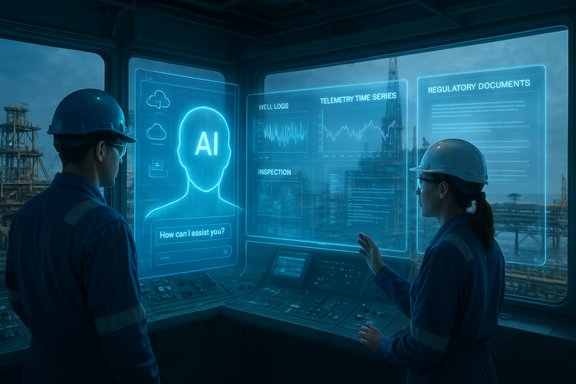
Infosys’ press materials and distributed releases present the energy Agent as a bundled solution that:- Ingests and reasons over multimodal inputs—well logs, telemetry time‑series, inspection images, plots and documents—and grounds answers in those sources.
- Provides a conversational interface (chat and voice) for field crews and control‑room users to ask natural‑language questions and receive context‑aware summaries and next‑step recommendations.
- Automates routine documentation: daily shift logs, drilling reports, regulatory narratives and structured extraction of key parameters from semi‑structured sources.
- Produces predictive insights and early warnings intended to surface anomalies and prescriptive actions before they cause NPT or safety incidents.
- Runs as a hybrid cloud + edge design: heavy model inference and agent orchestration in Azure Foundry; deterministic alerts and safety loops at the edge as required by OT latency and reliability constraints.
Technical validation: do the components and capabilities check out?
A responsible read of the announcement breaks claims into two classes: (A) platform and architecture assertions that are verifiable in vendor documentation, and (B) quantified operational outcomes (e.g., X% reduction in NPT) that require independent pilot data to confirm.Platform and architecture — corroborated
- Infosys’ own press release and Topaz Fabric launch materials publicly describe Topaz as an “AI‑first” fabric for agents—an orchestration, lifecycle and integration layer intended to package reusable agent patterns for enterprise verticals. The Topaz Fabric announcement preceded the energy agent reveal and positions Topaz as the composable stack for models, agents and flows.
- Microsoft’s Azure AI Foundry and model router capabilities are documented and explicitly support multi‑model routing, multimodal inputs, model selection and enterprise deployment features that align with Infosys’ described runtime choices. Azure documentation details model routing logic, availability of multiple high‑capability models (and route optimization for cost/performance) and large‑context multimodal models suitable for engineering use cases. That confirms the feasibility of the runtime architecture Infosys references.
- Copilot Studio is a Microsoft product intended for low‑code/no‑code agent creation and orchestration; public materials show it can integrate connectors, process documents and host agent flows. The feature set fits the use cases Infosys lists for agent design and human‑in‑the‑loop controls.
Quantified outcome claims — unverified, vendor‑reported
The press release asserts improved safety, better wellbore quality and reduced NPT as outcomes. These are plausible effects of faster, grounded analysis and automated reporting, but the announcement does not publish independent metrics or the experimental methodology behind them. Independent analyses and forum summaries explicitly flag these as company‑reported pilot expectations and recommend treating percentages or “hours saved” claims as directional until third‑party audits or detailed customer case studies are available. Procurement teams should therefore insist on transparent KPIs and pre/post pilot baselines in contracts.How the solution likely fits together — a practical blueprint
The public material and platform docs indicate a sensible, standard enterprise agent pattern for safety‑sensitive industries:- Data ingestion and governance
- Edge collectors, SCADA connectors and document ingestion pipelines push time‑series, logs, images and PDFs into a governed lakehouse or knowledge graph with data contracts and schemas. This is a prerequisite for traceable, auditable outputs.
- Grounding and retrieval
- Vector retrieval and document search ground agent responses to specific documents, parts of logs or historical incidents—reducing hallucination risk and improving provenance. Azure AI Foundry and retrieval‑augmented generation (RAG) patterns are explicitly supported.
- Agent orchestration and runtime
- Infosys Topaz acts as the fabric for lifecycle, workflow orchestration and observability; Copilot Studio provides low‑code agent building; Azure AI Foundry hosts and routes models (GPT‑4o/GPT‑5 family or equivalents) optimized for multimodal reasoning and cost/performance tradeoffs.
- Edge and safety loops
- Deterministic, on‑prem or edge inference nodes run smaller, tuned models or hard rules for safety interlocks, while the cloud agent performs deeper analysis and reporting. Hybrid operation minimizes latency and reduces OT exposure.
- Governance and MLOps
- Model versioning, audit trails, human‑in‑the‑loop gates, red‑teaming and continuous retraining are required operational controls. Azure Foundry and corporate compliance templates (Infosys Cobalt) can be combined to meet these needs—but responsibility for governance remains with the operator.
Use cases where the agent delivers immediate, realistic value
Rather than grand claims of full autonomy, the most credible early returns come from bounded workloads:- Automated reporting and compliance
- Auto‑drafted shift logs, regulatory summaries and incident reports cut mundane hours from engineers and reduce transcription errors.
- Operational decision support in the control room
- Ranked scenarios, confidence metadata and citations to source documents speed operator triage and incident response.
- Predictive maintenance and anomaly detection
- Fusing telemetry trends with historical failure patterns to prioritize inspections and reduce unscheduled downtime.
- Well‑construction assistance
- Summaries of offset wells, BHA recommendations and pre‑filled technical templates speed planning and reduce design errors.
- Inspection and imagery analysis
- Visual anomaly detection (piping corrosion, flange leaks) plus provenance links to historical inspections make triage more efficient.
Strengths and strategic opportunities
- Scale + ecosystem: combining a global systems integrator with a hyperscaler reduces integration friction and shortens time‑to‑production for regulated environments. Infosys’ global delivery model and Microsoft’s Foundry catalogue form a credible delivery path.
- Hybrid design: the hybrid cloud + edge blueprint respects OT latency and safety requirements while providing cloud scale for heavy inference and long‑context reasoning.
- Domain packaging: prebuilt agent patterns, connectors for industry standards (OSDU, CMMS, PI/OSIsoft), and compliance templates accelerate pilots.
- Multimodal grounding: availability of multimodal models in Azure Foundry (images + text + long context models) makes realistic handling of engineering documents and imagery feasible.
- Commercial synergies: the “energy‑for‑AI” strategic narrative—hyperscalers and integrators working with energy companies to secure stable energy for compute in exchange for digital transformation services—can unlock new commercial models and capital flows.
Risks, limitations and critical questions
The potential is real—but so are serious risks that must be addressed before any agent touches automated, safety‑critical decision loops.- Safety & control thresholds
- The central question is: which decisions will the agent recommend and which will it execute? Public materials emphasize human‑in‑the‑loop design, but they do not publish the safety governance thresholds, validation regimes or rollback mechanisms operators must demand. Any automation that can affect valves, setpoints or crew dispatch requires deterministic gating and extensive testing.
- Model hallucination and provenance
- Generative models can fabricate plausible but incorrect outputs. Industrial deployments must insist on document grounding, traceable evidence for recommendations, and conservative gating for high‑risk actions. The announcement does not publish quantitative accuracy or false‑alarm rates for multimodal interpretation—operators should insist on blind tests against historical incidents.
- Connectivity, segmentation and data residency
- Many energy OT environments are air‑gapped or tightly segmented. The announcement references hybrid/cloud execution but does not specify architectures for secure OT replication or offline edge operation. Procurement must demand clear architectures for OT segmentation, encryption, and local inference options.
- Supply chain and model provenance risk
- Using third‑party models hosted in multi‑tenant clouds introduces supply‑chain and IP risks. Contracts must clarify where data resides, how models are fine‑tuned, and what indemnities apply.
- Unverified outcome metrics
- Numeric claims (e.g., percentage NPT reductions) are vendor‑reported. Until independent audits or customer case studies publish methodologies and raw data, treat these as aspirational.
Practical rollout checklist for energy operators
Organizations should follow a disciplined, measurable path from PoV to production:- Define narrow, measurable pilot KPIs (e.g., reduce NPT on a single rig by X% or shorten mean time to detect an event by Y minutes).
- Lock down data contracts and schemas for telemetry, logs and images before model fine‑tuning begins.
- Require conservative human‑in‑the‑loop gates for any recommendation that could trigger an operational change; classify actions by risk and automation tier.
- Validate the agent’s multimodal interpretation by running blind tests against historical incidents to measure recall, precision and false‑alarm rates.
- Instrument audit and observability: log who asked what, which model/version produced the output, the evidence cited, and whether the recommendation was acted upon.
- Confirm data residency, encryption at rest/in transit, and legal terms for cross‑border processing; involve legal and compliance teams early.
- Plan for continuous model validation, retraining cadence and red‑teaming to detect drift and emergent failure modes.
- Negotiate service levels, liability, deterministic rollback and incident escalation playbooks up front.
Commercial and market implications
Infosys’ move typifies a broader market dynamic: systems integrators and hyperscalers are converting raw LLM capability into packaged, vertical‑specific “agent stacks.” This benefits large operators who need predictable integration and governance, but raises the bar for competition: buyers will compare not just feature sets, but demonstrable pilot outcomes, governance models and long‑term support commitments.From a procurement perspective, the differentiators will be:
- Evidence: transparent pilot metrics with clear methodology.
- Governance: auditability, provenance and human override controls.
- Support: SLA commitments for model monitoring, retraining and incident response.
- Deployment flexibility: options for cloud, data‑zone and air‑gapped/edge configurations.
Measured conclusion — an operator’s view
Infosys’ energy Agent is an architecture‑sensible, ecosystem‑aligned attempt to industrialize agentic AI for energy operations. The building blocks exist—Topaz Fabric (agent orchestration), Cobalt (cloud blueprints), Copilot Studio (agent design) and Azure AI Foundry (model catalog and routing)—and are documented by the vendors. Early customer value is most credible in bounded workloads such as reporting automation, decision support and predictive maintenance where grounding, audit trails and human oversight can be enforced. However, the most important verification is empirical: independent, transparent pilot data that proves the agent’s recall/precision on multimodal inputs, demonstrates safe human‑in‑the‑loop governance, and shows measurable operational improvements without introducing new systemic risks. Vendors’ quantitative claims should be treated as directional until such data is published and contractually verifiable.Actionable recommendations for IT and operations leaders
- Start with bounded pilots that have clear KPIs and short feedback cycles.
- Insist on auditability: every recommendation must be traceable to model version and source data.
- Require uncertainty metadata and confidence scores with all outputs.
- Design conservative automation tiers: recommendations for high‑risk tasks, automated execution only for repeatable, low‑risk events with redundant human sign‑offs.
- Include continuous MLOps and red‑teaming in contracts and budgets.
- Negotiate liability and data residency explicitly; include right‑to‑audit provisions for models and datasets.
Infosys’ announcement brings a credible, repeatable technical pattern to the energy sector: agent orchestration (Topaz), cloud accelerators (Cobalt), low‑code agent design (Copilot Studio) and multimodal model hosting/routing (Azure AI Foundry). Whether this becomes a transformational productivity and safety tool for operators depends on the rigor of pilots, governance designs, validation of multimodal accuracy, and tightly negotiated contractual terms—especially where decisions affect safety and physical processes. Treat the current release as a reliable architecture and a vendor roadmap; treat outcome numbers as promises to be proven during pilot contracts with measurable, auditable evidence.
Source: scanx.trade Infosys Unveils AI Agent to Revolutionize Energy Sector Operations
