

Microsoft Turns Marketplace Into an AI Trust Filter
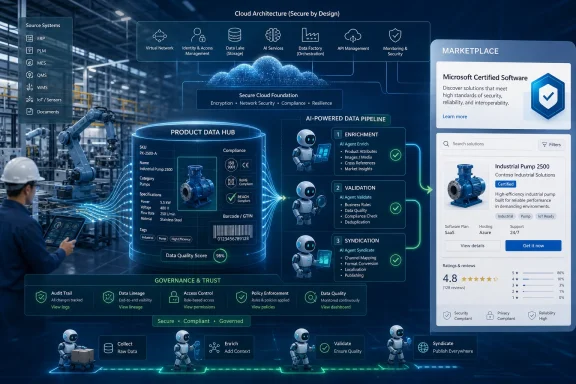
The phrase “Microsoft Certified Software” sounds administrative, but in the current AI market it carries more weight than the average partner logo. Enterprises are drowning in AI claims, especially from software vendors that have bolted generative features onto established products and now describe the result as agentic, autonomous, or transformation-ready. Microsoft’s certification program gives buyers a way to sort some of that noise inside a procurement environment they already know.
That does not mean Microsoft is personally guaranteeing business outcomes. It means the software has met Microsoft’s stated standards for security, compliance, and technical integration, and that it is positioned for purchase and deployment through Microsoft Marketplace. In practice, that matters most to enterprises already standardizing on Azure, Microsoft identity, Microsoft procurement workflows, and Microsoft’s compliance story.
The interesting move is that Microsoft is not treating AI as a generic software category. Inriver’s designation is tied specifically to Manufacturing AI, which reflects the broader industry-cloud strategy Microsoft has pursued for years. Rather than asking every customer to assemble AI, data, identity, and workflow pieces from scratch, Microsoft is encouraging certified vertical solutions that arrive with a clearer industry use case.
For Inriver, that use case is product information management, or PIM. For manufacturers, PIM is not glamorous, but it is foundational. If the data describing a product is incomplete, inconsistent, noncompliant, or formatted incorrectly for a channel, the fanciest AI model in the stack will still produce unreliable outputs.
Product Data Is Becoming the New Manufacturing Bottleneck
Manufacturing technology coverage often gravitates toward robotics, predictive maintenance, digital twins, and industrial IoT. Yet a huge amount of commercial friction lives in a less cinematic place: the product record. A product’s specifications, descriptions, images, certifications, translations, compatibility notes, compliance claims, and channel-specific metadata all have to be accurate before that product can move efficiently through distributors, marketplaces, retailers, and search engines.
That burden has grown heavier as manufacturers sell through more channels. A product description that works for a distributor portal may not work for an ecommerce marketplace. A compliance field required in one geography may be irrelevant in another. A technical spec written for an engineer may need to be converted into a customer-facing description without losing precision.
This is where Inriver wants to place itself: not as a chatbot sitting on top of a catalog, but as the system that governs the product data current before AI tools consume it. The company says its platform can help manufacturers accelerate time to market, improve AI discoverability, automate content quality, and reduce compliance issues. Those claims are ambitious, but they are aimed at a real pain point.
The AI angle matters because product discovery is changing. Search engines, recommendation systems, ecommerce platforms, procurement tools, and AI assistants increasingly depend on structured, high-quality data. If a manufacturer’s product information is poorly tagged or inconsistent, it may become less visible not only to human buyers but also to the automated systems mediating those buyers’ choices.
Agentic AI Needs Better Plumbing Than the Demo Suggests
Inriver’s recent positioning leans heavily on agentic AI, including specialized agents for content enrichment, no-code data transformation, and workflow orchestration. That language will sound familiar to anyone following enterprise software in 2026. Every vendor wants to be seen as moving from copilots that suggest actions to agents that actually perform work.
The trouble is that agentic AI is only as good as the permissions, data model, validation rules, and audit trail around it. A content agent that enriches 50,000 SKUs is useful only if the enrichment is governed, reversible, and testable against business rules. Otherwise, the automation simply scales mistakes faster than humans could make them manually.
This is where PIM is a more credible AI category than many flashier demos. Product information already has structured fields, approval workflows, syndication rules, and compliance checks. Those are the kinds of boundaries AI systems need if they are going to do useful work in production rather than merely impress a conference audience.
Inriver’s Microsoft alignment also gives the story a familiar enterprise architecture. The platform is described as using Microsoft technologies such as Azure OpenAI Service, Microsoft Foundry, and Azure Document Intelligence. That means the AI features are not being pitched as a disconnected black box, but as part of a Microsoft-centered stack many IT departments are already evaluating.
The Certification Is Also a Procurement Story
For many organizations, the most consequential part of the announcement may be the least exciting: Marketplace availability. Enterprise software buying is often slowed less by technical interest than by procurement review, vendor onboarding, security questionnaires, contract negotiation, and compliance validation. Microsoft Marketplace exists to compress some of that friction.
If a manufacturer already has a Microsoft commercial relationship, buying through Marketplace can make software acquisition easier to route through existing budgets and governance processes. That does not remove the need for due diligence, but it can make a new platform feel less like a one-off vendor exception. In a world where AI pilots are plentiful and production deployments are harder, procurement alignment is a competitive advantage.
This is one reason Marketplace has become strategically important to Microsoft. It is not merely a catalog. It is a control point where Microsoft can connect cloud consumption, partner software, industry solutions, and customer purchasing behavior. The more AI products enter enterprise environments through Marketplace, the more Microsoft becomes the default trust broker.
For Inriver, the upside is obvious. Marketplace presence puts the company in front of Microsoft customers looking for AI-capable business software, especially those in manufacturing and distribution. The certification gives sales teams a shorter answer to the predictable question: “Will this fit into our Microsoft environment?”
The Financial Wrapper Obscures the Enterprise Software Story
The news arrived in some feeds bundled with stock-market commentary, including Microsoft’s daily share move and unrelated trading notes about Datadog, Ubiquiti, Oracle, Alphabet, and Apple. That packaging makes sense for investor-oriented syndication, but it risks flattening the significance of the announcement into another “cloud AI stocks” item. Inriver’s certification is not really a market-mover story for Microsoft.
Microsoft is too large for a single PIM partner designation to matter financially in isolation. The more relevant signal is cumulative: Microsoft is filling its AI ecosystem with certified vertical software, then routing discovery and procurement through Marketplace. That creates a flywheel in which partners get distribution, customers get governance signals, and Microsoft gets more cloud-adjacent workload gravity.
For WindowsForum readers, that distinction matters. This is not a story about whether Microsoft’s stock rose on a given day. It is a story about how Microsoft is shaping the enterprise AI stack beneath the surface of everyday procurement. The visible announcement is a partner milestone; the underlying pattern is platform consolidation.
The same applies to the term “Cloud AI.” It is broad enough to cover everything from GPU infrastructure to SaaS copilots to security analytics. Inriver sits in a narrower but important lane: AI applied to product data operations. That specificity is what makes the announcement more interesting than the generic category label suggests.
Manufacturers Get a Cleaner AI Pitch Than Most Industries
Manufacturing is a strong fit for this kind of AI certification because the industry has an abundance of structured complexity. Product lines are deep. Documentation is dense. Regulatory obligations vary by market. Sales channels multiply faster than content teams can comfortably support.
A manufacturer selling thousands or millions of SKUs cannot manually rewrite and validate every product record for every channel without cost and delay. AI-assisted enrichment can help, but only if the organization trusts the underlying data model and approval process. That is why PIM is becoming a more strategic layer in manufacturing IT.
Inriver claims its platform can accelerate product content workflows, shorten time to market, and reduce compliance issues. Those metrics should be treated as vendor-reported outcomes rather than universal guarantees. Still, they map to problems manufacturers actually measure: launch delays, rejected listings, inconsistent product claims, and manual rework.
The larger shift is that product data is now part of customer experience, channel performance, and AI readiness at the same time. A manufacturer’s catalog is no longer just a database used by internal teams. It is the raw material for search, recommendations, digital shelf placement, sales enablement, and automated commerce.
Windows and Azure Shops Should Read This as an Ecosystem Signal
The Windows desktop is not the center of this announcement, but Microsoft’s enterprise ecosystem is. Many manufacturers still run Microsoft-heavy environments across identity, endpoint management, productivity, analytics, ERP integrations, and cloud infrastructure. When a vendor like Inriver receives a Microsoft certification and Marketplace placement, it is effectively being presented as a lower-friction option for those environments.
That does not mean every Microsoft shop should automatically prefer it. IT leaders still need to evaluate data residency, integration depth, API maturity, lifecycle management, role-based access controls, auditability, and how AI-generated content is reviewed before publication. Certification can narrow the search, but it cannot replace architecture review.
The Azure angle is especially important for security-minded teams. AI features that rely on document ingestion, content generation, and automated enrichment can create new data exposure paths. Product records may include embargoed launches, supplier details, pricing structures, regulated claims, or technical documentation not intended for broad access. The platform handling that data needs clear boundaries.
Microsoft’s value proposition is that Azure, identity, compliance tooling, and Marketplace governance can make those boundaries easier to define. The risk is that organizations mistake ecosystem familiarity for complete assurance. A Microsoft-certified solution still has to be configured, governed, and monitored correctly by the customer.
The AI Marketplace Is Becoming a Gatekeeping Layer
Enterprise software markets have always had gatekeepers: analyst rankings, reseller relationships, procurement frameworks, app stores, security certifications, and partner programs. AI is intensifying the need for those filters because the cost of a bad deployment is higher than a disappointing dashboard. A poorly governed AI system can generate inaccurate claims, leak sensitive data, or automate errors across thousands of customer-facing records.
Microsoft is positioning Marketplace as one answer to that problem. Customers can find AI apps and agents in a familiar environment, while Microsoft can emphasize certified, Azure-optimized, industry-specific offerings. This is good for discoverability, but it also gives Microsoft more influence over which vendors appear enterprise-ready.
For independent software vendors, the message is increasingly clear: integration is not enough. To win large customers, vendors need to show that they fit into the customer’s security model, procurement model, cloud architecture, and AI governance expectations. Certification becomes part of the product, not merely part of the marketing page.
That dynamic may favor vendors already aligned with hyperscalers. Smaller or more cloud-neutral vendors can still compete, but they may face a harder road if buyers increasingly equate Marketplace presence with reduced risk. The irony of enterprise AI is that a technology sold as disruptive may end up strengthening the distribution power of the largest platforms.
The Practical Test Comes After the Badge
The real test for Inriver will not be whether it can describe AI-powered PIM convincingly. It will be whether manufacturers can deploy the platform without turning product data governance into another sprawling transformation program. AI tools that require perfect upstream data before they produce value often stall in the same place older data projects did.
Inriver’s pitch is that it can help clean, enrich, govern, and syndicate product data across channels while embedding automation into the workflow. If that works as advertised, the platform sits close to revenue operations rather than remaining a back-office data utility. Faster launches, fewer rejected listings, and more consistent product experiences are business outcomes executives understand.
But implementation details will matter. Manufacturers have messy ERP systems, legacy product databases, supplier feeds, regional exceptions, and deeply customized channel requirements. The more heterogeneous the environment, the more important integration tooling and data stewardship become. AI does not eliminate that work; at best, it makes parts of it faster and more scalable.
There is also a cultural dimension. Product teams, compliance teams, ecommerce teams, and IT departments may not agree on who owns product data quality. Introducing AI agents into that environment can expose governance gaps that were previously hidden by manual processes. The platform may be certified, but the operating model still belongs to the customer.
Inriver’s Win Shows Where Enterprise AI Is Actually Landing
The popular image of enterprise AI still leans toward general-purpose assistants that answer questions and draft documents. Those tools are useful, but the more durable value may come from narrower systems embedded inside existing business processes. PIM is a good example because the work is repetitive, data-heavy, rules-bound, and commercially important.
Inriver’s certification suggests that Microsoft sees manufacturing product data as one of those practical AI landing zones. It is not as flashy as a humanoid robot or as broad as a companywide copilot, but it is closer to a workflow where automation can be measured. Did content move faster? Were listings rejected less often? Did teams reduce manual enrichment? Did products become easier for buyers and AI systems to discover?
That kind of specificity is healthy for the AI market. The industry has spent years promising generalized transformation. Customers are now looking for bounded use cases with clear controls and measurable operational results. A certified PIM platform for Manufacturing AI fits that mood.
It also hints at a future in which AI readiness is judged less by how many chat interfaces a company deploys and more by whether its core business data is structured, governed, and usable. For manufacturers, the product record is one of those core assets. If it is unreliable, every downstream AI story becomes fragile.
The Badge Matters Most Where Product Data Meets Procurement
The immediate lesson is not that every manufacturer needs Inriver, or that Microsoft certification should end the buying process. The better read is that Microsoft is turning industry-specific AI software into a Marketplace-led procurement category, and Inriver has positioned its PIM platform squarely inside that channel.
- Inriver’s Microsoft Certified Software designation applies to its AI-powered PIM platform for Manufacturing AI, with availability through Microsoft Marketplace.
- The announcement matters because product data is becoming a prerequisite for reliable AI-driven commerce, search, syndication, and compliance workflows.
- Microsoft Marketplace gives certified vendors a procurement and trust advantage with customers already invested in Azure and Microsoft commercial agreements.
- Manufacturers should treat vendor performance claims as starting points for evaluation, not guaranteed outcomes across every product catalog or channel mix.
- IT teams still need to validate integration depth, access controls, auditability, data governance, and human review processes before allowing AI agents to operate at scale.
- The broader signal is that enterprise AI is moving from generic copilots toward vertical, workflow-specific systems distributed through hyperscaler ecosystems.
Inriver’s certification is a modest announcement if viewed as a single partner milestone, but a more revealing one if viewed as part of Microsoft’s AI platform strategy. The next phase of enterprise AI will not be won only by the model with the best demo; it will be won by the systems that make messy business data usable, governable, and safe enough to automate. For manufacturers, that means the product catalog is no longer a quiet operational database. It is becoming a competitive surface, an AI substrate, and, increasingly, a place where Microsoft wants to mediate trust.