

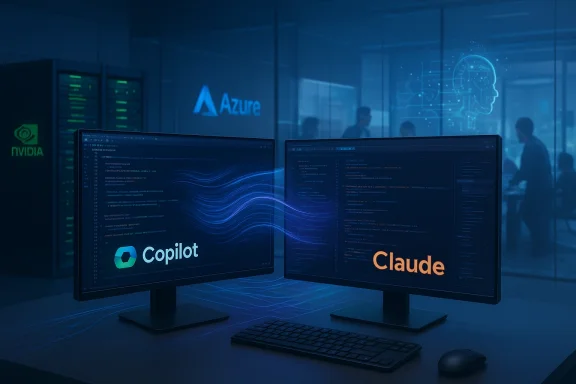
Microsoft’s internal experiments with AI coding tools have quietly revealed a pragmatic truth: the company that loudly promotes GitHub Copilot to customers is also road‑testing competitors inside its own walls — and in some teams, Anthropic’s Claude is being used side‑by‑side with Copilot to do real coding work.
Microsoft has spent the last three years embedding AI into Windows, Microsoft 365, Azure, and developer workflows under the Copilot banner. That public push is only part of the story; internally, teams are being encouraged to evaluate multiple AI coding tools — Copilot, Anthropic’s Claude family, and other large models — to determine which delivers the best results for real engineering tasks. This internal multiverse of AI testing was reported by major outlets and appears to be company policy rather than covert experimentation. Microsoft’s broader commercial relationship with Anthropic and Nvidia is material to this picture. In November, Microsoft, Nvidia, and Anthropic announced a strategic partnership that explicitly ties Anthropic’s Claude models to Azure, and that includes large compute and investment commitments from the parties involved. Those public commitments show Microsoft is not merely experimenting; it is aligning cloud infrastructure and product surface area with Anthropic’s model roadmap.
Conclusion
Microsoft’s internal use of Anthropic’s Claude alongside GitHub Copilot is not a sign that Copilot is obsolete; it is a pragmatic step toward understanding which AI models actually deliver value across the messy realities of product engineering. The commercial ties between Microsoft, Anthropic, and Nvidia make Claude an increasingly attractive option on Azure, but enterprise adoption will demand careful evaluation, robust governance, and ongoing human oversight. In short, AI will reshape how code is created, reviewed, and managed — but skilled engineers, auditors, and platform teams will remain central to safe, reliable software delivery.
Source: PC Gamer If you use GitHub Copilot in the future, it might actually be Anthropic Claude doing your vibe coding
 Background
Microsoft has spent the last three years embedding AI into Windows, Microsoft 365, Azure, and developer workflows under the Copilot banner. That public push is only part of the story; internally, teams are being encouraged to evaluate multiple AI coding tools — Copilot, Anthropic’s Claude family, and other large models — to determine which delivers the best results for real engineering tasks. This internal multiverse of AI testing was reported by major outlets and appears to be company policy rather than covert experimentation. Microsoft’s broader commercial relationship with Anthropic and Nvidia is material to this picture. In November, Microsoft, Nvidia, and Anthropic announced a strategic partnership that explicitly ties Anthropic’s Claude models to Azure, and that includes large compute and investment commitments from the parties involved. Those public commitments show Microsoft is not merely experimenting; it is aligning cloud infrastructure and product surface area with Anthropic’s model roadmap. What the reports say: internal Copilot vs Claude experiments
The basics of the internal program
Reports indicate Microsoft began focused experiments within its developer division and has since expanded the program to other engineering groups, including the “Experiences + Devices” teams that own Windows, Bing, Microsoft 365, Surface, and other product areas. The effort asks staff to try multiple AI coding assistants — not to sabotage Copilot, but to collect structured feedback on model performance for coding tasks. The goal described in reporting is simple: have working engineers and nontechnical staff use different models for realistic tasks and then compare outcomes. That means Microsoft is looking at usability, correctness, hallucination rates, latency, integration work, and developer trust when deciding which model to surface to customers via Copilot. Given the complexity of modern software systems, these are sensible evaluation criteria.Which models are in the mix
- GitHub Copilot (Microsoft/OpenAI lineage) remains the prominent in‑house offering and is heavily marketed to customers and enterprises.
- Anthropic Claude (Sonnet and Opus variants) has been deployed in internal experiments and — per GitHub’s own changelog — made available as selectable models in GitHub Copilot for paid tiers.
- Other models such as upcoming or experimental versions of GPT (including reported GPT‑5 variants) are also part of the comparison, typically used by engineering teams familiar with those APIs.
The Anthropic–Microsoft–Nvidia partnership: numbers that matter
What was announced
In November, the three companies announced a strategic pact in which Anthropic will scale key Claude models on Microsoft Azure running on Nvidia hardware. The public announcement spelled out significant commercial commitments: Anthropic committed to purchase up to $30 billion of Azure compute capacity, and Microsoft and Nvidia pledged investment amounts (Microsoft up to $5 billion; Nvidia up to $10 billion) as part of expanded collaboration terms. The partnership also emphasized optimizations between Anthropic models and Nvidia’s Grace Blackwell and Vera Rubin systems. Multiple independent outlets reported the same numbers and described the deal as a watershed moment for cloud‑model alignment: Microsoft not only becomes a preferred cloud vendor for Anthropic’s frontier models but also locks in a multi‑billion‑dollar consumption commitment that alters cloud capacity planning and vendor economics.Why the figures matter
The headline numbers are not just press release fodder. A commitment of this size changes incentives on both sides: Anthropic gains predictable, large‑scale compute and cloud integration; Microsoft secures long‑term revenue and product integration opportunities; Nvidia gets a steady, optimized hardware workload customer. For product decisions — such as which model backs GitHub Copilot by default — these commercial incentives are hard to ignore. The partnership creates a structural reason for Microsoft to ensure Claude runs seamlessly on Azure and is easy for enterprise customers to adopt.GitHub Copilot and Anthropic models: what changed
In mid‑2025, GitHub announced that Anthropic’s Claude Sonnet 4 and Claude Opus 4 were made generally available in GitHub Copilot, selectable in Copilot Chat and integrated across IDEs including VS Code, Visual Studio, JetBrains IDEs, Xcode, and more. For paid Copilot tiers, admins can enable Anthropic models via policies in Copilot settings, and enterprises can choose model availability centrally. This is a concrete, product‑level sign that Anthropic models are now first‑class options inside the Copilot product family. Operationally, that means a developer in Visual Studio Code can pick Claude Sonnet 4 as the assistant generating code, while another teammate uses a GPT‑based Copilot model — all within the same organization’s Copilot settings. For customers and admins, that introduces new management considerations: policy controls, regional availability, data residency, and compliance with vendor licensing.Technical strengths and weaknesses: Claude versus Copilot (GPT models)
Strengths observed (from industry testing and reports)
- Specialization for coding workflows: Anthropic’s Sonnet family has been described by engineers and testers as balanced and practical for code generation tasks, with optimizations for editing, context understanding, and multi‑step problem decomposition. This aligns with the decision to make Sonnet available to paid Copilot users.
- Reduced hallucination and guardrails: Anthropic’s safety‑first design philosophy is often credited with fewer risky completions in certain contexts, which matters for enterprise code that ties into infrastructure or contains secrets. Multiple reports suggest Claude can be more conservative in its outputs.
- Tool orchestration: Higher‑end Opus variants are tuned for complex agentic workflows and reasoning, making them powerful for tool‑using scenarios (CI/CD orchestration, multi‑file refactors, test generation).
Known weaknesses and unresolved questions
- Benchmarks and reproducibility: Public benchmark comparisons across coding models are noisy; different prompt styles, context windows, and evaluation methods yield different rankings. Vendors publish careful marketing language, so independent testing remains essential. The internal Microsoft program appears aimed at creating that grounded, contextual feedback loop.
- Integration latency and cost: Model performance at scale depends on infrastructure: context window sizes, streaming support, and dedicated hardware. Anthropic’s Azure deployment and Nvidia hardware optimizations will shift this calculus, but real enterprise load tests are the only way to validate cost‑performance tradeoffs.
- Edge cases and hallucinations: No model is immune to creative but incorrect code suggestions. The rise of “vibe coding” — where non‑experts generate or accept code suggestions without deep vetting — magnifies the risk of subtle functional bugs and security vulnerabilities slipping into production. Independent testing indicates that while Claude may reduce some classes of hallucinations, it does not eliminate them.
Vibe coding, non‑expert usage, and the future of developer roles
What is vibe coding?
“Vibe coding” describes an informal workflow where AI assistants produce large portions of code or design, and users — sometimes non‑programmers — iterate by giving high‑level prompts. The tool’s usability, promptcraft, and trust determine whether the output is production‑ready. Publications testing the approach found it can accelerate prototypes and small utilities, but it also introduces maintenance and security risks when used without skilled review.Implications for software engineering
- Productivity and accessibility: Vibe coding lowers the barrier to entry for certain tasks. Designers, product managers, or power users can prototype features quickly, which can be a net positive for innovation velocity.
- Risk shift to review and QA: If more code is generated by AI, the human role increasingly shifts to review, audit, and system design. That requires new skills: prompt engineering, AI output auditing, and stronger automated testing.
- Job displacement fears are premature but real: While some routine coding tasks will be automated, historical patterns suggest roles will evolve rather than vanish. Senior engineers may spend less time writing boilerplate and more time on architecture, safety, and cross‑system integrations. Still, the wholesale replacement of professional developers is not indicated by the current evidence; rather, job descriptions will shift.
A practical model for responsible vibe coding
- Use AI for scaffolding, tests, and repetitive boilerplate.
- Mandate human review for any change touching security, privacy, or critical logic.
- Integrate AI outputs into CI pipelines with unit, integration, and mutation testing.
- Maintain provenance and logging for AI‑generated code to support audits.
Security, IP, and compliance issues
Data residency and model access controls
Bringing Anthropic models into Copilot introduces questions about where prompts and code context are processed and stored. GitHub’s admin policies for enabling Anthropic models are a necessary control, but enterprises must also validate data flows, ensure compliance with industry regulations, and assess whether model provider terms align with corporate IP strategy.Intellectual property and licensing
AI models trained on public code repositories raise complex licensing considerations. Enterprises must be conscious of whether generated suggestions include identifiable snippets with license obligations. Legal teams should define guidance for acceptable reuse, attribution, and remediation. External audits and model card disclosures help, but companies must still operationalize legal guardrails.Supply‑chain and dependency risks
If a central vendor supplies the best coding model, organizations face concentration risk. The Anthropic–Microsoft–Nvidia partnership reduces friction for Claude on Azure, but it also means a single procurement decision could tie a customer’s development pipeline to that vendor stack. Diversification strategies and portable model interfaces (e.g., multi‑model toolchains) are prudent.Business strategy and geopolitics: where does OpenAI fit?
Microsoft’s relationship with OpenAI remains publicly active and strategic even as it expands Anthropic access. Company spokespersons and industry reporting emphasize that OpenAI continues as a primary model partner for frontier models, while Anthropic adds model diversity and enterprise choices. The bottom line: Microsoft is positioning itself as a neutral cloud provider with multiple model partners, not exclusively wedded to one. That stance has competitive and geopolitical consequences. Large investment and consumption commitments reshape vendor incentives and may influence which models are available in particular markets or product families. As cloud and model economics tighten, enterprises will need to make product, legal, and cost‑of‑ownership tradeoffs — often at the expense of simplicity.What enterprises and IT leaders should do now
Short‑term actions (30–90 days)
- Audit Copilot settings and model policies: Verify which models are enabled in your organization’s Copilot instance, including Anthropic model availability, and align admin policies with compliance requirements.
- Establish an AI safety checklist for code: Implement mandatory code review steps for AI‑generated changes, with special attention to security, third‑party code snippets, and secrets detection.
- Pilot multi‑model evaluation: Run controlled A/B tests comparing outputs from Copilot’s default model and Anthropic’s Sonnet/Opus family on representative tickets. Capture metrics: correctness, time‑to‑first‑working‑test, and required human edits.
Medium‑term strategy (3–12 months)
- Design model‑fallback architectures: Build toolchains that can switch providers or run local verification so model choice isn’t a single point of failure.
- Invest in developer training: Teach engineers how to validate AI outputs, create robust prompt patterns, and instrument AI‑generated code in observability systems.
- Revisit procurement and vendor agreements: Ensure SLAs, data handling terms, and indemnities reflect the organization’s risk appetite for AI‑generated code.
Long‑term considerations
- Governance and auditability: Prepare to meet regulators’ and customers’ demands for explainability, provenance, and audit trails for AI‑generated software.
- Workforce evolution: Update role descriptions, hiring criteria, and performance metrics to value AI supervision skills, verification expertise, and model orchestration capabilities.
Risks, open questions, and unverifiable claims
- Several reports rely on anonymous sources inside Microsoft describing internal directions; while multiple outlets have repeated those claims, the exact scope and permanence of the internal program remain company‑internal decisions and cannot be independently verified from outside the organization. Reported directives to specific teams should be considered reported and plausible, but not definitive corporate policy until confirmed by Microsoft.
- The long‑term effect on developer employment and wages is uncertain. Historical evidence favors role evolution, not pure elimination, but macroeconomic and region‑specific outcomes will vary. Predictions that AI will entirely displace professional coders are speculative; more grounded planning assumes redistribution of effort toward design, safety, and system governance.
- Performance comparisons between Claude Sonnet/Opus and GPT variants are dependent on prompt engineering, test suites, and dataset bias. Published vendor claims and early independent tests show strengths and tradeoffs, but no single public benchmark can definitively rank models in every coding scenario. Ongoing, reproducible enterprise tests remain the most reliable method for choosing a model.
Final analysis: pragmatic experimentation beats monolithic certainty
Microsoft’s openness to letting engineers use Anthropic’s Claude alongside GitHub Copilot is a striking example of real‑world product development: test broadly, measure carefully, and let engineers’ experiences inform product direction. This approach acknowledges that model development is fast moving and that vendor performance can vary by workload. It also underscores a critical enterprise truth: product marketing and engineering reality can — and often should — diverge until empirical evidence favors a clear direction. The Anthropic–Microsoft–Nvidia partnership supercharges this dynamic by aligning compute, investment, and deployment incentives. That will make Claude more accessible and performant on Azure, and it will pressure competitors (including OpenAI) to keep improving. The natural consequence is model pluralism inside enterprises: different models for different tasks, and a heavier emphasis on governance, auditing, and human oversight. For IT leaders and developers, the practical takeaway is straightforward: adopt a cautious experimentation strategy that measures real developer outcomes, strengthens review processes for AI‑generated code, and treats model choice as a changeable configuration rather than an irreversible platform bet. The coding future will be layered — partly human, partly AI — and the organizations that plan for that mosaic will gain the most durable advantage.Conclusion
Microsoft’s internal use of Anthropic’s Claude alongside GitHub Copilot is not a sign that Copilot is obsolete; it is a pragmatic step toward understanding which AI models actually deliver value across the messy realities of product engineering. The commercial ties between Microsoft, Anthropic, and Nvidia make Claude an increasingly attractive option on Azure, but enterprise adoption will demand careful evaluation, robust governance, and ongoing human oversight. In short, AI will reshape how code is created, reviewed, and managed — but skilled engineers, auditors, and platform teams will remain central to safe, reliable software delivery.
Source: PC Gamer If you use GitHub Copilot in the future, it might actually be Anthropic Claude doing your vibe coding
