

The Justice Department’s latest insider‑threat prosecution reads like a cautionary tale written for IT managers, security teams, and anyone responsible for protecting federal data: two former contractors allegedly used lingering privileged access to delete nearly 100 government databases within minutes of being fired, then — unable to reliably cover their tracks — turned to an AI chat tool for instructions on erasing server and database logs. The result, according to investigators, was a sprawling alleged attack on federal records that exposed glaring operational weaknesses at the contractor, highlighted how privileged access can be weaponized, and underscored the messy reality of attempting to “erase” digital evidence in modern environments.
In an indictment unsealed this month, federal prosecutors allege that two brothers who previously served prison terms for hacking‑related offenses accessed systems maintained by a Washington, D.C. area contractor shortly after being terminated and issued commands that deleted dozens of databases used by multiple U.S. agencies. Prosecutors say one brother deleted roughly 96 databases that contained Freedom of Information Act (FOIA) materials and sensitive investigative files; investigators also allege theft of IRS data for hundreds of individuals and unauthorized access to EEOC records.
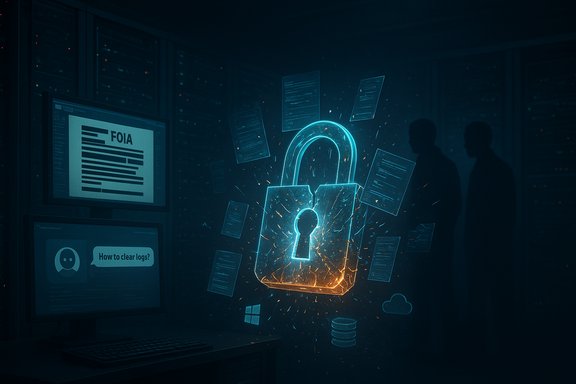
The indictment further details a moment that has captured headlines and professional cringe in equal measure: approximately one minute after deleting a Department of Homeland Security database, one of the defendants allegedly queried an AI chat tool with questions such as “how do i clear system logs from SQL servers after deleting databases” and “how do you clear all event and application logs from Microsoft windows server 2012.” That interaction — part of the evidence set prosecutors cite — turned an already dramatic case into a broader conversation about AI in the hands of insiders, the limits of cover‑your‑tracks advice, and the resilience of modern forensic tooling.
This article summarizes the case, explains the technical contours of the alleged actions, analyzes where controls failed, flags open questions and unverifiable claims, and offers practical mitigation steps for organizations that manage government or other sensitive data.
This prosecution highlights two legal vectors relevant to IT professionals:
The AI angle adds a modern twist: while an AI may be asked for instructions, the act of querying a third‑party service often creates yet another trace for investigators — a practical deterrent against the fantasy of perfect erasure. For organizations that manage sensitive government records, the lessons are concrete: lock down privileged access, assume session persistence will be abused, ensure forensic telemetry is beyond the reach of local tampering, and treat vendor personnel with appropriate, enforced limits when national‑ or citizen‑level data is at stake.
The final legal and operational outcomes of this prosecution will take time to unfold, but the incident already serves as a blueprint for improving how contractors, agencies, and security teams prevent, detect, and recover from malicious insider activity in an era where AI is another tool in the toolkit — for defenders and attackers alike.
Source: Ars Technica In comedy of errors, men accused of wiping gov databases turned to an AI tool
 Background / Overview
In an indictment unsealed this month, federal prosecutors allege that two brothers who previously served prison terms for hacking‑related offenses accessed systems maintained by a Washington, D.C. area contractor shortly after being terminated and issued commands that deleted dozens of databases used by multiple U.S. agencies. Prosecutors say one brother deleted roughly 96 databases that contained Freedom of Information Act (FOIA) materials and sensitive investigative files; investigators also allege theft of IRS data for hundreds of individuals and unauthorized access to EEOC records.The indictment further details a moment that has captured headlines and professional cringe in equal measure: approximately one minute after deleting a Department of Homeland Security database, one of the defendants allegedly queried an AI chat tool with questions such as “how do i clear system logs from SQL servers after deleting databases” and “how do you clear all event and application logs from Microsoft windows server 2012.” That interaction — part of the evidence set prosecutors cite — turned an already dramatic case into a broader conversation about AI in the hands of insiders, the limits of cover‑your‑tracks advice, and the resilience of modern forensic tooling.
This article summarizes the case, explains the technical contours of the alleged actions, analyzes where controls failed, flags open questions and unverifiable claims, and offers practical mitigation steps for organizations that manage government or other sensitive data.
Timeline: what prosecutors say happened
February termination and immediate access
- Company HR or a manager reportedly notified the two contractors of termination around 4:50 p.m. on a February afternoon.
- Within five minutes, prosecutors allege, both brothers attempted to use their credentials and active connections to access the contractor’s systems and the federal agency databases hosted on the contractor’s infrastructure.
Deletions, write‑locks, and alleged theft
- One brother’s account reportedly had already been disabled, but the other allegedly remained connected and, at roughly 4:56 p.m., issued commands that first prevented other users from modifying certain databases (a write‑protect or denial of access action) and then deleted an extensive set of databases.
- Investigators say approximately 96 databases were deleted across systems that stored FOIA materials and investigative records for multiple federal components.
- The indictment also alleges that the defendant extracted copies of IRS data from a virtual machine — including tax and identifying information for at least several hundred people — and accessed EEOC information without authorization.
Attempts to cover tracks and subsequent activity
- About one minute after deleting a DHS database, the defendant allegedly queried an AI chat tool for guidance on clearing logs from SQL Server and on clearing Windows event and application logs.
- In the hours and days that followed, prosecutors report discussions between the brothers about removing incriminating material from their residences, and computer forensic evidence indicates the two reinstalled operating systems on employer‑issued laptops three days later.
The human and organizational failure points
This incident exposes a sequence of failures common to high‑impact insider events:- Privileged access retention: A terminated employee who remains connected can leverage session persistence and cached credentials to carry out destructive actions. Immediate account termination and session revocation are essential steps but were apparently not uniformly enforced.
- Excessive standing privileges: The alleged ability to delete dozens of agency databases suggests overly broad privileges and insufficient separation between maintenance operations and destructive capabilities.
- Weak segmentation and controls: Hosting government agency databases on contractor infrastructure requires rigorous multi‑tenant isolation, role‑based controls, and strict change controls. The alleged actions indicate gaps in segmentation and safeguards such as granular RBAC, time‑based privileges, and just‑in‑time access.
- Inadequate monitoring and immutable logging: The defendants apparently believed they could erase logs and thereby evade detection. Organizations that rely on ephemeral logs rather than immutable, centrally collected telemetry are vulnerable to such efforts.
- Failure of vetting/placement policies: The two defendants had prior convictions for hacking‑related offenses. Their presence in positions with broad access raises questions about vendor hiring practices, background checks, and how prior incidents were considered when granting access to sensitive government data.
What the AI query tells us — and what it doesn’t
The image of a culprit asking an AI chat model how to erase logs has become shorthand for AI enabling poor operational security for criminal actors. That characterization is tempting but requires careful nuance.- Documented fact: The indictment alleges that, within a short time after deleting a DHS database, a defendant asked an AI tool how to clear SQL Server logs and Windows event/application logs. This is part of the investigative narrative and is cited as evidence that the defendants sought to cover their tracks using AI.
- Unclear causality: The indictment does not — and cannot, at this stage — definitively attribute the success or failure of evidence destruction to the AI responses themselves. Whether the AI provided incorrect, incomplete, or even accurate instructions that the defendants failed to execute properly is not a settled factual matter in the public record.
- AI as a tool; not a magic eraser: Even if an AI provided technically accurate steps, executing those steps properly on modern Windows + SQL Server deployments typically requires administrative access and leaves forensic artifacts. The presence of the AI query is evidence of intent to cover tracks; it is not proof that AI enabled successful evidence removal.
- Legal and ethical consequences: Using a public or commercial AI service in the course of a crime can create additional evidence trails — chat logs, account metadata, and timestamps — which investigators can subpoena. In this case, the alleged AI queries are described in the indictment and appear to have been useful to investigators.
Technical reality: can you "clear" SQL Server and Windows logs and be undetectable?
Short answer: no — not reliably, and not without leaving artifacts that modern forensic teams can often recover.SQL Server considerations
- Deleting a database from SQL Server removes the database files and associated transaction log files, but it does not eliminate every trace:
- If backups exist (full/differential/transaction log backups), deleted data can be restored from backup media.
- Transaction logs and the SQL Server error log may contain entries that record database operations; those logs may be preserved in centralized logging systems or backups.
- Databases often use underlying storage systems (SANs, snapshotting, replication) that retain copies or shadow images that forensic teams can analyze.
- Many managed environments have point‑in‑time recovery or continuous backup systems that capture data changes independently of the SQL Server instance.
- A properly instrumented environment with external backups and immutable archives will survive a deletion event.
Windows Server and event logs
- Clearing Windows Event Logs (e.g., Application, System, Security) can remove entries from local EVTX files, but clearing is a recordable operation that itself generates events or is visible in other artifacts.
- Remote collection and central SIEM ingestion means event data may already be forwarded off the host before any local clearing is attempted.
- Forensic artifacts remain in places such as the NTFS Master File Table (MFT), USN change journal, prefetch files, pagefile, registry hives, and volume shadow copies.
- On older versions like Windows Server 2012, central log forwarding and event subscriptions are commonly deployed in enterprise and government environments; even if the local log is truncated, the forwarded copies remain.
Why "erasing" evidence is a risky myth
- Attackers sometimes assume that deleting or clearing local logs equates to removing all traces of activity — that is rarely true.
- Modern forensic procedures frequently include cross‑checking network logs, storage snapshots, backup media, authentication logs on identity providers, firewall and proxy logs, and cloud provider audit trails.
- Interactions with third‑party services (for example an AI chat provider) create additional metadata trails that investigators can obtain by legal process.
Forensics and recovery prospects
From a defender’s viewpoint, deletion of databases is a worst‑case scenario but not necessarily irrecoverable:- Backups and snapshots: If immutable backups, off‑site copies, or air‑gapped snapshots exist, organizations can restore databases. The recovery window depends on the failing of backup jobs and retention policy.
- Redundancy and replication: Replicated copies (mirror/availability groups) can preserve data; deleting one replica does not always propagate to all copies.
- Recovery of deleted files: Deleted database files on NTFS may be recoverable until the underlying disk sectors are overwritten; recovery utility success varies but is possible, particularly with rapid incident response.
- Cross‑correlation of logs: SIEMs, network flow collectors, authentication logs from identity providers, and cloud service audit logs can reconstruct actions and timelines even when local logs are tampered with.
Legal charges and potential penalties
The indictment charges the defendants with a mixture of computer‑fraud, destruction of records, theft of government records, aggravated identity theft counts, and password trafficking. Those counts carry a range of potential penalties including mandatory minimum sentences for certain aggravated identity theft convictions and cumulative maximums that — for the principal defendant — could be substantial.This prosecution highlights two legal vectors relevant to IT professionals:
- Criminal liability for misuse of privileged access: Individuals with authorized access can be prosecuted if they exceed authorization and cause damage or steal information.
- Legal exposure for contractors and vendors: While criminal charges fall on individuals, contractors face significant reputational, contractual, and regulatory repercussions when they fail to control access to government data. Contract clauses, FISMA/NIST requirements, and agency SLAs often mandate breach response and can trigger penalties or loss of contracts.
Where policy and practice must change: recommendations for government and contractors
This incident underscores that technical controls alone are insufficient without robust identity, access, and contract governance. Key mitigations include:- Immediate deprovisioning on termination
- Implement instant revocation of user sessions, VPN tokens, SSH keys, and cloud access upon termination.
- Orchestrate automated session termination across all endpoints and cloud consoles.
- Just‑in‑time (JIT) and least privilege
- Apply JIT activation for high‑risk privileges and enforce time‑bound elevated access.
- Use role‑based access control and enforce the principle of least privilege for database operations.
- Immutable logging and centralized forensics
- Forward logs to an external, write‑protected store or centralized SIEM before they are writable on the host.
- Maintain immutable backups and retention policies appropriate for FOIA and investigative records.
- Segmentation and multi‑tenant hardening
- Ensure strict tenant isolation and monitor cross‑tenant access for contractor‑hosted systems.
- Use application‑level controls so that destructive actions at the storage layer require multiple approvals.
- Vendor hiring and placement policies
- Reassess policies that place previously convicted individuals into roles with broad access unless stringent remediation, supervision, and limited privileges are applied.
- Adopt enhanced onboarding controls and continuous monitoring for high‑risk vendor personnel.
- Incident response and tabletop readiness
- Conduct regular insider‑threat exercises that model immediate terminations and test session revocation, backup restores, and forensics.
- Define an incident playbook for FOIA/records loss scenarios, including public‑affairs coordination and legal steps.
The AI angle: operational security, audit trails, and policy
AI tools used by insiders to attempt cover‑ups produce a paradox: they can provide procedural guidance, but their use often leaves new evidence. Organizations should consider:- Policy on external AI usage: Restrict use of public AI services from corporate networks unless approved and logged; require that any privileged remediation or admin assistance comes from vetted, internal documentation.
- Logging and legal preserves: Be ready to include AI provider logs in legal preservation orders, because AI usage itself may be a digital breadcrumb.
- Training and awareness: Ensure staff — and contractors — understand that following malicious instructions (even from an AI) does not absolve legal or contractual responsibilities; training must cover ethical and legal constraints on system operations.
What remains uncertain and how to interpret open claims
- It is not publicly established whether the AI responses provided criminally effective instructions or whether the defendants failed to implement them. The indictment documents the queries but not the AI replies or the exact sequence of post‑query actions.
- Some media reports identify the contractor; official court filings and DOJ releases redact the company name. Independent reporting has named the contractor based on prior investigative reporting. Where reporting and redactions differ, treat corporate identifications as reported rather than judicially established.
- The final impact on FOIA backlogs, individual privacy, or ongoing agency operations depends on restoration successes, which have not been fully disclosed publicly. Agencies and the contractor may continue restoration and remediation efforts that will change the damage assessment over time.
Practical checklist for sysadmins and security teams (high‑priority actions)
- Immediately audit privileged accounts and active sessions; identify lingering connections that survive termination events.
- Enforce MFA and make remote access ephemeral (time‑boxed tokens).
- Implement centralized, tamper‑resistant logging and regular immutable backups; validate restore procedures quarterly.
- Harden database management consoles: remove deletion privileges from general admin roles and require multi‑party authorization for destructive operations.
- Run insider‑threat detection: monitor anomalous queries, mass deletions, and sudden outbound data transfers.
- Maintain a legal preservation process that can capture AI provider logs and local telemetry in the event of suspected wrongdoing.
Conclusion
This case — a dramatic mix of alleged database deletions, data exfiltration, and attempted log‑clearing aided by an AI query — is a stark reminder that human decisions and operational lapses remain the most dangerous vulnerabilities in complex IT ecosystems. Technical defenses like immutable backups, centralized logging, and least‑privilege controls provide resilience, but they must be matched with rapid deprovisioning workflows, rigorous vendor governance, and the expectation that insiders can and will attempt sophisticated or desperate measures.The AI angle adds a modern twist: while an AI may be asked for instructions, the act of querying a third‑party service often creates yet another trace for investigators — a practical deterrent against the fantasy of perfect erasure. For organizations that manage sensitive government records, the lessons are concrete: lock down privileged access, assume session persistence will be abused, ensure forensic telemetry is beyond the reach of local tampering, and treat vendor personnel with appropriate, enforced limits when national‑ or citizen‑level data is at stake.
The final legal and operational outcomes of this prosecution will take time to unfold, but the incident already serves as a blueprint for improving how contractors, agencies, and security teams prevent, detect, and recover from malicious insider activity in an era where AI is another tool in the toolkit — for defenders and attackers alike.
Source: Ars Technica In comedy of errors, men accused of wiping gov databases turned to an AI tool
