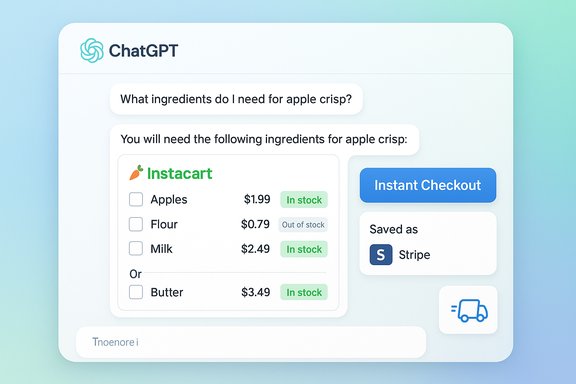
OpenAI and Instacart have taken a big step toward turning ChatGPT from a recipe and planning tool into a full shopping assistant: users can now compile grocery lists, pick items from local stores, choose delivery or pickup options, set tips, and pay directly inside ChatGPT thanks to an Instacart app that supports OpenAI’s Instant Checkout experience.
ChatGPT’s gradual move from research assistant to transactional interface has accelerated over 2025. OpenAI introduced the Instant Checkout and Agentic Commerce capabilities as part of a push to let merchants and marketplaces build purchase flows that run inside ChatGPT, beginning with single-item Instant Checkout pilots (Etsy, Shopify) and expanding to multi-merchant, multi-item experiences. Instacart’s integration is positioned as the first grocery partner to deliver a fully embedded, end‑to‑end Instacart shopping experience inside ChatGPT: start with meal inspiration, have the assistant compile ingredients into a cart sourced from local retailers, and complete checkout without leaving the chat window. Instacart frames this as the first app to offer an embedded Instant Checkout for groceries. This development follows a broader industry trend: large AI models are being paired with retailer catalogs, payment gateways, and fulfillment networks to create agentic shopping flows that can research, compare, and purchase items on behalf of users. The result is a new interface pattern that blends natural-language planning with real-world commerce.
Yet the rollout exposes the technology’s most delicate balance: usefulness versus perceived commercial influence. The recent user backlash over “app suggestions” that looked like ads demonstrates how fragile trust can be when assistants cross the line between suggestion and promotion. Privacy, inventory accuracy, merchant access, and the legal environment around training data are all active risk vectors that demand transparent policies, robust controls, and careful engineering.
The integration will be a boon for routine convenience if platforms maintain clear disclosures, empower users with control, and keep merchant data fresh and verifiable. If those guardrails slip, the same feature that promises to save time will quickly erode the user trust that makes conversational commerce possible in the first place.
Source: PCMag UK With Instacart Integration, ChatGPT Can Be Your Personal Shopper
 Background
ChatGPT’s gradual move from research assistant to transactional interface has accelerated over 2025. OpenAI introduced the Instant Checkout and Agentic Commerce capabilities as part of a push to let merchants and marketplaces build purchase flows that run inside ChatGPT, beginning with single-item Instant Checkout pilots (Etsy, Shopify) and expanding to multi-merchant, multi-item experiences. Instacart’s integration is positioned as the first grocery partner to deliver a fully embedded, end‑to‑end Instacart shopping experience inside ChatGPT: start with meal inspiration, have the assistant compile ingredients into a cart sourced from local retailers, and complete checkout without leaving the chat window. Instacart frames this as the first app to offer an embedded Instant Checkout for groceries. This development follows a broader industry trend: large AI models are being paired with retailer catalogs, payment gateways, and fulfillment networks to create agentic shopping flows that can research, compare, and purchase items on behalf of users. The result is a new interface pattern that blends natural-language planning with real-world commerce.How the Instacart–ChatGPT shopping flow works
The user experience is presented as a conversational loop where ChatGPT becomes the personal shopper: clear, linear steps describe what the integration enables.- Initiate inside ChatGPT: call the Instacart app by writing a prompt that names Instacart (for example: “Instacart, give me ingredients for apple crisp”). The assistant will parse the request and propose items.
- Build or edit a shopping list: the assistant compiles required ingredients and asks clarifying follow-ups (quantities, alternatives, brands). The user can add, remove, substitute, or request specific brands or store preferences.
- Local retailer matching: Instacart finds the items at nearby participating retailers in its network (thousands of stores across the U.S. and Canada). The cart is assembled from live inventory data or Instacart’s inventory signals when available.
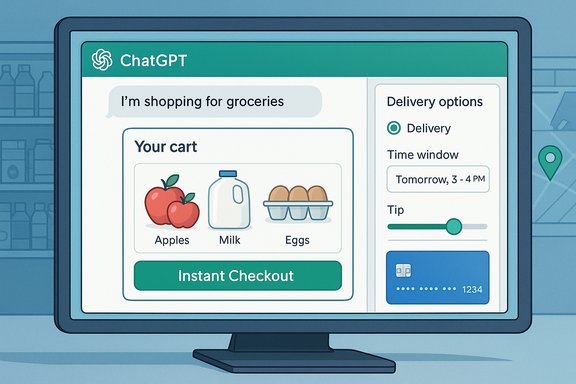
- Delivery and extra options: the user selects delivery time windows or pickup, chooses tip amounts, and reviews estimated fees. The assistant summarizes the total cost, delivery fee, and fulfillment options.
- Instant Checkout and payment: with Instant Checkout enabled, payment can be completed inside ChatGPT using previously stored payment methods or by entering a new method. The transaction is routed through the Instant Checkout / Agentic Commerce infrastructure that OpenAI introduced with merchant partners.
The technical plumbing: Instant Checkout and the Agentic Commerce Protocol
Behind the chat UI are three coordinated subsystems: the conversational model, a retrieval/action layer, and merchant/payment integrations.- Conversational layer: a tuned ChatGPT model handles natural-language parsing, clarifying questions, and the compositional task of synthesizing a shopping cart from a recipe or list. The assistant can prioritize items and suggest alternatives.
- Retrieval and inventory signals: the system queries merchant catalogs, Instacart’s fulfillment network, or cached product feeds to identify SKUs, prices, and inventory. When direct merchant APIs are available, the system uses them; when not, it relies on curated product graphs and retrieval methods.
- Action and payment layer: OpenAI’s Instant Checkout, introduced earlier in 2025 and built with partners such as Stripe, exposes a standardized mechanism for merchants to accept in-chat payments and complete orders. The Agentic Commerce Protocol is the coordination layer that lets ChatGPT call merchant APIs, confirm availability, and finalize payment and fulfillment handoffs. Instacart’s app implements that protocol to accept orders directly in the chat.
What the companies say
OpenAI frames this as a practical evolution for ChatGPT: make suggestions and connect them to real-world services to save users time. Instacart emphasizes the speed from inspiration to delivery and the convenience of paying inside the chat without tab switching. In the official announcement, OpenAI called Instacart the first grocery partner to deliver a fully embedded cart and checkout experience inside ChatGPT. Instacart’s CTO described the integration as a redefinition of AI-powered shopping. OpenAI’s earlier Instant Checkout blog also explained the broader merchant roadmap — Etsy, Shopify, and other merchants were early partners or pilots for in-chat purchasing — which set the stage for a grocery-first rollout with Instacart.Why this is meaningful for shoppers and Windows users
For consumers, the experience promises three measurable benefits:- Time savings and convenience: go from recipe to purchase in a single chat without toggling between recipe pages, multiple storefronts, and checkout forms. This reduces the cognitive and manual friction of assembling a cart.
- Better discovery and personalization: the conversational model can ask clarifying questions about dietary preferences, serving sizes, or brand tolerances and surface tailored suggestions. This mimics a personal shopper or experienced grocery clerk.
- Unified payments and delivery: Instant Checkout aims to standardize the payment flow across merchants, so stored payment methods, tips, and delivery options behave consistently inside ChatGPT. That’s particularly helpful on Windows desktops where users frequently switch between browser tabs and apps.
Risks, trade-offs, and the ad controversy
The new capability comes with notable caveats and a looming controversy about the boundary between helpful suggestions and paid promotion.- Perceived advertising and “app suggestions”: in December 2025, users reported seeing in-chat prompts that resembled retail promotions (for example, a “Shop at Target” suggestion appearing during unrelated queries). That prompted public backlash and an internal response: OpenAI’s Chief Research Officer acknowledged the company had “fallen short” in how those suggestions were surfaced and said the company “turned off this kind of suggestion while we improve the model’s precision.” OpenAI’s head of ChatGPT also insisted there were no live ad tests and that some screenshots were not ads. The episode underscores how tightly user trust is coupled to the perceived neutrality of conversational suggestions.
- Transparency and monetization risk: agentic commerce enables multiple monetization paths (affiliate fees, sponsored placements, or paid allowlists). If not managed transparently, suggestions can be seen as adverts dressed up as assistant recommendations — a reputational risk that can erode trust quickly. The company’s decision to temporarily disable the suggestion behavior signals the sensitivity of blending discovery with commerce.
- Privacy and data sharing concerns: while OpenAI and Instacart state that personal data is handled carefully as part of the app flow, any in-chat checkout inevitably involves transmitting address, payment choices, and order details to merchant and fulfillment systems. Users should verify privacy and consent defaults before enabling in-chat shopping. Past product pages and help documentation warn users to verify merchant details and note that prices and stock can change rapidly.
- Accuracy and inventory freshness: retrieval-based assistants remain vulnerable to stale or incomplete catalogs. If the assistant cannot access a merchant’s most recent inventory feed, it may place items into a cart that are out of stock, or surface older product models for non-grocery categories. Early evaluations of shopping assistants show that these systems sometimes prefer well-documented older SKUs over newer models due to signal volume dynamics. That same dynamic can surface here in other product categories.
- Legal and copyright headwinds: the broader OpenAI business faces active litigation from publishers over training data and content use. Ziff Davis filed suit alleging that OpenAI used its content without permission, a 2025 case that remains part of the industry-wide legal environment shaping AI vendor contracts and business models. Any expansion of commerce and content features will be scrutinized for how training, recommendations, and content synthesis are sourced and presented.
Retailer and market implications
For merchants and marketplaces, the ChatGPT integration represents both opportunity and challenge.- Distribution and conversion: integrating with ChatGPT can drive higher conversion by collapsing purchase friction. Agentic shopping flows that include Instant Checkout typically increase the conversion rate for shoppers who are already engaged with the assistant.
- Merchant control and fairness: the quality of recommendations depends heavily on which merchants are allowlisted or provide robust APIs. Merchants that do not integrate directly may be underrepresented in results or excluded from instant buy flows, shifting buyer attention to participating retailers. This can concentrate commerce and alter competitive dynamics.
- New ad channels and ethical choices: if OpenAI or other platforms monetize by promoting merchant partners inside the assistant, merchants could face pressure to pay for exposure. The recent “ads-like” suggestion controversy illustrates the fine line between helpful app suggestions and commercially motivated placements.
- Operational load: agentic commerce that calls local stores or fulfillment networks adds operational complexity. Automated calls, fulfillment handoffs, and shopper assignment introduce new points of failure that retailers and delivery partners must manage.
Practical guidance: how to use in-chat grocery shopping safely
- Confirm the retailer and item details before you hit checkout. Chat assistants can summarize but do not eliminate the need to verify SKUs, sizes, and expiration or sell-by dates when relevant.
- Review the delivery fees, tips, and substitution policies the assistant summarizes; these can materially change total cost and satisfaction with the order.
- Use saved payment methods cautiously. If possible, limit the scope of stored payment instruments or verify receipts against your bank or card statements shortly after purchases.
- If privacy is a concern, check the app’s permissions and data sharing prompts. Understand which data OpenAI retains versus what is shared directly with Instacart and the merchant.
- If you see suggestions that feel promotional, use existing controls (where available) to dial down or opt out, and report unexpected suggestions to the platform. OpenAI has said it is exploring better controls after recent user complaints.
Regulatory, legal, and ethical considerations
The rise of agentic commerce raises several regulatory questions:- Consumer protection and disclosure: regulators may require explicit disclosures when recommendations are influenced by commercial relationships, affiliate payments, or allowlists. Clear labeling — “sponsored,” “recommended partner,” or “allowlisted merchant” — helps preserve consumer trust.
- Competition and access: if assistant platforms favor merchants that pay for exposure or are tightly integrated, antitrust inquiries could follow, especially where a small number of platforms control large volumes of shopping traffic.
- Data portability and minimization: payment and delivery flows must adhere to payment-card industry standards and privacy laws. Users should be able to control whether their shopping data is retained for personalization or shared with third parties.
- Copyright and content provenance: as AI-generated shopping narratives synthesize product descriptions and review snippets, the legal regime around training data and content reuse remains unsettled. High-profile lawsuits against AI companies in 2025 make this a live risk for any product that reproduces or paraphrases publisher content in recommendations.
Critical analysis: strengths and weaknesses of in-chat grocery shopping
Strengths- Huge convenience gains: removing tab switches and automating cart assembly is a clear UX win for busy shoppers and meal planners. The conversational model can reduce cognitive load and speed routine purchases.
- Seamless payments: Instant Checkout reduces friction at the decisive moment — payment — which historically triggers most cart abandonments. Standardizing checkout in chat can increase completed purchases.
- Personalization potential: with user consent, the assistant can remember preferences and speed repeat purchases for staples and household items.
- Perception of advertising: even non-paid suggestions risk being perceived as ads. The December 2025 backlash shows that interface framing matters enormously; if users feel nudged toward a partner, trust evaporates quickly. OpenAI’s rapid rollback of certain suggestion behaviors underscores this fragility.
- Data and privacy trade-offs: any in-chat payment flow increases the amount of sensitive information handled by the assistant and merchant partners. Users and regulators alike will demand sharp, auditable privacy boundaries.
- Catalog and inventory accuracy: failure modes around stale data or incomplete merchant integrations will surface as missed or incorrect orders. Shopping assistants must prioritize fresh, merchant-verified feeds to avoid buyer frustration.
- Legal exposure for the platform: ongoing copyright litigation and publisher suits create legal ambiguity for models that rely on large corpuses of editorial material to power discovery or synthesize product narratives. Platforms must prepare for discovery and compliance obligations.
What to watch next
- Platform controls and transparency: watch for new user controls to disable or filter app suggestions, and for clearer labeling of any sponsored or promoted placements. OpenAI indicated it would add better controls after pulling certain suggestions.
- Merchant onboarding and coverage: the breadth of Instacart’s retail network in each region will determine how widely useful the in-chat grocery flow is; expanded retail participation will increase utility.
- Regulatory responses: expect consumer-protection scrutiny around in-chat commerce disclosures and data minimization, especially if monetization becomes explicit.
- Cross-platform competition: Microsoft, Google, and Amazon are rapidly improving their own assistant-driven shopping tools; competing approaches to transparency, data use, and merchant relationships will shape which platforms users prefer.
Conclusion
Bringing Instacart into ChatGPT with Instant Checkout is a logical, high-impact next step in the transition from conversational assistance to agentic commerce. For everyday shoppers, the convenience of moving from recipe idea to paid order without leaving a chat is real and valuable. For platforms and retailers, the economic upside — higher conversions and more seamless discovery — is equally compelling.Yet the rollout exposes the technology’s most delicate balance: usefulness versus perceived commercial influence. The recent user backlash over “app suggestions” that looked like ads demonstrates how fragile trust can be when assistants cross the line between suggestion and promotion. Privacy, inventory accuracy, merchant access, and the legal environment around training data are all active risk vectors that demand transparent policies, robust controls, and careful engineering.
The integration will be a boon for routine convenience if platforms maintain clear disclosures, empower users with control, and keep merchant data fresh and verifiable. If those guardrails slip, the same feature that promises to save time will quickly erode the user trust that makes conversational commerce possible in the first place.
Source: PCMag UK With Instacart Integration, ChatGPT Can Be Your Personal Shopper