

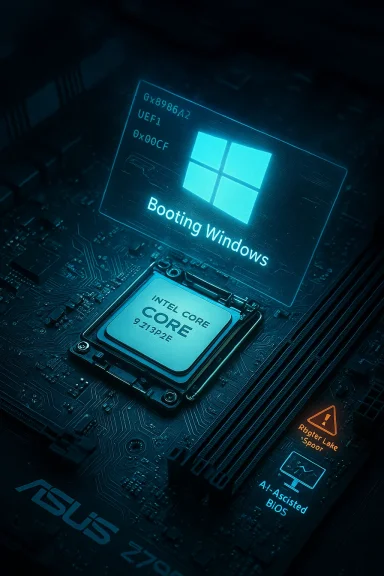
Intel’s Core 9 273PQE is doing what Intel never intended it to do: booting Windows on a consumer Z790 motherboard. The milestone is more than a party trick for overclocking forums. It is a proof point that Bartlett Lake’s P-core-only design, while marketed for embedded and edge deployments, is close enough to mainstream desktop plumbing that determined modders can bend it toward consumer use. Intel has now officially listed the chip in its embedded product stack, with 12 P-cores, 24 threads, and a 5.9 GHz turbo, which makes the community’s interest in getting it running on retail boards easy to understand.
What makes this development interesting is not that the chip was merely detected, but that it was reportedly coerced through BIOS changes, support-component additions, and a Raptor Lake spoof to get through the boot process. That moves the story from speculative rumor to hands-on firmware archaeology. It also raises a bigger question: if an embedded part can be made to behave this much like a desktop CPU, how much of Intel’s segmentation is policy, and how much is platform validation?
Bartlett Lake has been building toward this moment for months. Intel’s product pages now classify the family as “Products formerly Bartlett Lake” and place the Core 9 273PQE squarely in the Vertical Segment: Embedded category, with embedded options available and a launch date in Q1’26. Intel also says the part is 1S only, meaning it is intended for a single-socket system rather than the kind of workstation or server topology that would invite broad platform experimentation.
The chip itself is unusual even by modern Intel standards. It has 12 Performance-cores and zero Efficient-cores, which makes it a deliberate throwback to the days when CPU design prioritized raw throughput, predictable scheduling, and simpler software behavior over heterogeneous core balancing. Intel’s edge and embedded pages describe the design as favorable for deterministic performance, and the company explicitly markets the family as a way to reduce tuning complexity in edge workloads.
That embedded framing matters. Intel’s own edge materials emphasize a 10-year industrial lifecycle, faster upgrades through LGA compatibility, and shorter redesign cycles for OEMs and industrial customers. In other words, the chip is being sold as a platform stability product, not a hobbyist overclocker’s toy. The irony is that those same qualities—socket compatibility, long support, and familiar x86 behavior—are exactly what make enthusiasts want to try it on a Z790 board in the first place.
The hardware modding community has seen this movie before. Whenever Intel preserves socket continuity across multiple generations, someone eventually asks whether a supposedly “special” chip can be made to run on a mainstream board. Bartlett Lake’s arrival is especially tempting because it preserves LGA1700-era compatibility in a period when Intel’s consumer desktop roadmap is already shifting attention toward newer platforms. That creates a natural window for experimentation, curiosity, and firmware abuse.
From a market perspective, the chip sits in an awkward but potentially powerful middle ground. It is not a consumer halo product in Intel’s official positioning, yet it carries enough headline specs—12 cores, 5.9 GHz, and UHD Graphics 770—to attract attention from gamers, creators, and tinkerers who already own an LGA1700 board. That dual identity is why the modding story resonates so strongly. It highlights the distance between Intel’s intended market and the community’s imagined one.
Still, the hardware fundamentals are hard to hide. A socketed part with familiar memory support, familiar PCIe counts, and an integrated GPU looks an awful lot like a desktop CPU, even when the SKU sheet says otherwise. That is why the modder’s success in getting it to boot matters more than the raw event itself. It suggests Bartlett Lake is not some entirely exotic embedded silicon island; it is a close relative of desktop Intel parts wearing an industrial badge.
That said, this should not be mistaken for a polished or reproducible conversion guide. The report describes a rewritten BIOS with AI assistance, the addition of missing support components, and then another layer of boot-sequence deception. In the world of firmware hacks, each of those steps can be fragile on its own; together they form a project that is more proof-of-concept than recipe.
The modder reportedly saw the CPU recognized in tools like CPU-Z and ASUS TurboV Core, which suggests the silicon is at least broadly visible to software once the machine gets that far. The integrated GPU also appears to be detected, opening the door to future testing that could include graphics output and maybe even gaming benchmarks. That is the sort of detail enthusiasts care about because it moves the project beyond a one-line boot claim.
The ASUS Z790-AYW OC WiFi mention is especially noteworthy because the board is marketed to overclockers and builders who expect firmware flexibility. In other words, this is not some obscure industrial motherboard where Bartlett Lake would be a natural fit. The whole point is that the modder started with a consumer platform and pushed it toward embedded CPU support by altering the BIOS rather than by using a board designed for it.
This is also where AI-assisted BIOS work enters the story. The likely takeaway is not that AI magically solved hardware compatibility, but that it helped the modder sift through firmware structure, identify missing hooks, and make targeted edits faster than a fully manual approach might allow. That is very different from saying the machine now behaves like a validated desktop platform.
The temptation is sharpened by the fact that Intel has officially refreshed the socket in the embedded space while the consumer desktop market is moving on. That creates an emotional mismatch: enthusiasts see a capable chip on a familiar socket, while Intel sees a controlled industrial SKU with support boundaries. The modding attempt is essentially a protest against that segmentation, whether intentional or not.
There is also the practical question of value. If Bartlett Lake is difficult to source, unsupported on consumer boards, and likely sold through industrial channels, then the economics may make it a collector’s curiosity rather than a mass-market upgrade. That does not mean it is unimportant. It just means the most obvious audience for the chip may remain builders who like to test boundaries rather than buyers who simply want the best frames per dollar.
The modding story, however, puts pressure on that segmentation. If a consumer motherboard can be coerced into accepting the chip, then the line between “industrial only” and “desktop capable” looks more like a business choice than a fundamental technical wall. That does not invalidate Intel’s market strategy, but it does weaken the mystique around the boundary.
There is also product positioning to consider. Intel is already juggling a consumer desktop roadmap that includes newer generations and refreshes, so Bartlett Lake works best as a specialized family rather than a desktop hero. Keeping it in embedded preserves pricing flexibility and avoids the risk of cannibalizing future mainstream parts. In that sense, the modder’s success is interesting precisely because it exposes how much effort Intel puts into preventing this kind of overlap.
If Bartlett Lake were ever to be sold broadly to consumers, it could become a very interesting rival to mainstream desktop parts on mature LGA1700 boards. But Intel has not done that, and the company’s official framing remains embedded-first. For now, the competitive effect is mostly psychological: it reminds the market that Intel still knows how to build a high-frequency, all-big-core chip when it wants to.
There is also a niche competitive overlap with workstation and content-creation buyers who care less about brand narratives and more about predictable throughput. If the modding project eventually proves stable and performant, it may generate renewed discussion around whether a consumer-facing all-P-core Intel part would still have a place. That question is more strategic than practical right now, but the internet loves a chip that invites “what if?” conversations.
Another opportunity is educational. Modders learn more about firmware boundaries, board vendors learn where their validation assumptions fail, and readers get a rare look at how modern x86 platforms really come together. That makes the project valuable even if it never becomes a practical consumer upgrade. Sometimes the experiment is the point.
There is also a broader risk of overreading the significance. A booting chip does not prove Intel should have sold this part to consumers, nor does it prove that consumer motherboards are ready for the product. Enthusiast communities are very good at finding loopholes, but loopholes are not the same thing as product fit. That distinction matters.
Watch for benchmark screenshots, thermal data, memory scaling behavior, and whether the integrated graphics path can be made reliable. Also watch for any sign that more than one board vendor can be convinced to cooperate, because that would separate a one-off hack from a repeatable platform experiment. In hardware journalism terms, the difference between “it booted” and “it behaves” is enormous.
Intel’s Core 9 273PQE booting Windows on a Z790 motherboard is not just another overclocking stunt. It is a sharp reminder that the boundaries between embedded, edge, and desktop hardware are often enforced as much by firmware policy and market segmentation as by silicon itself. If the modding effort continues to mature, Bartlett Lake could become one of those rare parts that is remembered less for its official launch and more for the community that refused to accept Intel’s intended use case.
Source: TweakTown Intel Core 9 273PQE 'Bartlett Lake' CPU seen successfully booted into Windows on a Z790 motherboard
What makes this development interesting is not that the chip was merely detected, but that it was reportedly coerced through BIOS changes, support-component additions, and a Raptor Lake spoof to get through the boot process. That moves the story from speculative rumor to hands-on firmware archaeology. It also raises a bigger question: if an embedded part can be made to behave this much like a desktop CPU, how much of Intel’s segmentation is policy, and how much is platform validation?
 Background
Bartlett Lake has been building toward this moment for months. Intel’s product pages now classify the family as “Products formerly Bartlett Lake” and place the Core 9 273PQE squarely in the Vertical Segment: Embedded category, with embedded options available and a launch date in Q1’26. Intel also says the part is 1S only, meaning it is intended for a single-socket system rather than the kind of workstation or server topology that would invite broad platform experimentation.The chip itself is unusual even by modern Intel standards. It has 12 Performance-cores and zero Efficient-cores, which makes it a deliberate throwback to the days when CPU design prioritized raw throughput, predictable scheduling, and simpler software behavior over heterogeneous core balancing. Intel’s edge and embedded pages describe the design as favorable for deterministic performance, and the company explicitly markets the family as a way to reduce tuning complexity in edge workloads.
That embedded framing matters. Intel’s own edge materials emphasize a 10-year industrial lifecycle, faster upgrades through LGA compatibility, and shorter redesign cycles for OEMs and industrial customers. In other words, the chip is being sold as a platform stability product, not a hobbyist overclocker’s toy. The irony is that those same qualities—socket compatibility, long support, and familiar x86 behavior—are exactly what make enthusiasts want to try it on a Z790 board in the first place.
The hardware modding community has seen this movie before. Whenever Intel preserves socket continuity across multiple generations, someone eventually asks whether a supposedly “special” chip can be made to run on a mainstream board. Bartlett Lake’s arrival is especially tempting because it preserves LGA1700-era compatibility in a period when Intel’s consumer desktop roadmap is already shifting attention toward newer platforms. That creates a natural window for experimentation, curiosity, and firmware abuse.
Why Bartlett Lake Matters
Bartlett Lake is not just another refresh. It is Intel’s answer to a specific set of embedded and edge problems: high-thread-count x86 compute, low platform complexity, and long-life availability. The P-core-only formula matters because many edge workloads are latency-sensitive, and the company’s own messaging leans heavily on deterministic response time rather than simply chasing peak benchmark numbers.From a market perspective, the chip sits in an awkward but potentially powerful middle ground. It is not a consumer halo product in Intel’s official positioning, yet it carries enough headline specs—12 cores, 5.9 GHz, and UHD Graphics 770—to attract attention from gamers, creators, and tinkerers who already own an LGA1700 board. That dual identity is why the modding story resonates so strongly. It highlights the distance between Intel’s intended market and the community’s imagined one.
Embedded by Design, Desktop by Accident
Intel’s product language is careful for a reason. The company wants Bartlett Lake to be seen as an industrial and edge solution, supported by long availability windows and stable qualification, not as a stealth desktop upgrade path. The 1S only limitation also signals that Intel expects these chips to live in controlled systems, where board vendors, firmware teams, and integrators can validate behavior in advance.Still, the hardware fundamentals are hard to hide. A socketed part with familiar memory support, familiar PCIe counts, and an integrated GPU looks an awful lot like a desktop CPU, even when the SKU sheet says otherwise. That is why the modder’s success in getting it to boot matters more than the raw event itself. It suggests Bartlett Lake is not some entirely exotic embedded silicon island; it is a close relative of desktop Intel parts wearing an industrial badge.
- 12 P-cores make the chip unusually simple to schedule.
- 24 threads keep it in the same class as many mainstream desktop chips.
- LGA1700 compatibility invites platform experimentation.
- Embedded longevity is attractive to industrial buyers.
- 5.9 GHz turbo gives the family instant enthusiast appeal.
The Modding Milestone
The core claim in the latest report is straightforward: the CPU reportedly reached Windows on a consumer ASUS Z790-AYW OC WiFi board after BIOS work and a spoofing step that tricked the platform into treating the chip like a familiar Raptor Lake-class processor. That is a significant jump from mere detection or partial POST. A full Windows boot means the board, CPU initialization path, and enough early device enumeration all lined up well enough to move into the operating system.That said, this should not be mistaken for a polished or reproducible conversion guide. The report describes a rewritten BIOS with AI assistance, the addition of missing support components, and then another layer of boot-sequence deception. In the world of firmware hacks, each of those steps can be fragile on its own; together they form a project that is more proof-of-concept than recipe.
What “Booted Successfully” Really Means
A Windows boot does not automatically mean the platform is ready for daily use. It only means the machine progressed far enough to hand off from firmware to the operating system. Stability, sleep states, device handling, thermal limits, and performance all remain open questions, and those are often the very areas where “impossible” CPU experiments fail.The modder reportedly saw the CPU recognized in tools like CPU-Z and ASUS TurboV Core, which suggests the silicon is at least broadly visible to software once the machine gets that far. The integrated GPU also appears to be detected, opening the door to future testing that could include graphics output and maybe even gaming benchmarks. That is the sort of detail enthusiasts care about because it moves the project beyond a one-line boot claim.
- The milestone is boot-to-Windows, not full validation.
- Firmware manipulation was clearly part of the process.
- Device detection does not equal platform support.
- Stability remains an open question.
- Graphics detection is a promising next step.
Why a Z790 Board Could Matter
Z790 is the right proving ground because it is one of the most mature and widely understood platforms in Intel’s recent desktop ecosystem. Enthusiasts already know how to tune it, flash it, and rescue it when things go wrong. That makes it an ideal base for trying to force unsupported parts into service, especially when the socket, power delivery expectations, and memory behavior are close enough to encourage optimism.The ASUS Z790-AYW OC WiFi mention is especially noteworthy because the board is marketed to overclockers and builders who expect firmware flexibility. In other words, this is not some obscure industrial motherboard where Bartlett Lake would be a natural fit. The whole point is that the modder started with a consumer platform and pushed it toward embedded CPU support by altering the BIOS rather than by using a board designed for it.
The Firmware Problem
Modern Intel platforms are less about raw pin compatibility than about firmware and initialization policy. A CPU can fit the socket and still fail to initialize if the BIOS does not know how to enumerate it correctly, configure its microcode, or present the right identity to the boot chain. That is why the spoofing detail matters: if the platform expects a known family and sees a family it does not recognize, the hardware can stall long before Windows ever appears.This is also where AI-assisted BIOS work enters the story. The likely takeaway is not that AI magically solved hardware compatibility, but that it helped the modder sift through firmware structure, identify missing hooks, and make targeted edits faster than a fully manual approach might allow. That is very different from saying the machine now behaves like a validated desktop platform.
- Consumer boards can be technically close to embedded boards.
- BIOS identity checks remain a major gatekeeper.
- AI can assist reverse engineering, but it does not replace validation.
- Spoofing can get a system past early boot barriers.
- Firmware support is often the real product boundary.
Consumer Appeal and Enthusiast Temptation
It is easy to see why the modding community is fascinated. A 12-core, 24-thread P-core-only Intel chip with a 5.9 GHz max turbo sounds like a dream part for gaming, streaming, and creative workloads, especially if it can be made to run on an already-owned Z790 board. For many enthusiasts, the appeal is not just performance, but the possibility of wringing new life out of mature LGA1700 systems.The temptation is sharpened by the fact that Intel has officially refreshed the socket in the embedded space while the consumer desktop market is moving on. That creates an emotional mismatch: enthusiasts see a capable chip on a familiar socket, while Intel sees a controlled industrial SKU with support boundaries. The modding attempt is essentially a protest against that segmentation, whether intentional or not.
The Gaming Question
Gamers are likely to ask the simplest question first: how fast is it? That is understandable, but it is also premature. Even if Bartlett Lake ends up delivering excellent single-thread and multi-thread results, consumer gaming depends on much more than headline core count, including memory behavior, platform latency, BIOS maturity, and driver support. A booting chip is not yet a gaming platform.There is also the practical question of value. If Bartlett Lake is difficult to source, unsupported on consumer boards, and likely sold through industrial channels, then the economics may make it a collector’s curiosity rather than a mass-market upgrade. That does not mean it is unimportant. It just means the most obvious audience for the chip may remain builders who like to test boundaries rather than buyers who simply want the best frames per dollar.
- Attractive core count for modern multitasking.
- Familiar socket compatibility increases curiosity.
- Gaming potential is still unproven.
- Platform tuning may matter as much as the CPU itself.
- Supply and support are likely to limit mainstream adoption.
Intel’s Segmentation Strategy Under Pressure
Intel’s embedded strategy depends on clear segmentation. The company wants Bartlett Lake to serve long-life industrial customers, not to become a shortcut desktop upgrade for enthusiasts. That distinction matters because Intel’s sales, support, and validation models all assume that embedded parts live in controlled ecosystems with predictable qualification cycles.The modding story, however, puts pressure on that segmentation. If a consumer motherboard can be coerced into accepting the chip, then the line between “industrial only” and “desktop capable” looks more like a business choice than a fundamental technical wall. That does not invalidate Intel’s market strategy, but it does weaken the mystique around the boundary.
Why Intel Still Wants the Boundary
There are good reasons Intel keeps embedded SKUs separate. Validation costs, support complexity, BIOS fragmentation, and chipset qualification all become harder when unsupported end users start mixing industrial CPUs with consumer boards. A corporate customer can tolerate a service bulletin; a retail buyer expects plug-and-play simplicity and may blame the chip when a board vendor’s firmware gets weird.There is also product positioning to consider. Intel is already juggling a consumer desktop roadmap that includes newer generations and refreshes, so Bartlett Lake works best as a specialized family rather than a desktop hero. Keeping it in embedded preserves pricing flexibility and avoids the risk of cannibalizing future mainstream parts. In that sense, the modder’s success is interesting precisely because it exposes how much effort Intel puts into preventing this kind of overlap.
- Segmentation protects support and margin structures.
- Embedded customers need long validation cycles.
- Consumer buyers expect easy compatibility.
- Unsupported overlap can create confusion for OEMs.
- Intel benefits from keeping Bartlett Lake niche.
Competitive Implications
Competitively, Bartlett Lake lands in a market where AMD and Intel are both balancing efficiency, platform longevity, and platform identity. A P-core-only design gives Intel a straightforward message: fewer scheduling headaches, consistent performance characteristics, and potentially strong Windows behavior for latency-sensitive workloads. That is a sensible answer to edge deployments, but it also sounds attractive to desktop enthusiasts who have grown tired of architecture compromises.If Bartlett Lake were ever to be sold broadly to consumers, it could become a very interesting rival to mainstream desktop parts on mature LGA1700 boards. But Intel has not done that, and the company’s official framing remains embedded-first. For now, the competitive effect is mostly psychological: it reminds the market that Intel still knows how to build a high-frequency, all-big-core chip when it wants to.
The AMD Angle
AMD’s desktop message has leaned heavily on efficiency, gaming leadership in certain segments, and platform continuity through AM5. Bartlett Lake’s emergence reinforces the idea that Intel is still willing to offer high-core-count, all-performance-core designs, but only in specialized markets. That may not move near-term consumer share, yet it could influence how buyers think about Intel’s architectural flexibility.There is also a niche competitive overlap with workstation and content-creation buyers who care less about brand narratives and more about predictable throughput. If the modding project eventually proves stable and performant, it may generate renewed discussion around whether a consumer-facing all-P-core Intel part would still have a place. That question is more strategic than practical right now, but the internet loves a chip that invites “what if?” conversations.
- Intel can still deliver high-frequency all-P-core silicon.
- AMD’s AM5 platform remains the cleaner consumer story.
- Bartlett Lake may influence perception more than sales.
- Workstation buyers care about predictability, not slogans.
- Enthusiast curiosity can amplify a product far beyond its target market.
Strengths and Opportunities
The biggest strength of this story is that it exposes a genuinely unusual technical product at exactly the right moment. Intel’s Bartlett Lake family is already interesting on paper, and the modding community’s success gives it a kind of grassroots legitimacy that marketing copy never could. It also creates a chance for deeper testing of socket compatibility, BIOS design, and edge-to-desktop crossover potential.Another opportunity is educational. Modders learn more about firmware boundaries, board vendors learn where their validation assumptions fail, and readers get a rare look at how modern x86 platforms really come together. That makes the project valuable even if it never becomes a practical consumer upgrade. Sometimes the experiment is the point.
- High-performance P-core-only design is inherently attractive.
- LGA1700 continuity lowers the barrier for experimentation.
- Windows boot success is a meaningful proof point.
- AI-assisted firmware work may accelerate future reverse engineering.
- Embedded longevity makes the chip strategically important.
- Future benchmarks could clarify real-world potential.
- Community visibility can drive wider platform interest.
Risks and Concerns
For all the excitement, the project sits on a foundation of unsupported firmware edits, unofficial spoofing, and incomplete validation. That means the outcome could range from unstable to non-repeatable to outright destructive if copied by less experienced users. It is one thing to watch a modder succeed; it is another to assume the same path will work on a different BIOS revision or board.There is also a broader risk of overreading the significance. A booting chip does not prove Intel should have sold this part to consumers, nor does it prove that consumer motherboards are ready for the product. Enthusiast communities are very good at finding loopholes, but loopholes are not the same thing as product fit. That distinction matters.
- Instability may be the norm rather than the exception.
- Firmware spoofing can create hard-to-debug failures.
- BIOS edits may brick boards if done incorrectly.
- Supportability is essentially nonexistent in this configuration.
- Platform variance could make results inconsistent across boards.
- Thermal behavior remains unknown under sustained load.
- Misleading expectations could frustrate buyers who chase the hype.
What to Watch Next
The next phase will be much more interesting than the boot itself. If the modder can show sustained stability, proper device enumeration, and usable performance in real workloads, Bartlett Lake’s consumer appeal will move from theoretical to plausible. If not, the story will still matter, but mostly as a reminder of how far firmware hacking can go when a community keeps pushing.Watch for benchmark screenshots, thermal data, memory scaling behavior, and whether the integrated graphics path can be made reliable. Also watch for any sign that more than one board vendor can be convinced to cooperate, because that would separate a one-off hack from a repeatable platform experiment. In hardware journalism terms, the difference between “it booted” and “it behaves” is enormous.
Key Things to Monitor
- Stability testing under sustained CPU load.
- Gaming performance if the iGPU and drivers hold up.
- BIOS portability across different Z790 boards.
- Memory compatibility with DDR5 profiles and training.
- Thermal limits at high turbo behavior.
- Windows device support after repeated reboots.
- Any future Intel response to community experimentation.
Intel’s Core 9 273PQE booting Windows on a Z790 motherboard is not just another overclocking stunt. It is a sharp reminder that the boundaries between embedded, edge, and desktop hardware are often enforced as much by firmware policy and market segmentation as by silicon itself. If the modding effort continues to mature, Bartlett Lake could become one of those rare parts that is remembered less for its official launch and more for the community that refused to accept Intel’s intended use case.
Source: TweakTown Intel Core 9 273PQE 'Bartlett Lake' CPU seen successfully booted into Windows on a Z790 motherboard
Last edited:
